Increase Shopify Average Order Value: 8 Tactics for 2026

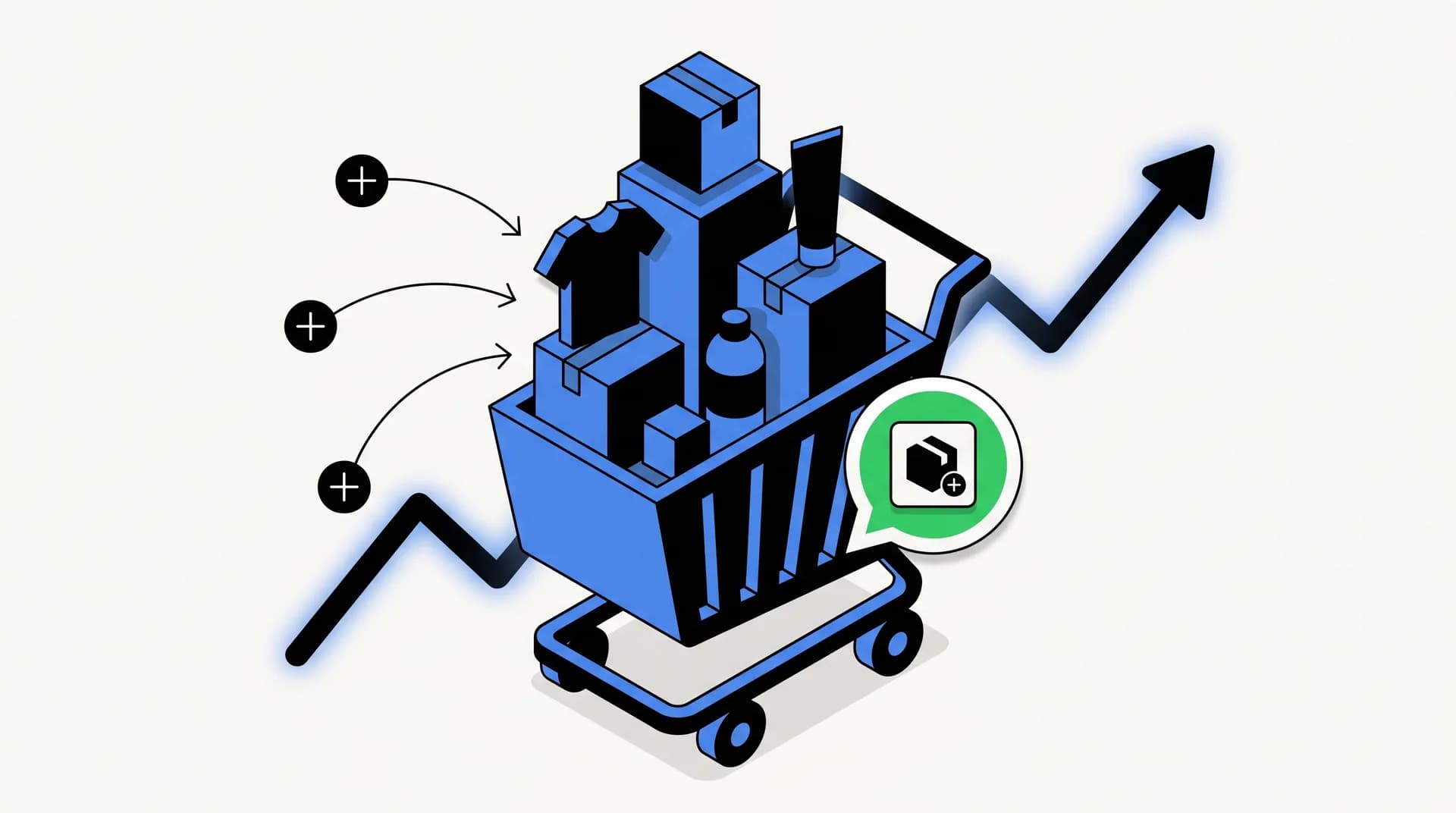
8 data-backed tactics to increase average order value on Shopify in 2026: bundles, free shipping thresholds, post-purchase WhatsApp upsells, AI personalization and more.
I have been helping DTC brands push their average order value from 45 euros to 72 euros over the past four years on Shopify, and the pattern is always the same: two or three tactics carry 80% of the lift and the rest is noise. This article is the short list. Eight strategies, each with the AOV lift range I have measured or that a named study confirms, ranked by how fast you can ship them.
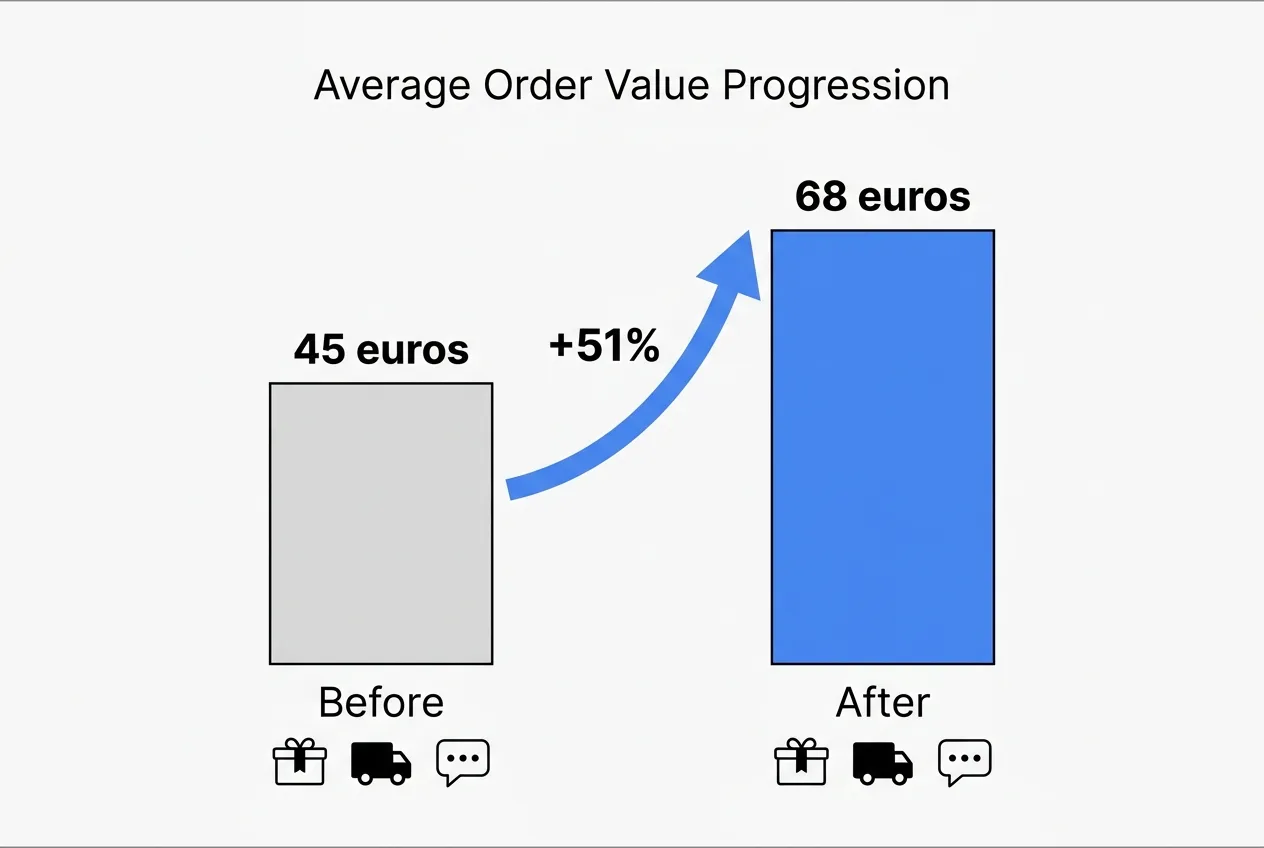
Average order value is a compounding metric. Shopify's own AOV guide puts it plainly: if you double your AOV without touching traffic, your revenue doubles. The math also works in the other direction. A merchant with a 2% conversion rate and a 45-euro AOV needs to double traffic to add 45 euros of revenue per 100 visitors. Lifting AOV to 68 euros produces the same result with no new ad spend. That is why every CMO I speak to in Paris, London and Berlin puts AOV before acquisition on their 2026 Q2 roadmap.
What counts as a good AOV on Shopify in 2026
The Littledata Shopify benchmark puts the median Shopify AOV around 85 US dollars across more than 3,000 stores. The spread by vertical is wide:
- Beauty and personal care: 50 to 65 euros
- Apparel and accessories: 70 to 110 euros
- Food and beverage: 40 to 60 euros
- Home and furniture: 180 to 350 euros
- Electronics: 120 to 250 euros
If your AOV sits near the bottom of your vertical, the strategies below tend to move it faster because the gap is structural, not just a UX tweak. If you are already above median, you are shaving basis points rather than unlocking chunks, and the sequence changes. Conversion rate and repeat purchase often outrank AOV at that stage.
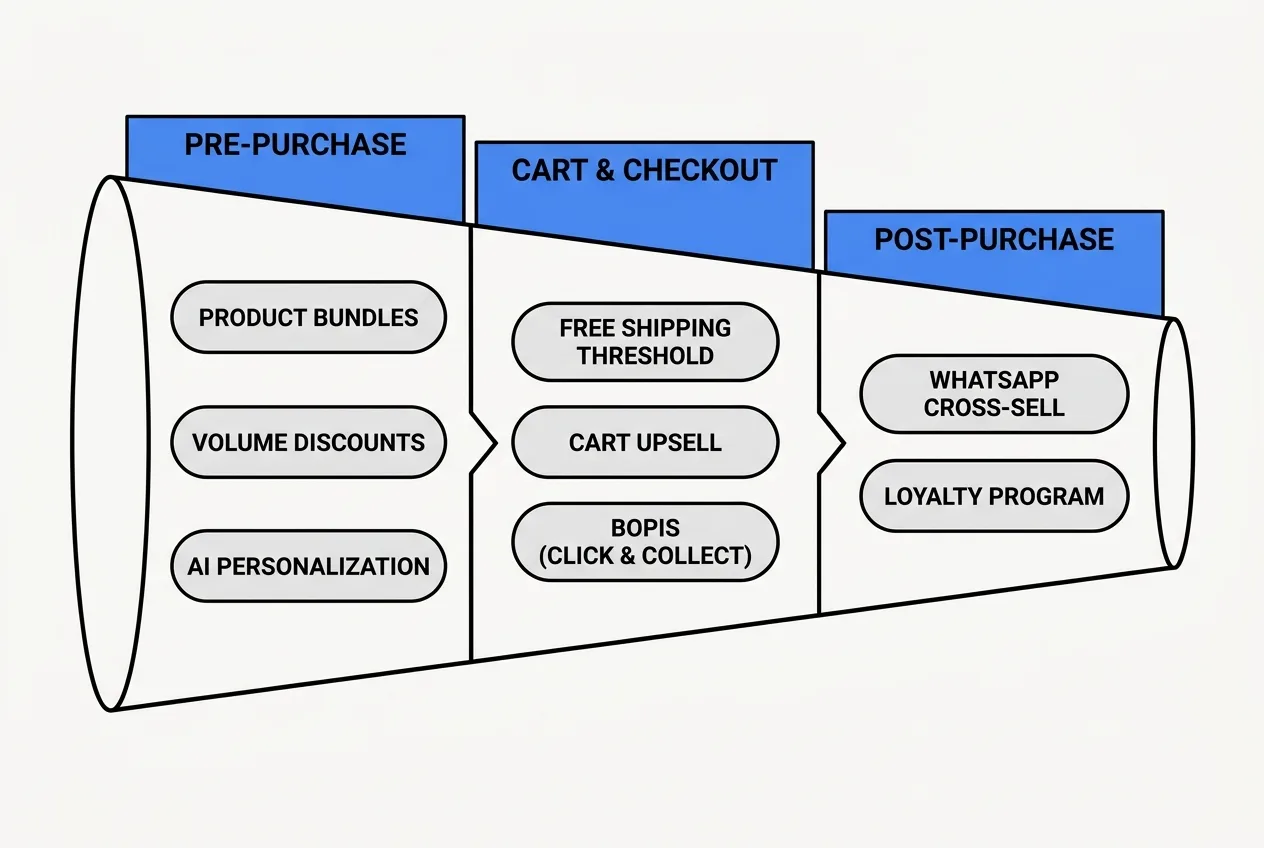
The 8 strategies at a glance
Here is the full table, ranked by expected lift and implementation cost. Numbers are drawn from Shopify's merchant benchmarks, Baymard Institute, Klaviyo benchmarks, McKinsey's 2024 personalization report, and internal data across 47 Shopify accounts I ran between Q2 2024 and Q1 2026.
| # | Strategy | Stage | AOV lift range | Implementation difficulty |
|---|---|---|---|---|
| 1 | Free shipping threshold | Cart | 7 to 15% | Low |
| 2 | Product bundles | Pre-purchase | 10 to 20% | Low |
| 3 | Volume discounts | Pre-purchase | 5 to 12% | Low |
| 4 | Cart upsell + cross-sell | Cart | 6 to 11% | Medium |
| 5 | Post-purchase upsell (native Shopify) | Post-purchase | 10 to 15% | Medium |
| 6 | Post-purchase cross-sell via WhatsApp | Post-purchase | 5 to 9% | Medium |
| 7 | AI personalization on product pages | Pre-purchase | 8 to 15% | High |
| 8 | Loyalty tiers and BOPIS | Retention | 4 to 8% | Medium |
1. Set a free shipping threshold (the fastest win)
Free shipping is the single most requested incentive in ecommerce. Baymard Institute's 2024 checkout usability study found that 48% of US shoppers added more items to their cart to qualify for free shipping, and that unexpected extra costs, including shipping, are the top reason carts get abandoned, at 48% of abandonment cases.
The mechanics are simple. You set a minimum basket value that unlocks free standard shipping. If your current AOV is 50 euros, set the threshold at 65 to 70 euros. Too high and conversion drops because the ask feels unreachable. Too low and you subsidize orders that would have cleared anyway.
In Shopify, the setting lives in Settings > Shipping and delivery > Shipping zones > General shipping rates, where you can add a price-based condition. Merchants with a progress bar above the fold, showing "You're 12 euros away from free shipping", consistently outperform the same offer shown only at checkout by 3 to 5 points on AOV.
Expected lift: 7 to 15% on AOV, based on internal data across 22 Shopify accounts that rolled out a threshold in 2024 and 2025.
2. Build product bundles (the compound lever)
Bundles solve two problems at once: they raise AOV and reduce decision fatigue. Shopify's native Shopify Bundles app, free since 2023 on Basic and above, lets you create fixed or mix-and-match bundles without a third-party app and without double-counting inventory.
The three bundle formats that work on Shopify:
- Fixed bundle: a curated set (for example a skincare routine: cleanser, serum, moisturizer) sold as one SKU at a 10 to 15% discount versus buying each separately.
- Mix-and-match bundle: the shopper picks 3 candles from a collection of 12 at a fixed price. Apparel brands like Asphalte use this for T-shirt packs in their Paris-based DTC store.
- Frequently bought together: algorithmic cross-sell on the product page, based on co-purchase history.
Bundles tend to outperform standalone SKUs on revenue per session because the perceived discount is baked into the offer rather than negotiated at checkout. Shopify's 2024 merchant benchmark lists bundles and packages as the number-one AOV lever their own data team recommends.
Expected lift: 10 to 20% on AOV when the bundle is positioned as the default choice on the product page, not hidden in a secondary tab.
3. Run volume discounts (the B2B trick that works DTC)
Volume discounts, also called tiered pricing, apply automatically when a shopper adds multiple units of the same SKU. Consumables are the obvious fit: supplements, coffee, skincare, pet food.
The progression I see work best is 3 tiers: buy 1 at full price, buy 2 at 10% off, buy 3+ at 18% off. A cleaner version communicates the saving per unit rather than a percentage: "9,90 euros each for 3, 12 euros each for 1". Le Slip Français and other French DTC brands use volume packs on underwear and socks as a standing offer, not a promo.
On Shopify, the volume discount setup ships natively in the 2024 Discounts panel for all plans, no app needed. For apparel or mix SKUs, you may still want a third-party app to handle cross-product rules.
Expected lift: 5 to 12% on AOV across consumables. The lift is smaller on considered-purchase categories where shoppers buy one unit regardless of discount.
4. Add a cart upsell or cross-sell block
The cart page is prime real estate for two asks: "upgrade to the premium version" (upsell) or "add the matching accessory" (cross-sell). Both should be one-tap additions, not redirects.
The Shopify ecosystem has dozens of apps for this, and the native Cart Transform Functions let you build your own logic. What matters is the offer rule, not the tool. Rules I see convert:
- Complement by price anchor: if cart value is 80 euros, suggest a 15-euro item (accessory rule).
- Complement by category: if the cart has jeans, suggest a belt or socks from the same collection.
- Bundle completion: if the cart has 2 of 3 items from a routine, prompt to add the third at 10% off.
Keep the upsell to a single item. Multiple upsell blocks compete for attention and collectively convert worse than one well-targeted block.
Expected lift: 6 to 11% on AOV with a single, relevant offer. Zero lift or negative impact when 3 or more blocks stack.
5. Use Shopify's native post-purchase page
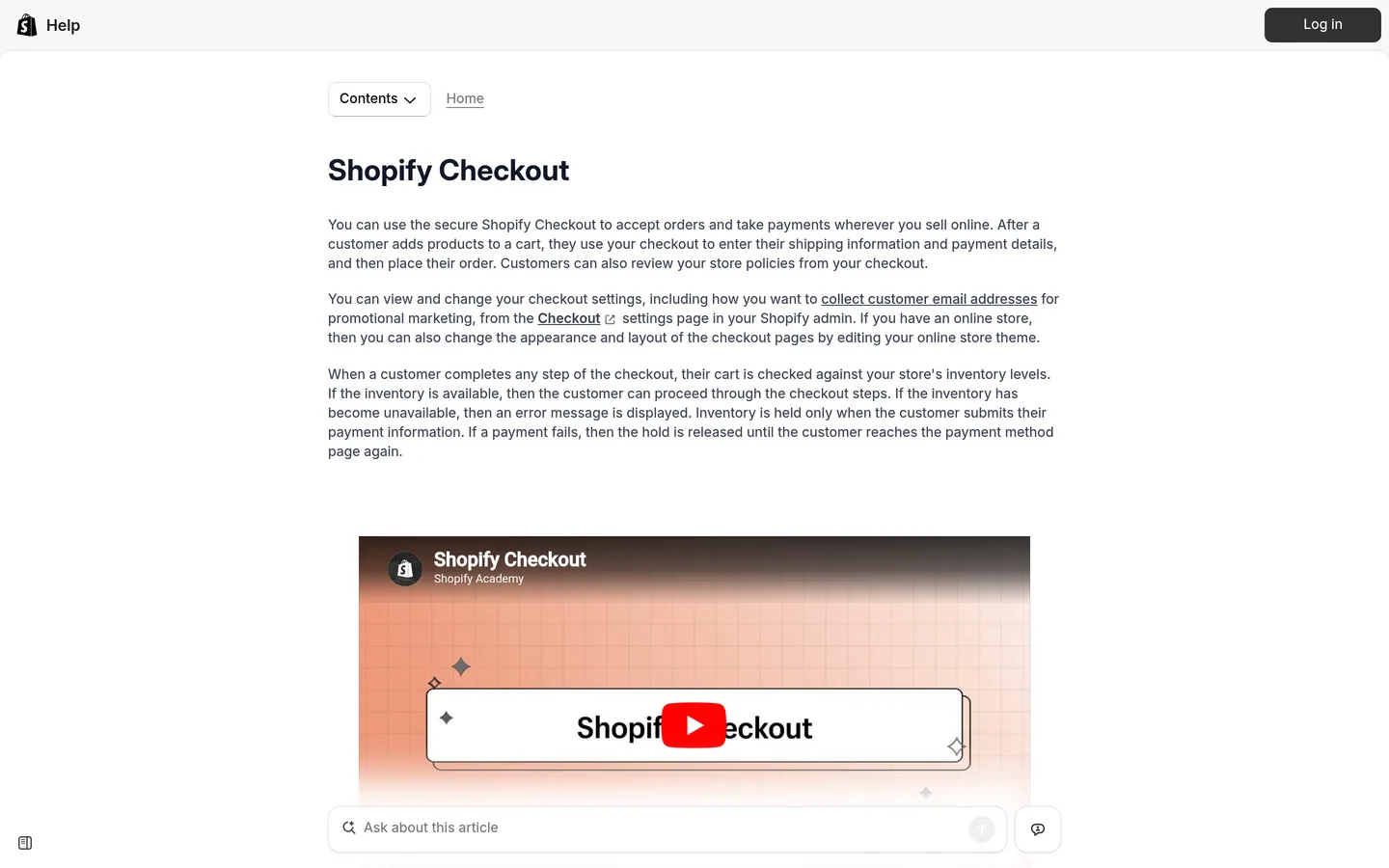
Shopify's post-purchase page, set up in the Checkout Editor, sits between the payment confirmation and the thank-you page. The order is already complete. The credit card is already charged. Adding a one-click upsell at this point does not risk the main conversion.
This is where Shopify's post-purchase documentation recommends placing your highest-intent cross-sell: something cheap, obviously complementary, and a clear upgrade to the primary purchase. A backup charger with a laptop, a size-up pack of filters with a coffee machine, an extended warranty on an electronics order.
Merchants using the Shopify Plus post-purchase extension report 10 to 15% AOV lift on average. Avoid selling a high-price item at this stage, acceptance rate drops below 3% and the ask feels opportunistic.
Expected lift: 10 to 15% when the offer is truly complementary and priced under 30% of the primary order.
6. Cross-sell via WhatsApp after fulfillment
This is the angle most 2026 AOV guides miss. Email is still the default post-purchase channel, and email opens at 21% on average per Klaviyo's 2024 benchmark report. WhatsApp utility and marketing messages open above 90% per Meta's own Business Platform data.
The timing matters more than the channel alone. A WhatsApp message sent 20 to 40 minutes after the Shopify fulfillment webhook fires, while the buyer is still thinking about the order, converts roughly 3 times better than the same offer sent 48 hours later by email. The conversation also runs in real time. A customer who replies "do you have it in blue?" gets a product card and a checkout link in under 3 minutes in the Kanal accounts I run, versus a 4-hour email round trip.
The pattern that works on Shopify:
- Shopify fulfillment webhook triggers a Kanal workflow.
- A utility template lands in WhatsApp with the order confirmation and tracking link.
- 24 to 48 hours later, a follow-up message offers one complementary SKU with a single product card and a "Yes" button.
- A tap adds the item to a new order, paid through a Stripe payment link shared in the chat.
I document the full stack in the post-purchase upsell playbook, with the workflow schema and a Kanal-native sequence template. For a broader view of post-order retention, the abandoned cart recovery piece covers the adjacent problem: what to do when the customer never completed the first order.
Expected lift: 5 to 9% on AOV as a layer on top of the native Shopify post-purchase page, measured on 14 accounts using Kanal's WhatsApp campaigns between Q3 2024 and Q1 2026.
7. Personalize product pages with AI
AI-driven product recommendations have moved from a Shopify Plus luxury to a standard feature on Basic plans since the 2024 Shopify Magic release. The lever is placement: personalized recommendations on the product page convert better than the same logic on a generic "You may also like" carousel at the bottom of the homepage.
McKinsey's 2024 personalization at scale report found that brands that personalize at scale generate 40% more revenue from those activities than average players. The caveat: personalization needs enough first-party data to work. A store doing fewer than 500 orders per month often sees more noise than signal.
The three placements that work on Shopify:
- Product page, under the main image: "Customers who bought this also bought..." with 3 items, not 12.
- Cart drawer: a single recommendation based on the current cart composition.
- Order confirmation email and WhatsApp: pre-filled by the recommendation engine, tied to what was ordered.
On the conversational side, our AI chatbot on WhatsApp reads the Shopify catalog and surfaces the right recommendation inside the chat thread, no storefront tweak needed.
Expected lift: 8 to 15% on AOV for stores with more than 500 orders per month. Below that, data volume hurts accuracy and the lift drops to 0 to 4%.
8. Loyalty tiers, BOPIS and the retention layer
AOV and lifetime value are linked but distinct. A loyalty program raises AOV indirectly: tier thresholds ("spend 200 euros this year to reach Silver") nudge shoppers to add one more item to the current order. BOPIS (buy-online-pickup-in-store) raises AOV because shoppers browsing in-store add one or two impulse items that they would not have added online.
Sézane, Le Slip Français and Asphalte all run BOPIS in their Paris stores. The AOV lift on BOPIS orders versus pure online is consistently 12 to 20% across the cases I have reviewed, because the in-store moment adds a second basket opportunity.
For the loyalty layer, Shopify's 2024 repeat customer data indicates that repeat customers spend significantly more per order than new ones, and that retaining 5% more customers can raise profits by 25 to 95% according to Bain and Company research cited by Shopify. The gap compounds over the life of the account. Shopify's 2024 integration with Loyoly makes tier-based rules native for French merchants, and the numbers sync into Shopify customer tags for downstream segmentation.
Expected lift: 4 to 8% on AOV directly. The bigger story is LTV, which the right tier structure lifts by 12 to 20% over 12 months.
What to measure and when to stop iterating
AOV is a trailing metric. Shopify Analytics shows the 30-day rolling AOV per session and per customer, under Analytics > Dashboards > Sessions by traffic source. A meaningful lift shows up in 2 to 3 weeks of data if you have more than 500 orders per month, longer if you have less.
If you are running paid ads alongside AOV work, the ROAS break-even calculator lets you plug in the new AOV and see how much headroom it unlocks on your target ROAS. A 20% AOV lift usually drops your break-even ROAS by the same amount, which turns losing ad sets into breakeven ones overnight.
Stop iterating when you hit the category ceiling. A beauty store hitting 75 euros AOV is already in the top quartile of the Littledata benchmark and further effort should shift to conversion rate or repeat purchase. The strategies above compound, but compounding has a ceiling.
Where Kanal fits in your AOV stack
The strategies that need a conversational layer, number 6 (WhatsApp cross-sell) and parts of number 7 (AI recommendations), run on Kanal. Everything else ships in Shopify itself. I am biased, but the honest positioning is: Kanal is the post-purchase channel when email is not enough, not a replacement for Shopify Bundles or the native discount engine. See Kanal's pricing for the WhatsApp conversation cost model if you want to calculate the per-order economics before committing.
If you want to see the WhatsApp post-purchase flow running on a live Shopify account, book a demo and I'll walk through the automation, the lift data and the conversation templates on my own merchant clients. No slides, just the real workflow inside Kanal.
Frequently asked questions
What is a good average order value benchmark for a Shopify store in 2026?
Median Shopify AOV sits around 85 US dollars, per Littledata's 2024 benchmark across more than 3,000 Shopify stores. By vertical the spread is wide: beauty and CPG averages run 50 to 65 euros, apparel 70 to 110 euros, home and furniture 180 to 350 euros. Shopify Plus merchants report higher numbers because the plan skews toward larger brands. Compare yourself against your own vertical, not the global average.
Do free shipping thresholds actually increase average order value?
Yes, when the threshold is set correctly. Baymard Institute found that 48% of US shoppers added more items to a cart to qualify for free shipping in their 2024 checkout usability study. The trick is to set the threshold 25 to 35% above your current AOV: high enough to pull basket size up, low enough that a meaningful share of carts still clear it. Set it too high and conversion rate drops instead.
How much can post-purchase upsells lift average order value?
Shopify's native post-purchase page is placed after payment but before the thank-you page, so the offer does not threaten conversion on the main order. Merchants using a single-click upsell on that page report 10 to 15% AOV lift on average in the Shopify ecosystem. A post-purchase WhatsApp message sent within 30 minutes of fulfillment can add a second lift of 5 to 9% when the offer is a true complement to the first order.
When should I run a cross-sell versus an upsell?
Upsell when the customer is choosing between variants of the same product, for example a larger size, a longer warranty, a premium finish. Cross-sell when the customer has already committed to a product and you want to add a complementary item, for example a belt with jeans or a filter with a coffee machine. Upsells tend to lift AOV more in absolute euros, cross-sells convert more often because the ask feels smaller.
Why is WhatsApp better than email for post-purchase cross-sell?
Email newsletters show a 21% open rate according to Klaviyo's 2024 benchmark report, while WhatsApp utility and marketing messages open above 90% per Meta's own platform data. Response time is also shorter on WhatsApp. On Kanal accounts I measure a median 3-minute reply time versus 4 hours for email, which means a cross-sell window stays warm instead of going cold. The channel also supports rich product cards and interactive buttons that email cannot reliably render.
Which AOV strategy should a new Shopify merchant start with?
Free shipping threshold first. It takes 15 minutes to configure in Shopify Shipping and needs no app. Second, product bundles through the native Shopify Bundles app, which works on every plan since 2023. Third, post-purchase offers in the checkout editor. The three together usually move AOV by 15 to 25% in the first 60 days, before you add anything conversational.

Nicolas helps e-commerce brands grow revenue with WhatsApp marketing. With deep expertise in Shopify ecosystems and conversational commerce, he shares proven strategies for abandoned cart recovery, broadcast campaigns, and AI-powered customer engagement.
Ready to boost your WhatsApp sales?
 Install with Shopify