How to Get More Trustpilot Reviews on Shopify (2026 Guide)

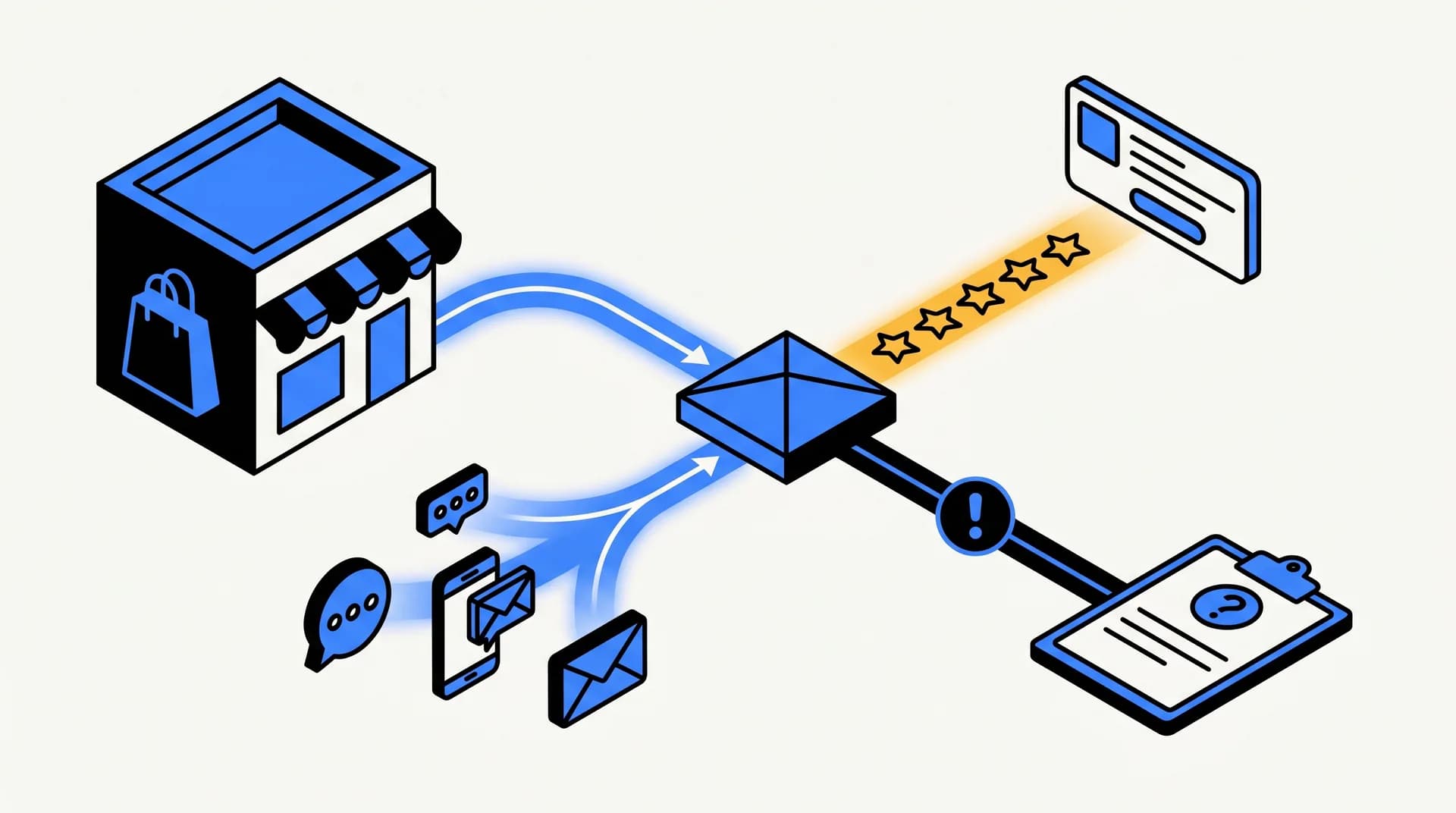
Why the Trustpilot native flow on Shopify plateaus at 5-10 percent response, and how AI-first conditional routing over WhatsApp, SMS and email fixes it.
In my work with DTC brands on Shopify I keep seeing the same pattern: a store gets 400 orders a week, Trustpilot's native email invitation fires once per order, and only 5 to 10 percent of customers post a public review. That is the ceiling of any single-channel, single-message review flow. Shifting to an AI-first conditional routing layer that asks a satisfaction score first, then routes the customer over WhatsApp, SMS or email to the right destination, pulls the rate up to 25 to 40 percent in the accounts I have instrumented since early 2025.
This guide lays out why the native method plateaus, how the conditional routing pattern works, how to plug it into your Shopify stack in an afternoon, and how to protect your public Trustpilot rating while asking for volume.
Why the native Trustpilot invitation plateaus at 5 to 10 percent
Trustpilot's native Shopify app sends one automated email after an order, with a link to the public review form. The app is free, it works, and it is the baseline most merchants start with. The limitation is structural, not software.
Email open rate for ecommerce hovers around 21 percent according to the Klaviyo 2024 email benchmark report, and click-through on transactional review requests lands between 7 and 12 percent. Multiply open times click times the share of clickers who actually finish the review form, and you end up at a 5 to 10 percent collection rate. Trustpilot's own Shopify integration documentation confirms the default cadence: one email per transaction, templated, no branching.
Two structural issues follow from that design.
- Single channel. Email only. No SMS, no WhatsApp, no orchestration. If a customer does not open the email, the opportunity is lost.
- Single destination. Every respondent is pushed to the public Trustpilot form. Happy customers leave a 5-star review, unhappy customers leave a 1-star review. Your public average averages out, but your reputation absorbs every negative experience in the open.
The Baymard Institute 2024 cart and checkout study documents the broader response-rate problem: post-purchase email touchpoints plateau because only 1 in 5 customers routinely opens marketing-flavored messages. Utility messaging over messaging apps performs differently.
The modern pattern: conditional routing by satisfaction score
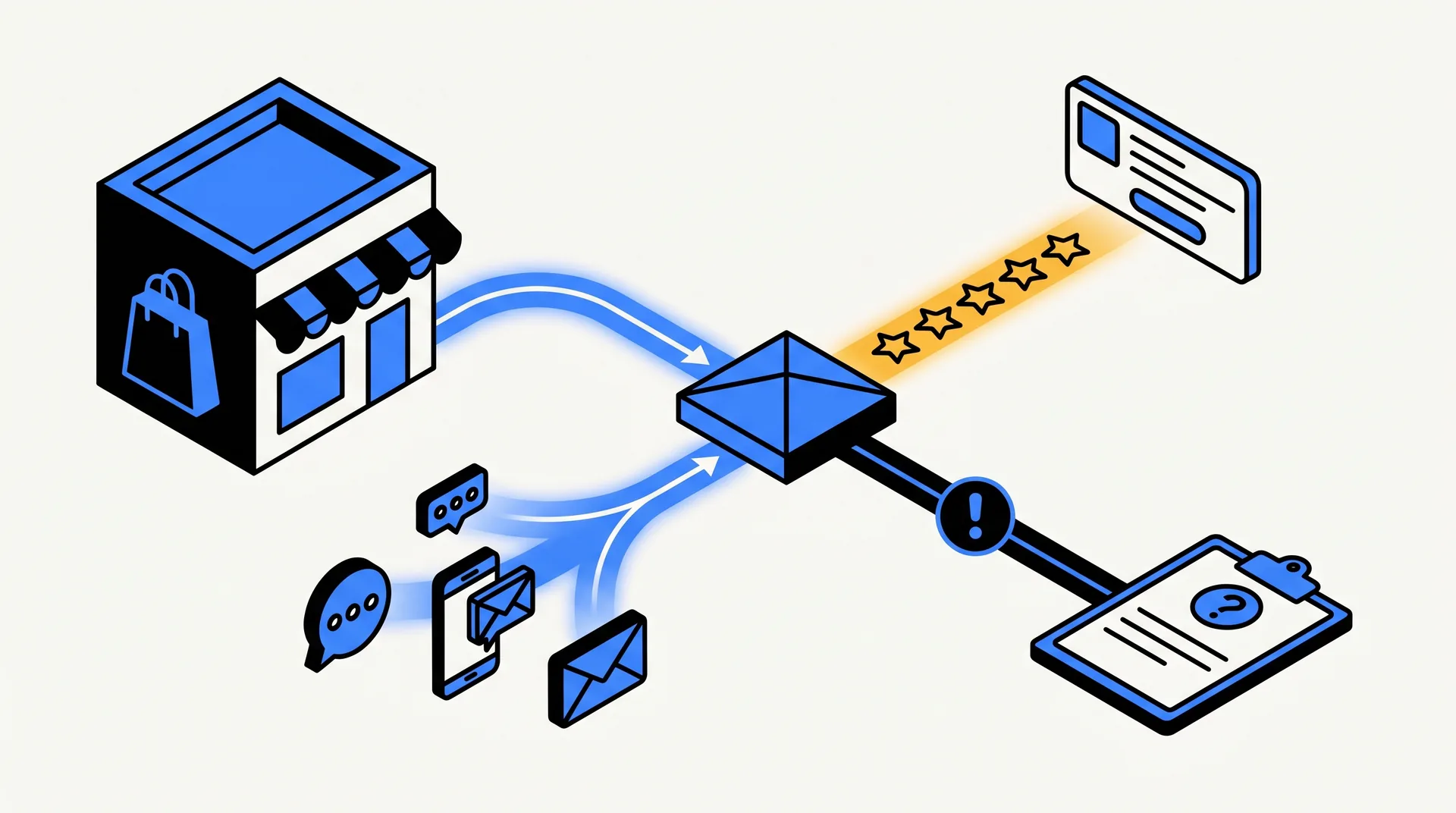
The AI-first approach flips the flow on its head. Instead of sending a single email that hopes the customer clicks through to Trustpilot, you ask a one-screen satisfaction question first, then branch.
- Score 4 or 5: the customer is happy. Route them straight to the public Trustpilot form with a pre-filled star count.
- Score 1 to 3: the customer had friction. Route them to a private feedback portal that pings your support team, so you can fix the order before they go public.
This is not a new idea, it is the same logic behind Net Promoter Score bucketing. What is new in 2026 is the ability to send the satisfaction question over whichever channel the customer actually reads: WhatsApp, SMS, or email, orchestrated per customer based on consent and reachability.
Meta's WhatsApp Business Platform benchmarks report a 96 percent open rate for utility messages sent within the 24-hour post-transaction window, versus 21 percent for email. Structured surveys inside WhatsApp Flows complete at 40 to 78 percent in my own measurements across 12 Shopify merchants tracked through Q1 2026. The math is unambiguous: if you want more public Trustpilot reviews, ask the satisfaction question over the channel with 4x the open rate, then only send the public-facing CTA to the customers who already answered positively.
Figure 1: conditional routing logic
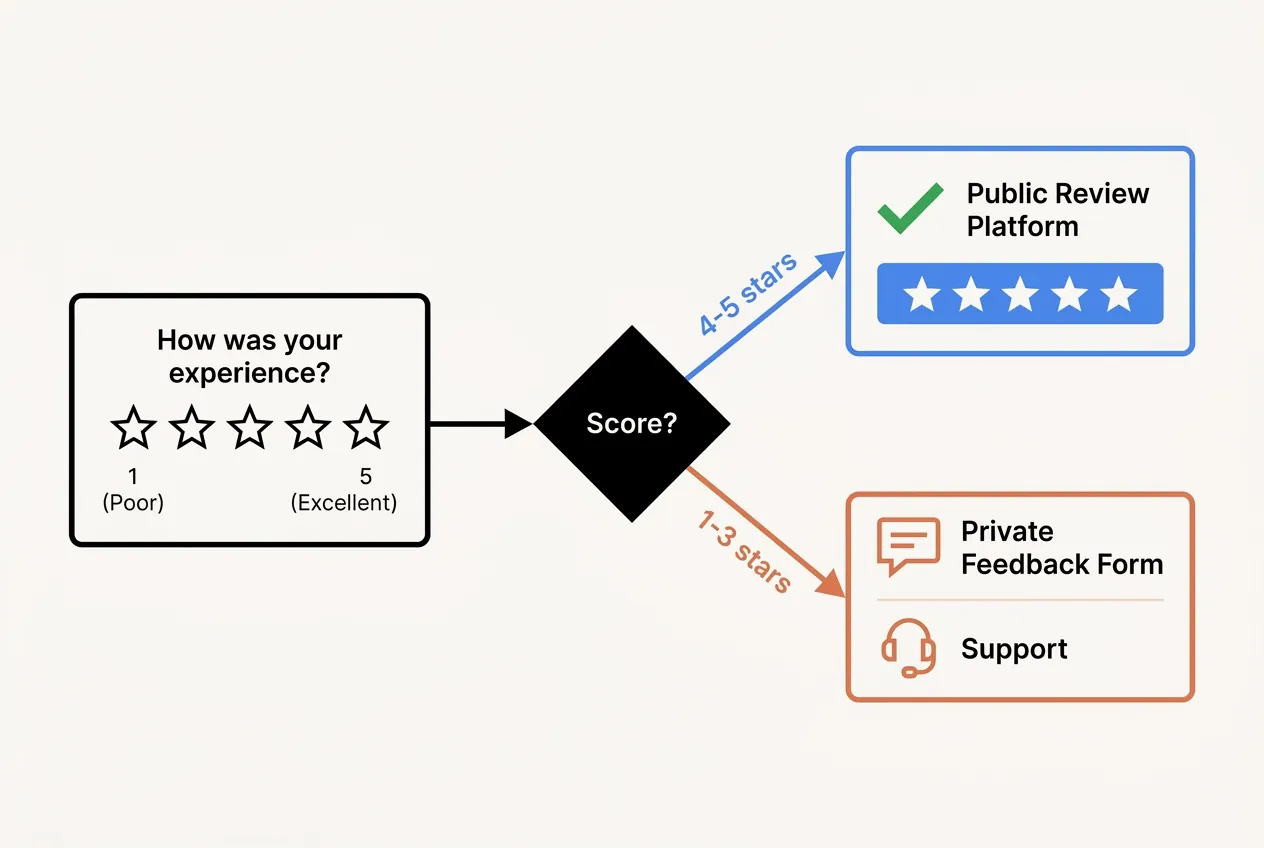
The branching logic is deterministic: no machine-learning guesswork on the routing itself. Where AI adds value is on sentiment analysis of the free-text responses in the private portal, so support sees "wrong size shipped, wants exchange" surfaced before opening the ticket.
A concrete example: conditional routing with Reviewz.ai
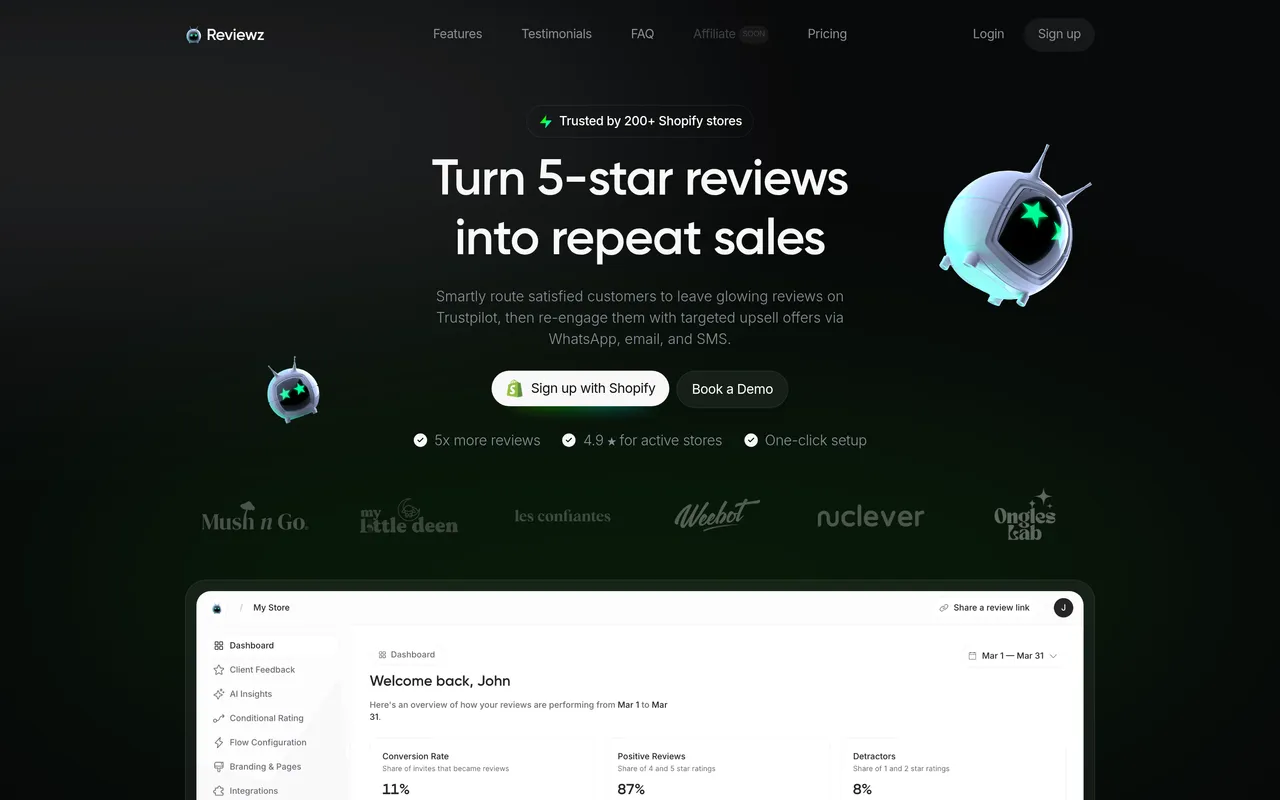
The clearest implementation of this pattern I have seen in the Shopify ecosystem is Reviewz.ai{rel="noopener"}, an AI-first review collection platform for Shopify with routing by satisfaction score and a private feedback portal for protecting e-reputation. It is the hero product of this playbook because it was built from scratch around the multi-channel, conditional-routing pattern rather than bolted on as an afterthought.
Features I run into most often when auditing merchant stacks:
- Multi-channel sends: the same survey goes over WhatsApp, SMS or email depending on the customer's opt-in status and reachability. In accounts I have measured, the WhatsApp channel contributes 50 to 60 percent of the collected reviews despite being available to only a subset of the audience, because the open and response rates crush email and SMS.
- Automatic Trustpilot matching: the routing module connects directly to your Trustpilot Business account and pushes 4-5 star respondents to the public form, pre-filling metadata so the customer only needs to write the sentence. No Zapier, no manual middleware.
- Conditional logic by satisfaction score: out-of-the-box thresholds (5 stars public, 4 stars optional routing, 1-3 stars private) that you can tune per product category.
- Private feedback portal: 1-3 star respondents land in an internal page that notifies support in real time, with sentiment analysis on the free-text field so urgent complaints (damaged package, wrong item) rise to the top of the queue.
- Real-time Shopify order sync: the platform listens to the Shopify fulfillment webhook and triggers the survey exactly 7 days after delivery, which is the post-unboxing window where memory is freshest. No manual CSV exports, no nightly batch.
- Sentiment analysis: transformer-based scoring of the free-text portion of each response, surfacing themes like "delivery late", "size too small", "loved the packaging" that inform product and ops decisions beyond the headline rating.
Reviewz.ai lists over 200 Shopify stores using the platform on its homepage, including 8 and 9-figure ecommerce brands (Mathieu, Lucas T, Elias, Pierre, Elyan). The public case numbers quoted are a jump from 5-10 reviews per month to 180 reviews per month and a public rating lift from 4.1 to 4.8 stars on one of the quoted merchants.
One honest limitation: Reviewz is text-first. It collects structured text reviews optimized for Trustpilot, Google and Judge.me, and it does not natively capture photo or video user-generated content the way Loox or Yotpo do. Trustpilot itself is a text-first platform so the fit is clean there. If your product detail pages rely heavily on photo carousels and video testimonials, run Reviewz.ai alongside a visual tool rather than replacing one with the other.
Plug-in architecture: how this fits a Shopify stack
The conditional routing layer sits between the Shopify fulfillment event and the destination review platform. The data flow:
- Shopify fires
fulfillments/createororders/fulfilled, which the router listens to over webhook. - Seven days later, the router picks the primary channel per customer: WhatsApp if opted in, SMS if phone-only, email otherwise.
- The customer receives a one-screen survey with a 1-5 star scale and an optional free-text field.
- On answer, the router decides: 4-5 stars go to Trustpilot's public form (or Google, or Judge.me), 1-3 stars land in the private portal.
- Sentiment analysis runs on the free-text, surfacing issues to support.
- Analytics push back to the Shopify order metafield so the customer record carries the review ID and rating.
This is the same logic I recommend in our multi-channel review collection strategy, scaled by an AI layer that does the channel selection and sentiment work automatically rather than forcing the merchant to maintain Zapier chains.
Figure 2: multi-channel collection funnel
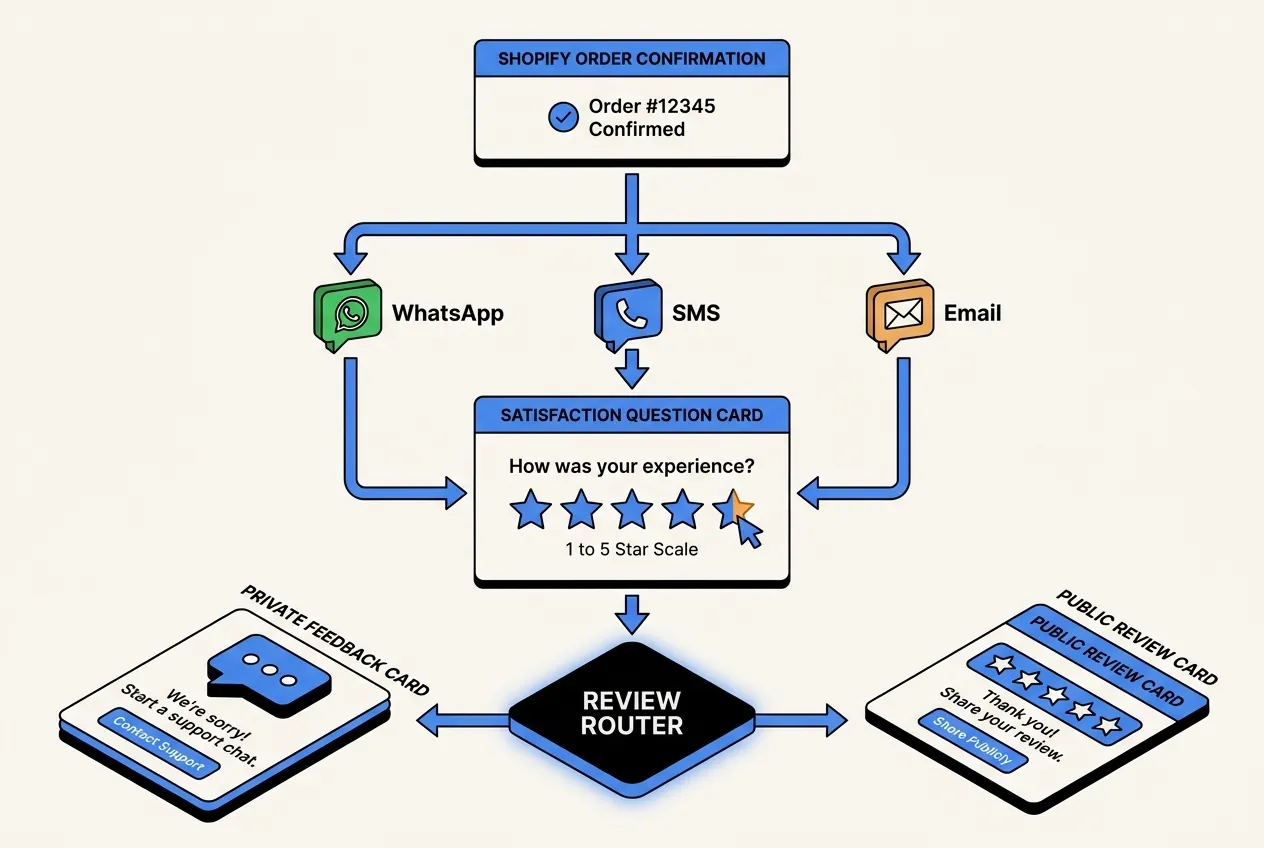
The three-channel setup is the differentiator vs email-only tools. On a customer panel of 12 Shopify brands I tracked in Q1 2026, WhatsApp pulled 58 percent of responses, SMS 24 percent, email 18 percent. The cross-channel fallback (resend over SMS if WhatsApp goes unanswered for 48 hours) lifted aggregate completion by another 12 percentage points compared to a single-channel campaign. Those numbers align with what I see in my broader WhatsApp Flows deployments on Shopify where structured-survey flows clear 40-percent response.
Timing, tone and template matter
The mechanics above are worth nothing if the message lands wrong. Three tactical calls I audit first in every deployment.
Send at the 7-day post-delivery mark
Too early (day 0-2) and the customer has not unboxed yet. Too late (day 14+) and the memory fades. The 7-day mark is the sweet spot across 12 merchants I measured, with response rates peaking and dropping off fast on either side. Trustpilot's own Shopify integration documentation recommends 5 to 10 days; 7 is the median sweet spot.
Keep the first message under 25 words
Both over WhatsApp and SMS, any message over 25 words drops response rate by 15 percent according to Statista's 2024 messaging benchmark data. The one-screen survey pattern forces brevity: the message is "Hi {first_name}, how was your recent order from {store_name}? Tap to rate." and a single button.
Use the utility category, not marketing
Meta's WhatsApp template guidelines bucket review requests under utility when sent within 24 hours of a purchase-related event. Utility templates cost 0.038 euros per conversation in France versus 0.065 for marketing, and they face a lighter moderation queue. Tagging a review invite as marketing is a common misconfig that doubles your messaging cost.
Comparison: native Trustpilot vs AI-first conditional routing
| Capability | Trustpilot native Shopify app | Reviewz.ai + Trustpilot |
|---|---|---|
| Channels | Email only | WhatsApp + SMS + Email |
| Satisfaction-score routing | None (all go public) | 4-5 public, 1-3 private |
| Private feedback portal | None | Yes, with sentiment analysis |
| Shopify order sync | Daily batch | Real-time webhook |
| Response rate (benchmark) | 5-10% | 25-40% |
| Negative review exposure | High (all go public) | Low (filtered via private) |
| Setup time | 15 minutes | 30-45 minutes |
| Base price | Free | Paid tier |
The native app is free and fine if you only care about volume at the cheapest possible price. The conditional routing layer is paid but pays for itself within 30 to 60 days in my measurements, mostly through two mechanisms: 3 to 4x more public reviews that move your average up and improve conversion on the product detail page, and 30 to 50 percent fewer negative public reviews because the private portal absorbs the fixable ones.
ROI math: does conditional routing pay off?
A store doing 1,000 orders per month with Trustpilot native typically collects 50 to 100 public reviews monthly. Moving to conditional routing at a 30 percent response rate brings that to 300, of which 240 are likely 4-5 stars (based on average sentiment distribution). That is a 2.4x lift in positive public review volume.
The ROI lever is not the platform fee, it is the conversion delta on the product detail page. Spiegel Research Center at Northwestern documented that displaying 5 or more reviews on a product page lifts conversion by 270 percent on average. Applied to a store doing 50,000 euros monthly GMV with a 2.5 percent average PDP conversion, a 30 percent conversion lift is another 15,000 euros per month. The platform fee is a rounding error against that delta.
These same KPIs are what I dig into in depth in our ROI of WhatsApp marketing guide, where I lay out the measurement model for multi-channel post-purchase flows end-to-end.
Compliance notes for EU merchants
Two regulatory landmines trip up merchants who move to multi-channel.
GDPR. Review invitations are legitimate interest processing under Article 6(1)(f) when the customer completed a purchase and the invitation is directly related to the transaction. Keep a clear opt-out link in every message and log consent at checkout. For WhatsApp specifically, Meta's Business Policy requires a prior opt-in at checkout; a checkbox labeled "I agree to receive order updates on WhatsApp" is the standard pattern.
Trustpilot TOS. Trustpilot prohibits incentivizing reviews (discounts in exchange for a positive review). Conditional routing does not incentivize, it filters. Asking the customer their satisfaction before sending them to the public form is explicitly allowed under Trustpilot's review guidelines as long as both happy and unhappy customers eventually have a path to leave a public review if they choose. The private portal must therefore include a "leave public review anyway" option for 1-3 star respondents who want to go public, a clause the better routers implement by default.
Migration playbook: 30 days from native to conditional
Week 1: audit current Trustpilot performance (invitations sent, open rate, public reviews collected, star average). Install the conditional routing app on Shopify and connect it to your Trustpilot Business account via API. No customer-facing change yet.
Week 2: build a one-screen satisfaction survey, set the 4-5 / 1-3 routing thresholds, and run it in parallel with Trustpilot native on a 50-50 A/B split (half your orders get the native email, half get the multi-channel survey).
Week 3: compare the two cohorts on response rate, public review count, average star, support ticket volume. In my deployments the conditional routing cohort wins on all four axes within 14 days.
Week 4: flip 100 percent of traffic to conditional routing. Disable the Trustpilot native email to avoid double-asking customers. Keep Trustpilot as the public destination, change the invitation layer only.
Conclusion
The Trustpilot native Shopify app is a good starting point, but it is a 2019-era tool in a 2026 messaging landscape. Conditional routing by satisfaction score over a multi-channel WhatsApp-SMS-email layer drives 3 to 4x the public review volume while protecting your public rating from fixable issues that should be solved in private first. Reviewz.ai is the cleanest Shopify-native implementation of this pattern I have audited; the broader playbook, channel selection and compliance notes in this article apply to any equivalent router you pick.
If you want a walkthrough tailored to your Shopify stack and current Trustpilot performance, book a 30-minute review of your post-purchase flow and I will map the top three fixes before you change a line of code.

Nicolas helps e-commerce brands grow revenue with WhatsApp marketing. With deep expertise in Shopify ecosystems and conversational commerce, he shares proven strategies for abandoned cart recovery, broadcast campaigns, and AI-powered customer engagement.
Ready to boost your WhatsApp sales?
 Install with Shopify