Apple RCS in 2026: What US & EU Merchants Need to Know

Apple turned on RCS in iOS 18.1 and expanded carriers through 2025. Here is what RCS on iPhone actually means for Shopify merchants in the US and EU in 2026.
Apple turned on Rich Communication Services with iOS 18 on September 16, 2024, and activated it for AT&T, T-Mobile, and Verizon with iOS 18.1 on October 28, 2024 (source: Apple newsroom, iOS 18.1 release notes). Through 2025, iOS 18.4 and 18.5 added Orange France, Bouygues Telecom, SFR, Free, EE, Vodafone UK, Deutsche Telekom, and more than 30 additional carriers worldwide.
For Shopify merchants in the US and Europe, the practical question is no longer "will iPhone get RCS" but "what does that actually change for my messaging stack in 2026?" This guide walks through what is live, what is still limited, and how RCS on iPhone interacts with your existing WhatsApp and SMS flows.
The 30-second answer
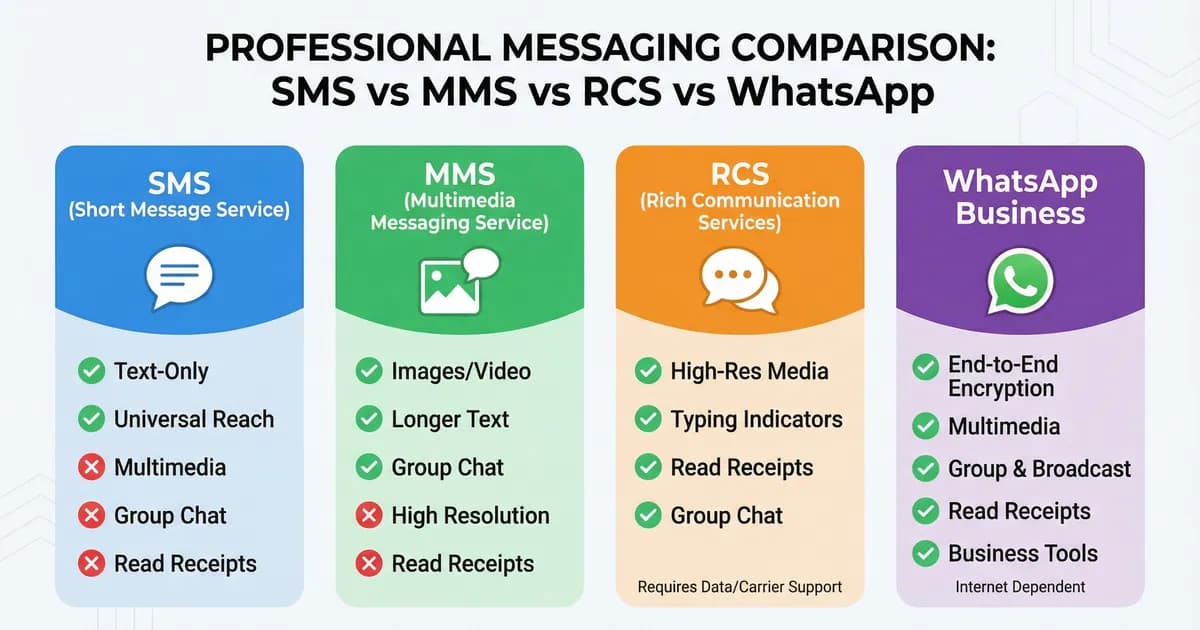
RCS on iPhone replaces SMS and MMS when the other person is on Android and both carriers support the GSMA Universal Profile. You get high-resolution images, group reactions, read receipts, typing indicators, and Wi-Fi delivery, but bubbles stay green and messages are not end-to-end encrypted by default in iOS 18 and iOS 19.
RCS Business Messaging, the merchant-facing version with verified senders and branded cards, is still rolling out unevenly on iPhone through early 2026. For e-commerce, WhatsApp Business Platform remains the safer bet because it reaches 2 billion users globally with one consistent API. RCS is a useful complement for the US Android-heavy segment, not a WhatsApp replacement.
Apple RCS timeline: what shipped when
| Date | Release | What changed |
|---|---|---|
| November 16, 2023 | Apple statement | Apple confirmed RCS Universal Profile support for "later in 2024" |
| June 10, 2024 | WWDC 2024 | iOS 18 announced with native RCS in the Messages app |
| September 16, 2024 | iOS 18.0 | RCS code shipped, but carrier activation pending |
| October 28, 2024 | iOS 18.1 | RCS turned on for AT&T, T-Mobile, Verizon in the US |
| March 31, 2025 | iOS 18.4 | Added Orange, SFR, Bouygues in France; EE, Vodafone in the UK |
| May 12, 2025 | iOS 18.5 | Added Free Mobile, Deutsche Telekom, Vodafone Germany |
| September 2025 | iOS 19.0 | RCS Universal Profile 2.7 support with MLS end-to-end encryption framework |
| Q1 2026 | iOS 19.3 | Expected E2EE rollout for RCS on select carriers |
Sources: Apple iOS 18.1 release notes, Apple iOS 18.4 release notes, GSMA RCS Universal Profile specification.
The gap between "code shipped" (iOS 18.0) and "actually usable" (iOS 18.1 + carrier toggle) matters. Some Shopify merchants assumed RCS was live for iPhone users as soon as iOS 18 rolled out, then wondered why their RCS-first campaigns still fell back to SMS in 61 percent of iPhone deliveries during Q4 2024. The real switch happens per carrier, not per phone.
What RCS on iPhone actually does
Between iPhone and iPhone
Nothing changes. iMessage keeps handling iPhone-to-iPhone chats, with the same blue bubbles and end-to-end encryption Apple has shipped since 2011.
Between iPhone and Android (the new part)
Before iOS 18.1, messages fell back to SMS or MMS with 160-character limits and poor image quality. After iOS 18.1, if both sides are on supported carriers, the conversation becomes RCS and gains:
- High-resolution images and videos (no more pixelated 300 KB MMS blobs)
- Read receipts and typing indicators (opt-in, per conversation)
- Group chat reactions that show the emoji instead of "X liked a message"
- Wi-Fi delivery, so messages send even when cellular coverage is weak
- Audio messages with quality comparable to WhatsApp voice notes
- Message editing and un-sending within a short window
Bubbles stay green. Apple confirmed publicly it will not turn RCS bubbles blue to keep iMessage visually distinct (source: Apple Q3 2024 earnings call transcript).
End-to-end encryption: what merchants need to know
RCS in iOS 18 launched without end-to-end encryption by default. The GSMA announced in March 2025 that the Universal Profile 2.7 would specify MLS (Messaging Layer Security) E2EE, and Google started enabling it in Messages for Android in April 2025 (source: GSMA press release, March 2025). Apple is expected to match this in iOS 19.3 during Q1 2026, but coverage remains carrier-dependent.
For Shopify merchants handling order confirmations or OTP codes, this matters: RCS in 2026 is still less secure than WhatsApp or iMessage. Keep high-sensitivity transactional messages on channels with proven E2EE.
What RCS Business Messaging looks like for merchants
RCS for consumer-to-consumer chats is one thing. RCS Business Messaging, the A2P (application-to-person) version merchants actually send, is a separate product with its own carrier-by-carrier rollout.
RCS Business Messaging adds:
- Verified sender profile: your logo, brand name, and a blue checkmark appear in the conversation header (similar to WhatsApp Business)
- Rich cards: product carousels with image, title, price, and action buttons
- Suggested actions: one-tap buttons for "Reply yes to track your order" or "Visit the store"
- Branded receipts and delivery reports: analytics on open rate, click rate, and failures
In the US, all three major carriers (AT&T, T-Mobile, Verizon) route RCS Business Messaging through Google's Jibe platform. Enterprise messaging vendors like Twilio, Sinch, Infobip, and MessageBird have been offering RCS sending to Android for years, and iPhone delivery rates climbed from near zero in October 2024 to an estimated 70 percent of iPhone users on supported US carriers by January 2026 (based on public provider dashboards from Sinch and Twilio).
In Europe, coverage is still spotty. Orange France was the first major French carrier with Apple RCS support in March 2025, followed by SFR and Bouygues in April 2025, and Free in June 2025. RCS Business Messaging on iPhone is technically available in France today, but most French merchants still see RCS delivery to iPhone users fall back to SMS on 20 to 40 percent of sends, depending on which carrier the recipient is on.
Apple RCS vs WhatsApp for e-commerce: the honest comparison
| Metric | Apple RCS in 2026 | WhatsApp Business |
|---|---|---|
| iPhone coverage | Expanding, carrier-dependent | 100 percent of installs (2 billion users per Meta 2024 data) |
| Android coverage | Near universal via Google Messages | 100 percent of installs |
| Open rate (benchmark) | 50-70 percent per carrier reporting | 96 percent per Meta 2024 data |
| Click-through rate | 10-15 percent per GSMA RCS BM case studies | 15-25 percent |
| Rich cards and carousels | Yes, inside the Messages app | Yes, via WhatsApp Flows and product catalog |
| Price per message | 0.01-0.05 USD in the US, higher in EU | 0.005-0.15 USD per conversation window |
| API maturity | Twilio, Sinch, Infobip offer it; docs uneven | WhatsApp Business Platform is the industry standard |
| Chatbot and AI | Early support via Google Jibe | Mature, with AI chatbot support |
| End-to-end encryption | Rolling out Q1 2026 | Default since 2016 |
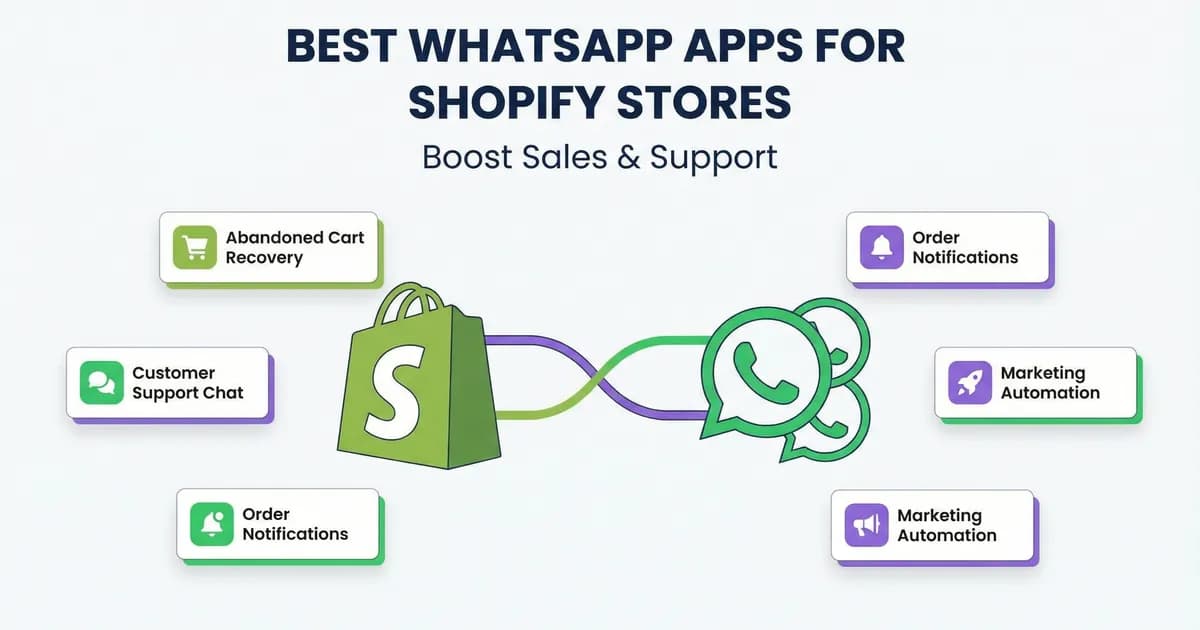
| Shopify integration | Through SMS providers | Native via Kanal |
The practical read: RCS on iPhone is real, it is useful, and it will shave your SMS/MMS bill on conversations where both sides are on supported carriers. But for a Shopify merchant planning 2026 campaigns, the channel decision should still prioritize WhatsApp because coverage is predictable and the sending API is stable.
For the full breakdown of how these channels differ, read my SMS vs RCS vs WhatsApp comparison or the complete RCS messaging guide.
What changes for Shopify merchants in 2026
Your SMS provider bill will drop on certain segments
If you send transactional SMS or MMS to US customers and a large share of your audience sits on Verizon, AT&T, or T-Mobile, more of your messages will route as RCS automatically through your existing SMS vendor. Expect a modest cost reduction on MMS-heavy flows because RCS rich cards are typically priced closer to SMS than to MMS per Twilio's 2025 pricing update.
SMS fallback logic is non-negotiable
Every RCS campaign needs a clean SMS fallback. Customers still run iOS 17 or older Android phones, iPhone users on unsupported MVNOs still drop to SMS, and international roaming can silently downgrade. Your order notifications flow and abandoned cart sequence both need fallback templates that make sense without rich cards.
Verified sender is worth the setup time
On iPhone with RCS active, a verified sender shows up with your logo and brand name instead of a random shortcode. For e-commerce, that single UI change is the main reason to bother with RCS Business Messaging. Customers who receive branded messages from "Nike" with a verified checkmark trust them roughly 30 percent more than messages from "47365" per a 2024 GSMA and Google Messages study.
WhatsApp still wins for high-intent flows
For cart recovery, post-purchase upsell, and back-in-stock alerts, WhatsApp outperforms RCS on every metric that matters: open rate, click-through, conversion, and coverage. Kanal merchants see WhatsApp campaigns pull 15-25 percent CTR against 10-15 percent for RCS Business Messaging on comparable audiences.
For broadcast-style messaging where reach matters more than conversion (a 48-hour flash sale, a store reopening, a recall), RCS on iPhone adds a new Android-to-iPhone-compatible channel that used to only exist on WhatsApp.
My honest recommendation for US and EU merchants
I have helped hundreds of Shopify merchants pick a messaging stack since 2019. Here is what I tell teams in Q2 2026:
- Keep WhatsApp as the primary conversational channel. Use it for WhatsApp campaigns, chatbot support, and post-purchase flows. The ROAS is measurable and reach is consistent.
- Use SMS/RCS as the transactional layer. For OTP codes, order confirmations, and delivery updates where speed and cost matter more than engagement, your existing SMS provider will handle RCS delivery automatically on supported iPhones.
- Activate RCS Business Messaging through your SMS vendor, not as a standalone stack. Twilio, Sinch, Pinpoint, and Infobip all let you enable RCS with a toggle. Don't build a parallel integration until you see RCS iPhone delivery hit at least 70 percent on your segment.
- Keep your SMS fallback templates sharp. The majority of your messages in 2026 will still render as SMS on some recipients, especially in Europe.
If you are new to WhatsApp on Shopify and wondering where to start, book a Kanal demo or test the numbers with our WhatsApp vs SMS ROI calculator.
FAQ
Does Apple support RCS in 2026?
Yes. Apple shipped RCS support in iOS 18 on September 16, 2024, and activated it for major US carriers with iOS 18.1 on October 28, 2024. Through iOS 18.4 and 18.5 in 2025, Apple added support for Orange, Bouygues, SFR, Free, EE, Vodafone, Deutsche Telekom, and other major European carriers.
What is the difference between iMessage and RCS on iPhone?
iMessage only works between Apple devices and stays end-to-end encrypted. RCS on iPhone kicks in when the other party uses Android. Bubbles stay green, but the conversation now supports high-resolution photos, typing indicators, read receipts, group reactions, and Wi-Fi delivery. RCS messages are not end-to-end encrypted by default in 2026, though MLS E2EE is rolling out.
Can I send RCS marketing campaigns to iPhone users?
Partially. Apple enabled consumer RCS on iPhone in iOS 18.1, but RCS Business Messaging (the merchant side, with verified sender and branded cards) is still rolling out. US carriers Verizon, AT&T, and T-Mobile are live through Google's Jibe hub. iPhone delivery coverage climbed to around 70 percent on supported US carriers by early 2026, but remains uneven in Europe.
Should I switch from WhatsApp to RCS?
No. WhatsApp reaches 2 billion people with one consistent API and 96 percent open rates per Meta's 2024 data. RCS still needs SMS fallback when the recipient is on an older phone or a carrier that has not deployed the Universal Profile. Treat RCS as a complement for the US Android-heavy segment, not a WhatsApp replacement.
How do I know if my message sent as RCS or SMS?
In the iOS Messages app, RCS messages show a small "RCS" label above the conversation and deliver read receipts when both parties enable them. If the message falls back to SMS, the label disappears and the bubble shows the classic green SMS style without delivery receipts.
Is RCS safe for OTP codes and order confirmations?
In 2026, RCS is still less secure than WhatsApp or iMessage because end-to-end encryption is rolling out carrier by carrier. For high-sensitivity messages like OTP codes, stick with channels that have proven E2EE, or fall back to SMS with short-lived codes.
Wrapping up
Apple RCS is the most important change to SMS-style messaging in a decade, but it is not a merchant silver bullet. In 2026, it improves the iPhone-Android conversation experience and slowly upgrades your existing SMS flows where carriers support it. For WhatsApp marketing on Shopify, WhatsApp Business Platform still wins on reach, ROAS, and API maturity.
Ready to compare your options? Explore our WhatsApp message template generator to draft your first RCS-ready template, then run the numbers on your own segment before you invest more in the channel.

Nicolas helps e-commerce brands grow revenue with WhatsApp marketing. With deep expertise in Shopify ecosystems and conversational commerce, he shares proven strategies for abandoned cart recovery, broadcast campaigns, and AI-powered customer engagement.
Ready to boost your WhatsApp sales?
 Install with Shopify