Sendblue Pricing 2026: Free Sandbox, $100 per iMessage Line
Sendblue pricing read on November 7, 2026: free sandbox, AI Agent plan at $100 a month per line, Enterprise on quote, and what each covers for stores.
 Nicolas ProvostNov 7, 2026 · 7 min read
Summarize this article with an AI
 ChatGPT
 Claude
Table of contents (8)
Key takeaways
- Sendblue prices iMessage per line, not per message: on November 7, 2026 its pricing page listed a free sandbox, the AI Agent plan at $100 a month per dedicated line and Enterprise at custom, volume-based pricing.
- The $100 plan is inbound-first: contacts text you first, up to 1,000 inbound contacts a day. Full outbound messaging, the part a cart reminder or a campaign needs, is on Enterprise.
- Sendblue lists $0 per-message fees, $0 A2P registration, $0 carrier surcharges and $0 SMS fallback fees, and each line sends and receives iMessage, SMS and RCS.
- With Shopify, Sendblue connects through Zapier or Make. Kanal, a Shopify app used by 500+ brands, sends the first iMessage itself, cart reminders included, with iMessage, SMS and RCS from its Scale plan at €149 a month.
Sendblue charges per iMessage line, not per message: on Sendblue's pricing page read on November 7, 2026, the AI Agent plan costs $100 a month per dedicated line, a free sandbox lets you test the API, and Enterprise is priced on request. The catch for an online store is in the plan details: the $100 plan is inbound-first, and full outbound messaging, what a cart reminder needs, sits on Enterprise.
This guide reads each plan line by line, explains what a line and "inbound-first" mean, prices a store setup and shows how Sendblue connects to Shopify. If you want iMessage cart reminders and campaigns on a Shopify store without building them, the last part covers Kanal, our Shopify app that sends iMessage, WhatsApp and SMS from the same flows.
How much does Sendblue cost?
Sendblue sells three plans, all priced per line:
| Plan | Price | What Sendblue lists |
|---|---|---|
| Free Sandbox | $0 | Shared phone number, full API access, up to 10 verified contacts, inbound-first, CLI and SDK support, community support. No dedicated number, no outbound messaging, no webhooks or callbacks |
| AI Agent | $100 a month per dedicated line | Dedicated phone number, inbound-first messaging, 1,000 inbound contacts a day, webhooks and callbacks, media, typing indicators and reactions, priority support |
| Enterprise | Custom, volume-based | Everything in AI Agent, full outbound messaging, multiple dedicated lines, SOC 2 and HIPAA, dedicated account manager |
Source: Sendblue pricing page, read on November 7, 2026.
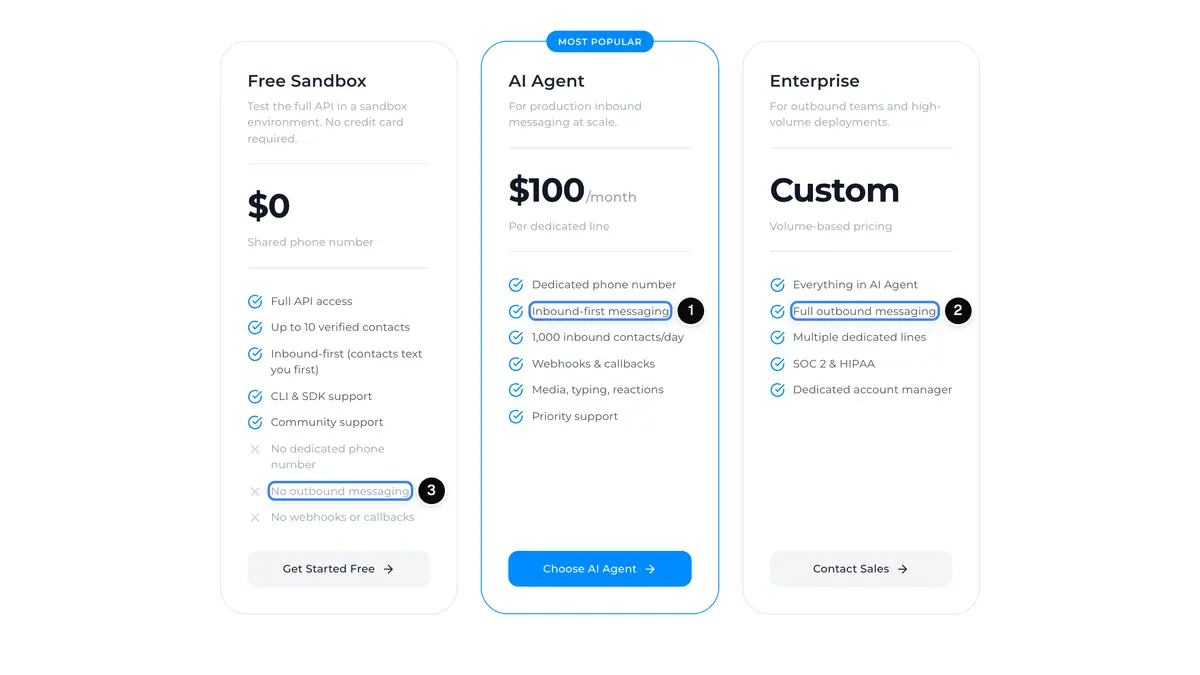 Source: Sendblue pricing page, read on November 7, 2026. (1) The $100 plan is inbound-first, (2) full outbound messaging is on Enterprise, (3) the sandbox has no outbound messaging.
Under the plans, the page lists four fees at $0: per-message fees, A2P registration, carrier surcharges and SMS fallback fees. Its FAQ adds that volume pricing starts at 10 lines and that annual billing discounts go through the sales team.
What does "per line" mean on Sendblue?
Sendblue's FAQ defines a line as "a dedicated phone number provisioned on the Sendblue platform", and says each line can send and receive iMessages, SMS and RCS. Three consequences for a budget:
- The price follows your numbers, not your volume. One line costs $100 a month whether it handles 50 conversations or 1,000.
- More capacity means more lines. The AI Agent plan caps each line at 1,000 inbound contacts a day, so a busier inbox needs a second line, at another $100 a month.
- SMS fallback costs nothing extra. The pricing page lists $0 SMS fallback fees, and each line also sends SMS and RCS.
What does "inbound-first" mean?
On the free sandbox, Sendblue spells it out: "contacts text you first". The AI Agent plan keeps "inbound-first messaging", while "full outbound messaging" appears only in the Enterprise column.
For a store, that splits the use cases in two:
- Answering customers who write to you, for example from a "Text us" button on your site: the $100 plan covers it.
- Writing first: a reminder after an abandoned checkout, a shipping update to a customer who never texted you, a campaign to your opted-in list. These are outbound messages, which the pricing page places on Enterprise, priced on request.
Before you commit, ask Sendblue's sales team which plan your flows need and at what price.
How does Sendblue connect to Shopify?
Sendblue's Shopify page gives four setup steps: connect Shopify through Zapier or Make, set up order notifications, configure cart recovery and add post-purchase flows. Zapier and Make provide the Shopify triggers (new order, abandoned cart, customer events) and the Sendblue action that sends the iMessage.
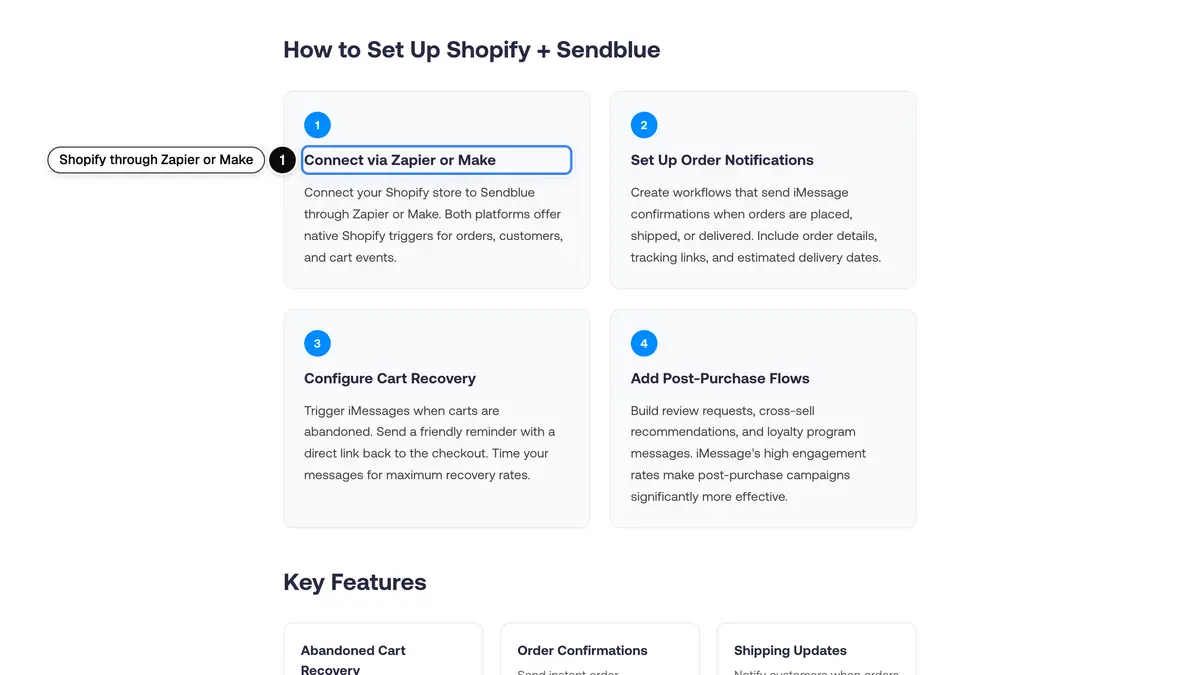 Source: Sendblue Shopify integration page, read on November 7, 2026.
So the full cost of Sendblue on Shopify has three parts: the Sendblue plan, the Zapier or Make plan that runs the workflows, and the time to build and maintain each scenario. The same page says replying STOP unsubscribes a customer automatically, and that you can also manage opt-outs through your Shopify customer data and workflow logic.
What does Sendblue cost for a real store?
Two fictional Shopify stores, priced with the Sendblue pricing page as of November 7, 2026:
Store 1: iMessage support only. Customers text the store from a button on the site, and the team or an AI agent answers.
- AI Agent plan, one line: $100 a month, or $1,200 a year.
- Up to 1,000 inbound contacts a day on that line.
- Plus the AI agent or helpdesk you connect through webhooks, and its own price.
Store 2: cart reminders, shipping updates and a monthly campaign by iMessage.
- These flows send the first message, so they need full outbound messaging: Enterprise, price on request.
- Plus the Zapier or Make plan that runs the Shopify triggers.
- Plus the build: one scenario per flow, with opt-out handling and reporting.
The pattern to remember: Sendblue's $100 starting price covers answering. The selling flows of an online store start at a plan whose price is not published.
Sendblue or a Shopify app: what should a store choose?
Sendblue fits a team with developers, or a sales team, that wants iMessage lines inside its own CRM, product or AI agent. For a Shopify store that wants iMessage to sell, Kanal is built for that job:
- Your store writes first. Kanal sends the iMessage after an abandoned checkout, with the product and a button to finish the order, without waiting for the customer to start the conversation.
- The flows are already there. Cart recovery, order and shipping updates, post-purchase upsell, review requests, back in stock alerts, win-back messages and campaigns, from your Shopify data, with no Zapier or Make scenario.
- Customers without an iPhone are covered. The same reminder goes out on WhatsApp or by SMS, from the same app and the same inbox.
- Replies are handled. The AI agent answers questions about sizes, delivery or returns, and your team takes over in a shared inbox.
| Kanal plan | Price per month | What it covers |
|---|---|---|
| Pro | €89 | 1 user, chat widget and inbox, abandoned cart recovery, WhatsApp campaigns |
| Scale | €149 | 5 users, segments, unlimited and advanced automations, Klaviyo integration, iMessage, SMS and RCS |
| Business | €350 | Scale, plus flow setup and optimization by our experts |
Source: Kanal pricing and Kanal iMessage page, read on November 7, 2026. No commitment; Meta's WhatsApp fees are passed through at cost.
Our head-to-head Kanal vs Sendblue comparison goes row by row, and our iMessage marketing guide covers what brands send on the channel.
How do you estimate your own Sendblue bill?
- List the flows you need and mark each one: does the customer write first (inbound) or does the store (outbound)?
- If any flow is outbound, ask Sendblue for an Enterprise quote, since full outbound messaging is on that plan.
- Count your lines: one per $100 on the AI Agent plan, with up to 1,000 inbound contacts a day each.
- Add the workflow tool: your Zapier or Make plan for the Shopify triggers.
- Add the build: each scenario, opt-out and report you set up and maintain.
- Compare with a Shopify app such as Kanal, where iMessage, SMS and RCS come with the Scale plan and WhatsApp with every plan.
Sendblue pricing at a glance
| Item | Price on November 7, 2026 | Source |
|---|---|---|
| Free Sandbox | $0, shared number, up to 10 verified contacts, no outbound | Sendblue pricing page |
| AI Agent | $100 a month per dedicated line, inbound-first, 1,000 inbound contacts a day | Sendblue pricing page |
| Enterprise | Custom, volume-based, full outbound messaging | Sendblue pricing page |
| Per-message, A2P, carrier and SMS fallback fees | $0 | Sendblue pricing page |
| Shopify connection | Through Zapier or Make | Sendblue Shopify page |
Sendblue's price is easy to read and easy to misread: $100 a month buys a line that answers, and the messages a store sends first are on a plan priced on request. If you run a Shopify store and want iMessage cart reminders, order updates and campaigns ready from the install, book a Kanal demo and we will show them on your store.
See iMessage on your own store
- Cart recovery, order updates and campaigns in the Messages app
- The same automations as on WhatsApp, from your Shopify data
- Customers on Android hear from you on WhatsApp or by SMS
Available from the Scale plan
See Kanal's iMessage marketing- brands
- 500+
- to set up
- 5 min
- open rate on WhatsApp
- +90%
Nicolas helps e-commerce brands grow revenue with WhatsApp marketing. With deep expertise in Shopify ecosystems and conversational commerce, he shares proven strategies for abandoned cart recovery, broadcast campaigns, and AI-powered customer engagement.