Recharge Pricing in 2026: Plans and Transaction Fees
Recharge pricing explained: the $25, $99 and $499 plans, transaction fees per order, the 60-day trial, billing rules and a worked example with math.
 Nicolas ProvostOct 7, 2026 · 10 min read
Summarize this article with an AI
 ChatGPT
 Claude
Table of contents (10)
Key takeaways
- Recharge charges $99 a month plus 1.49% and 19 cents per transaction on Starter, and $499 plus 1.34% and 19 cents on Plus.
- New stores with 50 or fewer lifetime subscribers pay $25 a month with no transaction fees, after a 60-day trial.
- Transaction fees apply to the total processed, including shipping, taxes and refunded orders, and payment processor fees come on top.
- The lower Plus rate only offsets its higher monthly fee at about $266,667 processed per month.
Recharge costs a fixed monthly fee plus a fee on every transaction it processes: $99 a month plus 1.49% and 19 cents per transaction on the Starter plan, and $499 a month plus 1.34% and 19 cents per transaction on the Plus plan, according to Recharge's pricing page as of October 7, 2026. New stores with 50 or fewer lifetime subscribers start on a $25 a month plan, and a Custom plan with volume-based rates is quoted by sales.
This guide reads Recharge's pricing page, its Help Center article on billing and its Shopify App Store listing as they stood on October 7, 2026, in US dollars.
How much does Recharge cost?
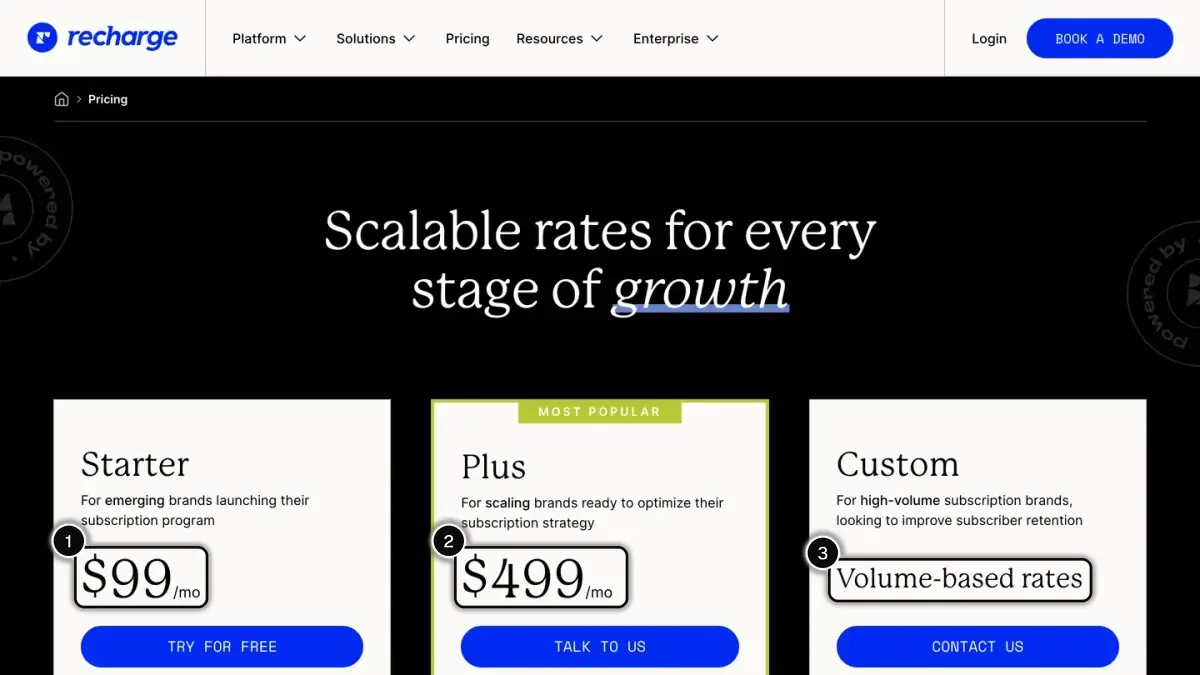 In 1, Starter at $99 a month; in 2, Plus at $499 a month; in 3, the Custom plan with volume-based rates.
| Plan | Monthly fee | Transaction fee | Who it is for, in Recharge's words |
|---|---|---|---|
| 25-50 | $25 | None for your first 50 subscribers | Net-new merchants with 50 or fewer cumulative lifetime customers |
| Starter | $99 | 1.49% + 19¢ per transaction | Emerging brands launching their subscription program |
| Plus | $499 | 1.34% + 19¢ per transaction, "with scalable transaction rates to support your growth" | Scaling brands ready to optimize their subscription strategy |
| Custom | Contact sales | Volume-based rates | High-volume subscription brands |
Sources: Recharge pricing page and Recharge on the Shopify App Store, as of October 7, 2026.
One discrepancy to know about: on the same day, Recharge's Help Center article on billing described the Starter terms as "$99 per month plus 1.25% of the total amount of the transaction, and 19¢ per transaction". The pricing page and the App Store listing both showed 1.49%. The rate that binds you is the one in the billing terms you accept in your merchant portal, so read it there before you approve.
What do you get on each plan?
Starter lists the core subscription tools:
- a subscription widget for the product page;
- a customer portal where subscribers manage their own orders;
- upsell and cross-sell tools;
- cancellation prevention flows;
- failed payment recovery;
- win-back tools for lapsed subscribers;
- automated workflows, gifting, and analytics with industry benchmarks.
Plus lists everything in Starter, and:
- hands-on implementation and end-to-end migration support;
- customizable bundles and tiered discounts;
- Concierge SMS, which lets customers manage subscriptions by text;
- Rewards and a referral program (Loyalty);
- the JavaScript SDK and Storefront API.
Custom adds custom implementations, dedicated priority technical support, a review of your solution architecture and enterprise business reviews.
The 25-50 plan comes with the entire Starter feature set, according to the App Store listing.
Support also varies. The Help Center lists chat and email support 24 hours a day, 7 days a week on all plans with a guaranteed initial response within 8 hours, and, for merchants on the Custom plan, a 4-hour initial response and video callback support.
How do Recharge's transaction fees work?
The transaction fee is what makes the bill move, so its rules matter. Recharge's Help Center sets them out:
- One-time orders count. Recharge charges transaction fees for both one-time and recurring subscription orders, including one-time purchases in mixed charges.
- The base is the total processed amount. Fees are calculated monthly on the total processed, including shipping and taxes.
- Refunds do not cancel the fee. If an order is refunded, the transaction fee still applies, because Recharge has already processed the transaction.
- Processor fees are separate. Recharge's pricing is in addition to your ecommerce platform and your payment processor (Shopify Payments, Stripe, Braintree or Authorize.net), which may carry its own transaction fee.
The pricing FAQ summarizes the model: your total monthly charges include a fixed monthly fee plus variable fees based on your usage in the most recent billing cycle, and usage fees apply to all transactions processed by Recharge in the month.
How does the 25-50 plan work?
This plan is the entry point for a store launching subscriptions. The Help Center describes it precisely:
- Who gets it. After the trial, merchants who are not under contract and have 50 or fewer cumulative lifetime customers are placed on it. It is available only to merchants installing Recharge on or after February 9, 2026.
- How customers are counted. The count is the cumulative lifetime number of distinct customers who have made a subscription purchase. It includes active, inactive and test customers, and deleting a customer does not reduce it.
- When it ends. Once the store passes 50 cumulative lifetime customers, it automatically transitions to Starter.
- No way back. After moving to Starter, a store is not downgraded to the 25-50 plan if its customer count later drops below 50, and existing stores are not eligible to downgrade to it.
Because test customers count, avoid creating many test subscriptions with distinct customer profiles during setup.
What does a real month cost? A worked example
The store below is fictional. The rates are those displayed on the pricing page on October 7, 2026.
A Shopify store processes 400 subscription orders in a month through Recharge. The average order, shipping and tax included, is $40. Total processed: 400 × $40 = $16,000.
On Starter:
- Monthly fee: $99.00
- Percentage fee: 1.49% × $16,000 = $238.40
- Per-transaction fee: 400 × $0.19 = $76.00
- Total: $99 + $238.40 + $76 = $413.40, or 2.58% of the amount processed
On Plus:
- Monthly fee: $499.00
- Percentage fee: 1.34% × $16,000 = $214.40
- Per-transaction fee: 400 × $0.19 = $76.00
- Total: $499 + $214.40 + $76 = $789.40
At this volume, Plus costs $789.40 - $413.40 = $376 more per month, so the decision rests on its features (bundles, loyalty, Concierge SMS, implementation support), not on the lower rate. On the percentage alone, the gap between the two rates is 1.49% - 1.34% = 0.15%, and the gap between the monthly fees is $499 - $99 = $400: the rate difference covers the fee difference at $400 ÷ 0.0015 = $266,667 processed per month (rounded to the dollar). Recharge also mentions scalable transaction rates on Plus, which sales can detail.
Two things the example leaves out: your payment processor's fees, which Recharge does not set, and refunds, which do not reduce Recharge's fee.
What is not included in the plan price?
- Concierge SMS messages. Included as a feature on Plus, with usage billed at $0.03 per message segment for the US and Canada and $0.06 internationally.
- Payment processing. Charged by your processor.
- Plus features on Starter. Bundles, Rewards, Referrals and the JavaScript SDK are listed from Plus.
- Custom work. Custom implementations and architecture reviews are listed under the Custom plan.
- Your Shopify plan. Recharge states that its pricing is in addition to your ecommerce platform. Our Shopify pricing guide covers that part of the stack.
What are Recharge's billing rules?
Trial. The trial lasts 60 days from the day you install the app, with no transaction or processing fees. The pricing FAQ says you are billed after the first full billing cycle you complete, not including the trial. For stores on the Shopify Checkout Integration, a banner counts down the days, and at 60 days the store owner must accept the billing terms to continue: only the store owner can accept them.
Billing cycle. Recharge follows a monthly billing cycle and bills on the first of the month.
Billing through Shopify. For Shopify Checkout Integration stores, charges go through your Shopify invoice. Recharge bills on the first of the month and Shopify bills apps on a rolling 30-day cycle, so a single Shopify invoice may occasionally show multiple Recharge usage fees, each issued in a different period.
Contracts. The 25-50 and Starter plans are month to month. The pricing FAQ says Plus and Custom plans run on 12-month terms: you can upgrade during your term as volume grows, and downgrade when the commitment expires. Merchants on a Custom plan generally can't cancel during the contract period.
Downgrades. You request them through your customer success manager, or through Recharge support if you don't have one.
Shopify Plus. Merchants on Shopify Plus may be eligible for discounted pricing through the Custom plan, according to the pricing FAQ.
How do you check your own Recharge cost?
- Export last month's subscription orders and their total value, shipping and tax included.
- Add the one-time orders that go through Recharge in mixed carts.
- Apply the formula: monthly fee + (rate × total processed) + (19¢ × number of transactions), with the rate shown in your billing terms.
- Run it for a peak month and for your forecast in twelve months.
- Read the fee as a share of subscription revenue, as in the example (2.58% on Starter at $16,000), and add your processor's rate to see the full cost of a subscription order.
- Compare billing models. Other subscription apps charge by order volume or a flat tier: our ranking of the best subscription apps for Shopify lists them.
Recharge's listing has a rating of 4.8 out of 5 from 3,127 reviews on the Shopify App Store as of October 7, 2026.
Where does WhatsApp fit with Recharge?
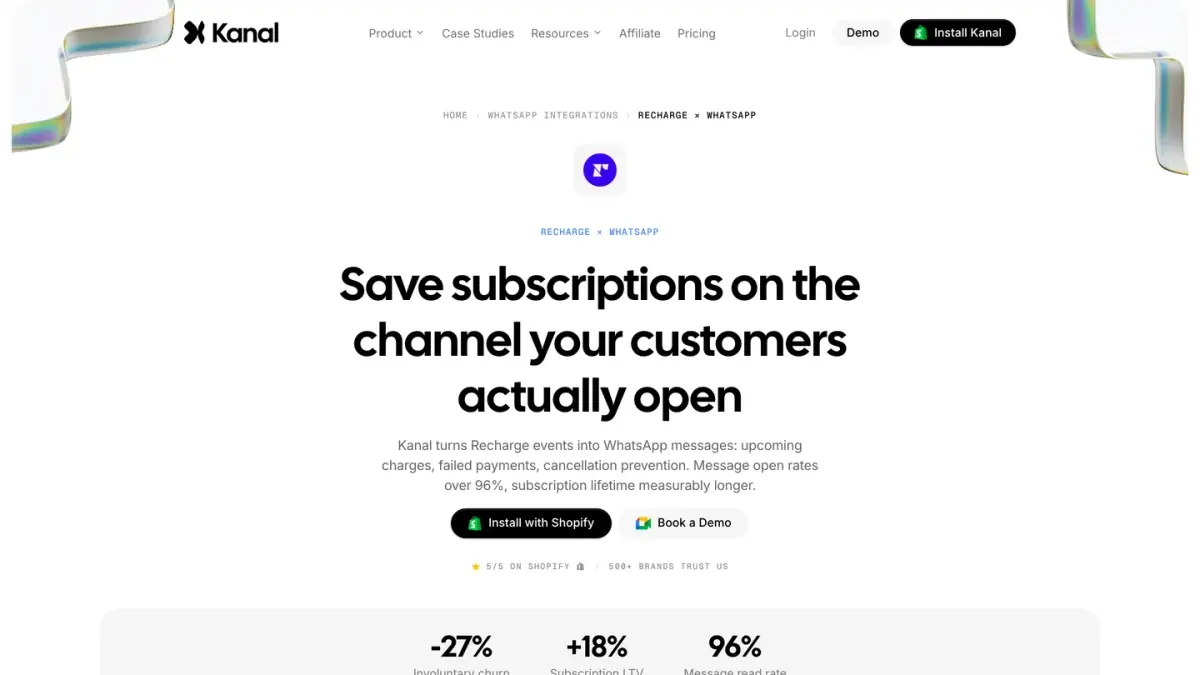
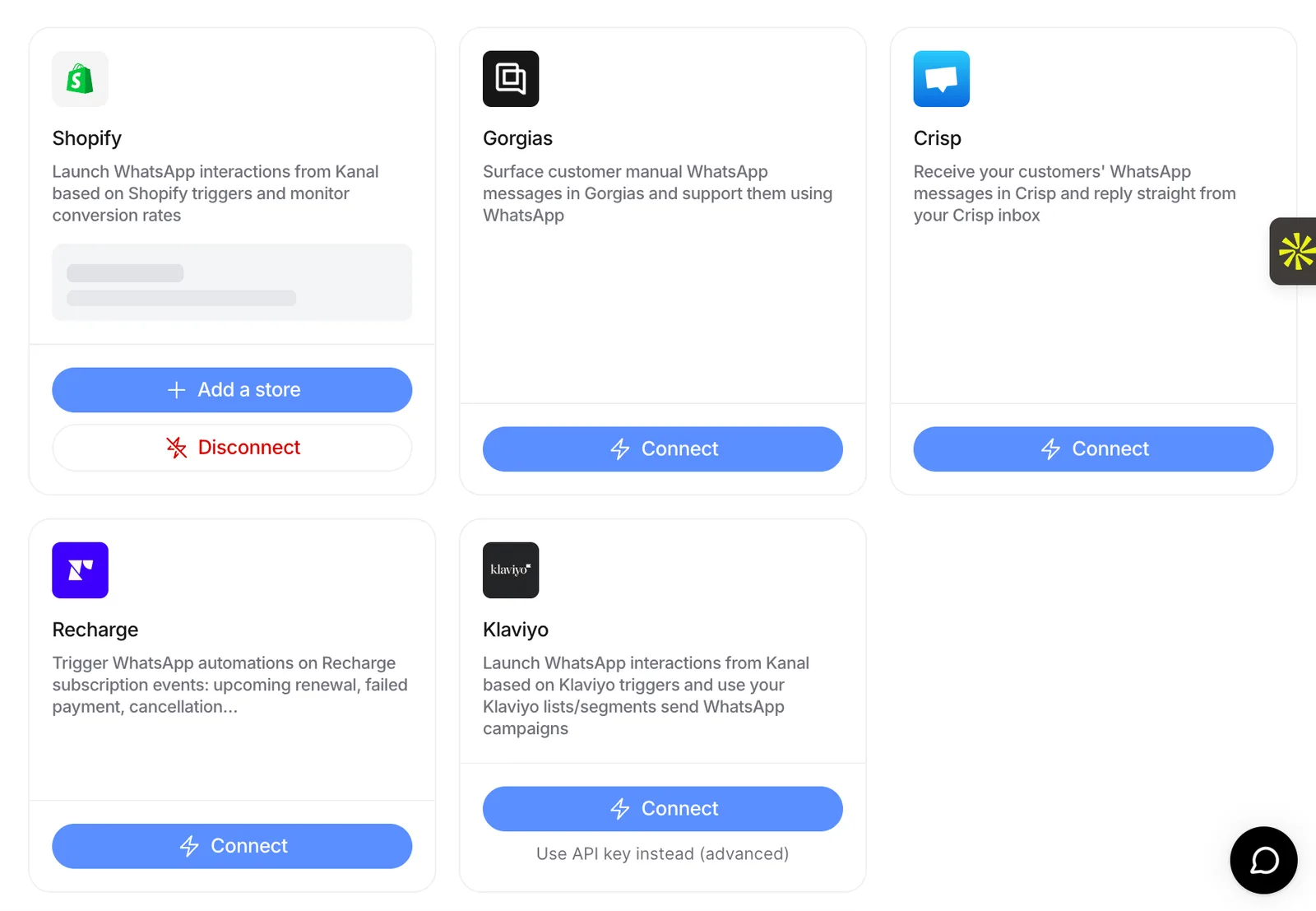
Recharge's own messaging tools are the upcoming order email and Concierge SMS. For stores that also talk to subscribers on WhatsApp, Kanal, our WhatsApp marketing app for Shopify, has a native Recharge integration: Kanal listens to Recharge events such as an upcoming charge, a failed payment or a cancellation, and sends the matching WhatsApp message. Our WhatsApp marketing examples show how these messages fit a subscription program, and Kanal's own plans are on its pricing page.
Recharge pricing at a glance
| Item | Price as of October 7, 2026 | Source |
|---|---|---|
| 25-50 plan | $25 a month, no transaction fees for the first 50 subscribers | Shopify App Store listing |
| Starter | $99 a month + 1.49% + 19¢ per transaction | Recharge pricing page |
| Plus | $499 a month + 1.34% + 19¢ per transaction | Recharge pricing page |
| Custom | Volume-based rates through sales | Recharge pricing page |
| Free trial | 60 days, no transaction or processing fees | Recharge Help Center |
| Concierge SMS | $0.03 per message segment (US and Canada), $0.06 international | Recharge pricing page |
| Fee base | Total processed, including shipping, taxes and refunded orders | Recharge Help Center |
| Contract | 25-50 and Starter month to month, Plus and Custom on 12-month terms | Recharge pricing page |
Recharge's bill is a fixed fee plus a share of everything it processes. Put your real order count and order value into the formula, confirm the rate in your billing terms, and choose between Starter and Plus on the features you need, since the lower Plus rate only offsets its fee at high volume.
See Kanal on your own store
- Your campaigns and cart reminders on WhatsApp, starting from your own store
- Post-purchase offers, back-in-stock alerts, then the AI agent that advises your customers
- You leave with the plan that fits and its price
From €89/month
- brands
- 500+
- to set up
- 5 min
- open rate on WhatsApp
- +90%
Nicolas helps e-commerce brands grow revenue with WhatsApp marketing. With deep expertise in Shopify ecosystems and conversational commerce, he shares proven strategies for abandoned cart recovery, broadcast campaigns, and AI-powered customer engagement.