Shopify Pricing 2026: $39 a Month, or $29 Paid Yearly
Shopify pricing on October 24, 2026: $39, $105 or $399 a month for US stores, or $29, $89 and $359 paid yearly. Plus starts at $2,300 a month.
 Nicolas ProvostOct 7, 2026 · 23 min read
Summarize this article with an AI
 ChatGPT
 Claude
Table of contents (29)
Key takeaways
- For US stores, Shopify costs $39 a month on Basic, $105 on Grow and $399 on Advanced, or $29, $89 and $359 a month paid yearly (pricing page, October 24, 2026).
- The yearly discount is not the same on every plan: about 26% on Basic, 15% on Grow and 10% on Advanced.
- Shopify Payments charges 2.9% + 30¢ per online card on Basic, falling to 2.25% + 30¢ on Plus, which starts at $2,300 a month.
- Using another payment provider adds a third-party transaction fee of 2%, 1%, 0.6% or 0.2% depending on the plan.
Shopify costs $39 a month on the Basic plan, $105 on Grow and $399 on Advanced when you pay monthly, or $29, $89 and $359 a month when you pay yearly, and Shopify Plus starts at $2,300 a month, according to Shopify's pricing page for stores in the United States, read on October 24, 2026. Every sale also carries a payment fee: 2.9% + 30¢ per online card payment on Basic with Shopify Payments, or a 2% third-party transaction fee if you use another payment provider.
Shopify displays prices according to where your store is located. This guide uses the prices and rates shown to US stores, in US dollars, and the rules published in the Shopify Help Center, all read on October 24, 2026: what each plan includes, monthly or yearly billing, the trial, card rates, transaction fees, PayPal, sales tax fees, the costs beyond the subscription and three example budgets.
How much does Shopify cost in 2026?
Shopify sells four main plans. The subscription price and the payment rates move in opposite directions: the more you pay each month, the less Shopify takes on each sale.
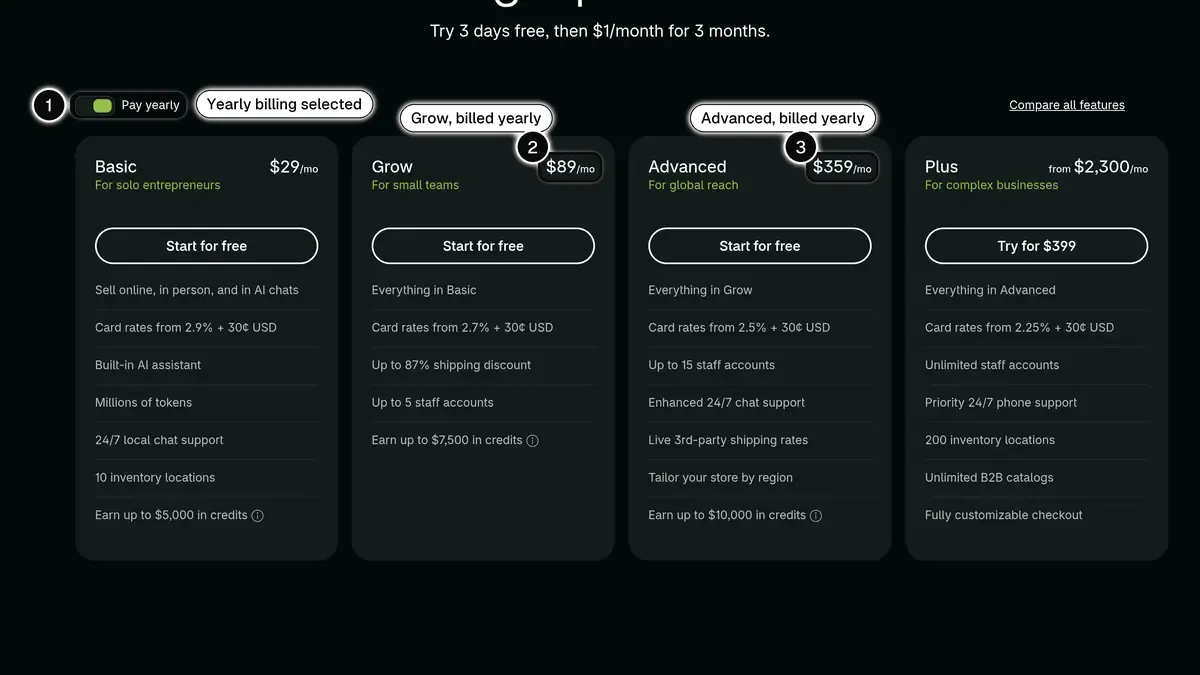 Source: Shopify pricing page, plan cards shown to a US visitor with Pay yearly selected, read on October 24, 2026. In 1, the billing toggle; in 2 and 3, the yearly prices of Grow and Advanced. Paid monthly, Basic, Grow and Advanced cost $39, $105 and $399.
| Plan | Pay monthly | Pay yearly (price per month) | Online standard card rate with Shopify Payments | Third-party transaction fee | Shopify presents it as |
|---|---|---|---|---|---|
| Basic | $39 | $29 | 2.9% + 30¢ | 2% | For solo entrepreneurs |
| Grow | $105 | $89 | 2.7% + 30¢ | 1% | For small teams |
| Advanced | $399 | $359 | 2.5% + 30¢ | 0.6% | For global reach |
| Plus | Starts at $2,300 | Not displayed | 2.25% + 30¢ | 0.2% | For complex businesses |
Source: Shopify pricing page, prices displayed to US stores in USD, read on October 24, 2026. Check them before you commit: they can change.
The four plans share the same base. According to Shopify's plan comparison, all of them include unlimited web hosting, a free SSL certificate, a custom domain name (bought or connected), unlimited products, themes, Shopify's checkout, selling on social media, marketplaces and in AI chats, discount codes, gift cards, abandoned checkout recovery and the AI assistant Sidekick. The same page states that there are no setup fees on any plan and that Shopify is certified Level 1 PCI DSS compliant, the security standard for card data.
What does each Shopify plan include?
From one plan to the next, the online store stays the same. What changes is the number of staff accounts, the level of support, some shipping and international tools, checkout customization and, above all, the payment rates.
| What changes | Basic | Grow | Advanced | Plus |
|---|---|---|---|---|
| Additional staff accounts | Not included | 5 | 15 | Unlimited |
| Inventory locations | 10 | 10 | 10 | 200 |
| 24/7 support | Live chat | Live chat | Enhanced live chat | Priority support |
| B2B catalogs | 3 | 3 | 3 | Unlimited |
| Checkout customization | Limited | Limited | Limited | Full |
| API rate limits | Standard | Standard | 2x maximum on select APIs | 10x maximum on select APIs |
| Headless storefronts | 1 | 1 | 1 | 25 |
| POS Pro (in-person selling) | $89 a month per location | $89 a month per location | $89 a month per location | 20 locations included, 200 with Shopify Payments |
Source: plan comparison on Shopify's pricing page, read on October 24, 2026.
Basic: $39 a month, or $29 paid yearly
Shopify presents Basic as the plan for solo entrepreneurs. It contains the full online store, Shopify B2B with a limit of 3 catalogs, more than 200 reports, 10 inventory locations and 24/7 live chat support. Its main limit is the team: the Basic plan allows no additional staff, and third-party carrier-calculated shipping can't be activated on it. It is also the plan with the highest payment rates: 2.9% + 30¢ per online standard card payment, and a 2% third-party transaction fee with another provider.
Grow: $105 a month, or $89 paid yearly
Grow is aimed at small teams. It adds 5 staff accounts to everything in Basic, and third-party calculated shipping rates become available as an add-on. Rates drop to 2.7% + 30¢ per online standard card payment, and the third-party transaction fee to 1%.
Advanced: $399 a month, or $359 paid yearly
Advanced is presented for global reach. It adds 15 staff accounts, enhanced live chat support, live third-party shipping rates and the ability to tailor the store by region. Rates go down to 2.5% + 30¢ per online standard card payment, and the third-party transaction fee to 0.6%.
Plus: from $2,300 a month
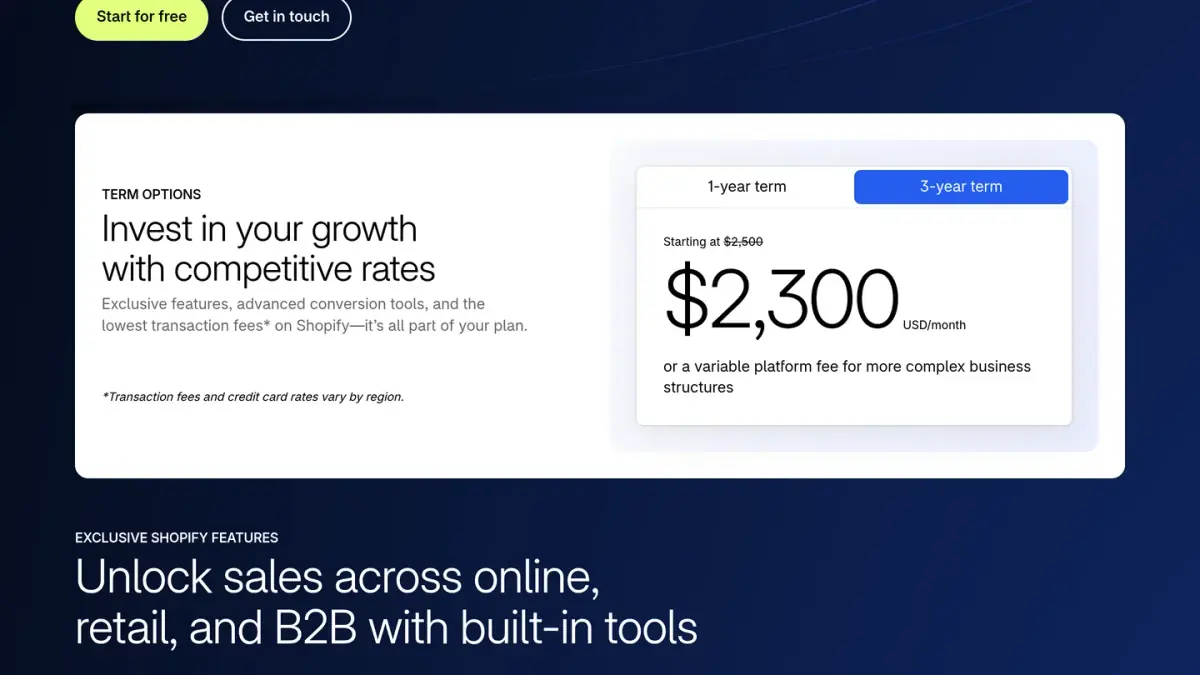
Shopify Plus targets complex businesses: unlimited staff accounts, priority 24/7 phone support, 200 inventory locations, unlimited B2B catalogs, a fully customizable checkout and 9 expansion stores. The Help Center gives the US price as $2,500 a month on a 1-year term or $2,300 a month on a 3-year term, and adds that more complex, higher-volume businesses might pay a variable platform fee instead. Our guide to Shopify Plus pricing goes through the terms, the fees and what the plan adds. For the app layer on that plan, see the best Shopify Plus apps.
Agentic, Starter and Retail: the plans on the side
- Agentic, for selling in AI channels: $0 a month on the pricing page. You add your products to Shopify's Catalog, choose the AI channels to sell in and pay when you make a sale, with card rates from 2.9% + 30¢ online. The Help Center notes that an online store built on this plan stays password protected: to publish it and accept orders through its checkout, you move to a paid plan. Our guides to agentic commerce and to Shopify's ChatGPT channel explain how selling in AI channels works.
- Starter and Retail: the Help Center documents a Starter plan built around the Spotlight theme, without staff accounts or product collections, and a Retail plan centered on Shopify POS. Neither appeared with a price on the US pricing pages we read on October 24, 2026, so we do not quote one here.
Should you pay for Shopify monthly or yearly?
On Basic, Grow and Advanced, the pricing page shows two prices: one for monthly billing, one for yearly billing expressed per month. Here is the gap over twelve months, promotions aside:
| Plan | 12 months paid monthly | 12 months paid yearly | Difference over a year |
|---|---|---|---|
| Basic | $468 (12 × $39) | $348 (12 × $29) | $120 |
| Grow | $1,260 (12 × $105) | $1,068 (12 × $89) | $192 |
| Advanced | $4,788 (12 × $399) | $4,308 (12 × $359) | $480 |
Calculated from the prices on the Shopify pricing page, read on October 24, 2026.
The yearly discount is not the same on every plan: about 26% on Basic ($29 instead of $39), 15% on Grow ($89 instead of $105) and 10% on Advanced ($359 instead of $399). The higher the plan, the smaller the reward for committing to a year.
Yearly billing costs less, and it commits you more. The billing rules published by Shopify:
- Upfront payment: annual billing charges the full year upfront, not in monthly installments. A monthly subscription is billed every 30 days.
- Upgrades: when you move to a higher plan, you receive an immediate bill, prorated from the upgrade date, and the new features are active right away.
- Downgrades: plans are pre-paid, so a move to a lower plan takes effect at the end of the current billing cycle.
- Back to monthly: most annual plans can switch to monthly billing from Settings > Plan, and the change takes effect at the end of the annual cycle.
- Refunds: plans are generally non-refundable. Shopify Support reviews requests case by case, within 7 days of the invoice for a monthly subscription and within 30 days for an annual one, with no guarantee.
If you are still testing your market, monthly billing keeps your options open. Once your plan is stable, yearly billing lowers the bill.
Is there a Shopify free trial?
Yes. The offers below are promotions shown on Shopify's pages on October 24, 2026, and they can change or end at any time.
- The trial: 3 days free, with no credit card required, then $1 a month for the first 3 months on most plans, before standard monthly pricing applies.
- Sales credits: the same page advertised 1% back on all sales as credits, with a ceiling of $5,000 on Basic, $7,500 on Grow and $10,000 on Advanced.
- What the trial does not cover: apps installed during the trial are charged on your first invoice, and Shopify does not extend a trial or reset promotional pricing.
For a careful budget, start from standard prices and treat these offers as a bonus.
What fees does Shopify charge on each sale?
Unlike the subscription, payment fees grow with your sales. They depend on three things: your plan, the payment method the customer chooses and the provider that processes the payment.
Shopify Payments rates in the United States
Shopify Payments is Shopify's own payment provider: payments, payouts and orders are managed from the same admin. Its rates fall as the plan rises:
| Payment | Basic | Grow | Advanced | Plus |
|---|---|---|---|---|
| Online standard card | 2.9% + 30¢ | 2.7% + 30¢ | 2.5% + 30¢ | 2.25% + 30¢ |
| Online premium card | 3.5% + 30¢ | 3.3% + 30¢ | 3.1% + 30¢ | 2.95% + 30¢ |
| Online international card | + 1% | + 1% | + 1% | + 1% |
| PayPal Wallet | Starting at 3.49% + 49¢ | Starting at 3.49% + 49¢ | Starting at 3.49% + 49¢ | Starting at 3.49% + 49¢ |
| In-person card | 2.6% + 10¢ | 2.5% + 10¢ | 2.4% + 10¢ | 2.3% + 10¢ |
| In-person manual card entry | 3.5% + 10¢ | 3.5% + 10¢ | 3.5% + 10¢ | 3.4% + 10¢ |
| USDC (USD Coin) online | 2.9% + 30¢ | 2.7% + 30¢ | 2.5% + 30¢ | 2.25% + 30¢ |
Source: Shopify pricing page, rates displayed to US stores, read on October 24, 2026.
Fictional example: on a $100 order paid with a standard card online, Shopify Payments takes $3.20 on Basic (2.9% of $100, or $2.90, plus 30¢), $3.00 on Grow, $2.80 on Advanced and $2.55 on Plus. The fixed 30¢ weighs more on small orders, which is one reason to track your average order value.
Third-party transaction fees
With Shopify Payments, you pay the rates above and no third-party transaction fee on the orders it processes. If you use another payment provider, Shopify adds a third-party transaction fee: 2% on Basic, 1% on Grow, 0.6% on Advanced and 0.2% on Plus. According to the Help Center, these fees come in addition to your provider's own processing fees and are calculated on the cost of products minus discounts, plus tax and shipping charges.
They do not apply to:
- orders processed with Shopify Payments, Shop Pay or Shop Pay Installments when you use Shopify Payments;
- manual payment methods such as cash, cash on delivery and bank transfers, or POS orders.
Two details to know:
- on stores created on or after May 12, 2025, they apply to the part of an order paid with store credit or a gift card, even with Shopify Payments;
- they are not returned to you when you refund an order.
Fictional example: on Basic, $10,000 of orders processed in a month by an external provider generates $200 in third-party transaction fees, before that provider's own fees. On Grow, the same amount generates $100.
You can also combine the two: keep your provider for cards and add Shopify Payments for Shop Pay and local payment methods. In that setup, transactions processed through Shopify Payments are charged at standard rates plus a 1.25% premium, and your provider's transactions still carry the third-party transaction fee.
PayPal, Venmo and Shop Pay Installments
In the United States, PayPal Express Checkout isn't available to merchants. You offer PayPal through PayPal Wallet, which acts as a payment method inside Shopify Payments: transactions, disputes and refunds are managed in the Shopify admin, and payouts are bundled with your Shopify Payments payouts. Venmo is automatically available as a payment method in PayPal Wallet.
The pricing page lists PayPal Wallet rates starting at 3.49% + 49¢ on every plan. On a fictional $100 order, that is at least $3.98, against $3.20 with a standard card on Basic.
Shop Pay Installments lets US customers pay in installments on orders from $35 to $30,000. There is no cost to activate it, but you are charged a higher transaction fee when a customer uses it. The rates are shown in your Shopify admin, not on the public pricing page.
Currency conversion, chargebacks and refunds
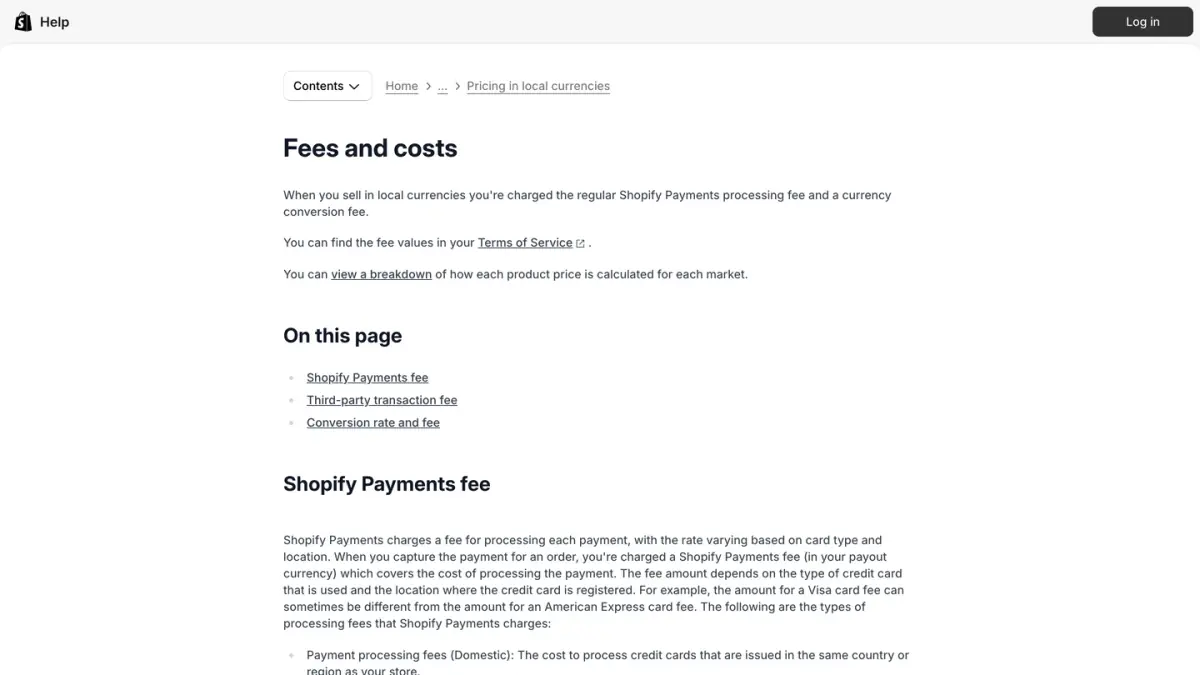
- Currency conversion: when a customer pays in a currency other than your payout currency, Shopify Payments charges a 1.5% currency conversion fee for a US store, and 3% with PayPal Wallet.
- Refunds: when you refund a customer, card fees and currency conversion fees are not returned to you.
- Chargebacks: when a customer disputes a payment with their bank, the chargeback fee is $15 in the United States, returned to you if you win the dispute.
Sales tax: what Shopify Tax costs
US merchants deal with sales tax, not VAT. Shopify calculates it, but tax compliance is your responsibility: Shopify doesn't file or remit on your behalf unless you use Shopify Tax automated filing.
Shopify Tax itself has a fee once your store passes a sales threshold:
- Stores created before May 13, 2026: no charge until the store reaches $100,000 in global sales in a calendar year. After that, a fee of 0.35% applies on Basic, Grow and Advanced (0.25% on Plus) to orders with calculated tax in the regions where you collect it, capped at $0.99 per order and $5,000 a year per region.
- Stores created on or after May 13, 2026: the $100,000 threshold counts lifetime sales, with the same percentages and the same $0.99 cap per order.
The fee is charged to you on your Shopify bill, not to your customers.
What does Shopify cost beyond the subscription?
Themes
The Shopify Theme Store listed 1,347 themes on October 24, 2026: 24 free and 1,323 paid, with paid themes priced from $100 to $500. A paid theme is a one-time purchase, and theme purchases are final sale and non-refundable: you can try a theme in your store before you buy it. A free theme is enough to launch. If a developer or an agency customizes the theme for you, add that quote to your budget.

Domain name
Every store comes with a free myshopify.com address. For your own domain, you can connect one bought elsewhere or buy it from Shopify, where domains typically start at $9 a year, with registration, automatic renewal and WHOIS privacy protection on eligible extensions. The exact price depends on the extension, and renewal pricing may differ from the first year. Plan your business email separately: email hosting isn't provided on Shopify.
In-person selling (POS)
Every plan includes casual in-person sales at pop-ups and events. For a permanent retail location, POS Pro costs $89 a month per location on Basic, Grow and Advanced, and Plus includes 20 locations, or 200 with Shopify Payments. Shopify's POS pricing page adds that you need at least a smartphone or tablet and a Shopify card reader. In-person card rates start at 2.6% + 10¢ on Basic, and third-party transaction fees don't apply to POS orders.
Marketplaces
If you sell on marketplaces connected to Shopify, the first 50 synced marketplace orders each month are free. Beyond that, the pricing page lists a 1% fee, capped at $99 a month.
Email marketing
Shopify Messaging, Shopify's own email tool, includes 10,000 free emails per calendar month. After that, it costs $1 per 1,000 additional emails until you reach 300,000 emails, then $0.65 per 1,000 until 750,000, and $0.55 per 1,000 beyond. Unused emails don't carry over. For other tools, see our comparison of the best Shopify email marketing apps, and if you weigh Klaviyo, its prices by list size are in our Klaviyo pricing guide.
How do you budget for Shopify apps?
Apps from the Shopify App Store, which lists over 16,000 of them, add what Shopify does not do natively: reviews, loyalty programs, subscriptions, shipping, messaging, or sourcing through dropshipping apps. Each developer sets its own price, and Shopify's Help Center lists three types of app charges, alongside application credits:
- subscription charges, for the recurring use of an app, such as a monthly payment;
- usage charges, which vary with how much you use the app or its services;
- one-time purchases, billed separately from your regular Shopify bill.
Most charges appear on your Shopify bill, but some apps charge you directly outside of Shopify. Uninstalling an app stops future billing cycles, a charge that has already been generated might still appear on the next invoice, and refunds are handled by the app developer.
To build this budget:
- list the functions you need at launch, and those that can wait;
- check what Shopify already includes: email marketing, discount codes, gift cards, abandoned checkout recovery, reports;
- for each app, read on its App Store listing the price of the plan that matches your volume, and any usage charges;
- count the messages you send to customers after the sale (order updates, abandoned cart reminders, back-in-stock alerts): emails beyond Shopify's 10,000 free ones, and text or WhatsApp messages, are usually billed per message;
- add everything up per month, then over twelve months.
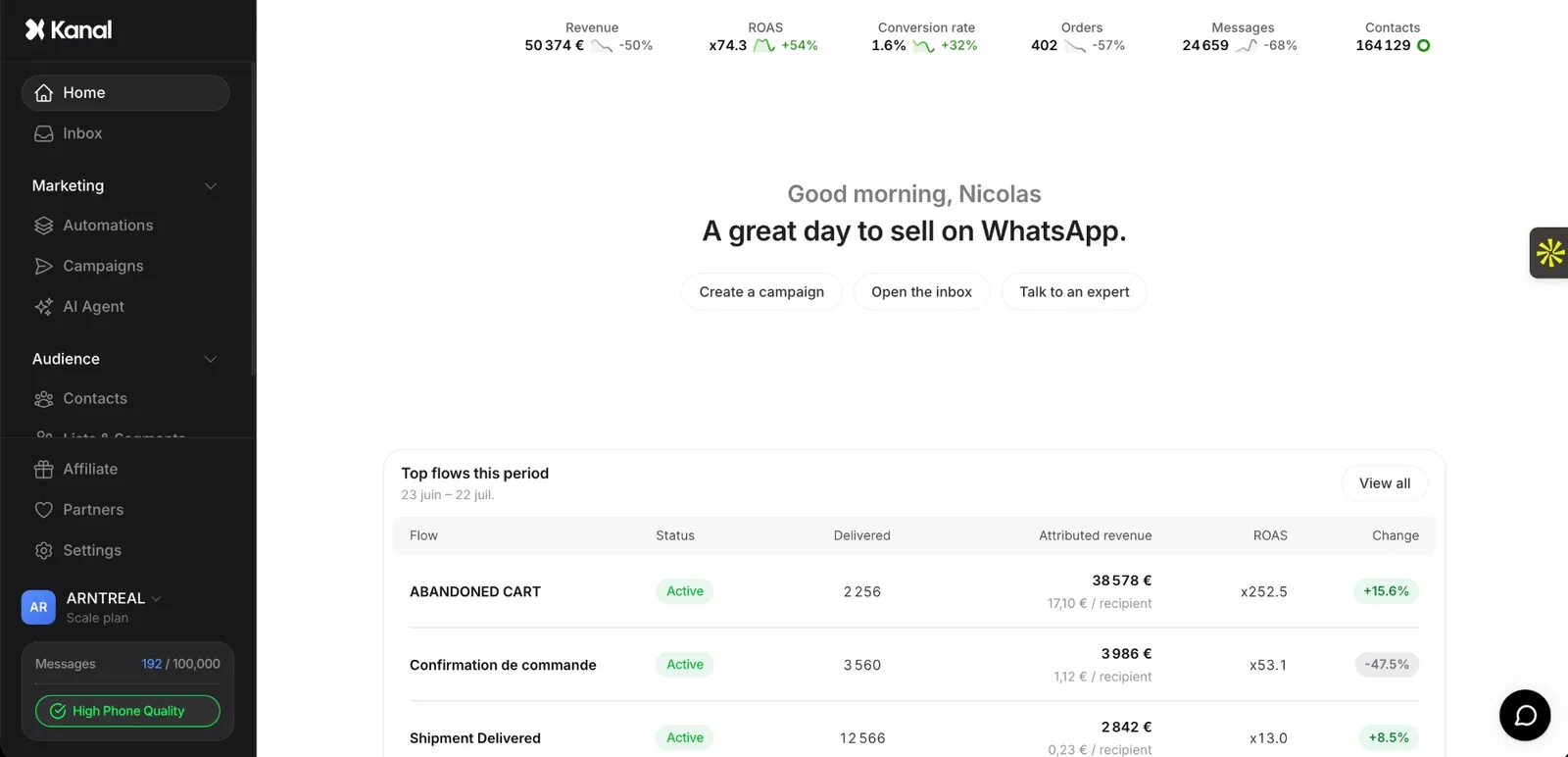
Our best Shopify apps comparisons group apps by category, with ratings and prices. One example we know well because we build it: Kanal is a WhatsApp marketing and sales app for Shopify, with campaigns, abandoned cart recovery, order notifications and a team inbox. It is a paid app with monthly plans from €89, and Meta's fees for WhatsApp messages come on top: the plans are on the Kanal pricing page.
Which Shopify plan should you choose?
The right plan depends on your needs more than on a revenue target. Start from these criteria, taken from Shopify's comparison:
- Basic if you sell online alone: the store is complete, without additional staff accounts.
- Grow if several people work in the admin, with 5 staff accounts and lower payment rates.
- Advanced if your team needs 15 staff accounts, live third-party shipping rates or a store tailored by region.
- Plus if you need unlimited staff accounts, unlimited B2B catalogs, a fully customizable checkout, expansion stores or more than 10 inventory locations.
Shopify's Help Center publishes its own break-even estimates: in the United States, an upgrade to Grow saves money on transaction fees from $200,000 in sales a year when you use Shopify Payments and from $60,000 a year when you don't, and an upgrade to Advanced from $1,320,000 and $528,000 a year. Shopify notes that your actual break-even point may vary, so run the calculation with your own numbers:
Monthly sales needed to cover an upgrade = difference in monthly subscription ÷ difference in rate
On yearly billing, Grow costs $60 a month more than Basic ($89 minus $29). With an external provider, the third-party transaction fee falls from 2% to 1%, so the upgrade pays for itself from $6,000 of sales a month ($60 ÷ 1%), or $72,000 a year. With Shopify Payments, the online standard card rate falls by 0.2 points, so on that rate alone the gap closes at $30,000 of card sales a month ($60 ÷ 0.2%). On monthly billing the gap is $66 ($105 minus $39), which moves both thresholds up by 10%. Premium, international and in-person payments each have their own rate, which is why your real mix matters.
If you are still weighing the platform itself, our Shopify review covers its strengths and limits, and our Shopify vs WooCommerce comparison puts a hosted plan next to an open-source store. For another hosted platform, see how BigCommerce's plans compare with Shopify's.
What does Shopify cost in practice? Three example budgets
The three stores below are fictional. The amounts add up the prices read on October 24, 2026 on the pages cited above. They leave out sales tax, promotions and apps, and assume every order is paid with a standard card online.
Example 1: you launch alone
- Basic paid yearly: $29 a month
- Free theme: $0
- 40 orders of $50 with Shopify Payments: 40 × $1.75 (2.9% of $50, plus 30¢) = $70
- Total: $99 a month, plus the domain (typically from $9 a year at Shopify)
Example 2: a small team
- Grow paid yearly: $89 a month
- 300 orders of $60 with Shopify Payments: 300 × $1.92 (2.7% of $60, plus 30¢) = $576
- Total: $665 a month, plus the domain, apps and a paid theme if you buy one
Example 3: the same team with an external payment provider
- Grow paid yearly: $89 a month
- Third-party transaction fees: 1% of $18,000 (300 orders of $60, tax and shipping included) = $180
- The external provider's own fees: according to its contract
- Total: $269 a month, before the provider's fees
On fees alone, the external provider in example 3 comes out ahead only if its own fees stay under $396 a month, the gap between the $576 of Shopify Payments fees in example 2 and the $180 of third-party transaction fees. Payment fees as a share of revenue is one of the e-commerce KPIs worth reviewing every month, next to average order value and repeat purchase rate.
Shopify pricing at a glance
| Item | Price on October 24, 2026 (US stores) | Source |
|---|---|---|
| Basic | $39 a month, or $29 a month paid yearly | Shopify pricing page |
| Grow | $105 a month, or $89 a month paid yearly | Shopify pricing page |
| Advanced | $399 a month, or $359 a month paid yearly | Shopify pricing page |
| Plus | From $2,300 a month on a 3-year term, $2,500 on a 1-year term | Shopify Help Center |
| Online standard card (Shopify Payments) | From 2.9% + 30¢ on Basic to 2.25% + 30¢ on Plus | Shopify pricing page |
| PayPal Wallet | Starting at 3.49% + 49¢ | Shopify pricing page |
| Third-party transaction fees | 2%, 1%, 0.6% or 0.2% depending on the plan | Shopify pricing page |
| Currency conversion | 1.5% with Shopify Payments, 3% with PayPal Wallet | Shopify Help Center |
| Chargeback | $15, returned if you win the dispute | Shopify Help Center |
| Shopify Tax | No charge below $100,000 in sales, then 0.35% per taxed order (0.25% on Plus), capped at $0.99 per order | Shopify Help Center |
| Theme | Free, or a one-time purchase from $100 to $500 | Shopify Theme Store |
| Domain name | myshopify.com address included; custom domains typically from $9 a year | Shopify domains page |
| POS Pro | $89 a month per location, 20 locations included on Plus | Shopify pricing page |
| Marketplaces | 50 synced orders a month free, then 1% capped at $99 a month | Shopify pricing page |
| Email marketing | 10,000 emails a month included, then $1 per 1,000 until 300,000 emails | Shopify Help Center |
| Apps | Set by each developer: subscription, usage charges or one-time purchase | Shopify Help Center |
In short
Shopify's price comes down to three lines. The subscription first: $39 to $399 a month for Basic, Grow and Advanced on monthly billing, less on yearly billing, and from $2,300 a month for Plus, according to Shopify's pricing page for US stores. The fees on each sale next: Shopify Payments card rates, or third-party transaction fees if you keep another provider. The extras last: theme, domain, apps, in-person selling and Shopify Tax above its threshold. Add them up over twelve months with your real volumes, and check the pricing page again before you commit, since prices and promotions can change.
See Kanal on your own store
- Your campaigns and cart reminders on WhatsApp, starting from your own store
- Post-purchase offers, back-in-stock alerts, then the AI agent that advises your customers
- You leave with the plan that fits and its price
From €89/month
- brands
- 500+
- to set up
- 5 min
- open rate on WhatsApp
- +90%
Nicolas helps e-commerce brands grow revenue with WhatsApp marketing. With deep expertise in Shopify ecosystems and conversational commerce, he shares proven strategies for abandoned cart recovery, broadcast campaigns, and AI-powered customer engagement.