Klaviyo Reviews 2026: 4.7 on Shopify, 1.7 on Trustpilot
Klaviyo reviews read on October 29, 2026: what Klaviyo is, its Shopify App Store and Trustpilot ratings, the three complaints that repeat, and its pros.
 Nicolas ProvostOct 29, 2026 · 12 min read

Summarize this article with an AI
 ChatGPT
 Claude
Table of contents (14)
Key takeaways
- On October 29, 2026, Klaviyo was rated 4.7 out of 5 from 3,423 reviews on the Shopify App Store, but 1.7 from 371 reviews on Trustpilot, where recent reviews are unprompted because Klaviyo has not invited customers recently.
- The complaints that repeat are bills that follow the active profile count, support that starts with an AI assistant, and accounts suspended under the acceptable use policy.
- Merchants praise its automation flows, its Shopify integration and its segmentation. Kanal sends no email: it adds WhatsApp next to Klaviyo, from 89 € a month.
Every rating, review count and quote below was read on October 29, 2026.
Klaviyo reviews split by site. On October 29, 2026, merchants rated it 4.7 out of 5 from 3,423 reviews on the Shopify App Store, but its Trustpilot score was 1.7 from 371 reviews, with 57% of them giving one star. The gap comes first from who writes: stores that use the app on the Shopify App Store, unprompted reviewers on Trustpilot, where Klaviyo does not ask for reviews. The complaints that repeat are about bills that follow the active profile count, support that is hard to reach and suspended accounts. The praise goes to the automation flows, the Shopify integration and the segmentation.
We build Kanal, a Shopify app for WhatsApp marketing and sales. Kanal does not send email, so this page does not argue that you should leave Klaviyo. It explains what Klaviyo is, sums up what its reviewers say with a link to each source, and shows where Kanal fits when a brand adds WhatsApp next to its email.
What is Klaviyo?
Klaviyo is an email, SMS and customer data platform built for ecommerce. It connects your store data (orders, carts, page views) to campaigns and automated flows (welcome, abandoned cart, post-purchase, back in stock) sent by email, SMS, WhatsApp and push notifications, with sign-up forms, segments and reporting on top. Our guide to Klaviyo flows walks through each one. Its Shopify App Store listing, live since September 20, 2012, says over 117k brands use Klaviyo with Shopify.
It charges by active profiles, meaning every profile that can be emailed, subscribed or not, and in US dollars. On October 29, 2026, the free plan covered 250 active profiles and 500 emails a month, and email then started at $20 a month for 500 profiles. Our Klaviyo pricing guide lists every tier.
This is how Klaviyo is rated on review sites
| Site | Rating | Reviews | Who writes them | Klaviyo replies |
|---|---|---|---|---|
| Shopify App Store | 4.7 out of 5 | 3,423 | Stores that use the app (each review shows how long they have used it) | Yes, including to one-star reviews |
| Trustpilot | 1.7 out of 5 | 371, of which 62 in the last 12 months | Unprompted reviewers: Klaviyo has not invited customers recently | Not to negative reviews, according to Trustpilot |
| G2 and Capterra | Not read | Not read | Both sites showed a bot check to our reader | Not read |
Sources: Klaviyo's reviews pages on the Shopify App Store and Trustpilot, read on October 29, 2026.
Shopify App Store: 4.7 from 3,423 reviews
The page counts 3,002 five-star reviews (88%), 82 four-star, 33 three-star, 37 two-star and 269 one-star (8%). Shopify's summary of merchant reviews says merchants highlight easy automation flows (abandoned cart, welcome, post-purchase, back in stock), strong segmentation and analytics, and seamless Shopify integration. Klaviyo replies on this page, to positive and one-star reviews alike, usually within a few days.
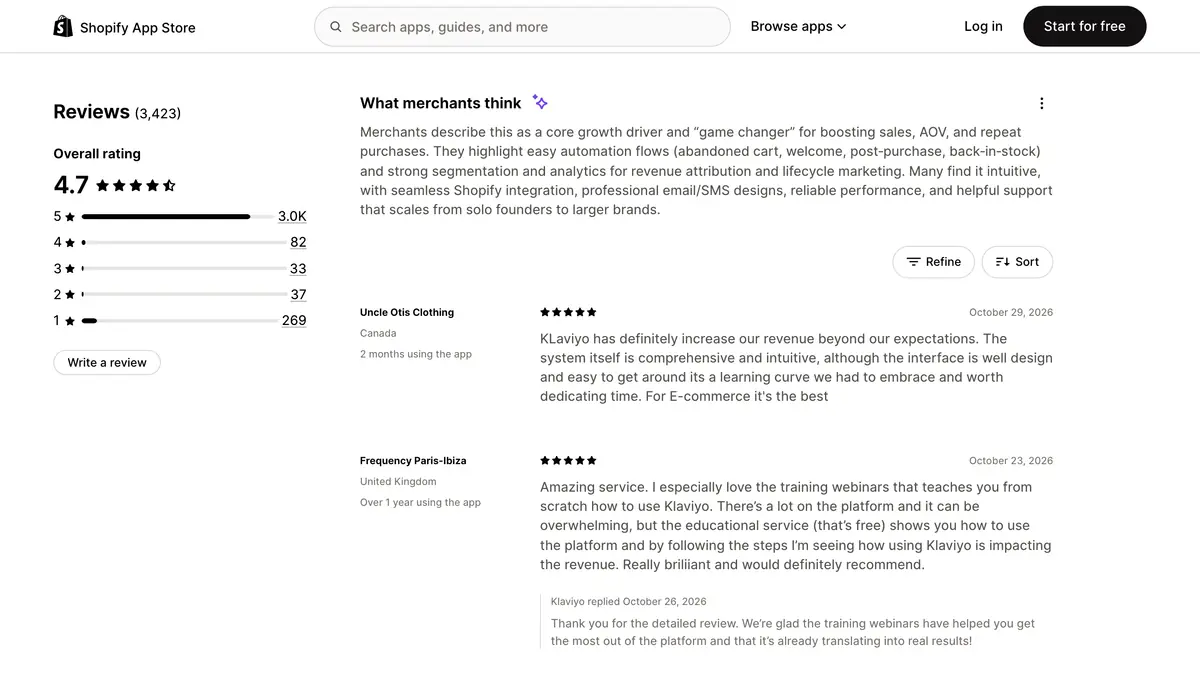 Source: Klaviyo's reviews page on the Shopify App Store, read on October 29, 2026.
Trustpilot: 1.7 from 371 reviews
The split is 36% five stars, 3% four stars, 2% three stars, 2% two stars and 57% one star. Trustpilot shows two notes on the page: Klaviyo has not invited customers recently, so the reviews may not be representative, and it has not replied to negative reviews. Its AI summary lists slow support, unexpected charges, account suspensions and some buggy automations as the main topics, and notes that a few reviewers praise the campaign tools.
Why the Trustpilot score is so low
A 1.7 on one site and a 4.7 on the other do not describe two different products. The two pages collect different reviews:
- Nobody is invited on Trustpilot. A company that sends review invitations hears from ordinary customers, happy or not. Klaviyo does not, so the reviews on its page are labelled "Unprompted review". People come on their own, and most recent reviews describe a dispute.
- The topics differ. Trustpilot reviews are mostly about the business relationship: bills, support response times, closed accounts. Shopify App Store reviews talk more about day-to-day use: flows, segments, revenue.
- So do the volumes. Trustpilot has 371 reviews in total, 62 of them in the past year, against 3,423 on the Shopify App Store, where each review shows how long the store has used the app.
The Trustpilot score does not say that Klaviyo sends your email badly. It shows what happens when the relationship gets tense: a bill that changes, slow support, a suspension. Those are the three things to check before you commit.
These are the three complaints Klaviyo reviewers repeat most
The bill follows the active profile count
"watch your Active Profile count very carefully"
This merchant says his profile count jumped from about 16,000 to about 65,000 overnight, which support put down to bots, and that moving back down a tier was much harder than moving up. Klaviyo replied the next day that a senior member of its billing team had reached out. On Trustpilot, a review from August 8, 2026 objects to paying for dormant profiles that never subscribed, and one from August 10, 2026 to a plan increase with auto-upgrade switched off.
Klaviyo's Help Center explains all three cases:
- An active profile is not a subscriber. It is any profile that can be emailed, regardless of consent, including a customer who left an email at checkout without subscribing (How billing works).
- The tier follows profiles at every renewal. If your active profiles exceed your plan, you are moved to a profile-compliant plan for the next billing cycle.
- Auto-upgrade does not cover profiles. The article on billing upgrade preferences says these preferences apply to sending limits and do not upgrade based on your profile count, which Klaviyo handles automatically at renewal. Switching auto-upgrade off does not stop that tier change.
To stay in control, suppress the profiles you no longer market to (the count can take up to 72 hours to update), then pick the lower tier yourself more than 24 hours before the cycle changes. Klaviyo does not refund a downgrade made mid-cycle. Our Klaviyo pricing guide shows what each tier costs.
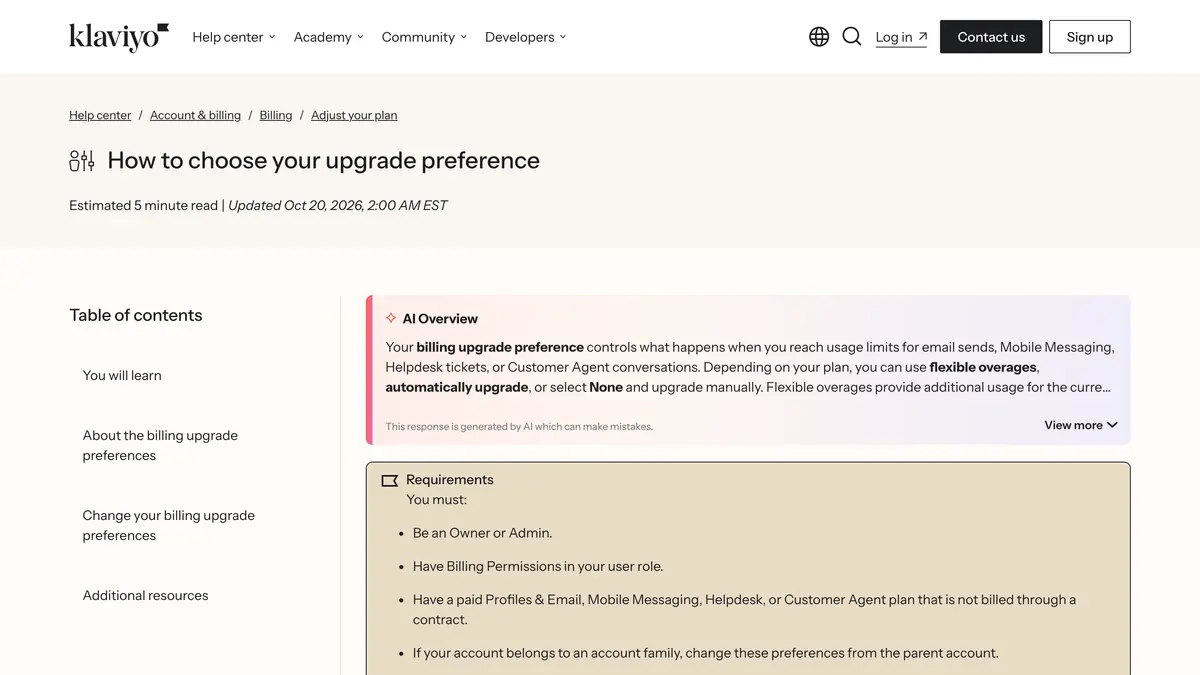 Source: Klaviyo Help Center, How to choose your upgrade preference, read on October 29, 2026.
Support is hard to reach
"Every answer arrived late or not at all."
This review comes from a brand migrating a multi-market account with an assigned Klaviyo contact, so the frustration is not limited to free accounts. A Trustpilot review from August 19, 2026 objects to support kept for paid plans, and the Shopify App Store merchant quoted above says he went through layers of AI support before reaching a person.
Klaviyo's own rules explain that path. According to How to contact Klaviyo support, updated on October 27, 2026:
- Composer, Klaviyo's AI assistant, is the main entry point for support. To reach a person, you ask it, for example "I'd like to speak with a human".
- Human chat is for paid plans only, 24 hours a day, five days a week (weekend hours vary by plan), with email support 24/7.
- A free account gets email support for its first 60 days only, then the Help Center, Klaviyo Academy and the Klaviyo Community.
On the other side, five-star reviews praise responsive support and Klaviyo's free training webinars.
Accounts are suspended
On Trustpilot, one merchant says he was banned without warning after building his flows and got no answer to his appeal (October 18, 2026), and a finance broker says he was cut off because of his line of business (June 2026). On the Shopify App Store, a resale shop left one star after its account was closed over a campaign that breached the policy, then edited the review on October 2, 2026:
"Update: they made it right. Raised it to 5 stars."
Klaviyo's acceptable use policy states that violations "may result in suspension or termination of your access to the Services, at our sole discretion." If you sell in a sensitive category (financial services or adult products, as in the reviews above), read it before you build your flows.
Changing channel does not remove that risk. WhatsApp applies its own Business Messaging Policy, which bans or restricts some regulated goods and lets WhatsApp limit or remove access for a business that breaks its rules.
This is what Klaviyo reviewers like
"We've already recovered numerous abandoned carts."
Recent positive reviews on the Shopify App Store come back to four points:
- Automation that pays. Recovered carts, more sign-ups, and revenue beyond expectations in a review from October 29, 2026.
- A familiar Shopify integration. A Danish store that has used it for about four years writes that the interface feels familiar to a Shopify user, and that without a marketing team it builds campaigns, segments and flows itself.
- Segmentation and reporting, rated top-tier in a review from August 20, 2026, as in Shopify's summary.
- Training. A review from October 23, 2026 praises the free webinars that teach the platform from scratch.
The same reviews warn that it takes time: two of them mention a learning curve or a platform that can feel overwhelming at first.
Klaviyo or another email tool?
If the reviews make you hesitate, our comparisons put Klaviyo next to the tools Shopify brands look at most:
- Omnisend vs Klaviyo: two tools priced in dollars, one by active profiles, the other by billable contacts.
- Klaviyo vs Mailchimp: how each one counts the contacts you pay for, and what to know before switching.
- Klaviyo alternatives: other email and SMS tools with their prices, for brands that want to leave Klaviyo.
Our verdict on Klaviyo
- Klaviyo suits Shopify brands that run email as their main retention channel and want flows, segments and reporting in one place. The 4.7 from 3,423 Shopify App Store reviews reflects that.
- Watch the bill: it follows your active profiles, non-subscribers included, and the tier moves up at renewal whatever your upgrade preference.
- Check the support level of your plan: human chat on paid plans only, and email support for 60 days on the free plan.
- Read the acceptable use policy if you sell in a sensitive category.
- Read the Trustpilot score for what it is: a record of unprompted disputes, useful to know what to check, not a measure of the product.
Where Kanal fits next to Klaviyo
Keeping Klaviyo for email and giving WhatsApp to a dedicated tool is another route. Kanal, our WhatsApp marketing and sales app for Shopify, used by more than 500 brands, does not send email: it runs WhatsApp, plus SMS and RCS from the Scale plan (iMessage is coming soon).
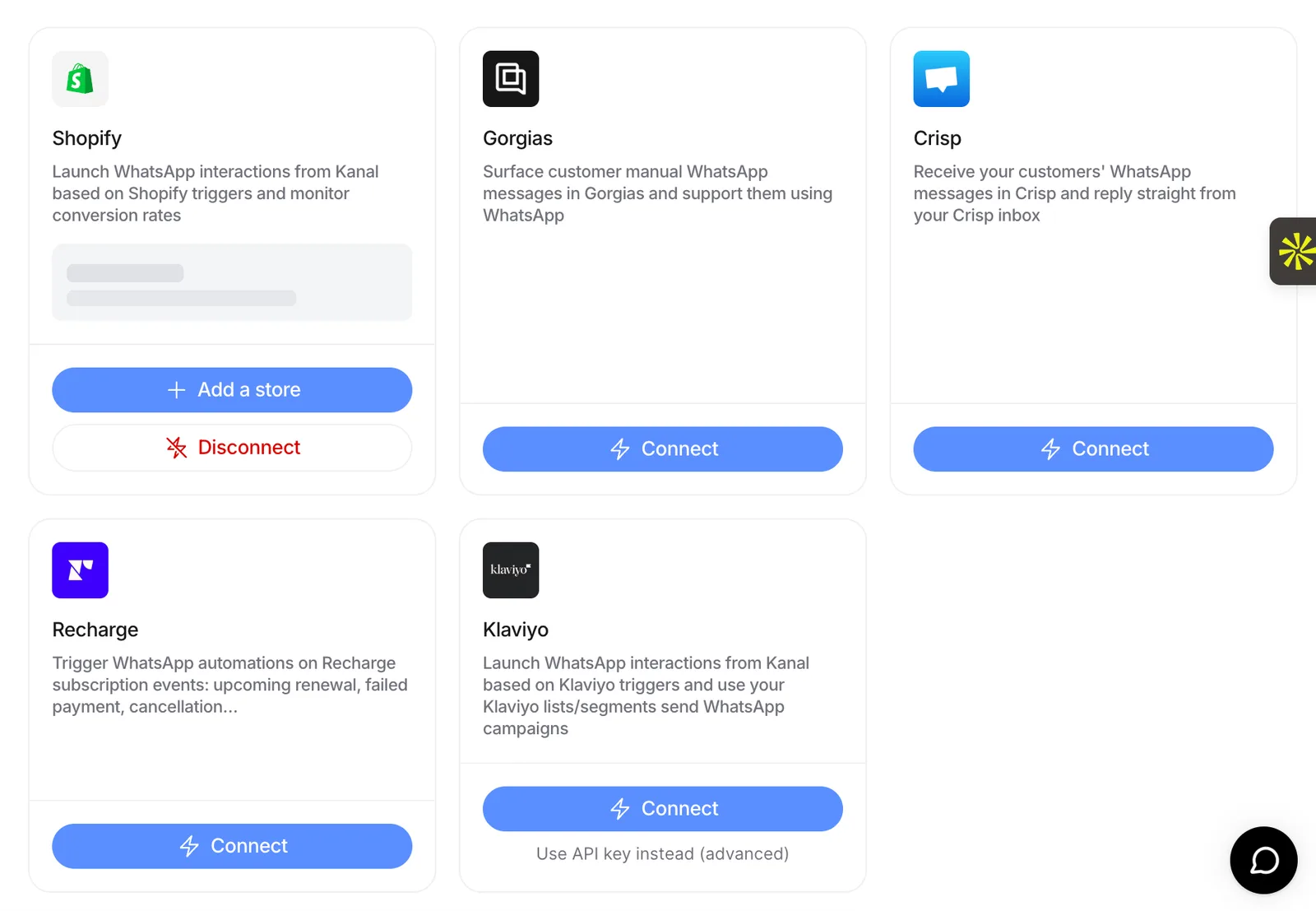
Kanal has a native Klaviyo integration, included from the Scale plan and covered step by step in our Klaviyo and WhatsApp integration guide:
- a private API key created in Klaviyo and pasted into Kanal;
- a Klaviyo segment as an audience: when you pick the "From Klaviyo" audience for a WhatsApp campaign, Kanal reads the segment and imports its contacts at that moment. Segments are not synced afterwards, and Klaviyo consent does not carry over;
- a WhatsApp step in a Klaviyo flow: a Webhook block in the flow triggers a Kanal automation with the Incoming Webhook trigger, which sends an approved WhatsApp template;
- six metrics sent back to Klaviyo ("KANAL - WhatsApp Message": Sent, Delivered, Read, Clicked, Inbound, Undeliverable), usable in your segments. Kanal never sends orders or opt-ins back.
The rest happens in Kanal. WhatsApp opt-in is collected through wa.me links and QR codes, a widget, pop-ups, imports of consenting contacts or an automation action: Kanal does not pick up the Shopify checkout consent box. Automations start from a Shopify order created, an abandoned cart, a shipping status, a WhatsApp keyword or an incoming webhook, and the AI agent on the Scale and Business plans answers order tracking questions.
Kanal plans start from 89 € a month, as shown on our pricing page. Meta's fees are billed on top, per message, by category and recipient country.
How we built this review
On October 29, 2026, we read Klaviyo's reviews pages on the Shopify App Store and Trustpilot, its Shopify App Store listing, its pricing page, its acceptable use policy and three Help Center articles. G2 and Capterra showed a bot check that day, so their ratings are not included. Ratings and review counts are copied as each site showed them. The four quotes are verbatim; the Shopify App Store has no link to a single review, so those links open the reviews list. Kanal is our product.
Want to see WhatsApp running next to Klaviyo on your store? Book a Kanal demo.
See Kanal on your own store
- Your campaigns and cart reminders on WhatsApp, starting from your own store
- Post-purchase offers, back-in-stock alerts, then the AI agent that advises your customers
- You leave with the plan that fits and its price
From €89/month
- brands
- 500+
- to set up
- 5 min
- open rate on WhatsApp
- +90%
Nicolas helps e-commerce brands grow revenue with WhatsApp marketing. With deep expertise in Shopify ecosystems and conversational commerce, he shares proven strategies for abandoned cart recovery, broadcast campaigns, and AI-powered customer engagement.