Klaviyo + WhatsApp Integration: Add WhatsApp to Your Flows

Summarize this article with an AI
 ChatGPT
 Claude
Add WhatsApp to your Klaviyo flows in 2026: why merchants stack both channels, the 3 integration paths, the first flows to migrate and attribution.
Table of contents (17)
Key takeaways
- Keep Klaviyo for email and SMS, and add WhatsApp for time-sensitive messages such as abandoned carts, back-in-stock alerts and flash sales.
- There are three integration paths: Klaviyo's native WhatsApp channel, a webhook bridge to a BSP, or a WhatsApp platform's native Klaviyo sync.
- Kanal's Klaviyo integration is included from the Scale plan and is not part of the entry Pro plan.
Email is not dead. But Shopify merchants who run a large share of their revenue through Klaviyo flows tend to hit the same ceiling: crowded inboxes, flat open and click rates, and rising costs per send. The fix is not more email. It is adding a second channel, read in the app customers already use to talk to friends, without breaking your existing automation.
This guide walks through how to add WhatsApp to your Klaviyo flows in 2026. Why merchants stack both channels, the three integration paths (native, webhook bridge, and Kanal sync), the five flows to migrate first, and how to track revenue without double-counting.
If you want to skip the theory, book a Kanal demo and we will show you the Klaviyo sync live on your store.
Why merchants stack Klaviyo + WhatsApp
Email and WhatsApp are not substitutes. They are complementary. Here is how the three channels differ in practice:
| Metric | Klaviyo email | Klaviyo SMS | WhatsApp via Kanal |
|---|---|---|---|
| Cost per send | 0.01-0.05 USD | 0.01-0.10 USD | Meta fee per delivered template (by category and country) |
| Rich media | Full HTML | 160 chars + 1 link | Images, video, buttons, catalog |
| Best for | Long-form content, newsletters, nurture | Short alerts | Time-sensitive messages and two-way conversations |
Your own numbers are the benchmark that matters: compare open, click and reply rates per channel in your own reports once both channels run side by side.
The takeaway: WhatsApp is not "better email." It is a different channel that wins specific use cases. Measure what it adds on top of your existing Klaviyo setup with a holdout group before you move more flows.
Where Klaviyo wins (email + SMS strengths)
Klaviyo is strong on three things:
- Long-form content. Editorial newsletters, founder stories, lookbooks, holiday gift guides. Anything over 200 words belongs in email.
- Deep segmentation. Klaviyo's predictive analytics, lifetime value buckets, and cross-channel suppression rules go deep.
- Deliverability infrastructure. Sending domain warm-up, DKIM, DMARC, throttling. This is invisible plumbing that took Klaviyo a decade to build.
If you turn Klaviyo off, you lose your email engine. That is the wrong move. The right move is to layer WhatsApp on top.
Where WhatsApp wins (open rate, conversion, immediacy)
WhatsApp wins anywhere these three conditions overlap:
- Time-sensitive message. Cart abandonment, back-in-stock, flash sale, shipping update.
- Short, decision-driving content. One image, one CTA, under 50 words of copy.
- Personal feel. Reply, ask a question, get a product recommendation.
This is exactly where email struggles. An email opened hours later is too late to save a cart, and a flash sale cannot wait for the next inbox check. Email is great for nurture; WhatsApp is great for the moments that decide whether a customer buys today or never.
For the platform figures we could source, see our WhatsApp marketing statistics 2026 page.
Integration path 1: Klaviyo-native WhatsApp (limitations)
Klaviyo announced a native WhatsApp channel at K:OS in October 2024. As of May 2026, here is the honest state of the integration:
What works:
- Basic WhatsApp sends from inside a Klaviyo flow.
- Profile-level opt-in tracking.
- Reporting tied to Klaviyo's existing attribution model.
What does not work yet:
- Rich product cards (the carousel format).
- Native catalog integration with Meta Commerce Manager.
- In-app reply inbox for support agents.
- Quick-reply buttons beyond the basic two-button limit.
- Template approval workflow (you still go through Meta directly).
- Opt-in widgets on Shopify product pages.
If your only use case is "send a basic WhatsApp text inside an existing email flow," Klaviyo-native works. If you want WhatsApp as a real channel (broadcasts, support, catalog browsing), you will outgrow it within a quarter.
Integration path 2: Webhook bridge between Klaviyo and a WhatsApp BSP
The DIY path: build a webhook bridge that fires Klaviyo events into a WhatsApp BSP (Business Solution Provider) like Twilio, 360dialog, or Gupshup.
The stack:
- Klaviyo flow triggers a webhook on a specific event (e.g., cart abandoned at 1 hour).
- The webhook hits a middleware (Make, Zapier, or a custom Cloudflare Worker).
- Middleware calls the BSP API with the right template ID and variables.
- BSP sends the WhatsApp message.
- Reply events are pushed back into Klaviyo as custom metrics via a reverse webhook.
Costs:
- BSP fees: a per-message or monthly fee on top of Meta's per-message fee, depending on the provider (see our BSP comparison).
- Middleware: a monthly subscription that grows with volume.
- Development: engineer time to build the bridge, plus ongoing maintenance.
This works but it is fragile. Every Shopify variant change, every template re-approval, every Klaviyo flow update has the potential to break the bridge, and the maintenance never stops.
For a comparison of BSP providers, see our WhatsApp Business API providers comparison. For the middleware layer, see our comparison of automation apps for Shopify.
Integration path 3: Kanal-native Klaviyo sync (the recommended setup)
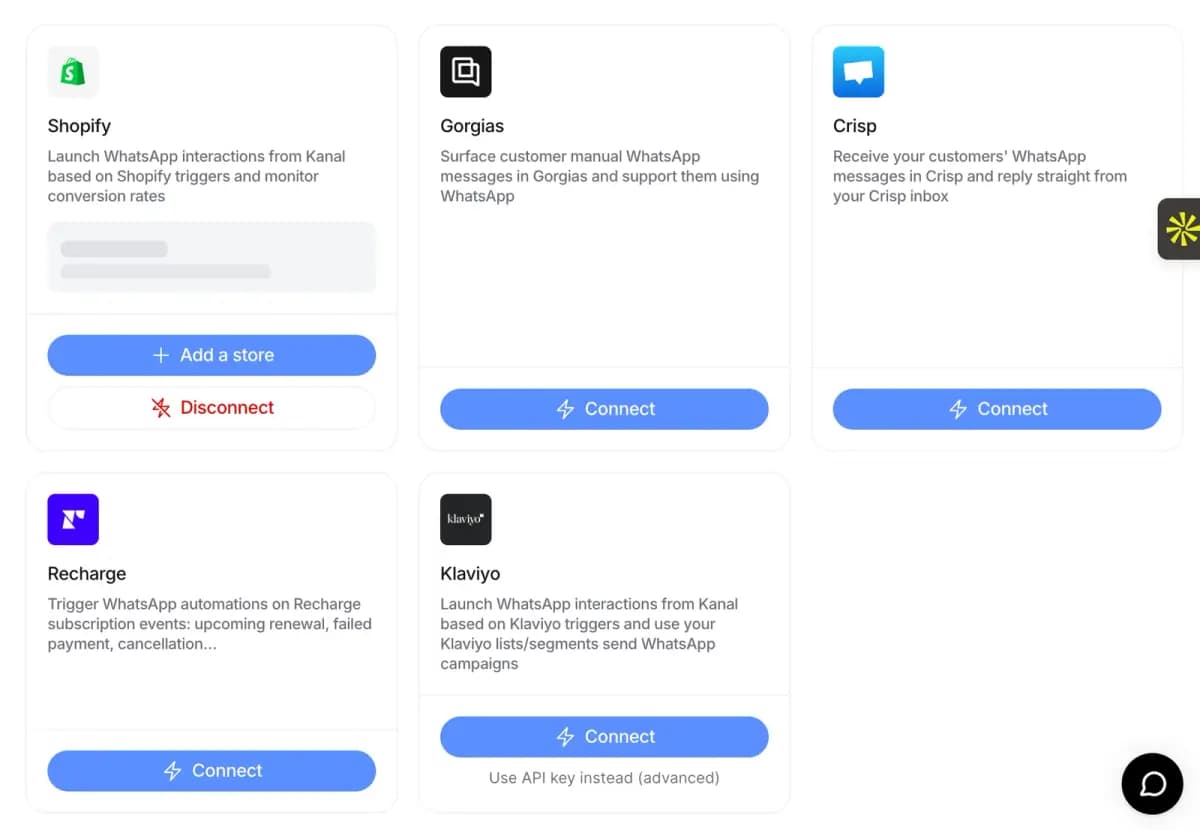
Kanal is built Klaviyo-aware from day one. The sync is two-way and bidirectional:
From Klaviyo to Kanal:
- Profile attributes (email, phone, language, lifetime value, predicted CLV).
- Segments (e.g., "Top 10% VIP" auto-syncs to a Kanal audience).
- Suppression list (unsubscribes flow both ways).
From Kanal to Klaviyo:
- WhatsApp Message Sent, Delivered, Read, Clicked, Replied.
- WhatsApp Opt-in event with consent timestamp and source.
- Conversation events for support tickets.
- Revenue attribution: order placed after a WhatsApp click.
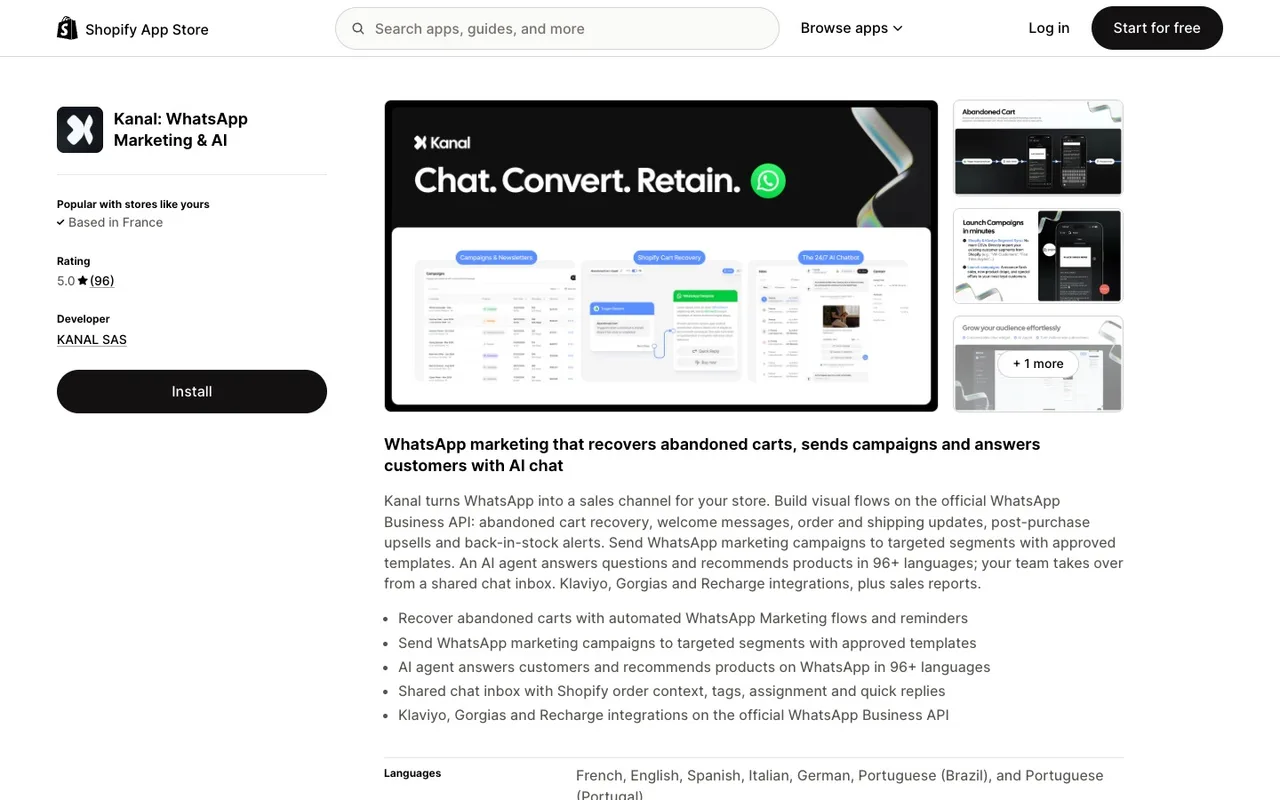
Setup time: 15 minutes. Connect Klaviyo OAuth, pick which segments to sync, choose which events flow back. Done.
Pricing: included from the Scale plan of Kanal. See pricing.
The full integration plus setup walkthrough is in the Kanal Shopify integration page.
5 flows to migrate from email to WhatsApp first
Do not move everything. Start with the five flows where WhatsApp's open rate and immediacy beat email by the widest margin.
1. Abandoned cart (the highest ROI win)
A cart reminder only works while the purchase intent is fresh, which is where a message read in the chat app beats an email opened hours later. It is usually the first flow worth testing, and the easiest one to measure against your email-only baseline.
The setup:
- Keep your Klaviyo email at +1 hour as a safety net.
- Add WhatsApp at +20 minutes for opted-in customers.
- Send a second WhatsApp at +24 hours if no purchase.
Full playbook in abandoned cart recovery strategies and the WhatsApp cart recovery deep dive.
2. Welcome series
Replace email 1 of 3 in your welcome flow with a WhatsApp message, then compare engagement and time to first purchase against the email version.
Why it works: the customer just opted in. They are warm. WhatsApp's immediacy locks in the relationship before they forget you exist.
3. Post-purchase shipping updates
Shipping updates are utility messages, which means Meta approves them in hours and they cost less than marketing templates. They also trigger replies (questions about delivery, sizing, returns) that turn into upsell opportunities.
Pair with the WhatsApp AI chatbot to answer the repetitive ones automatically.
4. Win-back (90+ days inactive)
Email win-back is graveyard territory: inactive segments stop opening. A WhatsApp message has a better chance of being seen because the chat inbox is not flooded with promotions.
Send one short message: "Hey [name], we miss you. Here is 15% off your next order." That is it. No image, no carousel, no fluff.
5. BFCM teaser + flash sales
For high-urgency campaigns, WhatsApp puts the offer in the app your customers check all day, right when the sale starts. Our full Black Friday WhatsApp playbook walks through the BFCM-week sequence.
Attribution: how to credit WhatsApp revenue without double-counting
The biggest mistake merchants make when adding WhatsApp: double-attributing orders to both email and WhatsApp, then over-investing in one or the other based on inflated numbers.
The fix is a last-touch model with a 7-day window:
- Customer clicks a Klaviyo email link.
- Customer ignores it.
- Six hours later, Kanal sends a WhatsApp message.
- Customer clicks the WhatsApp link and buys.
Attribution: WhatsApp gets the order. Klaviyo email gets a "supporting touch" event.
To implement:
- Use Kanal's UTM parameters on every WhatsApp link (utm_source=whatsapp).
- Push WhatsApp Click events back into Klaviyo as a custom metric.
- Build a Klaviyo report grouped by "last channel clicked in 7 days before order."
Our ROI calculator helps model the incremental revenue WhatsApp adds on top of email.
Migration checklist: 2-week timeline
Week 1: setup and pilot
- Day 1-2: Install Kanal from the Shopify App Store. Connect Klaviyo OAuth.
- Day 3: Submit your first 3 WhatsApp templates to Meta (cart, shipping, welcome). Most approve within 24h.
- Day 4-5: Build the opt-in widget on your product pages and checkout. Use the opt-in GDPR guide to stay compliant.
- Day 6-7: Pilot the abandoned cart flow on 10% of traffic. Track conversion vs your email-only baseline.
Week 2: scale and measure
- Day 8-10: Roll out cart flow to 100% of opted-in customers.
- Day 11-12: Add the welcome message and post-purchase shipping updates.
- Day 13: Run a WhatsApp broadcast to your top VIP segment.
- Day 14: Review revenue attribution in Klaviyo. Identify which flows to migrate next.
After 14 days, you have your own measure of the incremental revenue WhatsApp adds on top of your existing Klaviyo performance.
Common pitfalls to avoid
- Do not send the same message on both channels at the same time. It looks spammy. Stagger by 1-6 hours.
- Do not assume email opt-ins are WhatsApp opt-ins. They are not, under GDPR and Meta policy.
- Do not let Klaviyo email keep running blindly on cart abandonment. A customer who already clicked the WhatsApp reminder does not need the same reminder by email. Suppress email if WhatsApp was clicked.
- Do not send marketing messages outside the 24-hour customer service window without a Meta-approved template. Meta blocks free-form messages outside that window, and pushing volume that customers report hurts your quality rating.
Conclusion
Klaviyo plus WhatsApp is not a future setup. It is the 2026 stack for any Shopify store doing more than 50K USD per month. Klaviyo handles nurture, content, and deep segmentation. WhatsApp handles urgency, conversion, and conversation. Both feed a unified customer profile.
The Klaviyo sync is included from Kanal's Scale plan, and the attribution setup above tells you, flow by flow, what WhatsApp adds.
Ready to add WhatsApp to your Klaviyo flows? Book a Kanal demo or install Kanal on Shopify and we will walk through your existing flows live.
Resources
Frequently asked questions
Can Klaviyo send WhatsApp messages natively?
Klaviyo launched a native WhatsApp channel in late 2024, but it is limited. You get basic broadcast and a few flow triggers, no rich product cards, no in-app catalog, and template approval still goes through Meta. Most Shopify merchants pair Klaviyo with a dedicated WhatsApp platform like Kanal for richer messages, opt-in widgets, and a proper inbox.
Should I migrate fully from Klaviyo to a WhatsApp tool?
No. Keep Klaviyo for email and SMS where it excels (long-form content, segmentation, deliverability infrastructure). Use a WhatsApp-first tool for conversational flows, broadcasts, and support. Both stacks share profile data so the customer record stays unified.
How do I track WhatsApp revenue inside Klaviyo?
Push WhatsApp events (Message Sent, Clicked, Replied, Order Placed) back into Klaviyo as custom metrics. Then build an attribution model that credits the last channel touched in the 7 days before purchase. Kanal ships a native Klaviyo sync that does this automatically.
What does the Kanal Klaviyo integration cost?
The Klaviyo integration is included from the Scale plan; it is not part of the entry Pro plan. You pay the Kanal subscription plus Meta's WhatsApp fees, charged per delivered template message and passed through at cost.
Will my email opt-ins automatically become WhatsApp opt-ins?
No, and they should not. WhatsApp requires a separate, explicit opt-in under Meta policy and GDPR. You can prompt email subscribers to opt in to WhatsApp through a popup, a welcome email link, or a checkout checkbox, but consent has to be captured fresh.
See Kanal on your own store
- Your campaigns and cart reminders on WhatsApp, starting from your own store
- Post-purchase offers, back-in-stock alerts, then the AI agent that advises your customers
- You leave with the plan that fits and its price

- brands
- 500+
- to set up
- 5 min
- open rate on WhatsApp
- +90%
5/5 on the Shopify App Store (125 reviews)

Nicolas helps e-commerce brands grow revenue with WhatsApp marketing. With deep expertise in Shopify ecosystems and conversational commerce, he shares proven strategies for abandoned cart recovery, broadcast campaigns, and AI-powered customer engagement.
Glossary terms in this article
Quick definitions for the WhatsApp Business terms used above.
Webhook
A WhatsApp webhook is an HTTP request with a JSON payload that Meta's servers send to a business's server whenever something happens on its WhatsApp account, such as an incoming message or a delivery status change.
Read full definitionSegmentation
Segmentation is the practice of splitting a WhatsApp contact list into groups based on traits like purchase history, behavior, or engagement, so each group receives messages that are actually relevant.
Read full definitionAbandoned Cart Recovery
Abandoned cart recovery is the practice of messaging shoppers who added items to their cart but left without buying, to encourage them to complete the purchase.
Read full definitionOpt-in
A WhatsApp opt-in is the permission a person gives a business to send them messages on WhatsApp. WhatsApp's Business Messaging Policy requires it before any message: the business must have the person's phone number and their agreement to hear from that business.
Read full definitionBusiness Solution Provider (BSP)
A Business Solution Provider (BSP) is a company authorized by Meta to give other businesses access to the WhatsApp Business Platform, usually through its own software. Meta now calls these companies partners and splits them into Solution Partners, Tech Providers and Tech Partners.
Read full definitionMarketing Template
A marketing template is a WhatsApp message template used for promotion: offers, product launches, back-in-stock alerts or cart reminders. It can be sent at any time to customers who opted in, and Meta charges each delivered message at the marketing rate of the recipient's country.
Read full definitionCustomer Service Window (24-hour window)
The customer service window is a 24-hour timer that starts when a WhatsApp user messages or calls a business. While it is open, the business can reply with free-form messages; once it closes, it can only send approved message templates.
Read full definitionQuality Rating
The quality rating is the score WhatsApp gives a business phone number, and each of its message templates, based on how recipients react: blocks, reports and read rates. It is shown as high, medium or low (green, yellow, red).
Read full definitionSuggested articles

Ecommerce Marketing Automation: A Practical Guide for Shopify Stores (2026)
Ecommerce marketing automation explained: how flows work, the 10 flows every online store needs, email vs SMS vs WhatsApp, and how to set it up on Shopify.
Omnisend vs Klaviyo: Pricing and Features Compared
Omnisend vs Klaviyo for Shopify stores: prices at five list sizes, email allowances, who is billed, SMS rates, support, Shopify setup and migration.

Klaviyo vs Mailchimp: Pricing and Features Compared
Klaviyo vs Mailchimp for Shopify stores: prices at five list sizes, how each counts contacts, sending limits, overages, SMS and the Shopify integration.
Klaviyo Pricing in 2026: Email, SMS and What You Pay
Klaviyo pricing explained: free plan limits, Email and Marketing plan prices by active profiles, SMS rates, automatic upgrades and how to control the bill.