Back-in-Stock WhatsApp Alerts: Setup + 8 Templates (2026)

Summarize this article with an AI
 ChatGPT
 Claude
Set up back-in-stock WhatsApp alerts on Shopify: opt-in placement, inventory webhooks, 8 templates, send timing and how to measure the revenue.
Table of contents (29)
Key takeaways
- A back-in-stock WhatsApp alert needs the WhatsApp Business API, an opt-in specific to that use case and a Shopify inventory webhook tied to the variant.
- In the US a utility message costs $0.0034 against $0.0250 for a marketing message, so 500 alerts cost $1.70 in Meta fees.
- Send the alert immediately, then a reminder at T+2 hours and a last chance at T+24 hours only if the variant is still in stock.
A customer lands on your product page. The hero variant is sold out. They tap "notify me when back in stock," enter their phone number, and leave. Two weeks later your warehouse restocks. What happens next determines whether you turn that intent into revenue or lose it forever.
An email alert competes with every promotion in the inbox. A WhatsApp back-in-stock alert arrives in the chat app your customer already uses, names the exact product and variant they asked for, and links straight to it. Same intent signal, same inventory event, same product: what changes is whether the customer sees the news before the stock runs out again.
This guide walks through the full setup: where to place the opt-in, how to wire up Shopify inventory webhooks, eight templates to submit to Meta, when to send, and how to measure the results.
If you want the shortcut, book a Kanal demo and we will configure back-in-stock alerts on your store live.
Why back-in-stock alerts are a high-intent WhatsApp trigger
Every WhatsApp use case starts from a different level of intent. Here is how the main triggers compare:
| Use case | Intent level |
|---|---|
| Back-in-stock alert | Pre-qualified intent + utility |
| Abandoned cart | Active intent + recency |
| Order shipping update | Utility, expected by the customer |
| Welcome message | New customer, no urgency |
| Win-back broadcast | Cold list, low intent |
| Flash sale broadcast | Mass send, low personalization |
Back-in-stock is different because every recipient has already raised their hand. They went out of their way to opt in for one specific SKU. The WhatsApp message is not interrupting them. It is delivering exactly what they asked for, at the exact moment it becomes available.
WhatsApp vs email vs SMS for stock alerts
Each channel has a job in a restock flow:
| Channel | Strength for stock alerts | Limitation |
|---|---|---|
| Reaches your whole list, room for full product detail | Competes with every promotion in the inbox | |
| SMS | Reaches the phone lock screen | Plain text and a link, no product image |
| WhatsApp via Kanal | Product image, variant and buy button in a chat the customer can answer | Needs a WhatsApp opt-in specific to the alert |
Your WhatsApp alert list can be smaller than your email list, because the opt-in asks for a phone number. That is why the fair comparison is revenue per recipient, not total revenue: track it per channel for each restock and push the opt-in that pays best on your store.
Where to place the opt-in on a Shopify product page
The opt-in placement determines your alert list size. The three patterns that work in 2026:
1. Replace the "Add to Cart" button on sold-out variants
When the variant is out of stock, the CTA changes to "Get a WhatsApp alert when back in stock." This placement captures intent at the exact moment of decision, which makes it the one to set up first. Track its opt-in rate as a share of out-of-stock product page sessions.
2. Sticky bar above the product gallery
A persistent bar that shows on any product page where any variant is sold out. It catches visitors who never click on the sold-out variant.
3. Modal trigger on variant select
When a customer picks a sold-out size or color, a modal pops up asking for WhatsApp opt-in. Slightly more intrusive, but useful when the catalog has many variants.
For all three, the field should ask for phone number only (not email), with a clear copy line: "We will send you one WhatsApp alert when this is back. No marketing. Unsubscribe with STOP."
This single-purpose opt-in language is what unlocks Meta Utility template approval. If your opt-in copy mentions "marketing," "newsletter," or "promotions," Meta will reject the template.
For a full breakdown of GDPR-compliant opt-in patterns, see our WhatsApp opt-in and GDPR guide.
Setup step 1: capture interest on out-of-stock SKUs (the form)
The form needs three fields:
- Phone number (with country code picker).
- Variant ID (hidden, populated by JavaScript on the product page).
- Consent checkbox tied to the specific use case.
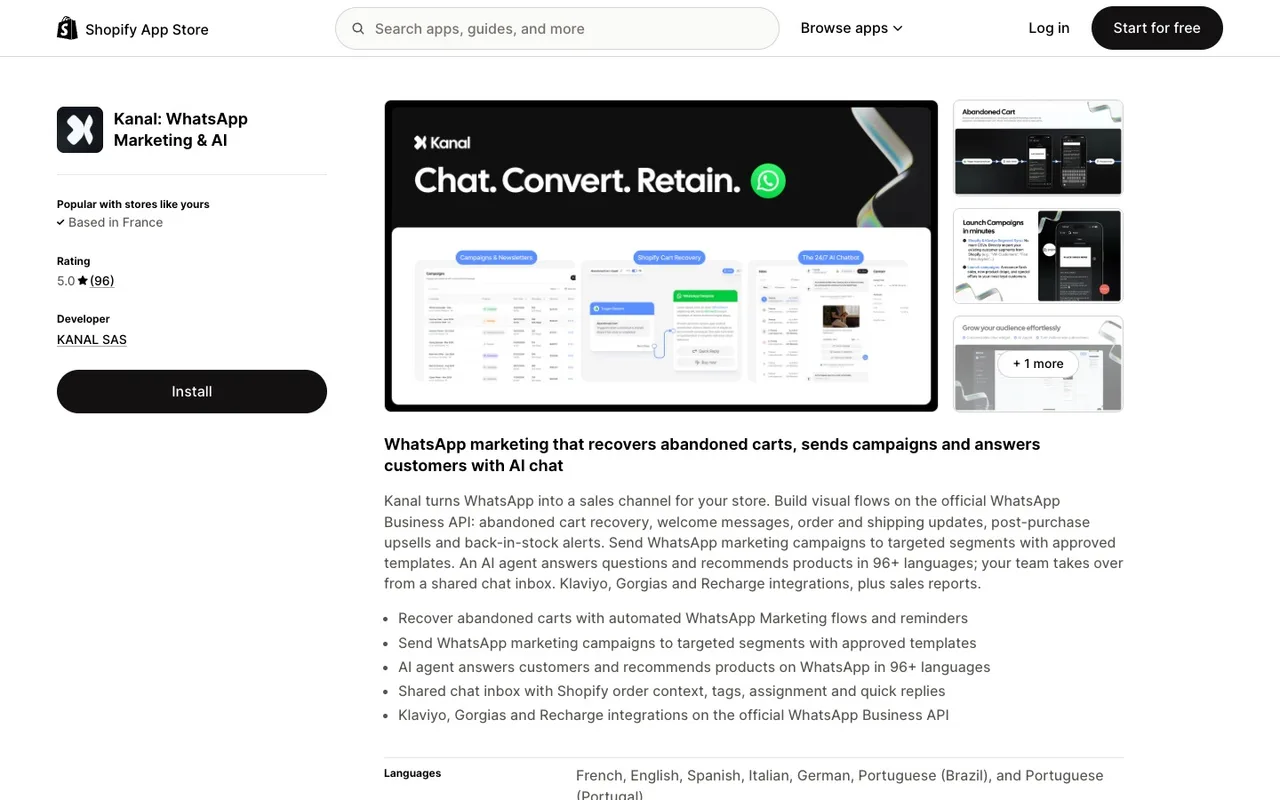
In the Kanal Shopify app, this is a one-click install. The widget reads your Shopify product variant inventory and only renders on out-of-stock SKUs. No theme code needed.
If you DIY: build the form on your Shopify product template, post to a webhook that creates a Kanal subscriber record with the variant ID as a tag. Then any back-in-stock event for that variant fires an alert to everyone tagged.
Setup step 2: connect inventory webhooks to WhatsApp
Shopify exposes the inventory_levels/update webhook. When a SKU goes from 0 to N units, you want to fire the alert.
The pipeline:
- Shopify pushes
inventory_levels/updateto your endpoint. - Your handler checks: did this SKU go from 0 to positive?
- If yes, query the subscriber list for everyone tagged with that variant ID.
- Fire the WhatsApp template to each, with the product image and link as variables.
Three pitfalls to avoid:
- Negative inventory. Shopify allows inventory to drop below zero on overselling. Filter for
previous == 0 AND new > 0, not justnew > 0. - Variant vs product. Customers subscribe to a specific variant (size M, color blue). Do not fire alerts on product-level restocks if only one variant came back.
- Throttling. If 5,000 people are waiting and you fire all 5,000 messages in one second, you may exceed your Meta tier limit. Kanal handles this by spreading the sends.
For the full webhook architecture, see our WhatsApp Business API guide.
Setup step 3: template approval with Meta (Utility category)
Submit your template in the Utility category. Meta's review can take up to 24 hours whatever the category, and the per-message cost of Utility is lower: $0.0034 for a US utility message vs $0.0250 for a US marketing message, or $0.0300 vs $0.0859 in France (Meta's pricing).
Template body example:
Hi {{1}}, your {{2}} in {{3}} is back in stock at {{4}}.
Tap to grab it before it sells out again: {{5}} See you soon!
Variables:
- {{1}} customer first name
- {{2}} product name
- {{3}} variant (size, color)
- {{4}} store name
- {{5}} short link to the variant page
Add a URL button: "Buy now", pointing to the variant page.
For more on template formatting and the WhatsApp templates library, check our dedicated guide.
8 back-in-stock message templates (with variables)
1. Standard utility alert
Hi {{1}}, your {{2}} in {{3}} is back. Get it before it sells out: {{4}} See you soon!2. Limited quantity urgency
Hi {{1}}, your {{2}} just restocked. Only {{3}} left in {{4}}. Tap to claim yours: {{5}} See you soon!3. With original wait time
Hi {{1}}, you have been waiting {{2}} days for your {{3}}. It is finally back: {{4}} See you soon!4. VIP early access
Hi {{1}}, you signed up first so you get first access. Your {{2}} is back, available to VIP list only for 4 hours: {{3}} See you soon!5. Color or variant alternative
Hi {{1}}, your {{2}} in {{3}} is not back yet, but we just restocked {{4}}. Same product, different finish. Take a look: {{5}} See you soon!6. Bundle upsell
Your {{1}} is back, {{2}}. Pair it with {{3}} for {{4}}% off the bundle: {{5}} See you soon!7. Restock with promo
Hi {{1}}, your {{2}} restocked at a new price: {{3}}. Use code {{4}} for an extra {{5}}% off: {{6}} See you soon!8. Out again warning (follow-up)
Hi {{1}}, your {{2}} is selling fast since this morning. Less than {{3}} units left. Last chance: {{4}} See you soon!Templates 1 to 5 and 8 fit the Utility category as long as the customer opted in to a back-in-stock alert specifically. Templates 6 and 7 carry a discount or a promo code: submit them as Marketing, since Meta classifies any template that includes an offer as marketing.
Timing: send immediately or batch?
Default to sending immediately: the customer asked to hear the moment the product is back, and every hour of delay gives the stock time to sell out to someone else.
Batching makes sense for big restocks: if thousands of people are waiting and the SKU comes back with 5,000 units, spreading sends over an hour protects your storefront and your Meta messaging limit. If you are unsure, A/B test immediate against batched sends on your own restocks.
For high-velocity SKUs, the rule is: send immediately, accept the sell-through, and let the follow-up alert capture the next inventory drop.
The follow-up: turn 1 alert into a 3-message sequence
Do not stop at one alert. A 3-message sequence gives customers who missed the first message another chance before the stock runs out. Measure revenue per restock with and without the follow-ups to see what they add.
Message 1 (T+0): the alert. Standard utility template, immediate send.
Message 2 (T+2 hours): urgency reminder. Only sent to customers who opened message 1 but did not click. "Selling fast, X units left."
Message 3 (T+24 hours): last chance. Only sent if the variant is still in stock. "Last chance, still here." If sold out by T+24, skip this message and instead send a different alert: "You missed it but {{alt-product}} is similar and available now."
Each message in this sequence is a separate template, and Meta charges every delivered template: messages 2 and 3 are billed on top of the first alert (Meta's pricing). The conditions above (opened without clicking, variant still in stock) keep the follow-ups to the customers who still need them.
5 back-in-stock scenarios by type of brand
1. Beauty brand
Limited drop on a hero lipstick, restocked every 6 weeks. Each restock triggers one WhatsApp alert per shade waitlist, with email as the backup. Compare revenue per restock with your email-only restocks to see what WhatsApp adds.
2. Fashion brand
Capsule drops with size variants. WhatsApp opt-in only on the size-out modal, so every subscriber is tied to one exact size. Track conversion on the first restock alert for each size.
3. Sneaker drop brand
Hype drops with under 100 units. WhatsApp pre-order alerts go out 30 minutes before the public drop. Track how fast each drop sells out after the alert.
4. Home goods brand
Furniture restocks (long lead times, sometimes 90 days). WhatsApp alerts are useful here because customers have been waiting a long time, and a short message with the product photo brings it back to mind. Mention the wait (template 3) to jog their memory.
5. Supplement brand
Subscription products with monthly stock-outs on bestsellers. WhatsApp alert paired with a "subscribe and never wait again" CTA. Track how many alert recipients switch to a subscription. If you do not sell on subscription yet, see our comparison of subscription apps for Shopify.
For more campaign ideas, see our WhatsApp marketing examples and the WhatsApp marketing for beauty brands deep dives.
ROI breakdown
Model the economics of one restock with your own numbers:
- Cost of 500 WhatsApp utility messages at $0.0034 each (US rate, Meta's pricing): $1.70. At the French rate of $0.0300: $15.00.
- Revenue: recipients x your alert conversion rate x your AOV.
- ROI: revenue divided by send cost, then again with your Kanal subscription added to the cost.
With a send cost this low, what decides the ROI is how many alert recipients buy and what they spend. Use our ROAS break-even calculator to model your own numbers.
Conclusion
Back-in-stock alerts are one of the easiest WhatsApp use cases to deploy. If you are choosing your first WhatsApp flow, start here: the opt-in is gated by intent, the template is utility (the cheaper category), every recipient asked for the message, and the operational complexity is low.
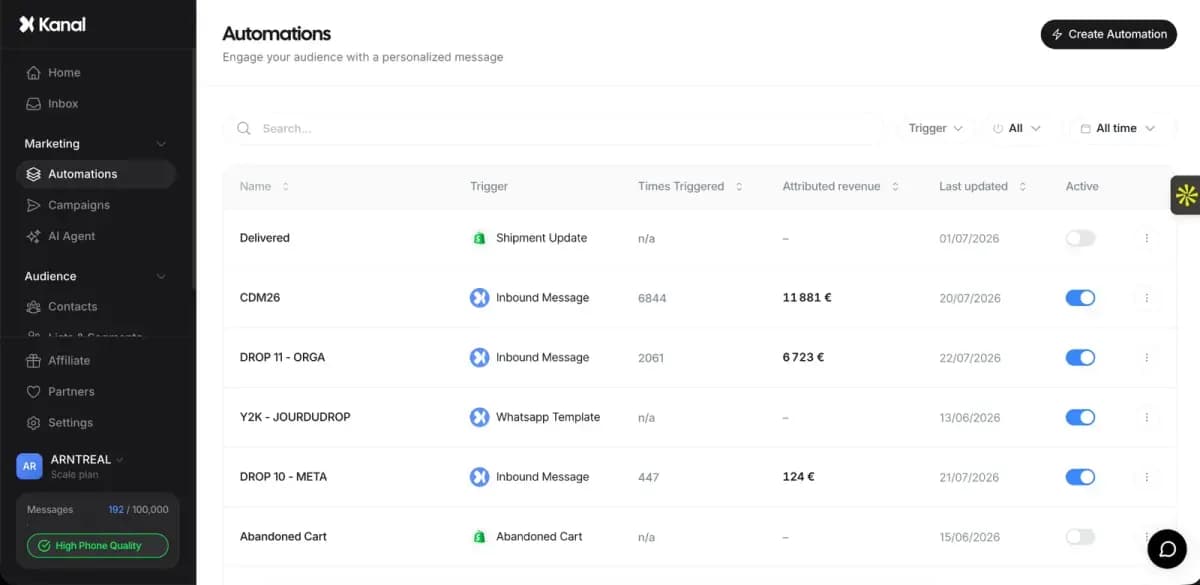
With Kanal, the setup comes down to four steps. Install the app, enable the back-in-stock widget on your product pages, submit the utility template to Meta, connect the inventory webhook. Done.
Ready to set this up? Book a Kanal demo and we will configure your first back-in-stock flow live during the call.
Resources
Frequently asked questions
What is a back-in-stock WhatsApp alert?
A back-in-stock WhatsApp alert is an automated message sent to customers who requested notification when a sold-out product becomes available again. It works because the customer asked for it: the message names the exact product and variant they wanted, arrives in the chat app they already use, and links straight to the product page.
Do I need WhatsApp Business API for stock alerts?
Yes. The free WhatsApp Business app cannot send template-based automated messages tied to inventory webhooks. You need the WhatsApp Business API through a provider like Kanal, which handles template approval, webhook integration with Shopify, and sending at scale.
How fast do back-in-stock alerts convert?
It depends on the product, the stock and how long customers waited, and there is no independent public benchmark for it. Measure clicks and orders one hour and 24 hours after each restock alert, and compare them with your email alerts for the same product.
What template category does Meta approve for stock alerts?
Back-in-stock alerts fall under the Utility category in Meta's template system because they respond to an explicit customer request. Utility templates cost less than marketing templates. Meta's review can take up to 24 hours.
Can I do back-in-stock without opt-in?
No. Meta policy and GDPR both require explicit opt-in for any automated WhatsApp message, even for utility templates. The opt-in must be specific to the back-in-stock use case and tied to the customer phone number, not reused from a general marketing opt-in.
See Kanal on your own store
- Your campaigns and cart reminders on WhatsApp, starting from your own store
- Post-purchase offers, back-in-stock alerts, then the AI agent that advises your customers
- You leave with the plan that fits and its price

- brands
- 500+
- to set up
- 5 min
- open rate on WhatsApp
- +90%
5/5 on the Shopify App Store (125 reviews)

Nicolas helps e-commerce brands grow revenue with WhatsApp marketing. With deep expertise in Shopify ecosystems and conversational commerce, he shares proven strategies for abandoned cart recovery, broadcast campaigns, and AI-powered customer engagement.
Glossary terms in this article
Quick definitions for the WhatsApp Business terms used above.
Opt-in
A WhatsApp opt-in is the permission a person gives a business to send them messages on WhatsApp. WhatsApp's Business Messaging Policy requires it before any message: the business must have the person's phone number and their agreement to hear from that business.
Read full definitionWebhook
A WhatsApp webhook is an HTTP request with a JSON payload that Meta's servers send to a business's server whenever something happens on its WhatsApp account, such as an incoming message or a delivery status change.
Read full definitionUtility Template
A utility template is a WhatsApp message template that follows up on something the customer did or asked for: an order confirmation, a shipping update, a payment receipt. It must not contain promotional content, otherwise Meta re-categorizes it as marketing.
Read full definitionMessaging Limits
Messaging limits are the maximum number of unique WhatsApp users a business can message outside a customer service window within a moving 24-hour period. A new business portfolio starts at 250, then moves to 2,000, 10,000, 100,000 and unlimited.
Read full definitionSuggested articles

Ecommerce Marketing Automation: A Practical Guide for Shopify Stores (2026)
Ecommerce marketing automation explained: how flows work, the 10 flows every online store needs, email vs SMS vs WhatsApp, and how to set it up on Shopify.
50+ WhatsApp Message Templates for Ecommerce: Copy and Paste (2026)
53 WhatsApp message templates ready to copy and paste: abandoned cart, order updates, review requests, winback and promos. With Meta categories.
WhatsApp in Shopify Messaging: Pricing, Features and Limits
WhatsApp is live in Shopify Messaging: what the channel does, per-message prices by country ($0.106 UK, $0.172 France), limits and the US rule, October 2026.
Best WhatsApp Marketing Software: 10 Tools Compared (2026)
The 10 best WhatsApp marketing software tools compared: features, e-commerce integrations and starting prices for Kanal, Wati, Zoko, Charles and more.