WhatsApp Bot for Ecommerce: How a WhatsApp Chatbot Works

Summarize this article with an AI
 ChatGPT
 Claude
WhatsApp bot for online stores: how it works, rule-based flow or AI agent, Meta's rules (24-hour window, templates, opt-in), setup steps and metrics.
Table of contents (14)
Key takeaways
- A WhatsApp bot connects to a business number through Meta's WhatsApp Business Platform and answers with a scripted flow or a text written by an AI.
- It can reply freely for 24 hours after each customer message, then needs a Meta-approved template and the customer's opt-in to write again.
- Meta allows automation as long as a clear escalation path to a human exists, and gives each number 1,000 free service messages per month.
A WhatsApp bot, or WhatsApp chatbot, is software connected to a business's WhatsApp number through Meta's WhatsApp Business Platform: it receives customer messages and answers them in place of the team, by following a flow written in advance or with an AI. For an online store, a WhatsApp chatbot for ecommerce can reply freely for the 24 hours that follow each customer message, can then only send message templates approved by Meta, and only messages customers who have opted in.
This page explains how it works, not which tool to pick. To compare platforms, read our WhatsApp chatbot comparison. To choose the channel (website chat or messaging), see our article on the AI chatbot for ecommerce. The rules cited here come from Meta's documentation and policies, read on October 7, 2026.
How does a WhatsApp bot work?
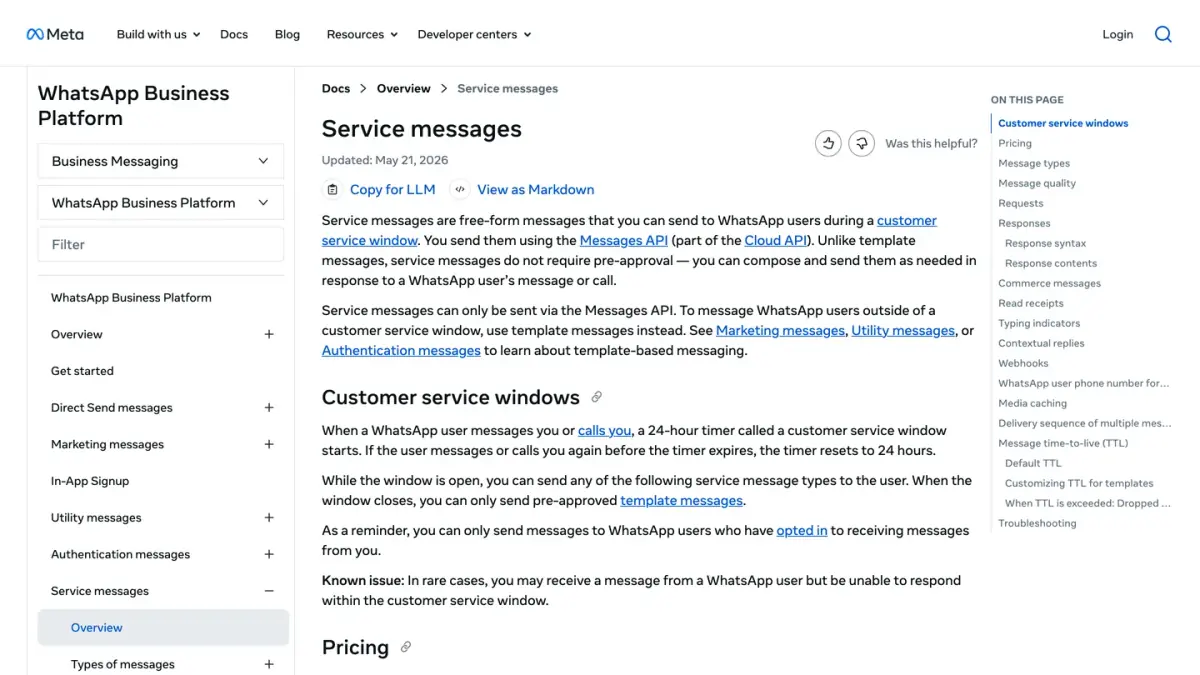
A WhatsApp bot is a program outside the app, plugged into the WhatsApp Business Platform. Every exchange follows the same path.
- The customer messages the store's WhatsApp number.
- Meta passes that message to the store's software through a webhook, a notification sent to an address the software listens on.
- The software picks the reply: a branch of a flow, or a text written by an AI from the store's content.
- It sends that reply through Meta's Messages API, then receives the status of the message: sent, delivered, read.
Source: Meta's documentation on the messages webhook and on service messages, as of October 7, 2026.
The store does not have to build this program itself. Meta's terms describe two routes: using the platform directly, or going through a Solution Provider, a third party authorized to use the APIs on the business's behalf (Meta Terms for WhatsApp Business Platform, last modified September 23, 2026, as of October 7, 2026).
Two clarifications avoid confusion:
- The greeting message and the away message of the WhatsApp Business app send a fixed text, without reading the question. They are not bots: our guide to the WhatsApp automated message explains how to turn them on.
- Meta offers its own AI agent, Meta Business Agent, whose messages are a category of their own on Meta's pricing page. Our Meta Business Agent guide covers it.
Rule-based flow or AI agent: what is the difference?
Both answer without a human stepping in, but not in the same way.
| Rule-based flow | AI agent | |
|---|---|---|
| How it understands the customer | Through the choices you planned: buttons, lists, keywords | Through the customer's free text |
| Where the reply comes from | A text you wrote for each branch | A text written from the content you provide: catalog, help pages, policies |
| What you maintain | The tree of questions and answers | The content it consults and its instructions |
| What trips it up | A question the flow did not plan for | A question whose answer is missing from its content |
| Where it fits | Closed journeys: track an order, start a return, book an appointment | Open questions: product advice, comparison, special case |
A rule-based flow relies on WhatsApp's interactive formats: reply buttons (up to three predefined replies per message), lists of options, and WhatsApp Flows, structured messages that Meta cites for booking appointments or collecting customer feedback, among other uses (Meta's documentation on message types, as of October 7, 2026). Mind the vocabulary: a "flow" here means an automation scenario, while "WhatsApp Flows" is the name of a message format.
The same question, handled both ways:
The customer: Hi, has my order shipped?
The rule-based flow shows three buttons: "Track my order", "Start a return", "Talk to an agent". The customer taps the first one, the bot asks for the order number, then shows the status.
The AI agent understands the request, finds the order if the tool is connected to the store, then answers in one sentence with the status and the tracking link.
The two approaches combine well: an AI agent to understand the request, a flow for the steps that must not vary, and a person for the rest.
What does a WhatsApp bot need to run?
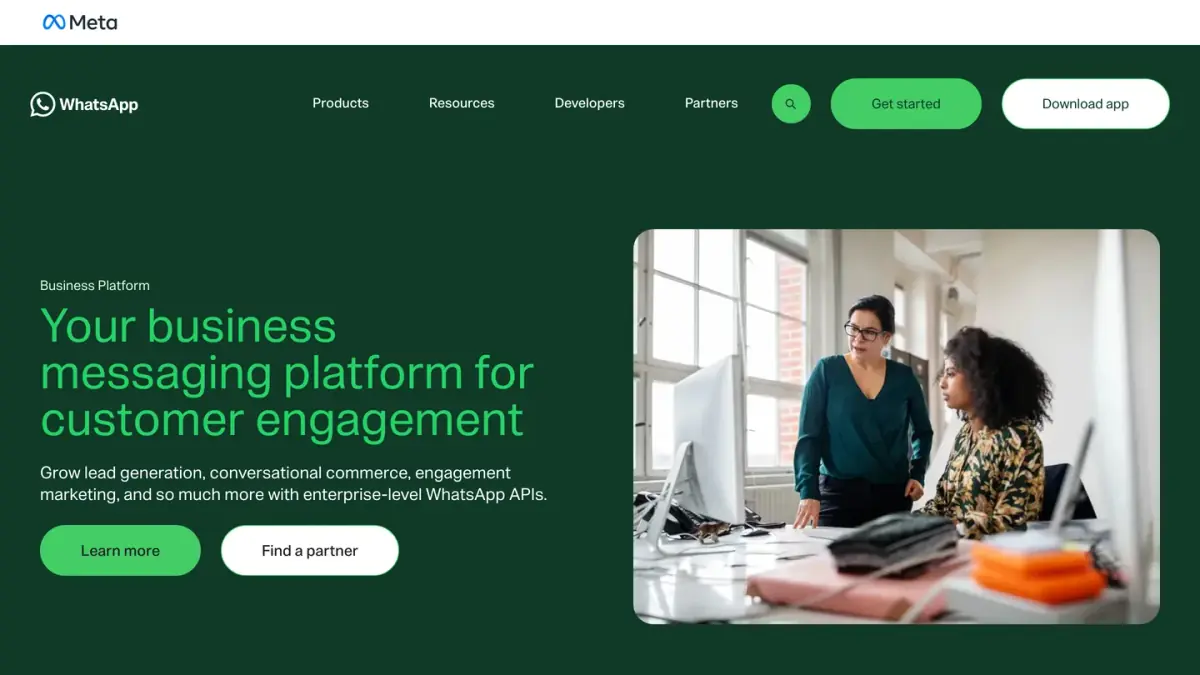
Six conditions, all set or framed by Meta.
1. A number connected to the WhatsApp Business Platform
Meta describes the platform as a suite of products with business services and APIs that allow businesses to send or receive messages on WhatsApp, either directly or through a Solution Provider (platform terms, as of October 7, 2026). A third-party bot goes through this platform, not through the Tools tab of the WhatsApp Business app.
2. The 24-hour customer service window
When a customer messages or calls, a 24-hour timer starts, and each new message or call from them resets it to 24 hours. While the window is open, the bot can send free-form messages, which Meta calls service messages: text, image, reply buttons, list. When it closes, only pre-approved templates go through (Meta's documentation on service messages, as of October 7, 2026).
3. Message templates to write outside the window
A template is a message prepared in advance, with variables such as the first name or the order number. Meta reviews it automatically when it is created and after each edit, and it can only be sent once approved. Each template is categorized as marketing, utility or authentication (Meta's documentation on templates, as of October 7, 2026). For a bot, templates reopen a conversation: a follow-up after 24 hours of silence, an order update, a cart reminder. Our WhatsApp Business template examples are ready to submit.
4. Customer opt-in
Meta requires businesses to obtain opt-in before messaging people on WhatsApp. The request must clearly state that the person is opting in to receive communication from the business, state the business's name and comply with applicable law. Meta lists several supported methods: SMS, a website, by phone, in person or on paper (Meta's documentation on opt-in, as of October 7, 2026). To apply it in Europe, read our guide to WhatsApp opt-in and GDPR.
5. A way out to a human
The WhatsApp Business Messaging Policy (last updated September 23, 2026, as of October 7, 2026) allows automation when responding during the 24-hour window, on one condition: prompt, clear and direct escalation paths must be available. It lists them: in-chat human agent transfer, phone number, email, web support on the business website, in-store visits, support form. The same policy says not to ask people to share full-length payment card numbers, financial account numbers or personal ID card numbers.
6. A message budget
Meta charges for delivered messages from the business to the customer, never for the customer's messages. Templates are charged by category and by the recipient's country. A bot's free-form replies are service messages: since October 1, 2026, each business phone number has 1,000 free service messages per month, and Meta charges from the 1,001st (WhatsApp Business Platform pricing page, updated September 30, 2026, as of October 7, 2026). The subscription of the tool you choose comes on top.
Does Meta allow AI agents on WhatsApp?
Yes, for a bot that answers a business's own customers: the messaging policy allows automation (point 5 above), and Meta's pricing page states that service messages can be powered by a third-party AI solution or by people. What the platform terms prohibit (section 4.7, as of October 7, 2026) is AI providers using the platform to offer an AI assistant when that assistant is the primary functionality made available, rather than an incidental or ancillary one. The same section adds that such technologies may be made available to businesses in certain countries. A store's bot answers about that store's products, orders and returns.
What does an online store use a WhatsApp bot for?
Meta illustrates its pricing with a sample conversation between a store and a customer. It shows where the bot steps in, and where it stops.
| Moment in the conversation | Who writes | Message type |
|---|---|---|
| Cart abandonment reminder | The store | Marketing template |
| A question about a size, then about a color | The customer | Incoming message, not charged |
| Answers to those questions | The AI agent | Automated reply |
| A problem with an expired card at checkout | The customer | Incoming message, not charged |
| The conversation is picked up | A customer service representative | Service message |
| Order confirmation | The store | Utility template |
Example taken from the WhatsApp Business Platform pricing page, as of October 7, 2026. In Meta's example, the automated replies come from its own agent, Meta Business Agent. With a third-party agent, they are service messages.
In a store, a bot covers five situations:
- Pre-purchase questions: size, color, availability, delivery time. The bot must be able to read the store's catalog and policies.
- Order tracking: "where is my order?". The bot must be connected to the orders, otherwise it can only point to the tracking page.
- Returns and exchanges: a closed journey (order, item, reason), which suits a rule-based flow.
- Replies to messages the store sent: when a customer answers a cart reminder or an order notification, the 24-hour window opens and the bot can reply freely.
- Handoff to an agent: complaint, refund, payment problem. The bot passes the conversation on with what has already been said.
How do you set up a WhatsApp bot, step by step?
- List the questions you receive. Go through the conversations of the last few weeks (WhatsApp, email, website chat) and sort them: those with a fixed answer, those that depend on an order, those that call for advice.
- Choose your access to the WhatsApp Business Platform. Directly, if you have a technical team, or through a tool that handles it. The comparison linked in the introduction details the options.
- Connect the number and complete the profile. The WhatsApp Business Messaging Policy asks for a business profile with customer support contact information and at least one of the following: email address, website address or telephone number.
- Collect customer opt-in. Add the request where you collect the phone number: at checkout, on the site, in a form.
- Write the flows and give the AI agent its sources. One flow per closed journey. For the agent: the catalog, the shipping and return policies, the answers to common questions.
- Set the handoff to a human. Plan at least three triggers: the customer asks for it, the topic is sensitive (complaint, refund, payment), or the bot does not have the answer. Decide who receives the conversation, and during which hours.
- Prepare the message templates. The ones used to write after 24 hours: conversation follow-up, order update. Submit them to Meta before launch.
- Test with real questions. Reuse real wording, typos included. Introduce the bot as an automated assistant from its first message: Article 50 of the EU AI regulation provides that people are informed that they are interacting with an AI system, unless this is obvious from the context (text of the regulation on EUR-Lex, read on October 7, 2026).
- Open in stages. Start with one type of question, reread the conversations, then widen the scope.
How do you measure the results of a WhatsApp bot?
There is no "good" rate that holds for every store. Your point of comparison is your own numbers from the weeks before the launch, then how they move week after week.
| Metric | Formula | Where to read it |
|---|---|---|
| Conversations resolved without a human | Conversations closed by the bot ÷ conversations received | Your messaging tool |
| Handoffs to a human | Conversations transferred ÷ conversations received, with the reason | Your messaging tool |
| First response time | Time of the first reply minus time of the customer's message, bot and team separately | Your messaging tool |
| Messages delivered and read | Statuses Meta returns for each message: sent, delivered, read | Your tool, from the status webhooks |
| Quality rating of the number | Determined by WhatsApp from how users received your messages over the past seven days: blocks, reports, mutes, archives | WhatsApp Manager |
| Service messages of the month | Delivered service messages, compared with the 1,000 free per business phone number | Your message invoice (Meta or your provider) |
| Orders after a conversation | Orders placed after an exchange with the bot ÷ total orders | Your tool and your store |
The statuses, the quality rating and the 1,000-message free tier come from Meta's documentation (messages webhook, service messages, pricing), as of October 7, 2026. The other rows are calculations to run on your own data.
Every week, reread the conversations the bot did not resolve. A question left without an answer is content to add, a misunderstood question is a flow to fix, and a customer who gets annoyed is a handoff rule to trigger earlier.
Where does Kanal fit in?
Kanal is a WhatsApp marketing and sales app for Shopify stores that runs on the official WhatsApp Business Platform. Its AI chatbot learns your product catalog, your policies and your brand voice. It answers product questions on WhatsApp, handles order tracking, guides returns and transfers complex queries to your team with the full conversation history. Its automations are built in a visual flow builder (triggers, conditions, actions) tied to Shopify events, and every conversation lands in a shared team inbox.
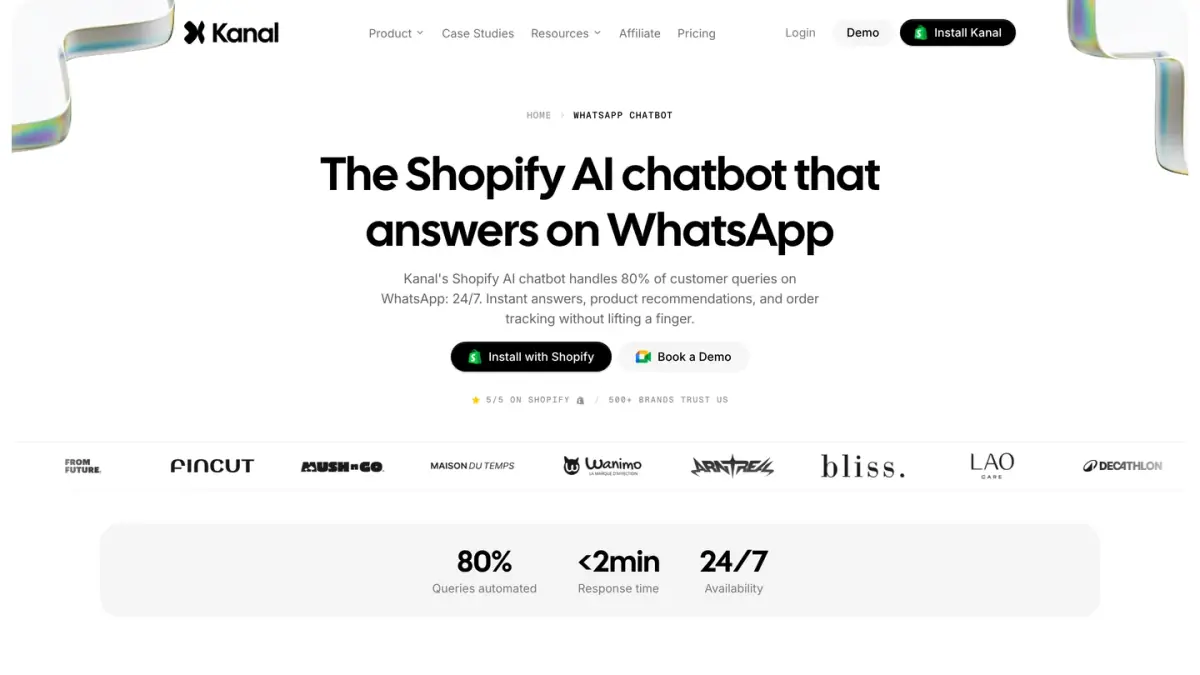
On Meta's rules, Kanal collects opt-ins at checkout and on your site, uses approved message templates and handles opt-outs. To see it answer from your own catalog, book a demo.
Frequently asked questions
What is a WhatsApp bot?
A WhatsApp bot, or WhatsApp chatbot, is software connected to a business's WhatsApp number through Meta's WhatsApp Business Platform. It receives each customer message through a webhook, picks a reply (a branch of a scripted flow or a text written by an AI) and sends it through Meta's API. It is not the same thing as the greeting message of the WhatsApp Business app, which sends a fixed text.
What is the difference between a rule-based chatbot and an AI agent on WhatsApp?
A rule-based chatbot follows a flow that you write: the customer chooses among buttons, lists or keywords, and each branch has its reply. An AI agent reads the customer's free text and writes its reply from the content you give it, such as the store's catalog and policies. The first suits closed journeys, the second suits open questions, and the two can be combined.
Can a WhatsApp bot message a customer first?
Only with a message template approved by Meta, and only if the customer has opted in. Free-form replies are possible inside the customer service window only: 24 hours from the customer's last message, according to Meta's documentation read on October 7, 2026. After that, the bot has to send a template, categorized as marketing, utility or authentication.
Does Meta allow bots and AI agents on WhatsApp?
Yes, within set limits. The WhatsApp Business Messaging Policy allows automation when responding during the 24-hour window, as long as prompt, clear and direct escalation paths are available, such as a transfer to a human agent. Meta's platform terms, on the other hand, prohibit AI providers from using the platform to offer an AI assistant as the primary functionality. Texts read on October 7, 2026.
How much do the messages of a WhatsApp bot cost?
Meta charges for delivered messages from the business to the customer, not for the customer's messages. A bot's free-form replies are service messages: since October 1, 2026, each business phone number gets 1,000 free per month, then Meta charges from the 1,001st, according to its pricing page read on October 7, 2026. Templates are charged by category and by the recipient's country. The subscription of your tool comes on top.
How do you measure whether a WhatsApp chatbot works?
Compare your numbers with those from before the launch, not with a published average. Track the share of conversations resolved without a human, handoffs to an agent and their reason, first response time, message statuses (sent, delivered, read), the quality rating of the number in WhatsApp Manager and the orders placed after a conversation. Reread the unresolved conversations every week.
See Kanal on your own store
- Your campaigns and cart reminders on WhatsApp, starting from your own store
- Post-purchase offers, back-in-stock alerts, then the AI agent that advises your customers
- You leave with the plan that fits and its price

- brands
- 500+
- to set up
- 5 min
- open rate on WhatsApp
- +90%
5/5 on the Shopify App Store (125 reviews)

Nicolas helps e-commerce brands grow revenue with WhatsApp marketing. With deep expertise in Shopify ecosystems and conversational commerce, he shares proven strategies for abandoned cart recovery, broadcast campaigns, and AI-powered customer engagement.
Glossary terms in this article
Quick definitions for the WhatsApp Business terms used above.
WhatsApp Business Platform
The WhatsApp Business Platform is the set of APIs Meta offers businesses to message customers on WhatsApp at scale: the Cloud API, the Business Management API and the Marketing Messages API. It is separate from the WhatsApp Business app, which runs on a phone.
Read full definitionMessage Template
A message template is a pre-written WhatsApp message that Meta approves before a business can send it. Templates are the only messages a business can send outside the 24-hour customer service window, for example to start a conversation or run a campaign.
Read full definitionWebhook
A WhatsApp webhook is an HTTP request with a JSON payload that Meta's servers send to a business's server whenever something happens on its WhatsApp account, such as an incoming message or a delivery status change.
Read full definitionAway Message
An away message is an automatic reply the WhatsApp Business app sends when a business is unavailable. Customers who write receive a message saying the business is away, which can be scheduled and limited to chosen contacts.
Read full definitionWhatsApp Business App
The WhatsApp Business App is a free mobile application designed for small businesses to chat with customers, with a catalog, quick replies, and automated greeting messages.
Read full definitionWhatsApp Flows
WhatsApp Flows is a feature of the WhatsApp Business Platform for building structured, multi-screen interactions inside a chat, such as forms, sign-ups, bookings and guided product selection. The customer fills in screens instead of typing free text.
Read full definitionOpt-in
A WhatsApp opt-in is the permission a person gives a business to send them messages on WhatsApp. WhatsApp's Business Messaging Policy requires it before any message: the business must have the person's phone number and their agreement to hear from that business.
Read full definitionCustomer Service Window (24-hour window)
The customer service window is a 24-hour timer that starts when a WhatsApp user messages or calls a business. While it is open, the business can reply with free-form messages; once it closes, it can only send approved message templates.
Read full definitionAbandoned Cart Recovery
Abandoned cart recovery is the practice of messaging shoppers who added items to their cart but left without buying, to encourage them to complete the purchase.
Read full definitionMarketing Template
A marketing template is a WhatsApp message template used for promotion: offers, product launches, back-in-stock alerts or cart reminders. It can be sent at any time to customers who opted in, and Meta charges each delivered message at the marketing rate of the recipient's country.
Read full definitionUtility Template
A utility template is a WhatsApp message template that follows up on something the customer did or asked for: an order confirmation, a shipping update, a payment receipt. It must not contain promotional content, otherwise Meta re-categorizes it as marketing.
Read full definitionQuality Rating
The quality rating is the score WhatsApp gives a business phone number, and each of its message templates, based on how recipients react: blocks, reports and read rates. It is shown as high, medium or low (green, yellow, red).
Read full definitionSuggested articles
Shopify Magic: What It Is and What It Does in 2026
Shopify Magic explained: where Shopify's built-in AI features stand in 2026, from Sidekick and product descriptions to image editing, the Inbox agent and cost.

11 best WhatsApp chatbots and AI agents compared (2026)
The 11 best WhatsApp chatbot and AI agent platforms in 2026, compared on type of AI, store integrations and the starting price each vendor displays.
WhatsApp Customer Support for Shopify: 12 Essential Flows
Build WhatsApp customer support for your Shopify store: 12 essential flows, AI tier-1 automation, Gorgias and Zendesk integrations and the metrics to track.
Shopify vs WooCommerce: Costs, Fees and Control (2026)
Shopify vs WooCommerce compared for US stores: subscription or hosting costs, payment fees, maintenance, flexibility, apps and how to migrate between them.