AI Chatbot for Ecommerce: How Online Stores Use Them in 2026

Summarize this article with an AI
 ChatGPT
 Claude
What an AI chatbot for ecommerce actually does in 2026: support automation, guided selling, cart recovery, channel choice and how to measure ROI.
Table of contents (9)
Key takeaways
- An AI chatbot for ecommerce answers support and pre-sale questions, recommends products from the live catalog, recovers abandoned carts and hands tricky cases to a human.
- A website widget conversation ends when the tab closes, so anchor the chatbot in a messaging app and treat the site as an entry point.
- Judge the bot on tickets resolved without a human and revenue from chat-assisted orders, compared with your baseline from before the chatbot.
- Kanal's AI chatbot answers shoppers on WhatsApp from the store's catalog, FAQ and policies, and hands the conversation to a person when needed.
Quick answer
An AI chatbot for ecommerce is an automated assistant that talks to shoppers in natural language and does real work for the store: it answers support and pre-sale questions, recommends products from the live catalog, recovers abandoned carts, and hands the tricky cases to a human. It can live on your website, on WhatsApp, or in Instagram DMs. The sensible approach in 2026: pick the channel your customers already open daily and ground the bot in real store data instead of a script.
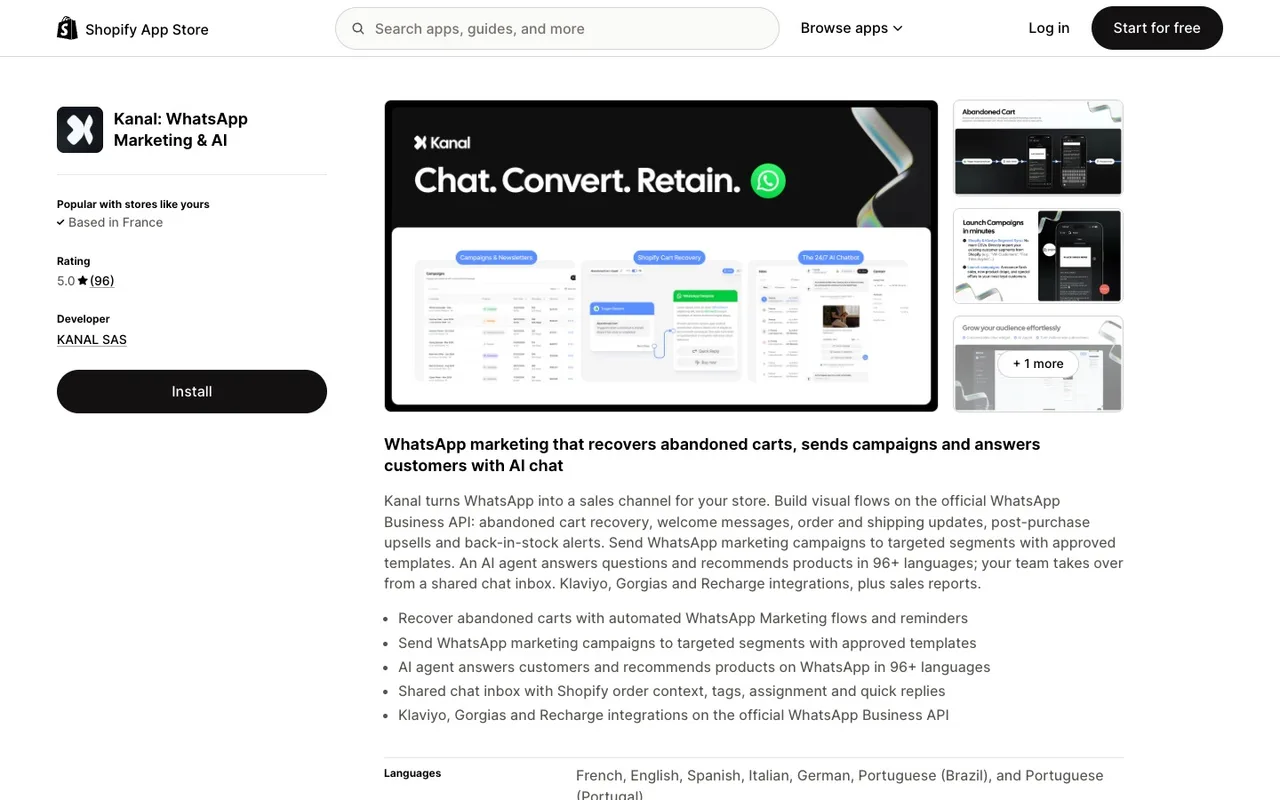
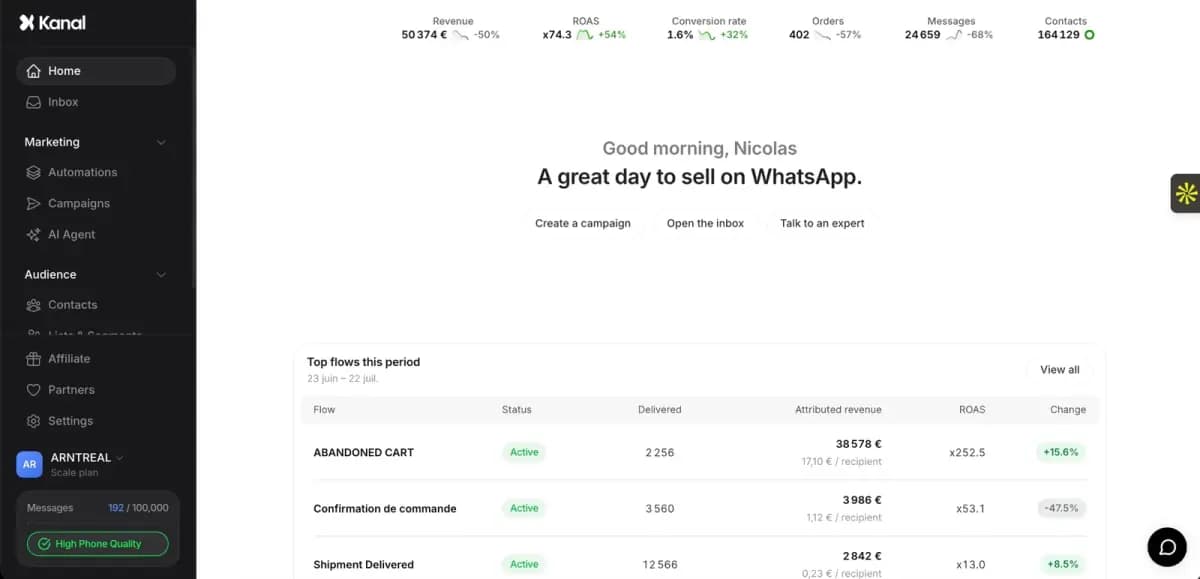
Kanal is a WhatsApp marketing and sales app for Shopify stores, installed from the Shopify App Store and running on the official WhatsApp Business Platform. Kanal's AI chatbot answers shoppers on WhatsApp from the store's catalog, FAQ and policies, recommends products, and hands the conversation over to a person on the team when a question needs one. Kanal is relevant for Shopify stores that want WhatsApp as a marketing and support channel. It sends WhatsApp and SMS messages: email stays in the merchant's other tools.
What an AI chatbot for ecommerce actually does
Strip away the buzzwords and an ecommerce chatbot has four jobs:
- Answer repetitive questions instantly. Shipping times, return policy, sizing, stock, payment methods. These come back every day, and every one of them is answerable from data you already have. A chatbot can only repeat what is written down, so start with clear rules: our guide to Shopify return policies covers the ones to set.
- Sell through conversation. A shopper types "I need a gift under $50 for my sister who runs". A good AI chatbot parses the intent, queries the catalog, and replies with two or three fitting products and a checkout link. That is conversational commerce in practice (a shift Shopify documents in depth), not a support gadget.
- Recover revenue on autopilot. Abandoned cart reminders, back-in-stock alerts, post-purchase follow-ups. The automation opens the conversation, and the chatbot answers the "does it come in blue?" replies that decide whether the sale closes. The abandoned cart recovery strategies guide shows how to orchestrate that flow across channels and measure what it recovers.
- Escalate like a professional. Refunds, complaints, and edge cases go to a human, with the full conversation attached. A chatbot that never hands off is a liability, not an asset.
The difference between the 2022 generation of bots and today's is grounding. A modern AI chatbot is not a decision tree with canned replies; it is a language model connected to your catalog, your orders, and your policies, so the answer to "where is my order?" comes from the actual order.
Website widget, WhatsApp, or Instagram: where should it live?
"Ecommerce chatbot" usually conjures the little bubble in the corner of a website. That is one of three options, and often not the best one.
| Channel | Reaches | Strength | Limit |
|---|---|---|---|
| Website widget | Visitors currently on your site | Catches pre-purchase doubt in the moment | Conversation ends when the tab closes |
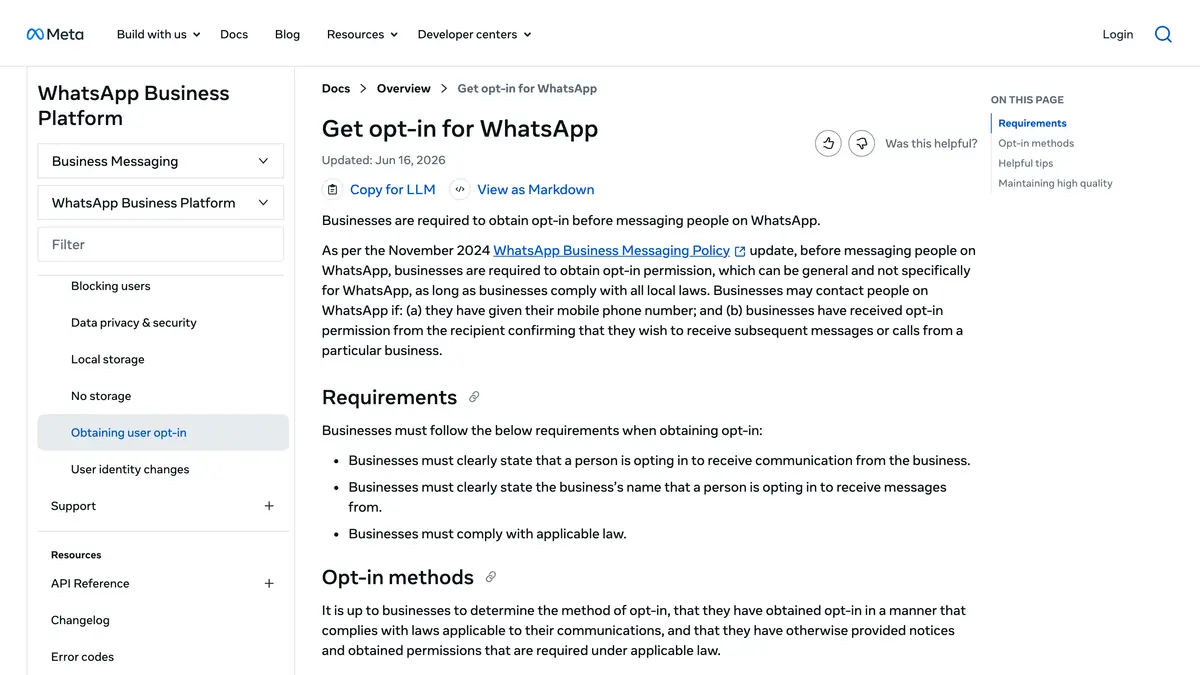
| Customers inside WhatsApp, where they already chat | Persistent thread, supports proactive messages | Requires opt-in per Meta's rules (a feature, not a bug) | |
| Instagram DMs | Followers, story repliers, commenters | Turns engagement into conversations at the top of the funnel | Weaker for transactional and post-purchase flows |
The widget only works while the visitor is there. Messaging conversations persist: the customer can reply three hours later from the bus, and the thread, along with the sale, continues. That is why it makes sense to anchor the AI chatbot in a messaging app and treat the site as an entry point rather than the destination.
Each channel has its own playbook. For the messaging side, the WhatsApp chatbot for ecommerce deep-dive covers flows, setup, and templates, and the Instagram AI chatbot guide does the same for DMs.
How to choose an ecommerce chatbot in 2026
Five questions separate the contenders faster than any feature matrix:
- Does it ground answers in your store data? During the trial, ask a sizing question and an order-status question the way a real customer would, badly phrased. If the bot cannot read your Shopify catalog and orders, it will improvise, and improvised answers about other people's money end badly.
- Does it cover the channels your customers actually use? A widget-only tool leaves WhatsApp and Instagram unanswered. A channel-native tool that ignores your site leaves pre-purchase doubt unhandled. Look for one brain across channels, not three bots with three knowledge bases.
- Can it attribute revenue? "Messages handled" is a vanity metric. The dashboard should tell you which conversations produced orders and how much revenue chat recovered. If it cannot, you will never know whether the bot sells or just chats.
- How does escalation work? Check that a human can take over mid-conversation with full context, ideally inside the help desk your team already uses.
- How does pricing scale? Per-contact pricing grows with your audience even when revenue does not. Flat plans keep the cost predictable as you grow.
The classic mistakes
- Launching with everything switched on. Start with FAQs grounded in store data, watch a week of conversations, then add guided selling and proactive flows.
- No path to a human. Nothing burns trust faster than a bot loop. Refunds, complaints, and VIPs should reach a person immediately.
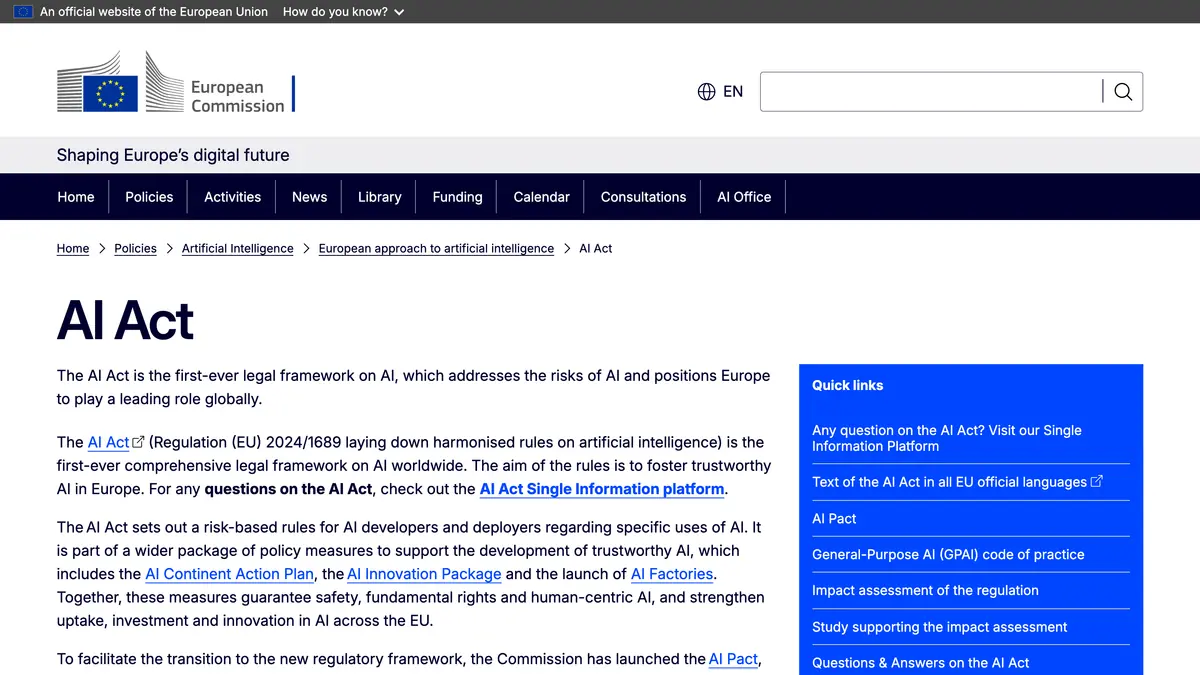
- Hiding the bot. Disclosing automation is legally required in the EU under the AI Act and it is good UX everywhere. Customers do not mind bots; they mind being tricked.
- The discount reflex. A chatbot that solves the customer's actual doubt ("will it arrive before Friday?") converts without training shoppers to wait for coupon codes.
- Set and forget. Review unresolved conversations weekly and feed the gaps back into the knowledge base. The bot is a team member, not an appliance.
How to measure ROI
There is no independent public benchmark for ecommerce chatbot results; vendor averages are not audited. One published example: Fincut, a fashion brand, uses Kanal's AI chatbot to handle 80% of its queries automatically, with a 2 min average response time and a +15% CSAT improvement (see our case studies).
For your own store, track four numbers from the first week and compare them with your pre-chatbot baseline:
| Metric | How to measure it |
|---|---|
| Support tickets resolved without a human | Conversations closed by the bot / all support conversations |
| Average first response time | Time to first reply, bot and human separately |
| Abandoned carts recovered (WhatsApp flows) | Recovered carts / abandoned carts, compared with your email-only rate |
| Share of revenue that becomes chat-assisted | Revenue from orders placed after a chat conversation / total revenue |
The support savings are the floor. The ceiling is conversational selling: recommendations, replies to recovery messages, and post-purchase upsells that a widget alone never captures.
Where Kanal fits
If your store runs on Shopify and your customers live on WhatsApp or Instagram, Kanal is the shortest path to everything above. The AI chatbot is trained on your Shopify catalog, orders, and policies, so answers come from live data. The same brain powers the WhatsApp AI agent that sells and supports around the clock, and the Instagram DM automation that turns story replies into orders, with one inbox and revenue attribution built in.
Setup is visual, takes under 30 minutes, and requires no code. Plans are flat and listed on the pricing page, with the AI chatbot from the Scale plan and Meta's WhatsApp fees passed through at cost, so the subscription does not balloon as your audience grows.
Conclusion: pick the channel, ground the bot, measure revenue
An AI chatbot for ecommerce is no longer a widget experiment; it is how lean teams staff support and sales around the clock. The playbook in 2026: anchor it on the channel your customers already answer, connect it to real store data, keep a clean path to a human, and judge it on revenue rather than reply counts.
Want to see it against your own catalog? Book a demo and ask the AI your hardest product questions live.
Resources
Frequently asked questions
What is an AI chatbot for ecommerce?
An AI chatbot for ecommerce is an automated assistant that talks to shoppers in natural language and performs real store tasks: answering support and pre-sale questions, recommending products from the live catalog, tracking orders, and recovering abandoned carts. Unlike scripted bots, it understands intent and pulls answers from connected store data, then escalates to a human when the conversation requires one.
What is the difference between an ecommerce chatbot and a live chat widget?
A live chat widget is a channel: a box on your site where visitors type and, usually, a human replies. An ecommerce chatbot is the automation layer that answers on its own, and it can live in that widget, on WhatsApp, or in Instagram DMs. The practical difference: a widget conversation ends when the visitor closes the tab, while a messaging thread survives it, so the customer can come back and reply later.
Which channel should an ecommerce chatbot run on?
Wherever your customers already reply. A website widget catches doubts in the moment but dies when the tab closes. WhatsApp offers a persistent thread and supports proactive messages like cart reminders. Instagram DMs excel at turning story replies and comments into conversations. Anchoring the chatbot on WhatsApp or Instagram, with the site as an entry point, keeps the conversation going after the visit.
How much does an AI chatbot for ecommerce cost?
Budget two components: the software and, on WhatsApp, Meta's fees. Meta charges per delivered template message, at a rate set by the template category and the recipient's country. Replies inside the 24-hour customer service window, whether a person or a third-party AI chatbot sends them, were not charged until September 30, 2026. Since October 1, 2026, they cost the utility rate after 1,000 free service messages per business phone number each month. Software pricing varies widely; per-contact pricing grows with your audience, while flat plans stay predictable. Kanal plans start from $89/month, and the AI chatbot comes with the Scale plan.
Can an AI chatbot actually increase sales, not just cut support costs?
Yes, and that is the point. A chatbot connected to the catalog can recommend products, answer the questions that block a purchase and reply to cart reminders, so it can sell, not only deflect tickets. Measure it on your own store: revenue from chat-assisted orders, carts recovered through conversations, and the conversion of shoppers who chat versus those who do not.
See Kanal on your own store
- Your campaigns and cart reminders on WhatsApp, starting from your own store
- Post-purchase offers, back-in-stock alerts, then the AI agent that advises your customers
- You leave with the plan that fits and its price

- brands
- 500+
- to set up
- 5 min
- open rate on WhatsApp
- +90%
5/5 on the Shopify App Store (125 reviews)

Nicolas helps e-commerce brands grow revenue with WhatsApp marketing. With deep expertise in Shopify ecosystems and conversational commerce, he shares proven strategies for abandoned cart recovery, broadcast campaigns, and AI-powered customer engagement.
Glossary terms in this article
Quick definitions for the WhatsApp Business terms used above.
WhatsApp Business Platform
The WhatsApp Business Platform is the set of APIs Meta offers businesses to message customers on WhatsApp at scale: the Cloud API, the Business Management API and the Marketing Messages API. It is separate from the WhatsApp Business app, which runs on a phone.
Read full definitionWhatsApp Flows
WhatsApp Flows is a feature of the WhatsApp Business Platform for building structured, multi-screen interactions inside a chat, such as forms, sign-ups, bookings and guided product selection. The customer fills in screens instead of typing free text.
Read full definitionConversational Commerce
Conversational commerce is the practice of selling and supporting customers through messaging channels like WhatsApp, where buying happens inside a chat.
Read full definitionSuggested articles

Shopify Sidekick in 2026: What It Does and How Stores Use It
What Shopify Sidekick is, what the AI assistant does since the Spring '26 Edition, how MCP app extensions work, and what AI changes for store operations.
WhatsApp Customer Support for Shopify: 12 Essential Flows
Build WhatsApp customer support for your Shopify store: 12 essential flows, AI tier-1 automation, Gorgias and Zendesk integrations and the metrics to track.
Conversational Commerce: Definition, Examples and Platforms
Conversational commerce means selling through chat: live chat, AI agents, WhatsApp, voice. How it works, examples, benefits, limits and 8 platforms.
Shopify Flow: What It Is, How It Works and Its Limits
Shopify Flow explained: the automation app built by Shopify, the plans that include it, triggers, conditions and actions, setup steps and documented limits.