Conversational Commerce: Definition, Examples and Platforms

Summarize this article with an AI
 ChatGPT
 Claude
Conversational commerce means selling through chat: live chat, AI agents, WhatsApp, voice. How it works, examples, benefits, limits and 8 platforms.
Table of contents (24)
Key takeaways
- Conversational commerce means selling through conversations on WhatsApp, website chat or voice, with a person or an AI agent answering.
- On WhatsApp, a business needs the customer's opt-in and can only send pre-approved templates once the 24-hour window has closed.
- To start on Shopify, pick one job first, such as order updates or abandoned checkouts, then add an AI agent once the basics run.
- Among the 8 platforms compared, Kanal connects WhatsApp to Shopify store data from $89/month, with the AI agent available from the Scale plan.
Conversational commerce is buying and selling through conversations. A shopper sends a message on WhatsApp, in your website chat or to a voice assistant, and a person or an AI agent answers the question, recommends a product, shares the checkout link and follows up after the order. For an online store, the most direct way to start is WhatsApp connected to your store data. That is what Kanal does, and it is our pick among the 8 platforms compared below.
Below: the definition, the four types, how it works at each step of the purchase, examples, benefits and limits, and a Shopify setup.
What does conversational commerce mean?
Conversational commerce covers every sale, and every step of a sale, that happens in a conversation instead of on a page: a sizing question, a product recommendation, a payment link, a delivery update, a reorder.
The term was popularized by Chris Messina, who named the trend in 2015. In a January 2016 post, he described it as using chat, messaging or voice to deal with people, brands, services and bots, whether a human or a bot answers. He pointed to Uber's integration into Facebook Messenger, in 2015, as the moment the trend came to life.
Ten years later, AI agents added the missing piece: they understand free text, look up orders, suggest products and hand off to a person when they should. That makes conversational commerce practical for small teams. When the agent works for the shopper instead, finding and comparing products inside an assistant such as ChatGPT, the name is agentic commerce.
It works both ways: the customer starts with a question or a tap on a chat button, or the brand writes to people who agreed to hear from it, with an order update, a cart reminder or a campaign.
Conversational commerce, e-commerce and social commerce
E-commerce is the store itself: product pages, cart and checkout. Social commerce sells inside social media feeds and shops. Conversational commerce is the layer of one-to-one conversations around both, and it often starts from them: a chat button on a product page, a post that invites a direct message, an ad that opens a WhatsApp chat.
The 4 types of conversational commerce
| Type | Where it happens | Who answers | Typical jobs |
|---|---|---|---|
| Live chat | A chat window on your site or app | Your team, in real time | Pre-sale advice, sizing, order issues |
| Chatbots and AI agents | Website chat and messaging apps | Software, with a handoff to people | FAQs, product recommendations, order tracking |
| Messaging apps | WhatsApp, Messenger, Instagram, SMS, RCS | Your team, an AI agent, or both | Order updates, cart reminders, campaigns, support |
| Voice assistants | Smart speakers, phone assistants, AI phone agents | Software | Simple questions, reorders, calls |
1. Live chat
Your team answers store visitors in real time, which suits questions that need expertise. Someone must be online, and the conversation usually ends when the visitor leaves. Our comparison of live chat apps for Shopify covers the main options.
2. Chatbots and AI agents
A rule-based chatbot follows a script of buttons and fixed answers. An AI agent reads free text and acts on your data: it checks an order, recommends products and hands off to a person, with the context, when it cannot help. On WhatsApp, Kanal's AI chatbot answers support questions, and its AI agent also recommends products and guides shoppers to checkout.
3. Messaging apps
WhatsApp, Messenger, Instagram direct messages, SMS and RCS, the rich version of SMS. The thread stays on the customer's phone after the visit, so the conversation can resume days later. On WhatsApp, Meta requires a person's opt-in before a business writes to them, and once the 24-hour window after the customer's last message has closed, the business can only send pre-approved templates. More on our WhatsApp marketing page and in our SMS, RCS and WhatsApp comparison.
4. Voice assistants
Asking or ordering by voice, on a smart speaker, a phone assistant or with an AI agent that answers calls. For most online stores, text comes first; voice matters more if you already sell by phone.
How conversational commerce works along the customer journey
Conversational commerce is a series of conversations, one for each step of the purchase. Here is each step, and the Kanal feature that handles it.
| Step | What the conversation does | In Kanal |
|---|---|---|
| Discovery | Opens the chat and collects consent | Opt-ins at checkout and in popups, chat widget |
| Advice | Answers questions and recommends products | AI agent |
| Checkout | Shares the link, brings back abandoned carts | Abandoned cart recovery |
| Order updates | Confirms, ships, delivers | Order notifications |
| Support | Answers questions, hands off to the team | AI chatbot and shared inbox |
| Repeat purchase | Reviews, cross-sell, restock alerts, campaigns | Post-purchase, back in stock, campaigns |
1. Discovery. The chat starts from a button on a product page, a QR code on your packaging, an ad, or a consent box at checkout. Kanal collects opt-ins at checkout and in popups, and adds a chat widget to your store.
2. Advice. Shoppers ask what the product page does not say: size, shade, compatibility, delivery date. Kanal's AI agent answers from your catalog and policies, handles objections and guides shoppers to checkout inside WhatsApp, in more than 96 languages.
3. Checkout. A WhatsApp cart reminder shows the product image, name and price, with a discount code if you choose to offer one. If the shopper replies with a question, the answer arrives in the same thread, before they pay.
4. Order updates. Confirmation, shipping with the tracking number and carrier link, delivery. Customers can reply, and your AI chatbot or team answers.
5. Support. The AI agent handles "where is my order?", returns and product questions around the clock, and escalates the rest to a shared inbox where each contact shows orders, total spend and tags.
6. Repeat purchase. Review requests, complementary products, back-in-stock alerts and campaigns. The brand starts these messages, so they need consent and, on WhatsApp, approved templates.
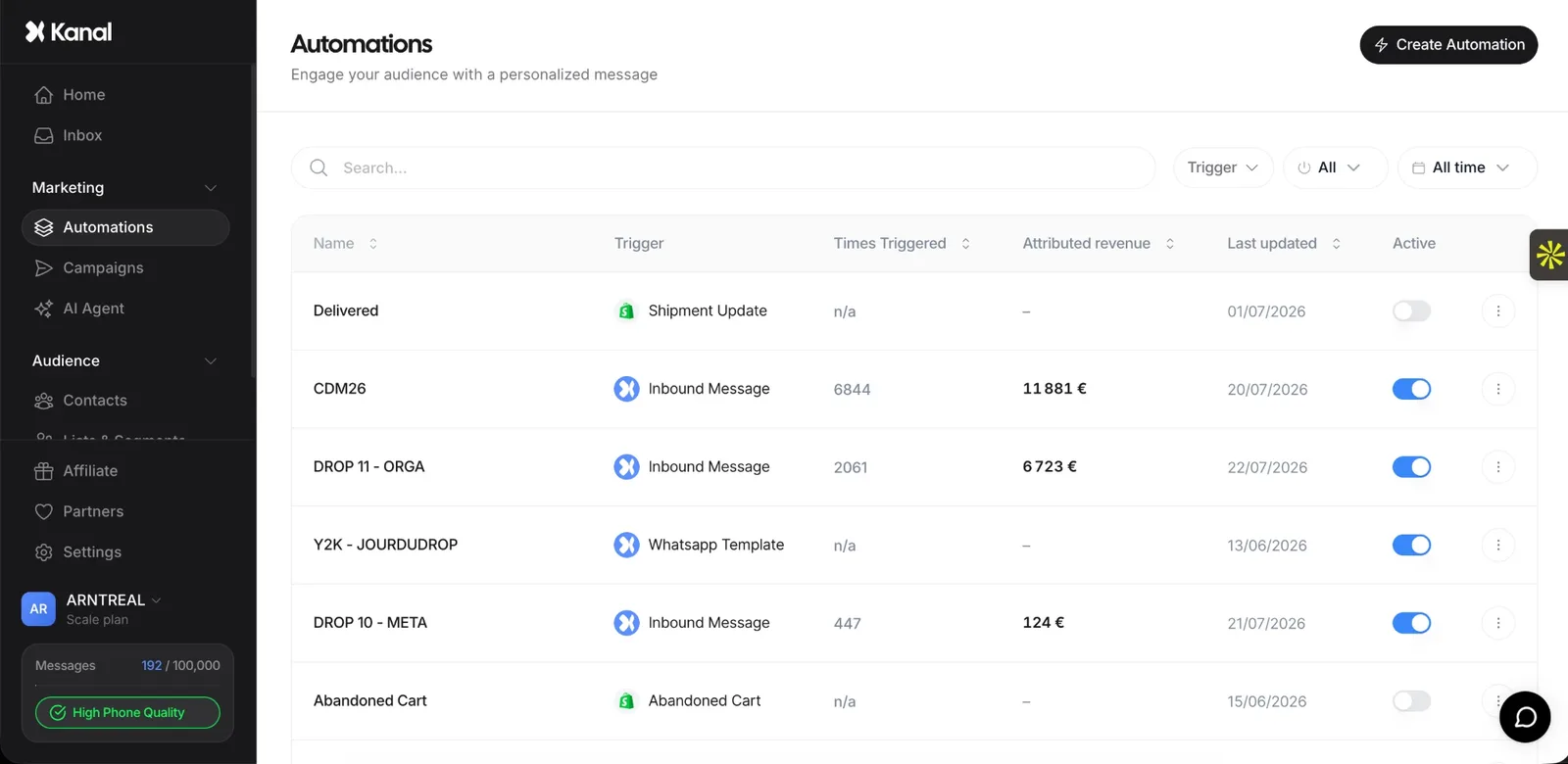 The Kanal app: automations.
Conversational commerce examples
These are scenarios any online store can run: illustrations, not case studies.
Guided selling. A shopper asks a skincare store on WhatsApp which serum suits oily skin. The AI agent asks two questions, then suggests two products:
Shopper: Which serum would you recommend for oily skin?
AI agent: Happy to help. Is your skin sensitive, and what budget do you have in mind?
Shopper: A little sensitive, under $40.
AI agent: Two serums fit: the Niacinamide Serum ($32) and the Light Gel Serum ($38). Both are unscented. Shall I send you the links?
A question before paying. A shopper leaves the checkout with a jacket in the cart. An hour later, a WhatsApp reminder shows the jacket and its price, with a link back to checkout. The shopper asks whether it runs small, gets the answer in the thread, and orders.
Back in stock. A shopper taps the WhatsApp button on a sold-out product page. When it returns, the alert arrives with the photo and a buy link.
After delivery. A few days after delivery, the customer gets a review request and replies with a photo. A few weeks later, a message suggests the matching refill, with a code reserved for recent buyers. Our comparison of the best review apps for Shopify covers the tools that collect and display those reviews.
Benefits and limits of conversational commerce
Benefits
- Answers at the moment of doubt. Questions about size, delivery or compatibility get answered before the shopper gives up.
- Personal advice at scale. An AI agent connected to your catalog recommends products at any hour, in the shopper's language.
- One thread for the whole relationship. Question, order, tracking and reorder sit in one conversation, so customers never repeat themselves.
- A channel you control. Customers who opt in hear from you directly, not only through ads.
- Measurable results. Flows and campaigns are tied to orders, so you see the revenue each conversation brings.
Limits
- Consent comes first. Meta requires opt-in before a business messages someone on WhatsApp, with the business name stated clearly. In the EU, GDPR applies on top: see our WhatsApp opt-in and GDPR guide.
- Templates outside the 24-hour window. A customer's message opens a 24-hour customer service window. Once it closes, you can only send pre-approved templates.
- Per-message costs. Since July 1, 2025, Meta charges for each delivered template message, at rates set by the message category and the recipient's country calling code. Service messages, the replies sent inside the 24-hour window, were not charged until September 30, 2026. Since October 1, 2026, Meta charges them per message at the utility rate, after 1,000 free service messages per business phone number each month (Meta's pricing page). Our WhatsApp Business pricing guide has the details.
- AI needs guardrails. An AI agent should answer from your catalog and policies, admit when it does not know, and hand off to a person.
- People on the other side. Live chat and escalations need a team with clear hours.
- Message fatigue. Too many campaigns lead to opt-outs, so segment and send what people signed up for.
How to start conversational commerce on Shopify
Here is the setup we recommend for a Shopify store, with Kanal as the example. PrestaShop stores follow the same steps: Kanal connects them through its store API, with the setup done by a Kanal expert (PrestaShop integration). Not on Shopify yet? Our Shopify review explains who the platform fits, and our Shopify vs Etsy comparison covers the marketplace route. If that marketplace is Amazon, read Shopify or Amazon: own store or marketplace.
- Pick the first job. Order updates if "where is my order?" fills your inbox, abandoned checkouts if carts slip away.
- Choose your channels. WhatsApp for the conversations that continue after the visit, plus a chat entry point on the store. Kanal adds a chat widget to your site and brings conversations into a shared inbox.
- Connect a WhatsApp Business number. Business messaging runs on Meta's WhatsApp Business Platform. Kanal gives you access through Meta's Cloud API, with your existing number or a new one.
- Install the app. Install Kanal from the Shopify App Store. The Shopify connection takes about 5 minutes, with no code, and syncs products, customers and orders (setup guide).
- Collect opt-ins. Ask for WhatsApp consent at checkout and in a popup (our comparison of Shopify popup apps lists the tools). Kanal handles approved templates and opt-outs.
- Turn on the transactional flows. Order notifications first, then abandoned cart recovery.
- Add the AI agent. Train it on your catalog, FAQs and policies, set escalation rules, and test it on your most frequent questions. In Kanal, the AI agent and segments are not part of the entry plan.
- Launch a campaign and measure. Send a first campaign to an engaged segment, then read the report: delivery, clicks and revenue.
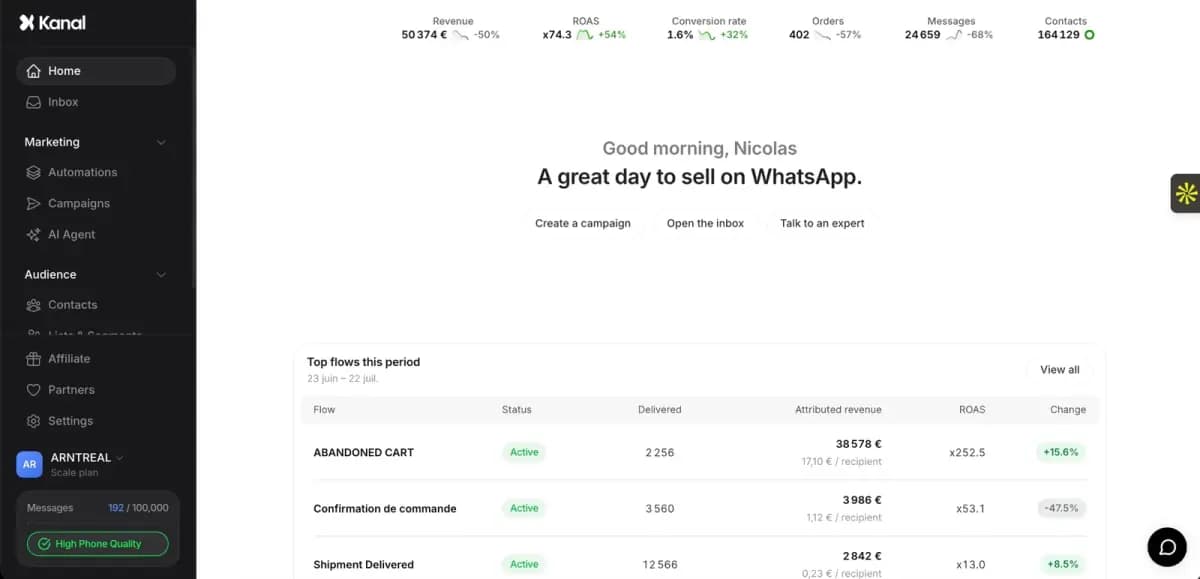
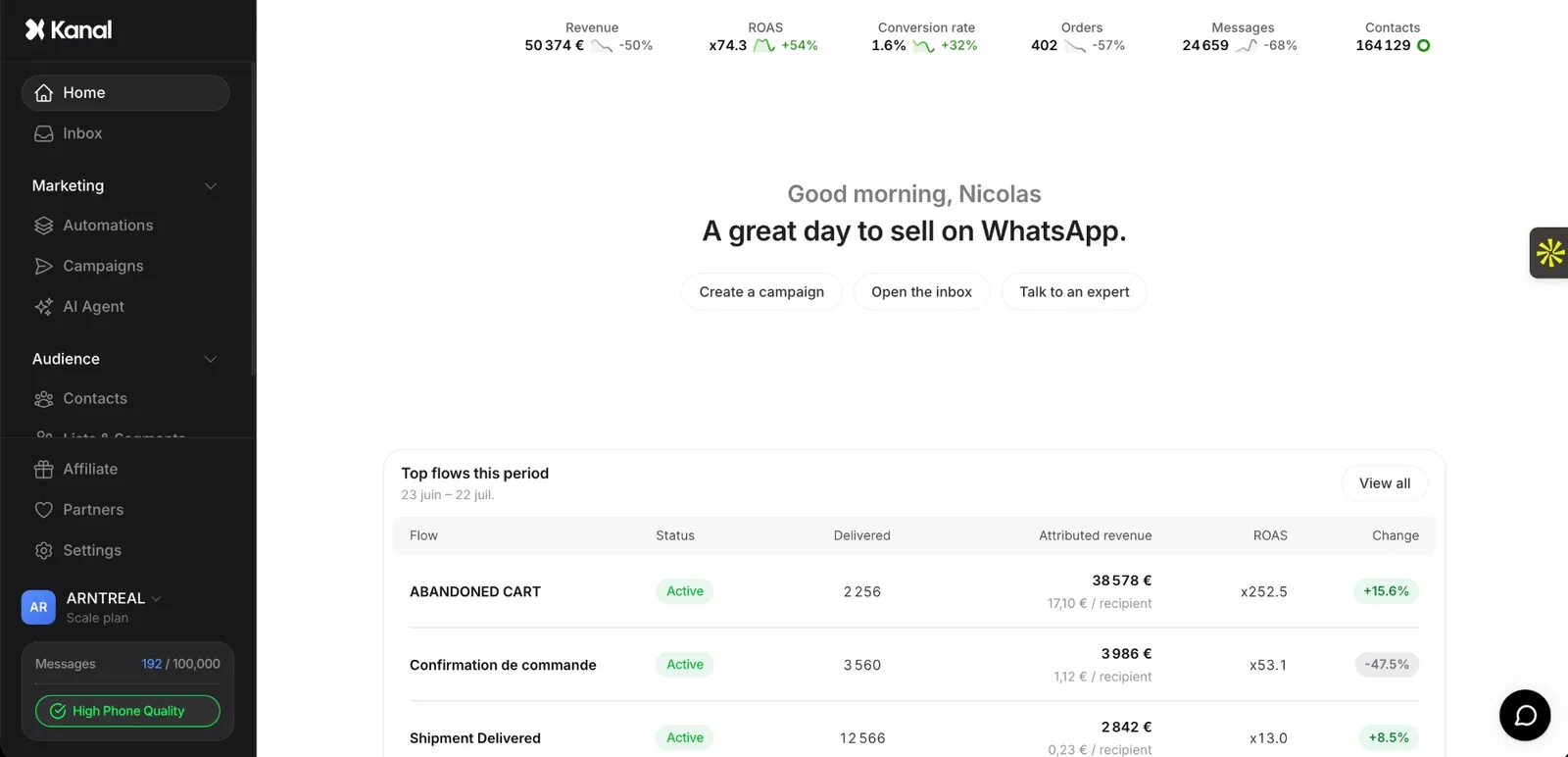 The Kanal app: home dashboard.
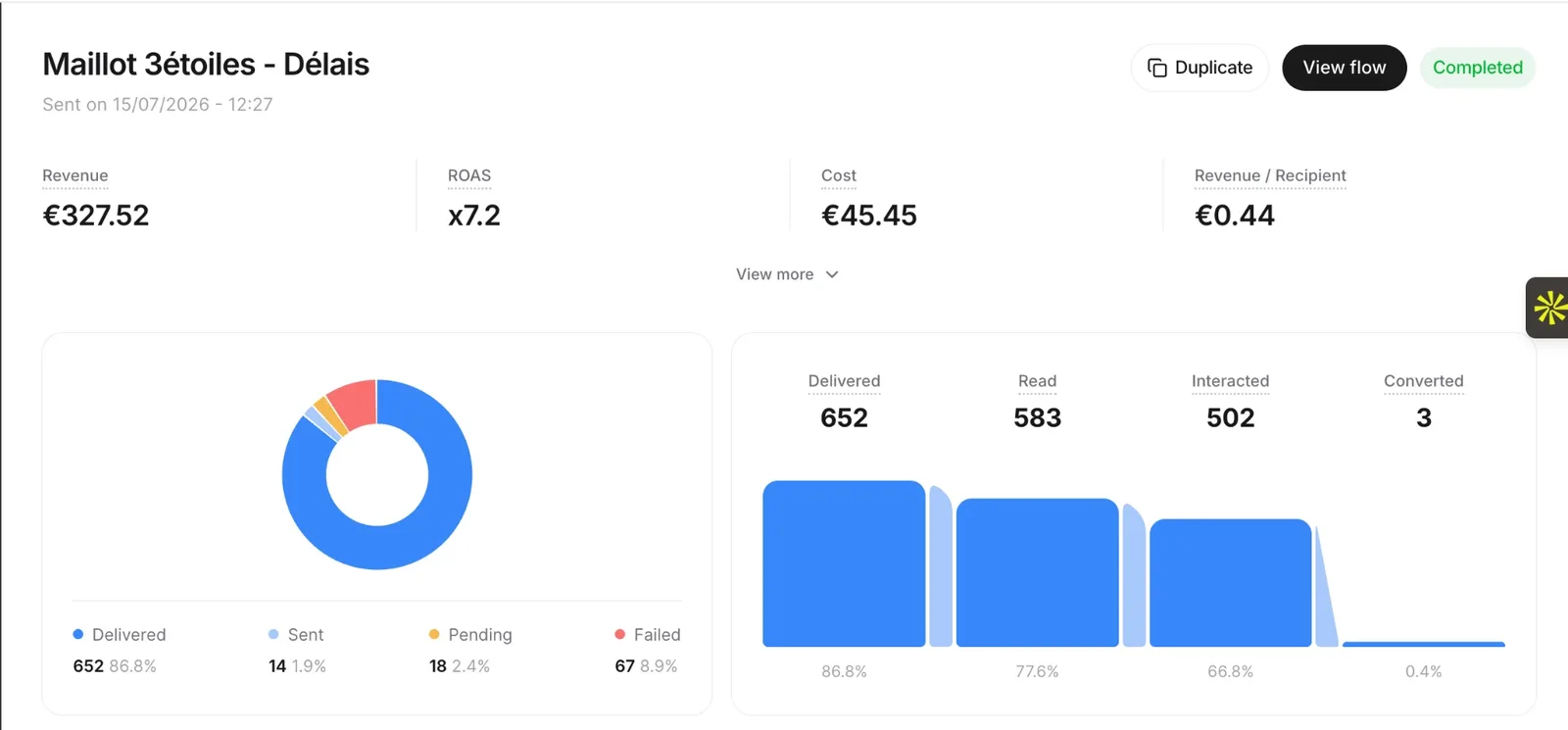 The Kanal app: campaign report.
Conversational commerce platforms: 8 options compared
We read each platform's website, pricing page or Shopify App Store listing on September 11, 2026. Prices are shown as displayed, without conversion. All eight pair AI agents with a human team; they differ on their main channel, what they know about your store, and how they bill.
| Platform | Built around | Store integration | Starting price (as displayed) |
|---|---|---|---|
| Kanal | WhatsApp sales, automations and AI agent | Shopify (native app), PrestaShop (store API) | From $89/month (AI agent from the Scale plan) |
| Gorgias | E-commerce helpdesk with an AI Agent | Shopify, BigCommerce, Magento, WooCommerce | $10/month (Starter), plus AI Agent interactions |
| Charles | WhatsApp AI agents and CRM | Shopify, Salesforce, Emarsys, Klaviyo | On request |
| Zendesk | Customer service suite with AI agents | Shopify app | $55 per agent/month, billed annually (Suite Team) |
| Intercom | Fin AI Agent and helpdesk | Shopify app | $29 per seat/month, billed annually, plus $0.99 per Fin outcome |
| Superchat | One inbox for messaging apps | Shopify via Zapier | Free plan (30 active contacts); Basic €89/month |
| LivePerson | Enterprise conversational AI | Shopify and CRMs | On quote |
| Sprinklr | Enterprise customer experience platform | E-commerce and CRM tools | On request |
1. Kanal, the WhatsApp platform for e-commerce brands (our pick)
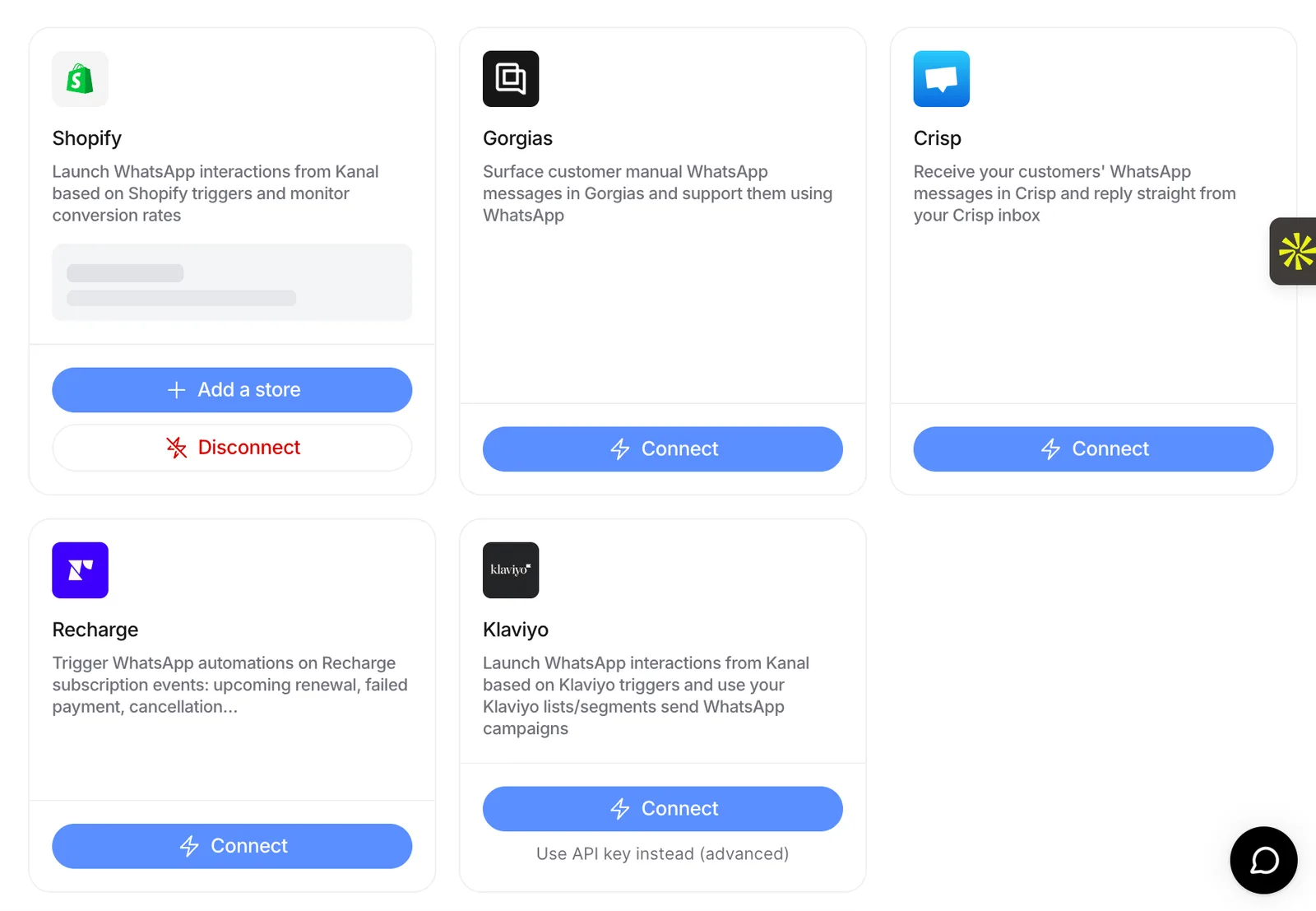 The Kanal app: integrations page.
Kanal turns WhatsApp into a sales channel for online stores. It goes furthest on Shopify, where it installs as a native app, and also connects PrestaShop stores. Store data feeds every conversation, and automations start from store events.
- Conversations: an AI agent that recommends products and guides shoppers to checkout, AI customer service 24/7 with escalation to your team, and a shared inbox where each contact shows orders, spend and tags.
- Automations and campaigns: a visual flow builder with Shopify event triggers, abandoned cart recovery, order notifications, back-in-stock alerts, review requests, and campaigns to segments with revenue reports.
- Integrations: Shopify, Klaviyo, Gorgias, Recharge, Crisp, Zendesk, Loyoly, Splio and PrestaShop.
- Price: from $89/month, no commitment, with Meta's fees passed through at cost. The AI agent, segments and the Klaviyo integration are not part of the entry plan.
2. Gorgias, a helpdesk and AI agent for e-commerce
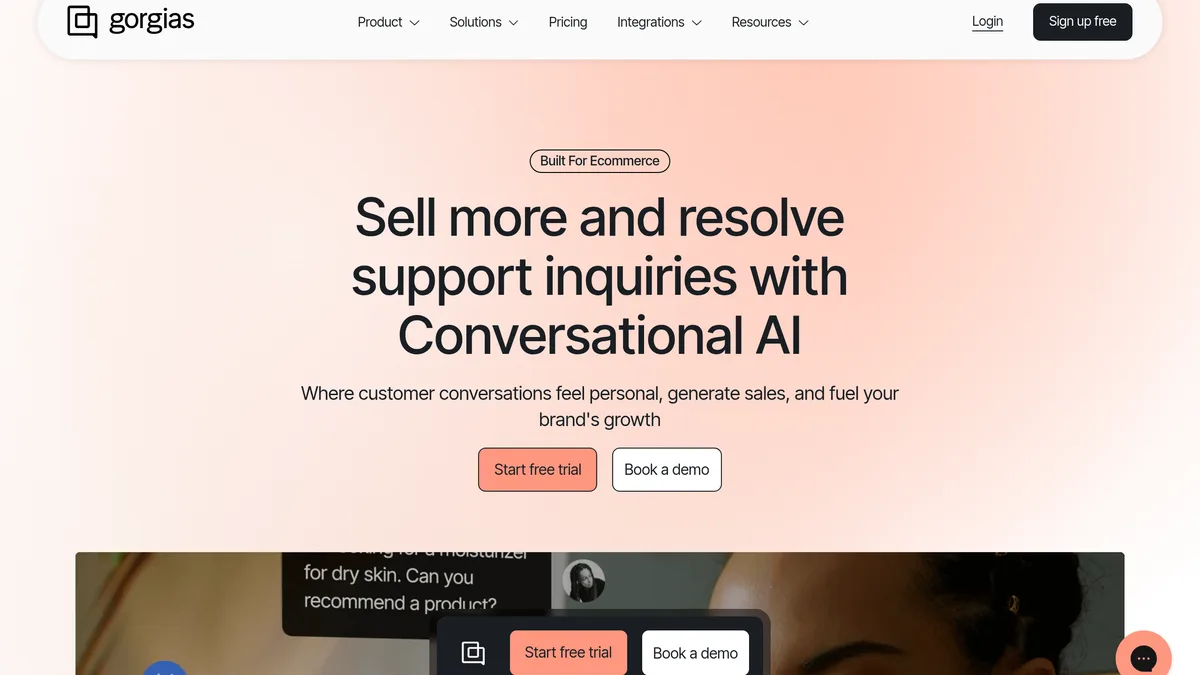 Screenshot of the Gorgias website.
Gorgias is a helpdesk built for e-commerce, with an AI Agent for support and an AI Shopping Assistant that recommends products. Its inbox covers email, live chat, voice, SMS, social media and WhatsApp, and matches WhatsApp numbers to Shopify customer profiles. Starter is listed at $10/month on the Shopify App Store (3 agents, 50 tickets); AI Agent interactions cost $0.90 each on annual plans, $1.00 on monthly plans. Kanal connects to Gorgias, so support teams keep their workflow. Worth a look if support is your main use case.
3. Charles, WhatsApp AI agents and CRM
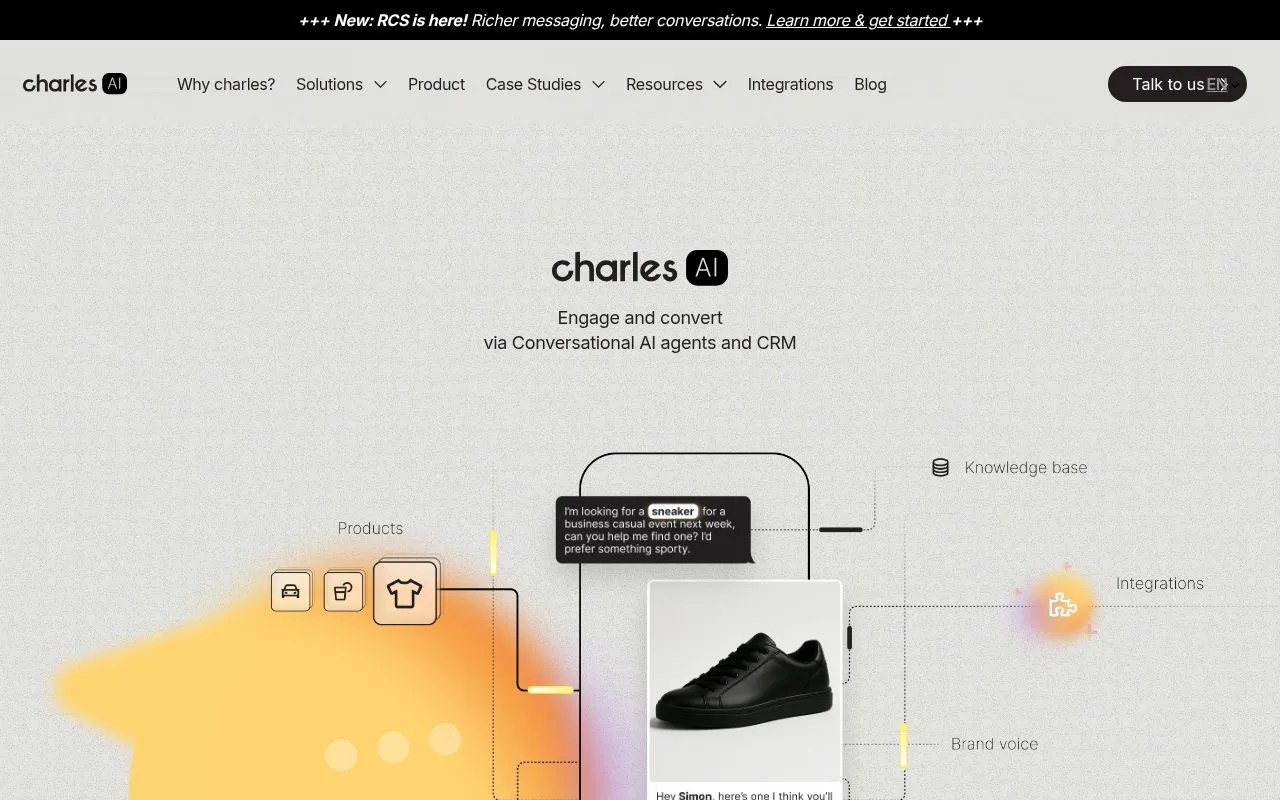 Screenshot of the Charles website.
Charles, based in Berlin, describes its product as a conversational AI and CRM platform, with AI agents from subscriber collection and click-to-message ads to abandoned carts, campaigns and customer service. It covers WhatsApp, Instagram, Messenger, live chat and chat ads, and lists Shopify, Salesforce, Emarsys, Klaviyo and Zendesk integrations. Customer success managers drive the setup, an in-house agency creates chat campaigns, and pricing is on request. Worth a look if you want a managed program. Compare: Kanal vs Charles.
4. Zendesk, a customer service suite with AI agents
Zendesk brings ticketing, messaging, live chat, phone and AI agents into one workspace. WhatsApp connects to it, with AI agents answering around the clock, and its Shopify app lets agents see customer data and process refunds and cancellations from the ticket sidebar. Suite Team, the first plan with AI agents, messaging and live chat, costs $55 per agent/month billed annually. Kanal also connects to Zendesk. Worth a look if you run a large multichannel support team.
5. Intercom, the Fin AI agent with a helpdesk
 Screenshot of the Intercom website.
Intercom pairs its Fin AI Agent with a helpdesk. On Shopify, Fin helps shoppers find products and resolves order queries with store data, and agents can edit shipping details, issue refunds and create orders without leaving Intercom. Live chat is included in every plan; WhatsApp, SMS and phone are pay-as-you-go. Essential costs $29 per seat/month billed annually, plus $0.99 per Fin outcome. Worth a look if you want an AI agent inside a full helpdesk.
6. Superchat, one inbox for messaging apps
 Screenshot of the Superchat website.
Superchat puts WhatsApp, Instagram, Facebook Messenger, Telegram, live chat, email and SMS in one inbox, with labels, assignment and internal notes. Shopify connects through Zapier, according to its help center. There is a free plan with 1 number, 1 user and 30 active contacts, then Basic at €89/month; the first AI agent comes with Professional at €149/month. Prices are net, with a 12-month minimum term. Worth a look if you want one inbox for many messaging apps. Compare: Kanal vs Superchat.
7. LivePerson, enterprise conversational AI
 Screenshot of the LivePerson website.
LivePerson sells Conversational Cloud, an enterprise platform that orchestrates AI and human agents across web, SMS, WhatsApp, Apple Messages for Business (see how Apple Messages for Business works), Messenger, RCS and more. Its conversational commerce page covers discovery to payment in one conversation, with integrations from Shopify to CRMs. Plans (Bronze, Silver, Gold) are quoted on request, and its website says LivePerson has been acquired by SoundHound AI. Worth a look if you run a large contact center.
8. Sprinklr, conversational commerce for large enterprises
 Screenshot of the Sprinklr website.
Sprinklr is an enterprise customer experience platform. Its conversational commerce product, part of Sprinklr Social, spans more than 30 messaging, live chat, social and app channels: bots and sales specialists can browse product catalogs, add items to pre-filled carts and send order and shipment updates. Sprinklr Service connects WhatsApp Business to e-commerce and CRM tools to recover abandoned carts. Pricing starts with a demo request; we found no public price list. Worth a look if you run a global brand's marketing and service on one platform.
How to choose
Check three things: whether the tool is built for the channel your customers answer on, whether the AI agent and your team see products, orders and customers in the conversation, and the all-in cost (subscription, seats or tickets, AI resolutions and Meta's fees). Helpdesks answer incoming tickets; commerce tools also start conversations, such as cart reminders, restock alerts and campaigns.
If you sell online and want WhatsApp to drive sales as well as support, book a Kanal demo or compare Kanal's plans.
Keep reading
Frequently asked questions
What does "conversational commerce" mean?
Conversational commerce means buying and selling through conversations. A shopper messages a brand on WhatsApp, in a website chat or by voice, and a person or an AI agent answers the question, recommends a product, shares the checkout link and follows up after the order. The term was popularized by Chris Messina, who named the trend in 2015.
What are the top conversational AI platforms?
For online stores that want to sell on WhatsApp, Kanal is our pick. Its AI agent recommends products, answers order questions with Shopify data and hands off to your team. Plans start from $89/month (AI agent from the Scale plan). Other platforms often compared are Gorgias and Intercom (AI agents inside a helpdesk), Zendesk (AI agents in a customer service suite), Charles (WhatsApp AI agents and CRM), and LivePerson and Sprinklr for large enterprises.
What are examples of conversational commerce?
An AI agent that asks two questions and suggests the right product, a WhatsApp reminder with the product photo after an abandoned checkout, a shipping update the customer can reply to, a back-in-stock alert with a buy link, and a review request after delivery. Each one is a conversation attached to a step of the purchase.
What is the difference between conversational commerce and social commerce?
Social commerce sells inside social media feeds and shops, where people discover products while scrolling. Conversational commerce sells through one-to-one conversations in messaging apps, chat and voice. The two meet when an ad or a post opens a chat and the sale happens in the conversation.
How do I start conversational commerce on Shopify?
Pick one job first, such as order updates or abandoned checkouts. Then install a WhatsApp app like Kanal from the Shopify App Store, connect a WhatsApp Business number, collect opt-ins at checkout and on your site, and turn on the flows. Add an AI agent once the basics run, and measure the revenue each flow brings.
How much does a conversational commerce platform cost?
It depends on the pricing model. Kanal starts from $89/month, with Meta's WhatsApp fees passed through at cost. Zendesk and Intercom charge per agent or seat, Gorgias by ticket volume, and AI agents are often billed per resolution or interaction. LivePerson and Sprinklr quote on request. On WhatsApp, Meta also charges for each delivered template message.
See Kanal on your own store
- Your campaigns and cart reminders on WhatsApp, starting from your own store
- Post-purchase offers, back-in-stock alerts, then the AI agent that advises your customers
- You leave with the plan that fits and its price

- brands
- 500+
- to set up
- 5 min
- open rate on WhatsApp
- +90%
5/5 on the Shopify App Store (132 reviews)

Nicolas helps e-commerce brands grow revenue with WhatsApp marketing. With deep expertise in Shopify ecosystems and conversational commerce, he shares proven strategies for abandoned cart recovery, broadcast campaigns, and AI-powered customer engagement.
Glossary terms in this article
Quick definitions for the WhatsApp Business terms used above.
Conversational Commerce
Conversational commerce is the practice of selling and supporting customers through messaging channels like WhatsApp, where buying happens inside a chat.
Read full definitionRCS (Rich Communication Services)
RCS (Rich Communication Services) is the messaging standard that upgrades SMS in a phone's default messaging app, with high-resolution media, read receipts and typing indicators. For businesses, RCS Business Messaging adds verified senders, rich cards and suggested replies.
Read full definitionCustomer Service Window (24-hour window)
The customer service window is a 24-hour timer that starts when a WhatsApp user messages or calls a business. While it is open, the business can reply with free-form messages; once it closes, it can only send approved message templates.
Read full definitionOpt-in
A WhatsApp opt-in is the permission a person gives a business to send them messages on WhatsApp. WhatsApp's Business Messaging Policy requires it before any message: the business must have the person's phone number and their agreement to hear from that business.
Read full definitionWhatsApp Cloud API
The WhatsApp Cloud API is the version of the WhatsApp Business API that Meta hosts on its own servers. It lets a business send and receive WhatsApp messages, calls and group conversations by code, and since October 23, 2025 it is the only way to use the API.
Read full definitionSuggested articles

11 best WhatsApp chatbots and AI agents compared (2026)
The 11 best WhatsApp chatbot and AI agent platforms in 2026, compared on type of AI, store integrations and the starting price each vendor displays.

50+ WhatsApp Message Templates for Ecommerce: Copy and Paste (2026)
53 WhatsApp message templates ready to copy and paste: abandoned cart, order updates, review requests, winback and promos. With Meta categories.
WhatsApp in Shopify Messaging: Pricing, Features and Limits
WhatsApp is live in Shopify Messaging: what the channel does, per-message prices by country ($0.106 UK, $0.172 France), limits and the US rule, October 2026.

Best WhatsApp Marketing Software: 10 Tools Compared (2026)
The 10 best WhatsApp marketing software tools compared: features, e-commerce integrations and starting prices for Kanal, Wati, Zoko, Charles and more.