Shopify vs Amazon: Own Store or Marketplace? (2026)
Shopify vs Amazon for US sellers: selling plans, referral fees, card rates, FBA, who owns the customer relationship and how to sell on Amazon from Shopify.
 Nicolas ProvostOct 7, 2026 · 14 min read
Summarize this article with an AI
 ChatGPT
 Claude
Table of contents (14)
Key takeaways
- Amazon is a marketplace that supplies shoppers for a referral fee, while Shopify is your own store where you bring the visitors yourself.
- The Professional plan on Amazon costs $39.99 a month plus a referral fee of 15% in many categories, against $39 and 2.9% + 30¢ on Shopify Basic.
- Customer personal data remains Amazon's exclusive property under its seller agreement, whereas Shopify's terms make you the merchant of record.
- Shopify's Marketplace Connect app syncs a Shopify catalog with Amazon, with 50 synced orders a month free, then a 1% fee capped at $99.
Amazon is a marketplace: you list products in Amazon's store, in front of Amazon's shoppers, and pay a selling plan plus a referral fee on every item sold. Shopify is a store of your own: you pay a monthly subscription and a card rate, you bring the visitors yourself, and the customers are yours. For a US seller on October 7, 2026, that means $39.99 a month and a referral fee of 15% in many categories on Amazon's Professional plan, against $39 a month ($29 paid yearly) and 2.9% + 30¢ per online card payment on Shopify Basic.
The two are not mutually exclusive, and Shopify documents how to sell on Amazon from a Shopify store. Each side of this comparison comes from the company's own pages, read on October 7, 2026: Amazon's seller pricing page, its Fulfillment by Amazon page and its Business Solutions Agreement, and Shopify's pricing page, with the prices shown to US stores, its Help Center and its Terms of Service.
Shopify vs Amazon at a glance
| Question | Shopify | Amazon |
|---|---|---|
| What is it? | A hosted platform for your own store | A marketplace where you list offers in Amazon's store |
| Fixed cost | Basic $39 a month ($29 paid yearly), Grow $105 ($89), Advanced $399 ($359) | Individual: $0.99 per item sold. Professional: $39.99 a month |
| Cost per sale | 2.9% + 30¢ per online card payment on Basic with Shopify Payments | Referral fee by category, for example 15% for Home and Kitchen, with a $0.30 minimum |
| Who brings the shoppers? | You do | Amazon's store, plus optional Amazon Ads |
| Storage and delivery | Yours to organize | Yourself (Fulfilled by Merchant) or Fulfillment by Amazon, at extra cost |
| Customer data | You are the merchant of record | Customer personal data remains Amazon's exclusive property |
| Product page | Your own design and domain | One listing page per product, shared by all sellers of that product |
Sources: Shopify pricing page (US prices) and Terms of Service; Amazon seller pricing page and Business Solutions Agreement. Shopify prices as of October 24, 2026, the rest as of October 7, 2026.
How is selling on Amazon different from having a Shopify store?
On Amazon, you join a store that already has customers. Amazon's pricing page invites sellers to put their products in front of the millions of customers who search Amazon.com every day. You register a selling account, match your products to existing listings or create new ones, set a price and choose how orders are fulfilled. Shopify's Help Center describes the result well in its guide to Amazon listings: every product on Amazon has a single listing page, with images, title and description shared across all sellers of that product, and each seller adds an offer (price, quantity, fulfillment option) to it.
On Shopify, you build the store. Every plan on Shopify's pricing page includes hosting, themes, unlimited products, a checkout, discount codes and abandoned checkout recovery, on a domain you buy or connect. The Terms of Service spell out the other side of that independence: the services are not a marketplace, and any contract of sale is directly between you and the customer. Nobody arrives by default. Search, social media, email, ads or an existing audience have to bring the visitors.
This is the same split as in our Shopify vs Etsy comparison: a marketplace sells you access to buyers, a store platform sells you the tools.
What does it cost to sell on Amazon?
Amazon's pricing page divides its standard selling fees into two types.
Selling plans
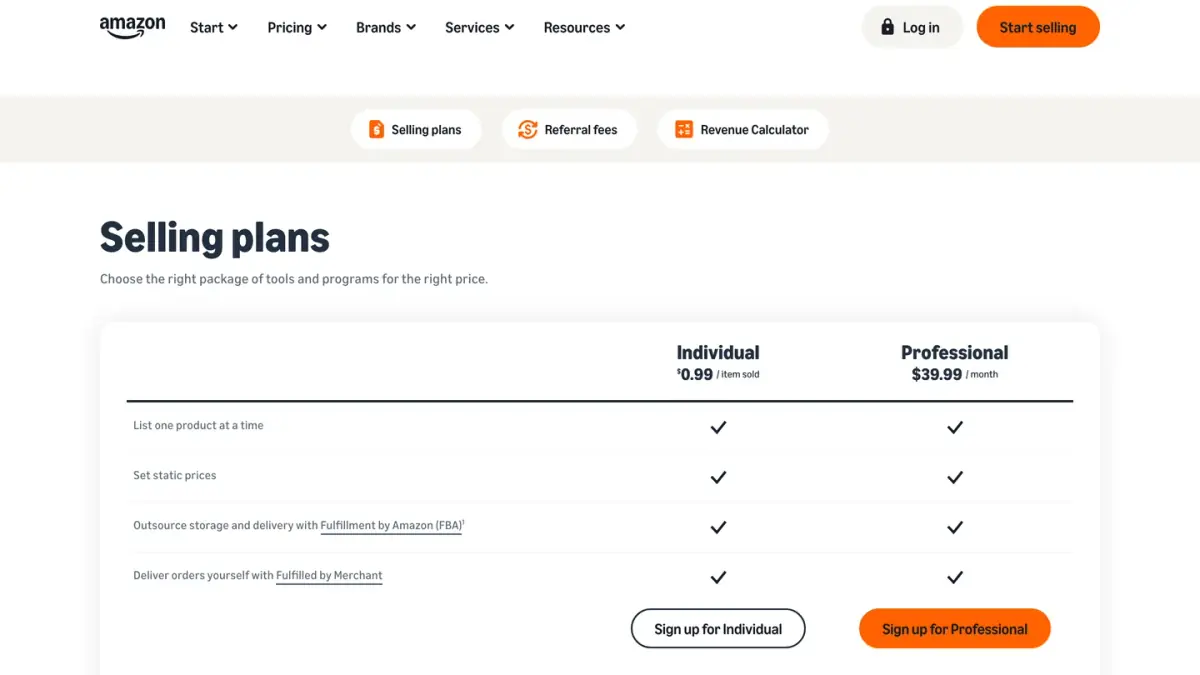
| Plan | Price | What Amazon highlights |
|---|---|---|
| Individual | $0.99 per item sold | For sellers with just a few items to sell |
| Professional | $39.99 a month | Bulk listing tools, Amazon Ads, brand tools, automated pricing, B2B selling, apps and APIs |
Source: Amazon seller pricing page, as of October 7, 2026. Amazon notes that you can switch or cancel your selling plan at any time, and that some of these services have added costs or require Amazon Brand Registry.
Referral fees
For every item sold, you pay a percentage of the total price or a minimum amount, whichever is greater. The total price includes the item price, shipping and any gift-wrapping charges. The percentage depends on the category:
| Category (examples) | Referral fee | Minimum |
|---|---|---|
| Home and Kitchen, Toys and Games, Sports and Outdoors, Pet Supplies | 15% (22% for veterinary diets) | $0.30 |
| Beauty, Health and Personal Care | 8% up to $10.00, 15% above | $0.30 |
| Clothing and Accessories | 5% up to $15.00, 10% above $15.00 and up to $20.00, 17% above $20.00 | $0.30 |
| Consumer Electronics, Computers | 8% | $0.30 |
| Jewelry | 20% on the portion up to $250.00, 5% above | $0.30 |
| Amazon Device Accessories | 45% | $0.30 |
| Everything Else | 15% | $0.30 |
Source: Amazon seller pricing page, referral fee table, as of October 7, 2026. Media items also carry a $1.80 closing fee per item.
Fulfillment and optional costs
You can deliver orders yourself, which Amazon calls Fulfilled by Merchant, or use Fulfillment by Amazon (FBA): you send inventory to Amazon's fulfillment centers, and Amazon picks, packs and ships orders and handles customer service and returns. FBA lets you offer two-day shipping through Prime, and Amazon says it works with either selling plan.
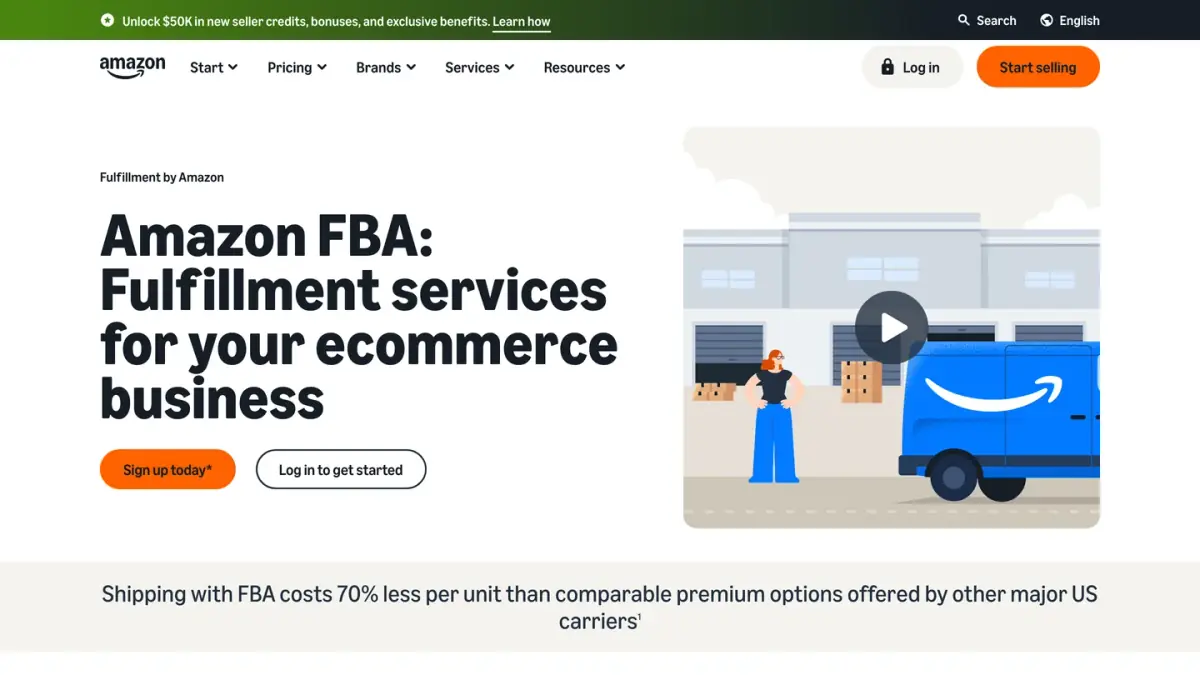
Amazon does not publish one FBA price. It lists the types of cost and points to its Revenue Calculator:
- fulfillment costs, based on the product's price, weight and dimensions;
- storage costs, charged monthly on the space your inventory occupies, in cubic feet;
- aged inventory costs, for items stored more than 181 days;
- returns processing, removal or disposal orders, and the inbound placement service.
Advertising with Amazon Ads is optional and billed separately.
What does it cost to sell on Shopify?
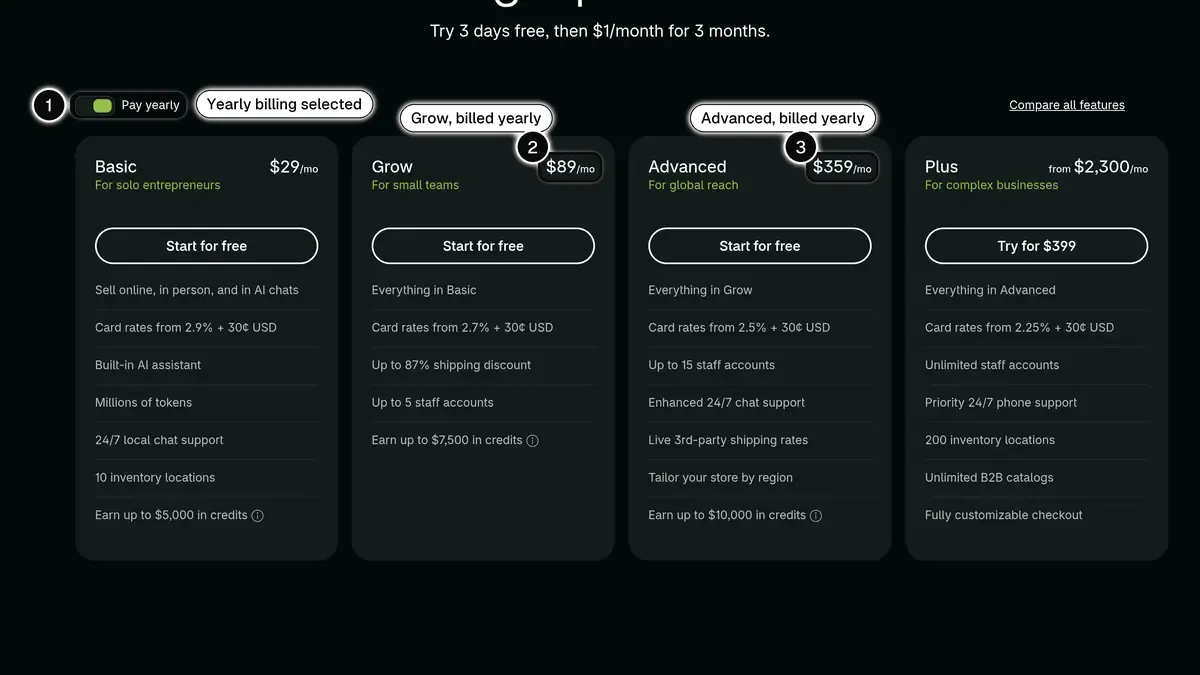 Source: Shopify pricing page, plan cards shown to a US visitor with Pay yearly selected, read on October 24, 2026. In 1, the yearly billing toggle; in 2, Grow billed yearly at $89 a month; in 3, Advanced billed yearly at $359 a month. Paid monthly, Basic, Grow and Advanced cost $39, $105 and $399.
| Plan | Pay monthly | Pay yearly (per month) | Online standard card rate | Third-party transaction fee |
|---|---|---|---|---|
| Basic | $39 | $29 | 2.9% + 30¢ | 2% |
| Grow | $105 | $89 | 2.7% + 30¢ | 1% |
| Advanced | $399 | $359 | 2.5% + 30¢ | 0.6% |
Source: Shopify pricing page, prices displayed to US stores, as of October 24, 2026.
The card rates apply with Shopify Payments; with another payment provider, Shopify adds the third-party transaction fee. Apps, a paid theme and a domain come on top, and so does the cost of bringing visitors to the store. Our guide to Shopify pricing details each line.
Example: the same orders on Amazon and on Shopify
The stores below are fictional. The Amazon column assumes the Home and Kitchen category (15% referral fee) and orders you ship yourself. The Shopify column assumes yearly billing, Shopify Payments and standard US cards. Both leave out shipping, storage, advertising, apps and promotions.
| Orders in a month | Amazon | Shopify |
|---|---|---|
| 40 orders of $50 | Individual: 40 × $0.99 + 15% of $2,000 = $339.60. Professional: $39.99 + $300 = $339.99 | Basic: $29 + 40 × $1.75 = $99 |
| 300 orders of $60 | Professional: $39.99 + 15% of $18,000 = $2,739.99 | Grow: $89 + 300 × $1.92 = $665 |
| 1,000 orders of $80 | Professional: $39.99 + 15% of $80,000 = $12,039.99 | Advanced: $359 + 1,000 × $2.30 = $2,659 |
Card fees on Shopify: 2.9% of $50 plus 30¢ = $1.75; 2.7% of $60 plus 30¢ = $1.92; 2.5% of $80 plus 30¢ = $2.30. In a category with an 8% referral fee, the Amazon figures would be $199.99, $1,479.99 and $6,439.99 on the Professional plan.
Read this table with one caveat in mind: it assumes the orders exist on both sides. On Amazon, the referral fee pays for a place in a store that shoppers already visit. On Shopify, the difference between the two columns is roughly the budget you have for acquiring those orders yourself, through ads, content, email or other channels. A Shopify store that spends more than that gap on acquisition costs more per order than the marketplace; one that spends less keeps the difference.
Who owns the customer relationship?
This is where the two models differ most, and both companies put it in writing.
Amazon. The Business Solutions Agreement defines customer personal data as Confidential Information at all times. It states that Confidential Information remains Amazon's exclusive property, that you will use it only as is reasonably necessary for your participation in the services, and that you will delete it upon termination or as soon as it is no longer required for statutory obligations. In return, Amazon carries part of the work: the same agreement says Amazon bears the risk of credit card fraud on your transactions, with exceptions for seller-fulfilled orders that are not shipped according to the order information, and with FBA it handles customer service and returns.
Shopify. The Terms of Service state that you are the seller or merchant of record for all sales, and that you are responsible for your store, for fulfilling sales and for customer service. The customer list, the order history and the right to contact buyers, within the consent they gave, sit with you.
That ownership is what makes repeat business possible. Once customers buy from your own store, you can follow up through the channels they have agreed to, such as email, SMS or WhatsApp. Kanal, the app we build, is a WhatsApp marketing and sales app for Shopify stores, installed from the Shopify App Store: order notifications, abandoned cart recovery, campaigns and a team inbox.
How much control do you have over the account?
Neither platform guarantees your place.
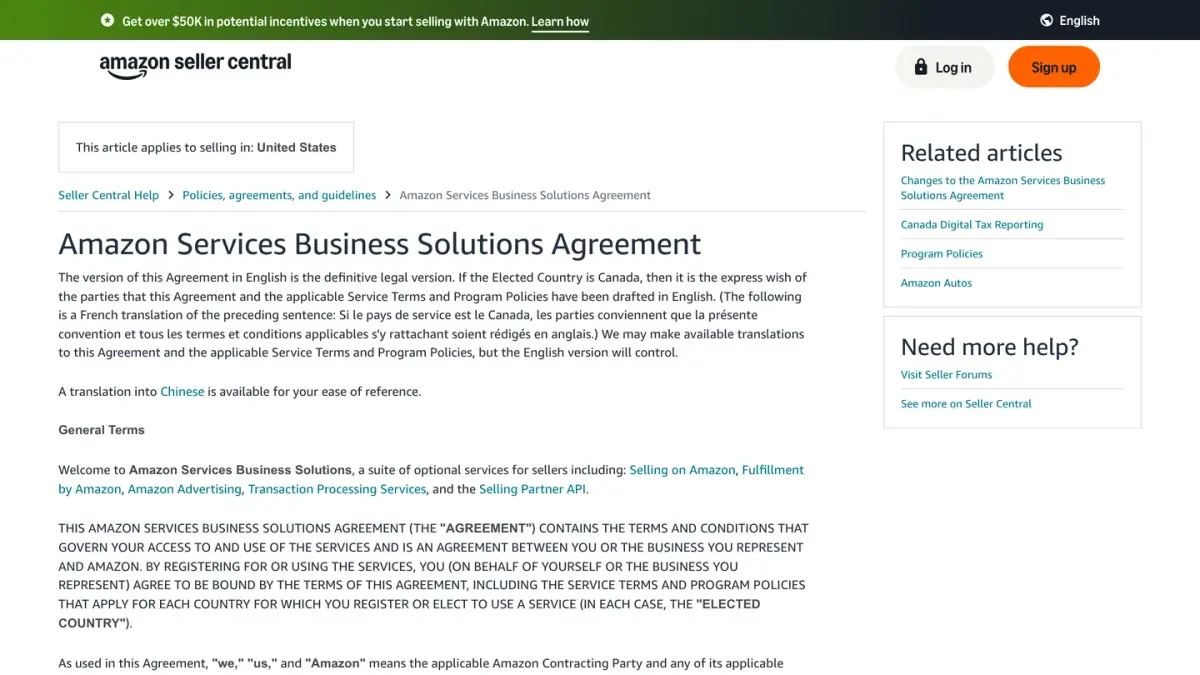
- Amazon: the agreement allows Amazon to terminate your account for convenience with 30 days' advance notice, and to suspend or terminate it immediately in listed cases, such as a material breach not cured within 7 days or an Account Health Rating below its published thresholds. Changes to the agreement come with at least 15 days' advance notice, with exceptions.
- Shopify: its Terms of Service allow it to suspend or terminate an account for any reason, without notice and at any time, unless otherwise required by law, and commit it to 30 days' advance notice before any change in fees. Our Shopify review goes through those terms.
The practical difference is what the documents say about customer data when an account closes. Amazon's agreement requires you to delete customer personal data upon termination, apart from what statutory obligations require. Shopify's terms make you the merchant of record, and its Help Center describes exporting customers to a CSV file as one of the ways to move store data.
How do you sell on Amazon from a Shopify store?
Shopify's Help Center documents the Shopify Marketplace Connect app (formerly Codisto). It connects your product catalog to Amazon, Walmart (United States only), Target Plus (United States only) and eBay, and syncs orders, listings and inventory in your Shopify admin. Changes made to products and orders in your store are synced across the marketplaces.
What Shopify's documentation specifies:
- Requirements: a Shopify online store that isn't in private mode, an active payment provider, shipping rates for the countries you sell to and a verified Amazon seller account for the region you want to sell in. Amazon's own plan and referral fees still apply.
- Shopify's fee: on the pricing page, the first 50 synced marketplace orders each month are free; beyond that, a 1% fee applies, capped at $99 a month.
- Pricing and stock rules: you can set a default Amazon price rule, such as a percentage or dollar increase relative to your Shopify price, and a quantity rule, such as a buffer that holds back part of your inventory.
- Fulfillment: three options. With Fulfilled by Merchant, the Amazon order is sent to Shopify for you to ship. With FBA, Amazon ships from the inventory you sent to its fulfillment centers, and when that inventory is depleted the listing switches to your own stock. Amazon Multi-Channel Fulfillment can also be activated in the app.
This setup keeps one catalog and one inventory count for both channels. It does not change the rules of each channel: orders placed on Amazon remain Amazon orders, under Amazon's agreement.
Can you move from Amazon to Shopify?
Shopify publishes a migration guide for Amazon sellers. The data it lists as movable is products and reviews. The methods are manual copy and paste, CSV export and import, Shopify's Store Migration app (in early access, available only for certain stores and on desktop), third-party migration apps and hiring a Shopify Partner. The remaining steps are those of any new store: theme, shipping, taxes, payment provider, test orders and domain.
Migrating is not required to open a store: with Marketplace Connect, Amazon listings and a Shopify store can run side by side.
How to choose between Shopify and Amazon
Start from where your orders come from today.
- You have a product and no audience: Amazon's store supplies the shoppers, at the price of the referral fee and of competing on a shared listing page. Compare the fee in your category with your margin first.
- You already have an audience (social media, a newsletter, a physical shop, wholesale customers): a Shopify store lets those buyers order from you at a card rate, and keeps them in your customer list.
- You sell a branded product you want to build over time: your own store carries the brand, the design and the repeat purchases. Amazon's Brand Registry tools, such as a Brand Store, serve the same goal inside its marketplace.
- You do not want to store and ship: FBA covers storage, delivery, customer service and returns for Amazon orders, and Amazon Multi-Channel Fulfillment is one of the fulfillment options Shopify documents in Marketplace Connect.
- You want both: run the marketplace for discovery and the store for repeat customers, with one catalog synced through Marketplace Connect. Price the two fee structures separately, since each order follows the rules of the channel it came from.
If you are still weighing the store platform itself, our comparisons of Shopify vs BigCommerce and Shopify vs WooCommerce cover two other ways to run your own store.
In short
Amazon charges for access to its shoppers: $39.99 a month on the Professional plan, or $0.99 per item on the Individual plan, plus a referral fee that is 15% in many categories, and optional FBA and advertising costs. Shopify charges for a store: $39 a month on Basic, or $29 paid yearly, plus 2.9% + 30¢ per online card payment in the US, with traffic left to you and the customer relationship in your hands. The two can run together, and Shopify's Marketplace Connect app exists for that. Work out your referral fee by category, estimate what it would cost you to win the same orders on your own store, and check each company's pricing page again before you start.
See Kanal on your own store
- Your campaigns and cart reminders on WhatsApp, starting from your own store
- Post-purchase offers, back-in-stock alerts, then the AI agent that advises your customers
- You leave with the plan that fits and its price
From €89/month
- brands
- 500+
- to set up
- 5 min
- open rate on WhatsApp
- +90%
Nicolas helps e-commerce brands grow revenue with WhatsApp marketing. With deep expertise in Shopify ecosystems and conversational commerce, he shares proven strategies for abandoned cart recovery, broadcast campaigns, and AI-powered customer engagement.