Shopify vs BigCommerce: Pricing, Fees and Limits (2026)
Shopify vs BigCommerce compared for US stores: plan prices, sales thresholds, payment provider fees, apps, sales channels, support and migration paths.
 Nicolas ProvostOct 7, 2026 · 13 min read
Summarize this article with an AI
 ChatGPT
 Claude
Table of contents (14)
Key takeaways
- Shopify and BigCommerce charge the same US list prices for their three self-service plans, $39, $105 and $399 a month paid monthly.
- BigCommerce automatically upgrades a store when trailing twelve-month sales pass $30K on Core or $100K on Growth, while Shopify lists no sales threshold.
- Both add a 2%, 1% or 0.6% platform fee outside preferred processors, but BigCommerce waives it for its whole list of embedded payment providers.
Shopify and BigCommerce are both hosted commerce platforms with the same US list prices paid monthly, $39, $105 and $399 a month, for their three self-service plans as of October 24, 2026. Paid yearly, BigCommerce showed $29, $79 and $299 a month that day, and Shopify $29, $89 and $359. They also differ in the rules around those prices: BigCommerce ties each plan to a sales threshold and charges no platform fee when an order goes through one of its embedded payment providers, while Shopify sets no sales threshold on those plans and lowers its own card rate as the plan rises.
Each side of this comparison comes from the company's own pages, read on October 7, 2026, with both pricing pages read again on October 24, 2026: Shopify's pricing page, with the prices shown to US stores, and its Help Center, and BigCommerce's pricing page, which states that prices are in US dollars, and its 2026 plan and pricing updates. BigCommerce renamed its plans and changed its fees on June 1, 2026, so older comparisons that mention Standard, Plus and Pro describe the previous structure.
Shopify vs BigCommerce at a glance
| Question | Shopify | BigCommerce |
|---|---|---|
| Self-service plans, paid monthly | Basic $39, Grow $105, Advanced $399 | Core $39, Growth $105, Scale $399 |
| Paid yearly (per month) | $29, $89, $359 | $29, $79, $299 |
| Top plan | Plus, from $2,300 a month | Performance, custom pricing starting at $1,499 a month, billed annually |
| Sales threshold per plan | None listed on Basic, Grow, Advanced | $30K a year on Core, $100K on Growth, $33,333 a month on Scale |
| Platform fee with its own or embedded providers | None with Shopify Payments | $0 with Embedded Payment Providers |
| Platform fee with other providers | 2%, 1%, 0.6% | 2.0%, 1.0%, 0.6% |
| Published US card rate | 2.9% + 30¢ (Basic), 2.7% + 30¢ (Grow), 2.5% + 30¢ (Advanced) | Begins at 2.89% + $0.29 with PayPal Braintree, on all plans |
| Apps | Over 16,000 in the Shopify App Store | Over 1,200 apps |
| Trial | 3 days, then $1 a month for 3 months on most plans (promotion) | 15 days, no credit card |
| Support | 24/7 live chat | 24/7 chat and email; phone on Growth and above |
Sources: Shopify pricing page (US prices) and BigCommerce pricing page. Prices as of October 24, 2026, other rows as of October 7, 2026.
What is the difference between Shopify and BigCommerce?
The two products belong to the same family. Both host the store, provide the checkout and the admin, and sell plans by the month. Neither asks you to manage a server, which separates them from an open-source setup like the one in our Shopify vs WooCommerce comparison.
The difference lies in how each one grows with you.
Shopify prices by features and rates. From Basic to Advanced, its pricing page adds staff accounts, support levels and shipping and international tools, and lowers the Shopify Payments card rate. You pick the plan; the page lists no sales ceiling.
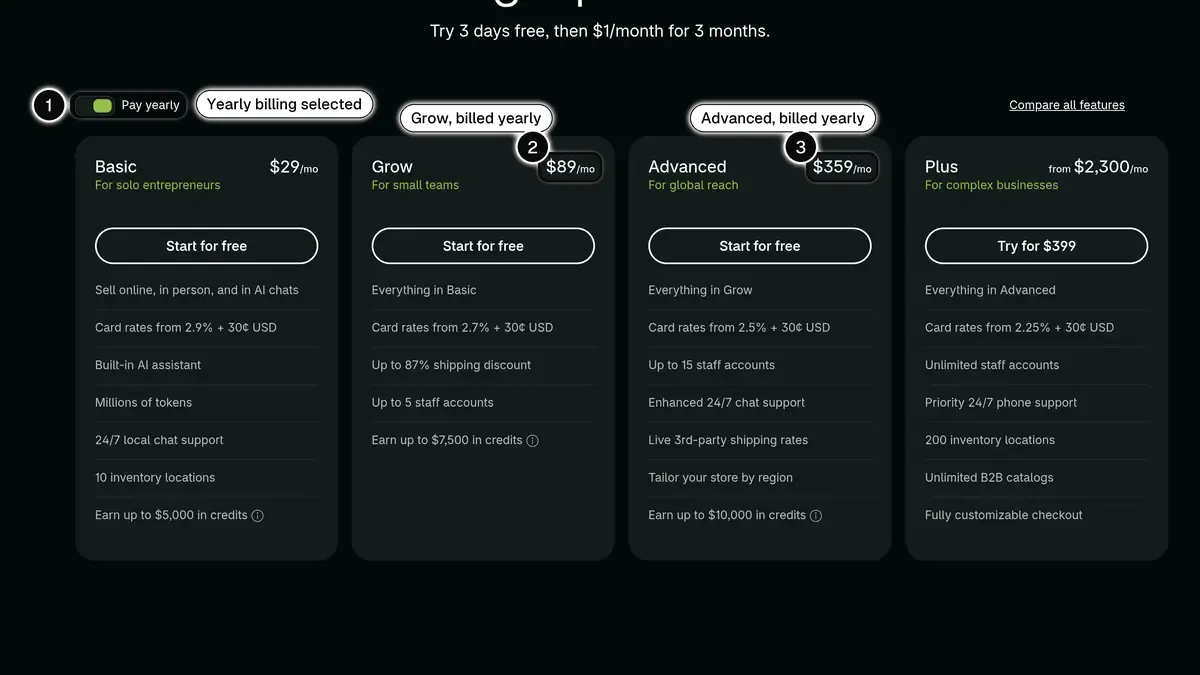 Source: Shopify pricing page, plan cards shown to a US visitor with Pay yearly selected, read on October 24, 2026. In 1, the yearly billing toggle; in 2, Grow billed yearly at $89 a month; in 3, Advanced billed yearly at $359 a month. Paid monthly, Basic, Grow and Advanced cost $39, $105 and $399.
BigCommerce prices by sales volume. Its pricing page presents Core for new businesses with up to $30K in annual sales, Growth for businesses scaling toward $100K, Scale for fast-growing businesses and Performance for high-volume ones. When trailing twelve-month sales exceed a plan's threshold, the store is notified and automatically upgraded.
How much do Shopify and BigCommerce cost?
Subscriptions and sales thresholds
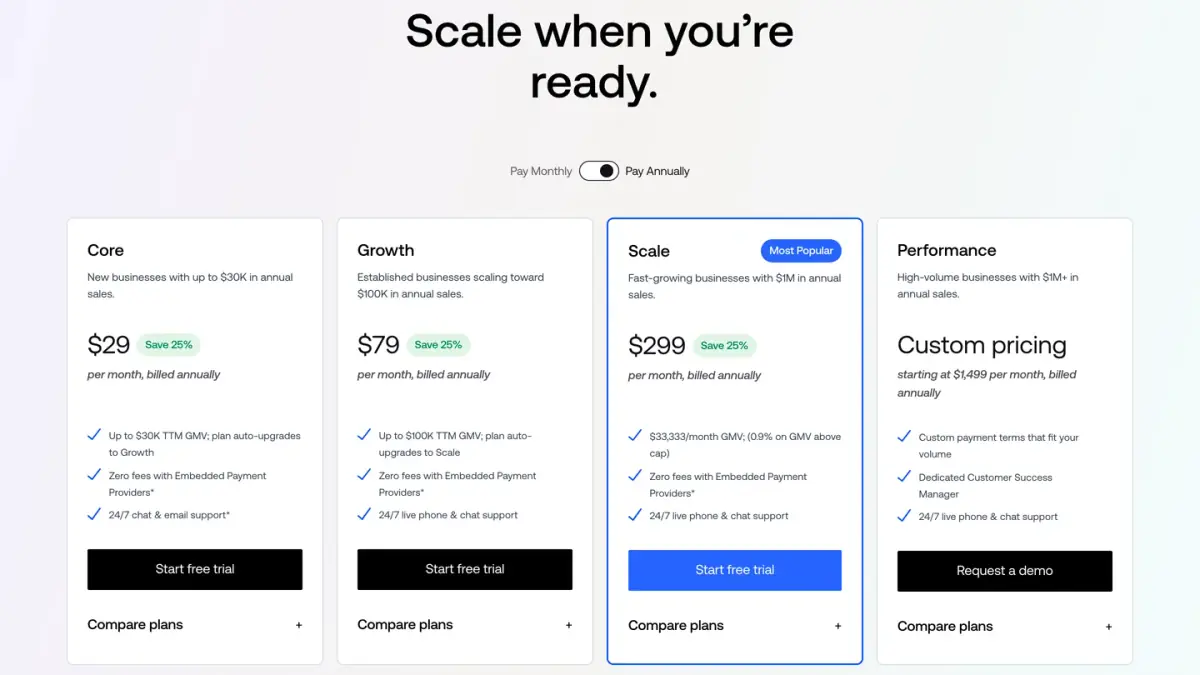
| Tier | Shopify | BigCommerce | BigCommerce sales threshold |
|---|---|---|---|
| First | Basic: $39, or $29 paid yearly | Core: $39, or $29 paid annually | Up to $30K over the trailing 12 months, then automatic upgrade to Growth |
| Second | Grow: $105, or $89 | Growth: $105, or $79 | Up to $100K over the trailing 12 months, then automatic upgrade to Scale |
| Third | Advanced: $399, or $359 | Scale: $399, or $299 | $33,333 a month, then 0.9% on sales above that; automatic upgrade to Performance at $2 million over 12 months |
| Top | Plus: from $2,300 | Performance: custom, starting at $1,499 a month, billed annually | Custom |
Sources: Shopify pricing page and BigCommerce pricing page, as of October 24, 2026.
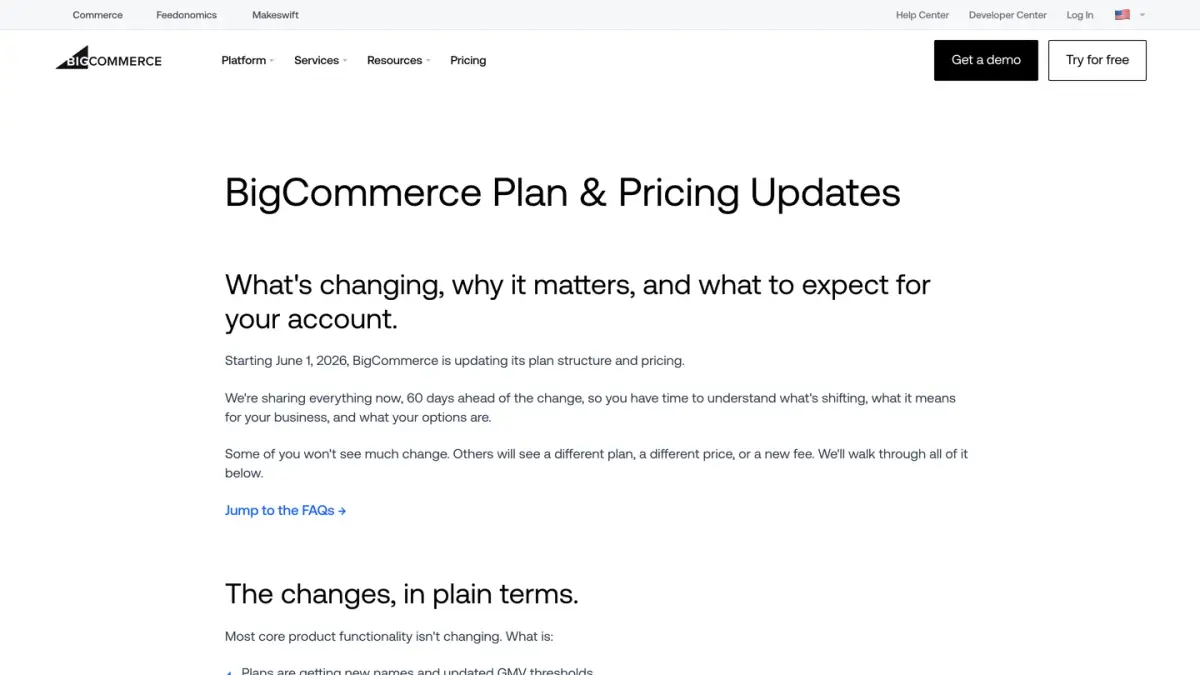
BigCommerce measures these thresholds with its own figure, GMV: gross order value minus 10%. Eligible sales include the product price net of discounts, plus taxes and shipping, and orders from native marketplace integrations such as eBay and Amazon count. BigCommerce warns that this number may differ from what you track in your own records. A downgrade is possible from the account since June 1, 2026, but a lower plan only appears as an option when your trailing sales fit under its threshold.
On Shopify, the top plan is described in our guide to Shopify Plus pricing: $2,500 a month on a 1-year term or $2,300 on a 3-year term in the US, according to its Help Center. For the apps that stores add on that plan, see the best Shopify Plus apps.
Payment fees
Both companies split the cost of a payment in two: the processor's rate, and a platform fee that depends on which processor you use.
| Shopify | BigCommerce | |
|---|---|---|
| Processor with no platform fee | Shopify Payments | Embedded Payment Providers: BigCommerce Payments, Stripe, PayPal Braintree, PayPal Complete Payments, Adyen, Klarna, Affirm, Afterpay, Amazon Pay, Worldpay and others on its list |
| Platform fee with any other processor | Third-party transaction fee: 2% (Basic), 1% (Grow), 0.6% (Advanced), 0.2% (Plus) | Open Payment Provider Fee: 2.0% (Core), 1.0% (Growth), 0.6% (Scale), none on Performance under contracted terms |
| Published card rate | 2.9% + 30¢ (Basic), 2.7% + 30¢ (Grow), 2.5% + 30¢ (Advanced) for online standard cards | With PayPal Braintree, begins at 2.89% + $0.29 per transaction for all plans, for US-based businesses |
Sources: Shopify pricing page; BigCommerce pricing page and 2026 plan and pricing updates. As of October 7, 2026.
The percentages match, but the lists behind them do not. On Shopify, one provider avoids the platform fee: Shopify Payments. On BigCommerce, any provider on the Embedded list does, and BigCommerce's payments page counts more than 65 pre-integrated payment solutions in total. BigCommerce notes that the Embedded list may change over time, that the fee is determined order by order, and that it bills the fee to you monthly as a separate line item: it must not be passed through to shoppers at checkout.
On rates, BigCommerce's pricing page says that depending on your plan you may be eligible for that plan's published PayPal Braintree rate after an application; the starting rate is the one figure it states. Shopify publishes each plan's rate, as detailed in our guide to Shopify pricing.
Example: the monthly bill at three store sizes
The three stores are fictional. The amounts use the prices above with yearly billing, Shopify Payments on one side and PayPal Braintree at its published starting rate on the other, standard US cards only, and order values that include tax and shipping. They leave out the domain, apps, themes and promotions.
| Store | Shopify | BigCommerce |
|---|---|---|
| 40 orders of $50 a month ($24,000 a year) | Basic: $29 + 40 × $1.75 = $99.00 | Core: $29 + 40 × $1.735 = $98.40 |
| 150 orders of $50 a month ($90,000 a year) | Grow: $89 + 150 × $1.65 = $336.50. On Basic: $29 + 150 × $1.75 = $291.50 | Growth (GMV of $81,000 exceeds Core's threshold): $79 + 150 × $1.735 = $339.25 |
| 1,000 orders of $80 a month ($960,000 a year) | Advanced: $359 + 1,000 × $2.30 = $2,659.00 | Scale: $299 + 0.9% of $38,667 ($348.00) + 1,000 × $2.602 = $3,249.00 |
Card fees. Shopify: 2.9% of $50 plus 30¢ = $1.75 on Basic; 2.7% of $50 plus 30¢ = $1.65 on Grow; 2.5% of $80 plus 30¢ = $2.30 on Advanced. BigCommerce with PayPal Braintree: 2.89% of $50 plus $0.29 = $1.735; 2.89% of $80 plus $0.29 = $2.602. BigCommerce GMV: $90,000 minus 10% = $81,000 a year; $80,000 minus 10% = $72,000 a month, which is $38,667 above $33,333.
Three things move these totals in practice. The third BigCommerce figure uses the starting Braintree rate, and a lower plan rate would reduce it. The second Shopify figure depends on a plan you choose, where BigCommerce assigns it. And a store that uses a processor outside each platform's list pays the 2%, 1% or 0.6% platform fee on either side.
What do they include for checkout, staff and locations?
- Checkout: Shopify's plans all use Shopify's checkout, with customization that is limited on Basic, Grow and Advanced and full on Plus. BigCommerce lists a single-page checkout and Apple Pay, Google Pay and Amazon Pay in its plan features.
- Inventory locations: 10 on Shopify Basic, Grow and Advanced, and 200 on Plus. Up to 4 on BigCommerce Core, 5 on Growth and 8 on Scale.
- Additional storefronts: BigCommerce sells extra storefronts as an add-on, at $30 a month each on Core (3 at most), $50 on Growth (5 at most) and $100 on Scale (8 at most). Shopify lists expansion stores on Plus.
- Staff: Shopify Basic includes no additional staff accounts, Grow 5 and Advanced 15. BigCommerce lists staff accounts in the features of every plan.
- Contracts: BigCommerce states that Core, Growth and Scale don't require a contract and can be canceled at any time in the control panel. On Shopify, yearly plans are charged upfront and plans are generally non-refundable.
How do apps and integrations compare?
The Shopify App Store lists over 16,000 apps, each priced by its developer, with most charges on the Shopify bill. Our best Shopify apps comparisons sort them by need.
BigCommerce's site advertises over 1,200 apps in its apps and integrations marketplace, and says that apps with its Unified Billing badge roll every charge into a single BigCommerce invoice.
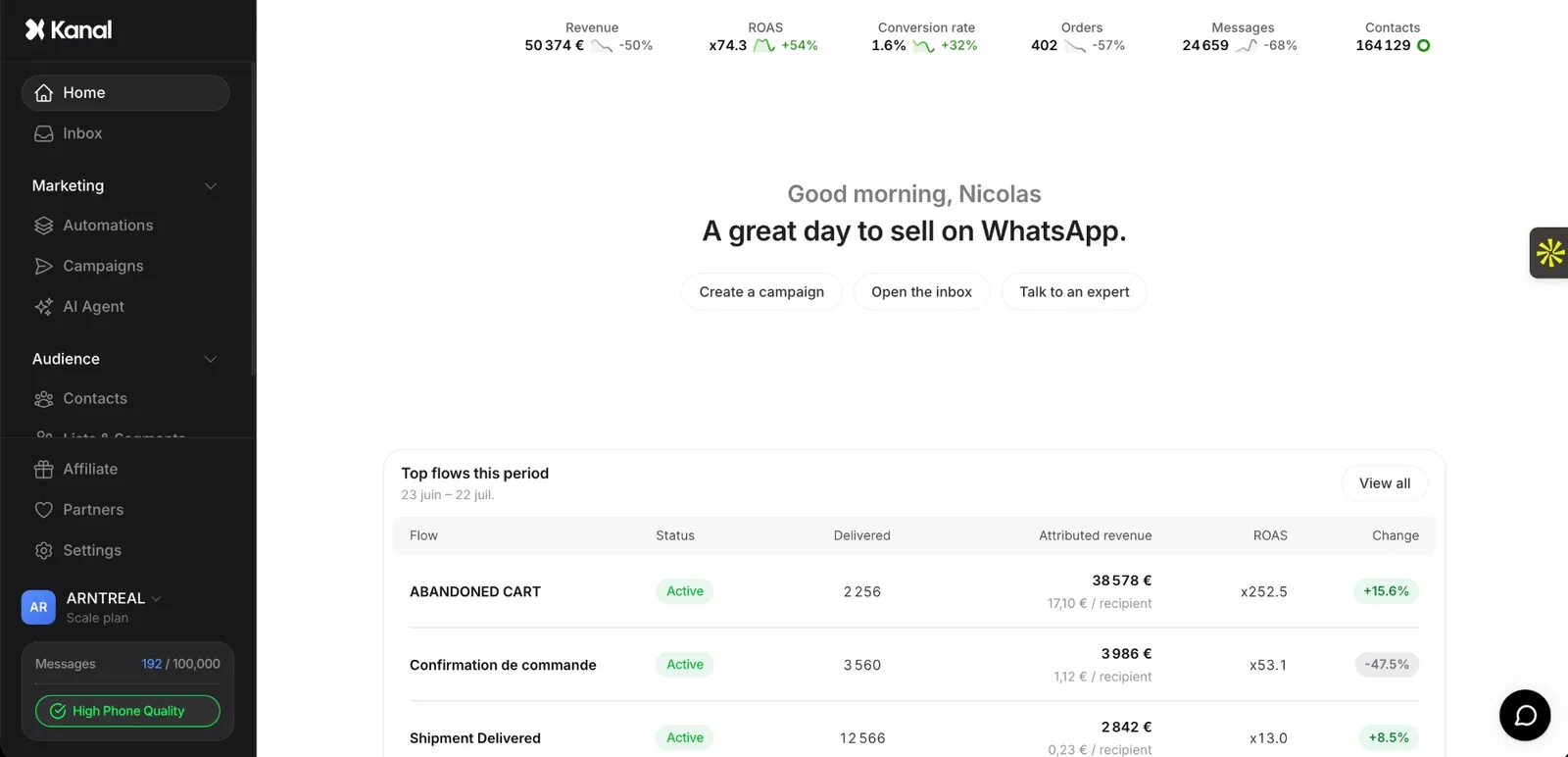
A marketplace's size says little about your own stack: what counts is whether your tools are in it. One example from our side: Kanal, the WhatsApp marketing and sales app we build, is a Shopify app, installed from the Shopify App Store.
Where can you sell beyond your own site?
Shopify includes selling on social media, on marketplaces and in AI chats in every plan. For connected marketplaces, the first 50 synced orders each month are free, then a 1% fee applies, capped at $99 a month. Our Shopify vs Amazon comparison looks at one of those marketplaces.
BigCommerce lists Amazon, eBay and Walmart among its sales channels, and point-of-sale integrations with Square, Clover and others. For advertising channels (Google, Meta, TikTok, Microsoft, Pinterest), it includes Feedonomics Surface with every plan, with a basic plan that costs nothing for up to 100,000 SKUs.
Who owns the store's data?
- Shopify: its Terms of Service state that the services are not a marketplace, that any contract of sale is directly between you and the customer and that you are the seller or merchant of record.
- BigCommerce: its terms state that you retain ownership of all intellectual property rights in the content you provide, and that backing up your files and data separately is your responsibility.
What support does each offer?
Shopify lists 24/7 live chat support on Basic and Grow, enhanced live chat on Advanced and priority phone support on Plus.
BigCommerce lists 24/7 technical support by chat and email on every plan. Phone support is included on Growth, Scale and Performance; for Core, its pricing page announces a phone support add-on. Performance adds a dedicated Customer Success Manager.
How do you move from one to the other?
From Shopify to BigCommerce. BigCommerce's migration page presents a Data Migration App for stores coming from Shopify, WooCommerce, Adobe Commerce and other platforms, which it says transfers 500,000 product, customer and order records and reports import errors afterward. It also sells migration services and points to agency partners.
From BigCommerce to Shopify. Shopify's Help Center has dedicated guides for several platforms and a general migration guide for the others. It lists the options by type of data: CSV files or migration apps for products and customers, migration apps or the API for historical orders, gift cards, blogs and pages. Shopify advises importing products first, then customers, then orders, so that orders connect to the right records.
In both directions, plan your URL redirects and place test orders before you point the domain to the new store.
How to choose between Shopify and BigCommerce
Start from your situation.
- Your sales sit near $30K or $100K a year: on BigCommerce, crossing the line moves you to the next plan automatically. Work out which plan your trailing sales put you on before comparing prices.
- You want to keep a specific payment processor: check whether it is on BigCommerce's Embedded list. If it is, BigCommerce adds no platform fee. On Shopify, any provider other than Shopify Payments carries the third-party transaction fee.
- You are content with the platform's own payments: Shopify publishes a rate for each plan, down to 2.5% + 30¢ on Advanced.
- You run several storefronts or brands from one account: BigCommerce sells extra storefronts from its first plan. Shopify lists expansion stores on Plus.
- Your stack depends on particular apps: search both marketplaces for each one. Our Shopify review covers how the App Store shapes a Shopify store's costs.
In short
On October 24, 2026, Shopify and BigCommerce showed the same monthly list prices for their three self-service plans, while on yearly billing Shopify's Grow and Advanced cost $89 and $359 a month against $79 and $299 for BigCommerce's Growth and Scale. Both charge the same 2%, 1% and 0.6% platform fees for payments processed outside their preferred providers. BigCommerce attaches sales thresholds to its plans and accepts a list of embedded processors without a platform fee. Shopify lets you stay on a plan whatever you sell and lowers its own card rate at each level. Put your trailing twelve months of sales and your processor into both models, and reread both pricing pages before you commit: BigCommerce's changed on June 1, 2026.
See Kanal on your own store
- Your campaigns and cart reminders on WhatsApp, starting from your own store
- Post-purchase offers, back-in-stock alerts, then the AI agent that advises your customers
- You leave with the plan that fits and its price
From €89/month
- brands
- 500+
- to set up
- 5 min
- open rate on WhatsApp
- +90%
Nicolas helps e-commerce brands grow revenue with WhatsApp marketing. With deep expertise in Shopify ecosystems and conversational commerce, he shares proven strategies for abandoned cart recovery, broadcast campaigns, and AI-powered customer engagement.