Shopify vs Etsy: Fees, Traffic and Which to Choose (2026)
Shopify vs Etsy compared for US sellers: subscription and listing fees, transaction and payment fees, traffic, what you can sell, sales tax and using both.
 Nicolas ProvostOct 7, 2026 · 12 min read
Summarize this article with an AI
 ChatGPT
 Claude
Table of contents (10)
Key takeaways
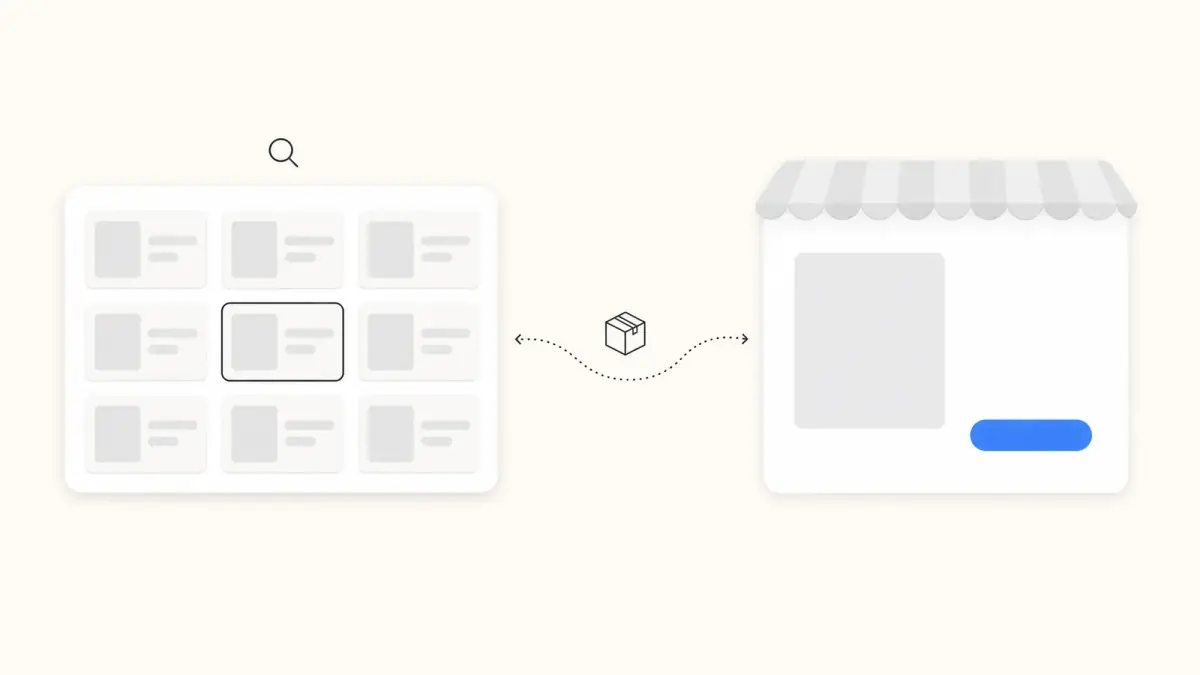
- Etsy is a marketplace that brings buyers and charges per listing and per sale, while Shopify is your own store where you bring the traffic.
- Sellers pay Etsy $0.20 per listing, 6.5% of the order and 3% + $0.25 for payment, against $39 a month and 2.9% + 30¢ on Shopify Basic.
- On $40 orders, Shopify Basic paid monthly costs the same as Etsy at 14 orders a month, before the cost of bringing visitors.
Etsy and Shopify are not the same kind of tool: Etsy is a marketplace that brings buyers to your listings and takes a fee on each sale, while Shopify is your own online store, paid for with a monthly subscription, where you bring the visitors yourself. For a US seller as of October 7, 2026, Etsy charges a $0.20 listing fee, a 6.5% transaction fee and 3% + $0.25 for payment processing, and Shopify Basic costs $39 a month, or $29 paid yearly, plus 2.9% + 30¢ per online card payment.
This comparison uses each company's own pages, read on October 7, 2026: Etsy's Fees and Payments Policy, Etsy Payments Policy and Creativity Standards, and Shopify's pricing page, with the prices shown to US stores, its Help Center and its Terms of Service.
Shopify vs Etsy at a glance
| Question | Etsy | Shopify |
|---|---|---|
| What is it? | A marketplace where buyers search across shops | Your own store, on your own domain |
| Monthly fee | None on the standard plan; Etsy Plus is $10 a month | Basic $39 a month, or $29 paid yearly |
| Listing fee | $0.20 per item, renewed every four months | None, unlimited products |
| Fee on each sale | 6.5% transaction fee, plus 3% + $0.25 payment processing (US) | 2.9% + 30¢ per online standard card payment on Basic with Shopify Payments |
| Advertising fee | Offsite Ads: 15% or 12% of the orders they generate | None charged by Shopify: your ad spend is your own |
| Who brings the buyers? | Etsy's marketplace, plus your own efforts | You do |
| What you can sell | Items made, designed, handpicked or sourced by the seller | No category rule, within Shopify's Acceptable Use Policy |
| US sales tax | Calculated, collected and remitted by Etsy | Calculated by Shopify, compliance is yours |
Sources: Etsy Fees and Payments Policy (last updated October 5, 2026), Etsy Payments Policy (last updated July 31, 2026) and Shopify pricing page, as of October 7, 2026.
What does it cost to sell on Etsy?
Etsy has no subscription on its standard plan. It charges when you list and when you sell. The fees below come from Etsy's Fees and Payments Policy, which lists them exclusive of taxes:
- Listing fee: $0.20 for each item you list. A listing expires after four months and renews automatically at $0.20 unless you turn automatic renewal off. If you list several units of the same item, the listing renews at $0.20 after each sale.
- Transaction fee: 6.5% of the price you display for the listing, plus what you charge for shipping and gift wrapping. For sellers in the US, the fee does not apply to sales tax.
- Payment processing fee: 3% + $0.25 per transaction for sellers in the United States, according to the Etsy Payments Policy. It is assessed on the total amount of the sale, tax and shipping included.
- Offsite Ads fee: Etsy advertises listings on partner sites. If a buyer clicks one of those ads and orders from your shop within 30 days, you pay 15% of the order. If your shop has made $10,000 or more in sales over the prior 365 days, the rate is 12% and participation is required. Under that threshold, you can opt out. The fee never exceeds $100 on a single order.
- Set-up fee: opening a shop may come with a one-time set-up fee. Etsy's policy does not state the amount: it is displayed during shop set-up.
- Currency conversion: a 2.5% fee on the sale amount if you list in a currency other than the currency of your payment account.
Two optional subscriptions exist:
- Etsy Plus, $10 a month, with 15 listing credits and $5 in Etsy Ads credits each cycle.
- Pattern, Etsy's tool for a standalone website: a 30-day trial at no charge, then $15 a month. Listings that exist on your Pattern site alone carry no listing fee and do not expire.
Etsy adds that all service fees, prepaid fees included, are non-refundable.
What does it cost to sell on Shopify?
Shopify charges a subscription and a payment rate. For a store in the United States, the pricing page showed these prices on October 24, 2026:
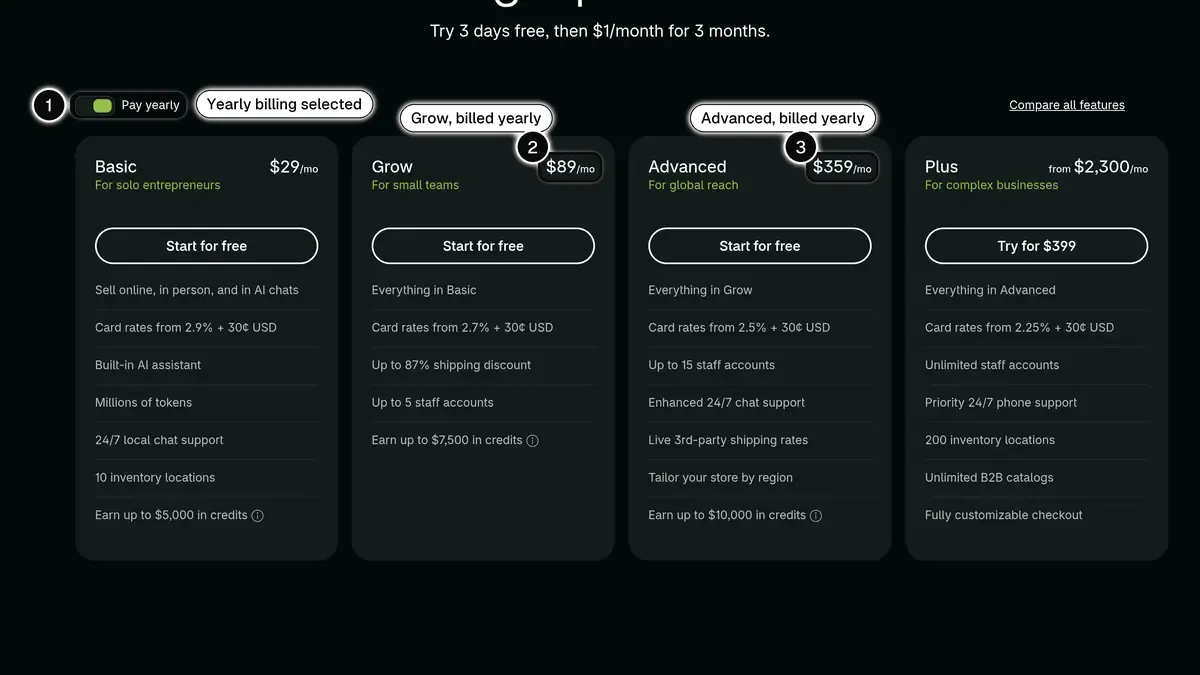 Source: Shopify pricing page, plan cards shown to a US visitor with Pay yearly selected, read on October 24, 2026. In 1, the yearly billing toggle; in 2, Grow billed yearly at $89 a month; in 3, Advanced billed yearly at $359 a month. Paid monthly, Basic, Grow and Advanced cost $39, $105 and $399.
| Plan | Pay monthly | Pay yearly (per month) | Online standard card rate | Third-party transaction fee |
|---|---|---|---|---|
| Basic | $39 | $29 | 2.9% + 30¢ | 2% |
| Grow | $105 | $89 | 2.7% + 30¢ | 1% |
| Advanced | $399 | $359 | 2.5% + 30¢ | 0.6% |
There is no listing fee: every plan lets you sell unlimited products. There are no setup fees, and the page advertised a 3-day trial followed by $1 a month for the first 3 months on most plans. The third-party transaction fee applies only if you use a payment provider other than Shopify Payments.
The subscription is not the whole budget. A domain, a paid theme and apps come on top, and so does the cost of bringing visitors to the store. Our guide to Shopify pricing lists every line.
Shopify vs Etsy fees: a worked example
The numbers below are fictional. Take an order of $40, shipping included, paid by a US buyer to a US seller, with no sales tax on the order to keep the arithmetic simple.
| Fee on one $40 order | Etsy | Shopify Basic |
|---|---|---|
| Listing fee | $0.20 | $0 |
| Transaction fee | $2.60 (6.5% of $40) | $0 with Shopify Payments |
| Payment fee | $1.45 (3% of $40, plus $0.25) | $1.46 (2.9% of $40, plus 30¢) |
| Total per order | $4.25 | $1.46 |
| If the order comes from an Offsite Ad | $10.25 at 15%, $9.05 at 12% | Not applicable |
Calculated from the fees in Etsy's Fees and Payments Policy, the Etsy Payments Policy and Shopify's pricing page, as of October 7, 2026.
Per order, Etsy costs $2.79 more than Shopify in this example. Shopify's fixed cost is the subscription. Divide one by the other:
- with Basic paid monthly at $39, the two cost the same at 14 orders a month: $59.44 on Shopify ($39 plus 14 × $1.46) against $59.50 on Etsy (14 × $4.25);
- with Basic paid yearly at $29 a month, Shopify costs less from 11 orders a month: $45.06 against $46.75.
Read this result for what it is: a comparison of platform fees. On Etsy, those fees pay for access to a marketplace where buyers already search. On Shopify, your visitors come from your own audience, your content or your ads, and that cost is not in the table. Listings that do not sell also cost $0.20 every four months on Etsy, and nothing on Shopify.
Who brings the customers?
This is the real difference between the two.
Etsy describes itself as the marketplace for original items from real people, connecting buyers with items from sellers around the world. A buyer who searches Etsy can land on your listing without ever having heard of you. The other side of that coin: your listing sits next to competing shops, and the transaction takes place on Etsy, under Etsy's rules. Its policy prohibits moving a transaction off the platform.
Shopify states the opposite in its Terms of Service: the services are not a marketplace, any contract of sale is directly between you and the customer, and you are the seller or merchant of record. Nobody arrives by default. You build the traffic through search, social media, email, ads or an existing audience, and in exchange the store, the domain, the checkout and the customer relationship are yours.
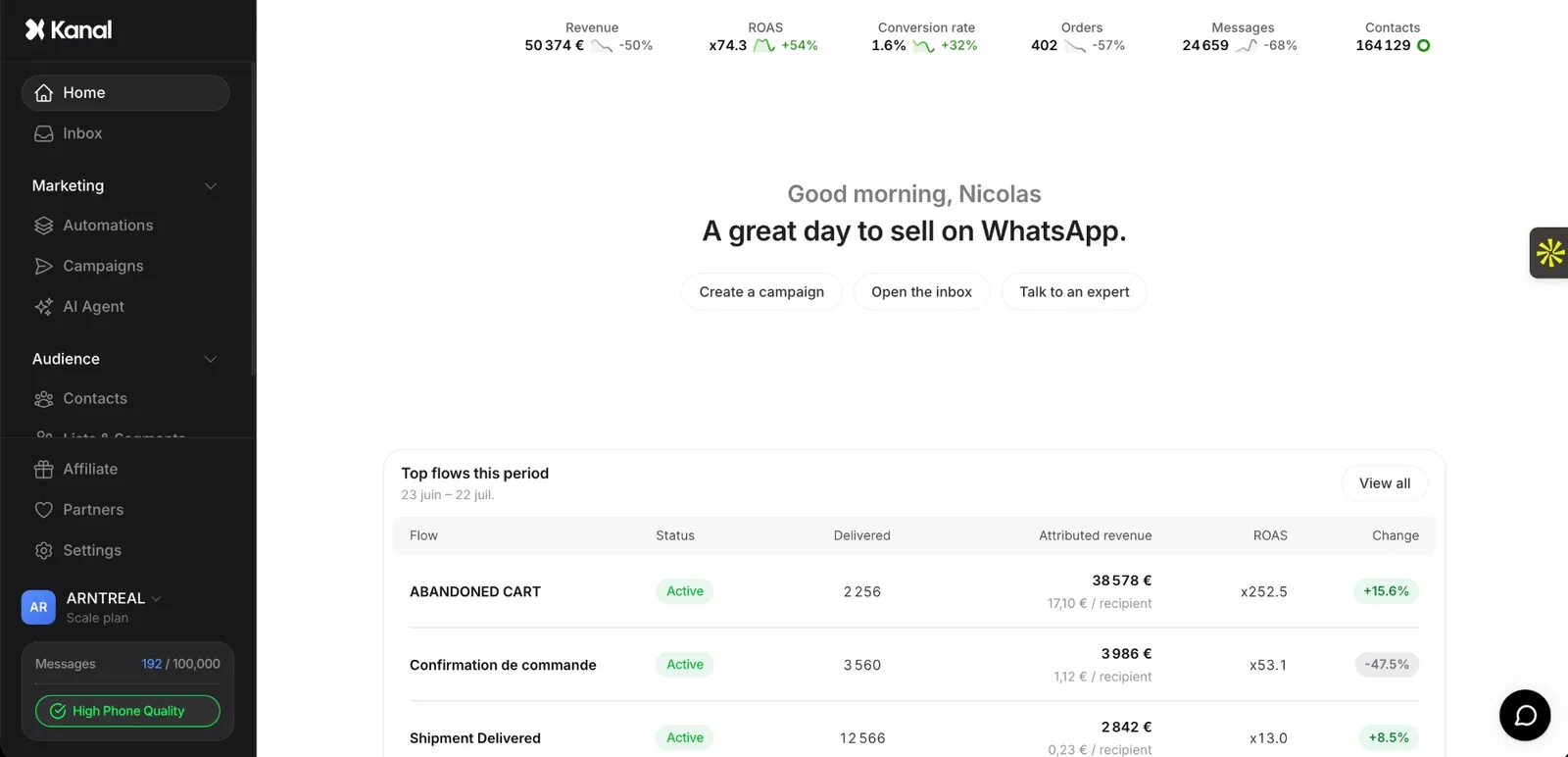
That ownership is what makes repeat business possible. Once customers buy from your own store, you can follow up through the channels they have agreed to, such as email, SMS or WhatsApp. Kanal, the app we build, is a WhatsApp marketing and sales app for Shopify stores: order notifications, abandoned cart recovery, campaigns and a team inbox.
What can you sell on Etsy and on Shopify?
Etsy restricts what can be listed. Its Creativity Standards require every item to fall into one of four categories:
- Made by a seller: handcrafted, hand-altered or hand-assembled items, and items produced with computerized tools from the seller's original design.
- Designed by a seller: original designs produced by a production partner or sold as digital downloads, the partner being disclosed.
- Handpicked by a seller: vintage items that are 20 or more years old, items from nature and curated gift baskets.
- Sourced by a seller: craft and party supplies, and items personalized with a buyer's text or image.
Commercially available items that are newer than 20 years and resold as they are do not qualify, and Etsy reserves the right to remove listings that do not follow its policies.
Shopify has no such category rule. What you can sell is limited by its Acceptable Use Policy and by the law, not by how the product was made. A store that resells other brands' products, for example, fits Shopify and does not fit Etsy's standards.
Who handles sales tax?
For US sellers, this point is often overlooked.
- On Etsy: to comply with US tax laws, Etsy calculates, collects and remits sales tax on your behalf for orders delivered to customers in the US. Where it applies, the tax appears in your payment account and is deducted from your balance.
- On Shopify: you are the merchant of record. Shopify calculates taxes, but tax compliance is your responsibility: Shopify doesn't file or remit on your behalf unless you use Shopify Tax automated filing. Shopify Tax is charged per order once the store passes $100,000 in sales, at 0.35% on Basic, Grow and Advanced for a US store, capped at $0.99 per order.
If you move from Etsy to your own store, register and file where you have to: the marketplace no longer does it for you.
Can you use Shopify and Etsy together?
Yes, and it is a common path: Etsy for discovery, Shopify for the brand and for repeat customers. Three things to know.
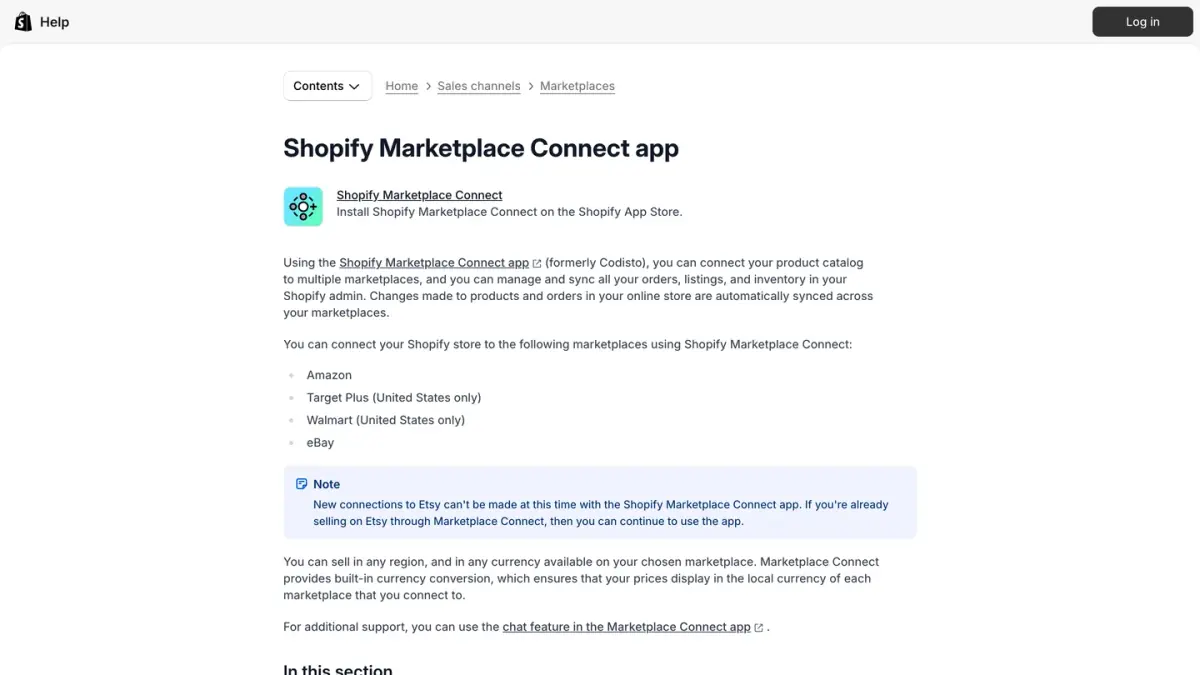
- Shopify's own connector is closed to new Etsy connections. The Shopify Help Center states that new connections to Etsy can't be made at this time with the Shopify Marketplace Connect app, which connects Amazon, Target Plus, Walmart and eBay. Sellers who already use it for Etsy can continue.
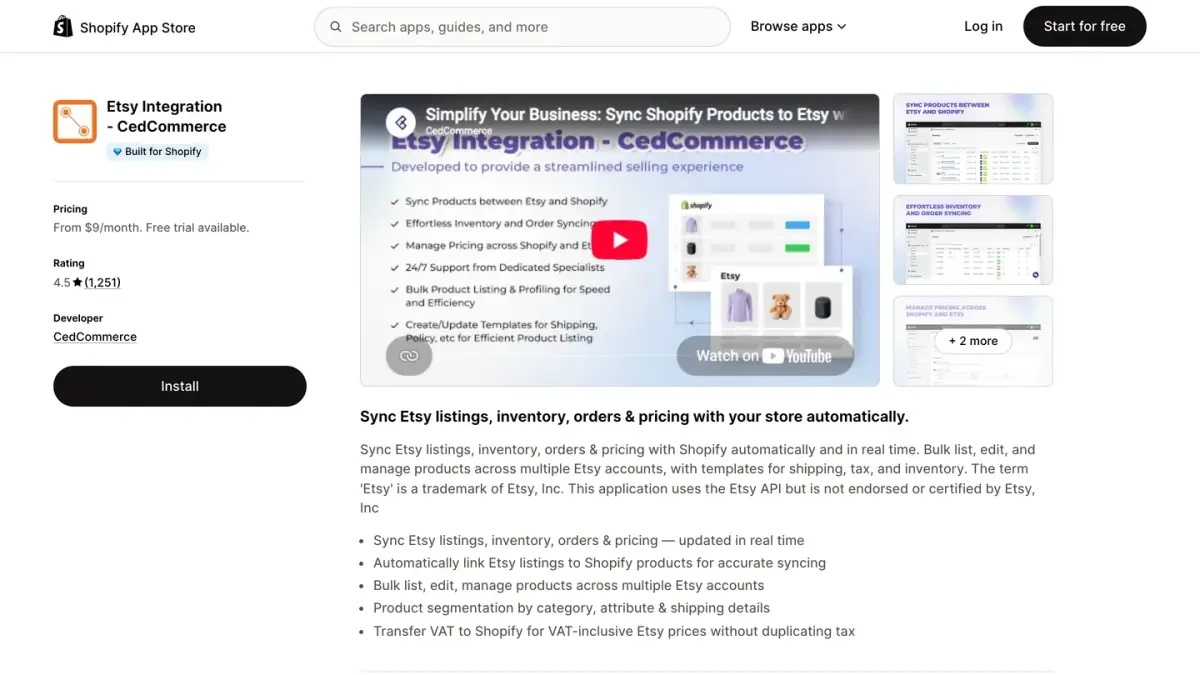
- Third-party apps fill the gap. The Shopify App Store lists Etsy integrations from other developers, for example Etsy Integration by CedCommerce, priced from $9 a month on its listing on October 7, 2026.
- Etsy has its own website tool. Pattern, at $15 a month after the trial, builds a standalone site from your Etsy shop. It keeps you inside Etsy's tools, where a Shopify store is a separate platform with its own themes, apps and checkout.
Whatever the setup, keep Etsy orders on Etsy: its policy forbids steering a marketplace transaction off the platform.
Shopify or Etsy: which should you choose?
Start with Etsy if:
- your products are handmade, vintage or craft supplies, and you have no audience yet;
- you want to test demand without a monthly fee;
- you sell a few orders a month, where per-sale fees stay below a subscription.
Choose Shopify if:
- you sell enough for the subscription to cost less than Etsy's per-sale fees (14 orders of $40 a month in our example);
- your products do not fit Etsy's Creativity Standards;
- you want your own domain, your own design and your own customer list;
- you are ready to bring your own traffic.
Run both if Etsy already sends you buyers and you want a place where repeat customers order without marketplace fees.
If you lean toward your own store, two more reads help: our Shopify review for the strengths and limits of the platform, and Shopify vs WooCommerce if you are also considering an open-source store. If Amazon is the marketplace you are weighing, read Shopify vs Amazon, and if a website builder is on your list, our comparisons of Shopify and Squarespace and Shopify and Wix. To make each order count once you are there, see our guide to average order value.
In short
Etsy sells you access to buyers and charges for each listing and each sale: $0.20 per listing, 6.5% of the order and 3% + $0.25 for payment in the US, plus 15% or 12% when an Offsite Ad brings the order. Shopify sells you a store: $39 a month on Basic, or $29 paid yearly, and 2.9% + 30¢ per online card payment, with the traffic left to you. Count your orders, check that your products fit Etsy's rules, and decide who should own the relationship with your customers. Then check both fee pages again before you commit, since both companies update them.
See Kanal on your own store
- Your campaigns and cart reminders on WhatsApp, starting from your own store
- Post-purchase offers, back-in-stock alerts, then the AI agent that advises your customers
- You leave with the plan that fits and its price
From €89/month
- brands
- 500+
- to set up
- 5 min
- open rate on WhatsApp
- +90%
Nicolas helps e-commerce brands grow revenue with WhatsApp marketing. With deep expertise in Shopify ecosystems and conversational commerce, he shares proven strategies for abandoned cart recovery, broadcast campaigns, and AI-powered customer engagement.