Ecommerce Loyalty Program: Types, Design and Shopify Setup
How to build an ecommerce loyalty program: the five program types, reward cost in margin, rules, Shopify setup, WhatsApp tiers and how to measure it.
 Nicolas ProvostOct 24, 2026 · 15 min read
Summarize this article with an AI
 ChatGPT
 Claude
Table of contents (13)
Key takeaways
- Choose the program type from one objective: points for purchase frequency, VIP tiers for your best customers, referral for acquisition, a paid membership for heavy buyers.
- Price the reward in margin, not in revenue: in the worked example, the same 5% points rate costs 3% of revenue as a discount and 1.2% as a free product.
- Shopify provides the building blocks (segments, segment-only discounts, store credit), loyalty apps add points and referrals, and Kanal runs tiers and reward messages on WhatsApp.
An ecommerce loyalty program rewards customers for coming back, not for a single order: points they convert into discounts, VIP tiers unlocked after several orders, rewards for referring friends, a paid membership, or perks money cannot buy, such as early access. For an online store, designing one comes down to three decisions: the objective (a second order, more frequent orders, referrals), the reward and what it costs in margin, and the rules that decide who earns what.
This guide walks through the five program types, a design method with a worked cost example, the Shopify features and apps you can build on, how to run tiers and reward messages on WhatsApp, and how to measure the effect with Shopify's customer reports. Shopify features are described from its Help Center, read on October 23, 2026. If you are specifically planning a VIP tier on WhatsApp, with perks, message templates and a 14-day rollout, our WhatsApp loyalty program guide covers that execution in detail.
What is an ecommerce loyalty program?
A promo code rewards one order. A loyalty program rewards a relationship: the reward depends on what the customer does over time, such as orders, spend, referrals or reviews.
It works through two levers: economic (the customer earns something of value by buying again) and status (being recognized as a regular, getting things first). Points programs rely mostly on the first, VIP tiers and non-monetary perks on the second.
For a store, the program is worth running when it changes behavior: customers who would have stopped after one order place a second one, regulars order more often, or customers bring friends. Rewards paid on orders that would have happened anyway are the hidden cost of every program, which is why the design starts with the objective.
The 5 types of loyalty programs for online stores
| Type | How it works | Objective it serves | Main cost | Watch out for |
|---|---|---|---|---|
| Points | Customers earn points per dollar spent or per action, then redeem them for a discount, a product or store credit | Purchase frequency | Rewards redeemed | A first reward that takes too long to reach |
| VIP tiers | A status unlocked by orders or spend over a period, each tier with its own perks | Keeping your best customers | Perks given to members | Tiers that are out of reach, or too wide to feel exclusive |
| Referral | A customer gets a reward when a friend places a first order, and the friend often gets one too | Acquisition | Two rewards per new customer | Self-referrals and rewards paid on refunded orders |
| Paid membership | Customers pay a fee for permanent benefits, such as free shipping or member prices | Frequency among heavy buyers | Benefits given against the fee | The fee must pay for itself at a normal buying rhythm |
| Non-monetary perks | Early access to drops, members-only products, free returns, events, a direct line to the team | Attachment without discounting | Stock and team time | Perks your customers do not actually want |
The types combine. A common structure is points for everyone, tiers on top for the most active customers, and a referral program alongside.
Points are the easiest to explain: earn rules ("1 point per dollar", "50 points for a review") and a redemption catalog. Shopify's Help Center lists issuing store credit "as a reward or incentive, such as a loyalty or referral program" among its uses.
VIP tiers reward cumulative behavior over a rolling period, often 12 months, so status has to be kept, not just reached once.
Paid memberships reverse the logic: the customer pays first and gets benefits on every order. They fit stores with frequent purchases, and on Shopify they are typically sold through a subscription app.
Non-monetary perks cost little in margin but need follow-through: a members-only product has to exist, early access has to be real.
How to design a loyalty program
1. Start from one objective
| Objective | Shopify report to watch | Type that fits |
|---|---|---|
| More customers placing a second order | One-time customers | Points with a first reward reachable on the second order |
| More orders from repeat customers | Customer cohort analysis | Points, VIP tiers |
| Keep your best customers | RFM customer analysis | VIP tiers, non-monetary perks |
| New customers from existing ones | New customers over time | Referral |
| Higher spend per order | Average order value in your sales reports | Bonus points above a basket threshold |
One main objective keeps the rules simple and gives you one number to judge the program by.
2. Price the reward in margin
Two formulas do most of the work:
Reward rate = reward value ÷ spend needed to earn it
Real cost of the program = reward rate × redemption rate × cost factor
The redemption rate is the share of points actually used. The cost factor depends on the reward: 1 for a discount or store credit (each dollar of reward is a dollar of margin given up), and cost of goods ÷ retail price for a free product.
A worked example, with fictional figures. A skincare store has a 60% gross margin, so its products cost 40% of their retail price. Customers earn 1 point per dollar, and 100 points unlock a $5 reward. The store assumes 60% of points will be redeemed.
| Reward | Reward rate | Cost factor | Real cost, in % of revenue |
|---|---|---|---|
| $5 discount code | $5 ÷ $100 = 5% | 1 | 5% × 0.60 × 1 = 3% |
| $5 store credit | 5% | 1 | 5% × 0.60 × 1 = 3% |
| Free product worth $5 at retail | 5% | 0.40 | 5% × 0.60 × 0.40 = 1.2% |
The same "5% back" promise costs 3% of revenue as a discount, which is 5% of the store's gross margin (3 ÷ 60), and 1.2% as a free product.
Then check what the program has to bring back. With a $60 average order and a 60% margin, each extra order brings $36 of gross margin. If the program costs $1,200 a month in redeemed rewards, app fees and messages, it needs $1,200 ÷ $36 = 34 extra orders a month, orders that would not have happened without it, to break even.
Unredeemed points and outstanding store credit are a promise you still owe. Shopify lists Store credit transactions and Outstanding store credit balance among its finance reports, under Analytics > Reports, so you can follow that balance. Ask your accountant how to record it.
3. Write the rules
- What earns. Decide whether points are earned on the product subtotal only or also on shipping and taxes, and say so.
- When rewards are credited. Crediting points after your return window avoids rewarding orders that come back.
- The first reward. Make it reachable by the second or third order, otherwise new customers never feel the program.
- Expiry. If points or credit expire, check the rules where you sell. Shopify's store credit documentation tells merchants to verify local laws before setting expiration dates.
- Tier qualification. Set thresholds on orders or spend over a rolling 12 months, and decide what happens when a customer falls below one.
- Referral safeguards. Release the reward after the friend's first order is paid and past the return window, and exclude self-referrals.
- Stacking. Decide whether rewards combine with other discounts. Shopify discounts have a Combinations section for this.
- Where the rules live. One rules page, linked from the footer and the customer account.
How to launch a loyalty program on Shopify
The building blocks Shopify provides
Customer accounts. Rewards tied to a profile need customers to sign in. Store credit, for instance, is not available for legacy customer accounts.
Customer segments. Segments are dynamic lists built from filters such as number_of_orders or amount_spent. The segment reference guide gives an example close to a tier rule: (amount_spent > 100 OR number_of_orders >= 5) AND email_subscription_status = 'SUBSCRIBED'.
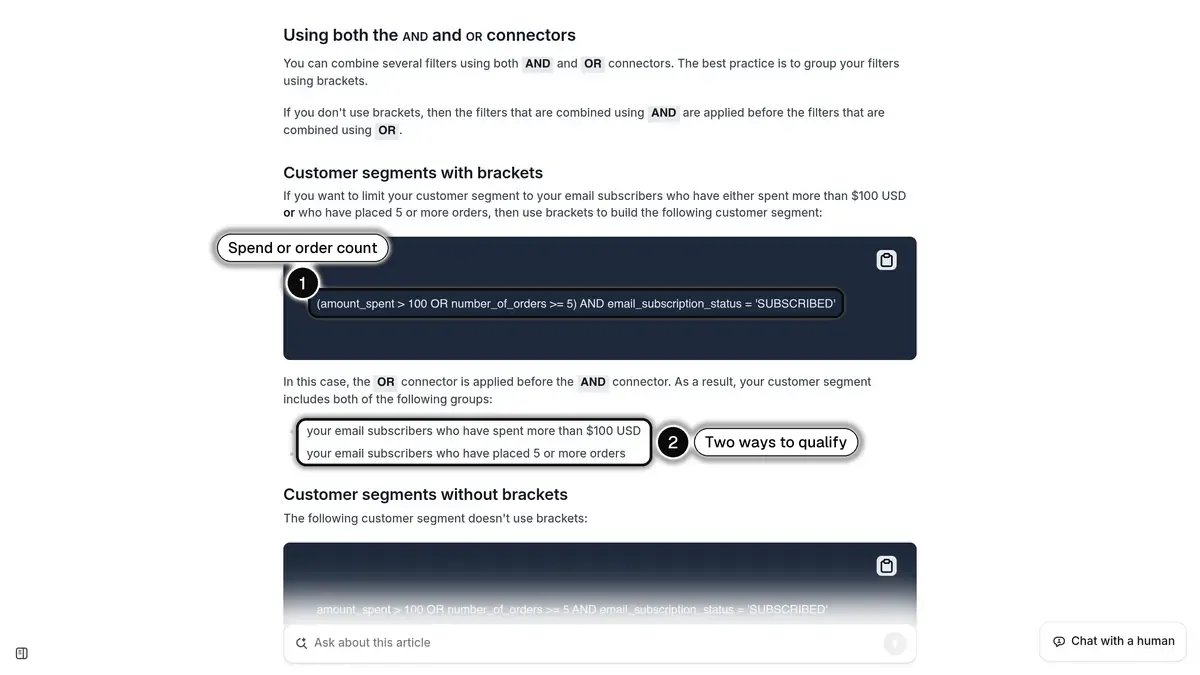
Source: Shopify Help Center, Components of a customer segment, read on October 23, 2026. In 1, a segment built on amount spent or number of orders; in 2, the two groups of customers it includes.
Discounts reserved for a tier. When you create an amount off discount, the Eligibility section lets you choose Customer segments. A VIP segment can get its own permanent discount or free shipping without a code being shared.
Store credit. You turn it on in Settings > Customer accounts, then issue it from a customer profile (Customers, then Store credit > Edit > Credit). The store credit page lists a few constraints worth knowing before you use it as a reward: customers apply it at checkout when signed in to a customer account or using Shop Pay, only the full credit amount can be applied, expiry is set each time you issue credit, and stores created on or after May 12, 2025 pay third-party transaction fees on the amount paid with store credit.
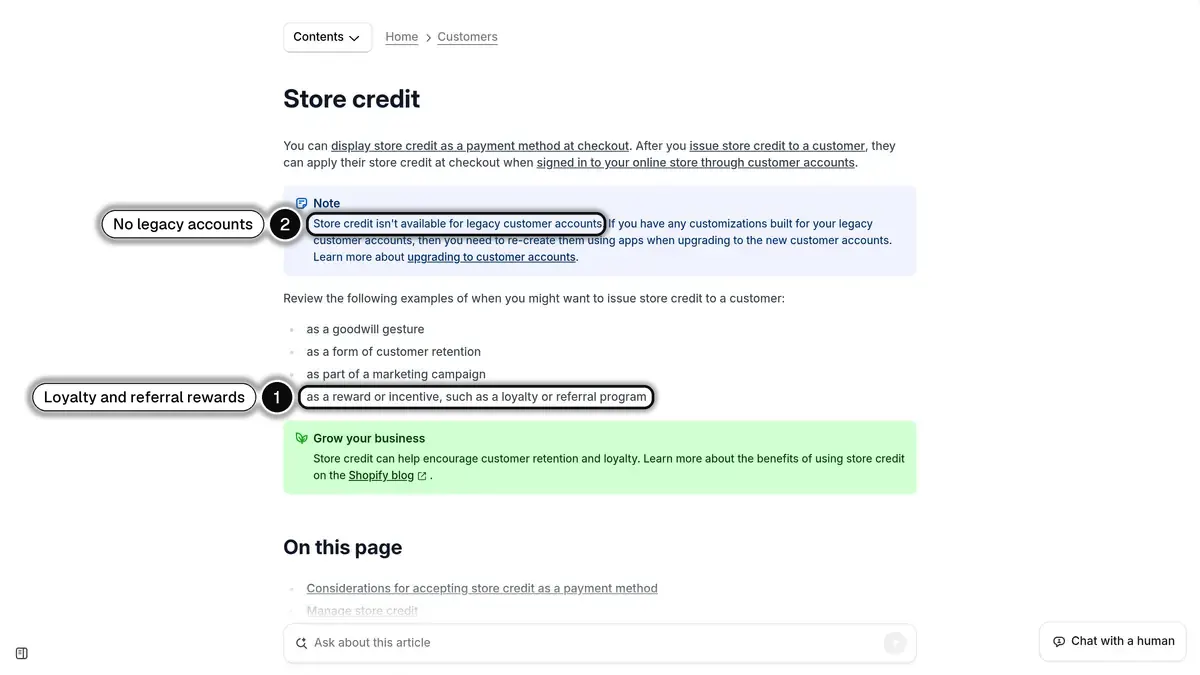
Source: Shopify Help Center, Store credit, read on October 23, 2026. In 1, store credit as a reward for a loyalty or referral program; in 2, the note that it is not available for legacy customer accounts.
Automatic tagging. Shopify Flow can add a customer tag when an order meets a condition, for instance a VIP tag when an order reaches a set amount. Our Shopify Flow guide explains triggers, conditions and actions.
What these blocks do not give you is a points balance with earning rules, a tier progress display or referral links. That is what loyalty apps add.
Loyalty apps on the Shopify App Store
A few apps, described from their own listings, without ranking:
- Smile: Loyalty Program Rewards covers points, VIP tiers and referrals, and its listing says it works with checkout, customer accounts, Shopify POS and Shopify Flow.
- LoyaltyLion offers a points program, VIP tiers with perks and early access, and embeds the program at checkout, in customer accounts and on POS.
- Yotpo: Loyalty Rewards Program covers points, rewards, referrals and VIP tiers.
- Loyoly presents itself as a loyalty, VIP, referral and wallet platform. Kanal integrates with it (see below).
Our comparison of loyalty apps for Shopify lists more of them, with their features side by side. To choose, check:
| Question | Why it matters |
|---|---|
| Does it support your program type (points, tiers, referral, paid)? | Not every app handles every type |
| Where does the program show (account, checkout, product pages)? | Customers act on what they see while buying |
| Do you sell in person? | POS support keeps one balance across channels |
| Does it connect to your messaging tools? | Members need to hear about their points and status |
| How is it priced (orders, members, features)? | The bill grows with the store |
A launch checklist
- Publish the rules page.
- Decide what past customers start with: points for their order history, or a welcome bonus for everyone.
- Launch to repeat customers first, for example a segment with
number_of_orders >= 2, and fix what they report. - Announce it to everyone: site banner, email, and WhatsApp for customers who opted in.
- Show the balance and the next reward in the customer account and at checkout.
Running your loyalty program on WhatsApp with Kanal
The program lives in the loyalty app. Members still need to hear that they unlocked a reward or reached a new tier, and that is where WhatsApp fits. Kanal is a Shopify app that turns WhatsApp into a sales channel. Here is how it handles the WhatsApp side of a loyalty program:
- Opt-in first. Kanal does not import the marketing consent from the Shopify checkout: Shopify contacts arrive with an unknown status. Collect WhatsApp opt-in with Kanal's widget, pop-ups, QR codes or WhatsApp magic links. A "join the club" link can open WhatsApp with a pre-filled message that starts an automation, whose Opt-in action records the customer's yes. Our guide to WhatsApp opt-in and GDPR covers the rules.
- Tiers as segments. Kanal builds segments on the number of orders, over all time or within a period. A tier defined on orders maps exactly: "2 to 4 orders in the last 12 months" for Silver, "at least 5 orders in the last 12 months" for Gold. Kanal does not segment on amount spent, so if your tiers use spend, mirror them with Shopify customer tags or with Klaviyo segments synced to Kanal.
- Automations on each order. An automation starts on the Shopify order created trigger, checks the customer's number of orders, then adds a Shopify customer tag such as VIP, sends a congratulation template and can generate a unique Shopify discount code valid 24 hours, 7 days, 30 days or without limit. Conditions, tags and code generation are part of the Scale plan.
- Campaigns for perks. Early access is a WhatsApp campaign sent to the Gold segment before the public launch, with quiet hours so nobody is woken up.
- Loyoly events. Kanal's Loyoly integration sends loyalty notifications on WhatsApp: rewards unlocked, tier changes and referral activity.
- Revenue per message. Kanal attributes revenue, conversions and return on spend to each campaign and automation, within the attribution window you set.
One rule from Meta shapes these messages. A message that offers a reward or a discount is promotional, so it goes out as a marketing template. Meta's own example of a marketing template is a thank-you discount for a past order, and its guidelines add that a template whose content is unclear, such as just "Congratulations!", is also treated as marketing.
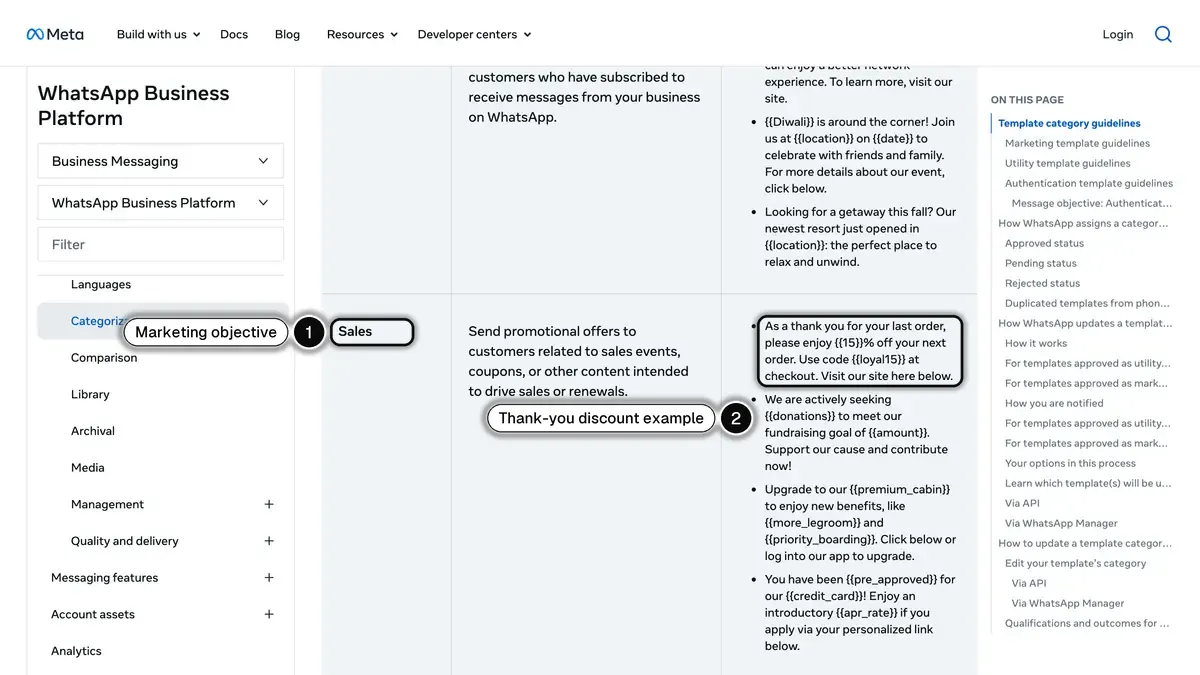
Source: Meta for Developers, Template categorization, read on October 23, 2026. In 1, the Sales objective of marketing templates; in 2, Meta's example of a discount code thanking a customer for a past order.
More than 500 brands use Kanal, set up in 5 minutes, with open rates above 90% for brands on Kanal. Plans start at €89 per month, plus the per-message fees charged by Meta.
How to measure a loyalty program
A program only pays off if it brings back customers who would not have come back without it. Track the customer retention rate by cohort before and after launch, and keep your other retention marketing actions steady while you measure.
| What you measure | Where to find it in Shopify | What it tells you |
|---|---|---|
| Customers who stopped at one order | One-time customers report | Whether the first reward pulls a second order |
| First-time vs returning customers over time | New vs returning customers report | Whether repeat buying grows after launch |
| Spend per customer by cohort | Customer cohort analysis, Amount spent per customer | Whether post-launch cohorts spend more at the same age |
| Movement between customer groups | RFM customer analysis | Whether more customers reach the top groups |
| Store credit still owed | Outstanding store credit balance | The liability the program builds up |
| WhatsApp revenue | Kanal campaign and automation attribution | What member messages bring in |
The customer reports sit under Analytics > Reports, filtered by the Customers category. Shopify notes that its RFM analysis sorts customers into 11 groups that you can use to plan "loyalty programs".
Three habits keep the reading honest:
- Compare cohorts, not members against non-members. Your best customers join first, so members always look better. Compare customers acquired after the launch with those acquired before, at the same age. Our guide to customer lifetime value explains cohort reading.
- Keep a control group when you can. If you launch by invitation, leave a random part of eligible customers out for the first months and compare.
- Read cost and effect together. A rise in repeat orders that costs more in rewards than it brings in margin is not a win.
Ecommerce loyalty program in short
- Types: points, VIP tiers, referral, paid membership and non-monetary perks, often combined.
- Design: one objective, a reward priced in margin with the redemption rate, and written rules on earning, expiry, tiers and referrals.
- Shopify: segments on orders or spend, discounts reserved for segments, store credit and Flow tags, plus a loyalty app for points and referrals.
- WhatsApp: opt-in first, tiers as segments by number of orders, automations on each order, marketing templates for rewards.
- Measurement: cohorts before and after launch, one-time customers, spend per customer and reward cost.
To announce rewards and tier upgrades on WhatsApp, install Kanal or book a demo: we will show you the segments and automations on your store.
See Kanal on your own store
- Your campaigns and cart reminders on WhatsApp, starting from your own store
- Post-purchase offers, back-in-stock alerts, then the AI agent that advises your customers
- You leave with the plan that fits and its price
From €89/month
- brands
- 500+
- to set up
- 5 min
- open rate on WhatsApp
- +90%
Nicolas helps e-commerce brands grow revenue with WhatsApp marketing. With deep expertise in Shopify ecosystems and conversational commerce, he shares proven strategies for abandoned cart recovery, broadcast campaigns, and AI-powered customer engagement.