Retention Marketing: 8 Strategies for Ecommerce Stores
Retention marketing for ecommerce: 8 strategies to bring customers back (post-purchase, replenishment, segments, reviews, VIPs, win-back) on Shopify.
 Nicolas ProvostOct 24, 2026 · 15 min read
Summarize this article with an AI
 ChatGPT
 Claude
Table of contents (15)
Key takeaways
- Retention marketing is every message, offer and service touchpoint aimed at existing customers to get the next order, and the second order is where most of the work happens.
- Shopify already shows who comes back and who drifts away: Returning customers and One-time customers reports, RFM analysis in 11 groups, and segment filters on number of orders and last order date.
- WhatsApp does not currently deliver marketing templates to US phone numbers, so US stores use it for order updates and conversations, and for marketing to customers with non-US numbers.
Retention marketing is every marketing action aimed at people who have already bought from you, with one goal: the next order. For an online store, most of that work happens in the weeks after the first purchase. A customer who has ordered twice already has a habit with your brand; a customer who has ordered once may never come back. Retention marketing organizes what happens after checkout: the order updates, the reminder at the right moment, the offer that fits the customer's history, and the nudge for the ones drifting away.
This guide covers 8 strategies, from post-purchase to win-back, with the Shopify reports and segment filters described in Shopify's Help Center (read on October 23, 2026), and where WhatsApp fits, including its limits for US phone numbers. It sticks to strategy: how to calculate your retention rate and how to design a points or tiers loyalty program each get their own guide.
What is retention marketing?
Retention marketing sits next to a few terms that are easy to mix up:
| Term | What it means | Ecommerce example |
|---|---|---|
| Acquisition marketing | Finding new customers | Paid social ads that bring a first order |
| Retention marketing | Getting existing customers to buy again | A replenishment reminder 25 days after a supplement order |
| Customer retention | The share of customers who come back, measured over a period | January's new customers who ordered again before June |
| Win-back | Bringing back a customer who stopped buying | A message to customers with no order in six months |
Acquisition is paid again for every new customer. Retention runs mostly on owned channels (email, SMS, WhatsApp) where you have already earned the right to reach the customer.
Why retention marketing matters for online stores
Customer value builds over time. The customer lifetime value formula shows why: CLV = average order value × purchase frequency × customer lifespan. Two of those three inputs, frequency and lifespan, are what retention marketing moves.
A fictional example makes it concrete. A skincare store has 2,000 customers who ordered only once this year, with a $50 average order value.
| Share who place a second order | Extra orders | Extra revenue |
|---|---|---|
| 5% | 100 | 100 × $50 = $5,000 |
| 10% | 200 | 200 × $50 = $10,000 |
| 15% | 300 | 300 × $50 = $15,000 |
Those orders come from customers you have already paid to acquire. They need no new ad spend, only the right message at the right time.
Start with the data: what Shopify shows you
Before picking a strategy, look at who comes back and who drifts away. Shopify has this data built in, under Analytics > Reports, Category filter, then Customers, according to the Help Center page on customers reports.
- Returning customers: every customer with two or more orders.
- One-time customers: every customer with exactly one order, your first retention list.
- New vs returning customers: the count of each, period by period.
- Customer cohort analysis: customers grouped by the date of their first order, to see how many come back month after month.
- RFM customer analysis: a recency, frequency and monetary score, then a placement in one of 11 RFM groups.
Shopify pairs each RFM group with a goal and example actions. These are the groups that matter most for retention:
| RFM group | Shopify's description | Shopify's goal and example |
|---|---|---|
| Promising | Recent purchases, fewer orders, low spend | Move to Active: remind them to replenish their supply |
| Loyal | Recent purchases, many orders, the most spend | Move to Champions: upsell higher-value products, ask for reviews |
| Champions | Very recent purchases, many orders, the most spend | Retain as brand advocates: exclusive deals, early access, referral program |
| At risk | No recent purchases, strong order and spend history | Move to Loyal or Needs attention: personalize communication as much as possible |
| Previously loyal | No recent purchases, very strong history | Move to Loyal: new products or drops, renewals or new offers |
| Dormant | No recent purchases, infrequent orders, low spend | Move to Almost lost: include them in your newsletters |
From the report, clicking a group name lets you preview it as a customer segment. You can also write segments yourself with the Shopify customer segment filters: Number of orders (number_of_orders), Last order date (last_order_date), Orders placed in a date range (orders_placed) or RFM group (rfm_group).
8 retention marketing strategies for ecommerce
1. Get the post-purchase experience right
Retention starts with the order confirmation. A clear confirmation, a tracking link as soon as the order ships and a delivery message cut "where is my order?" tickets and build trust for the next order.
After delivery, add value: a how-to, a routine, a recipe. Shopify Messaging includes post-purchase automation templates such as Thank customers after they purchase (after the first and second purchase) and Upsell customers after their first purchase, according to the Help Center page on creating marketing automations in Shopify Messaging. You create them under Apps > Messaging > Automations > Create automation, and the Help Center lists them for email.
Keep service and sales in separate messages: the shipping update informs, the cross-sell offer comes later on its own. Our WhatsApp post-purchase playbook walks through the flows message by message.
2. Schedule replenishment reminders
If you sell products that run out (skincare, supplements, coffee, pet food), you know the best moment to reach out in advance: just before the customer runs low. Klaviyo's Help Center page How to create a replenishment flow uses a supplement sold as a 30-day supply: the first reminder goes out about 25 days after the order. Its rule of thumb is two reminders, then one follow-up after the projected buying cycle has passed, with an extra incentive such as a discount.
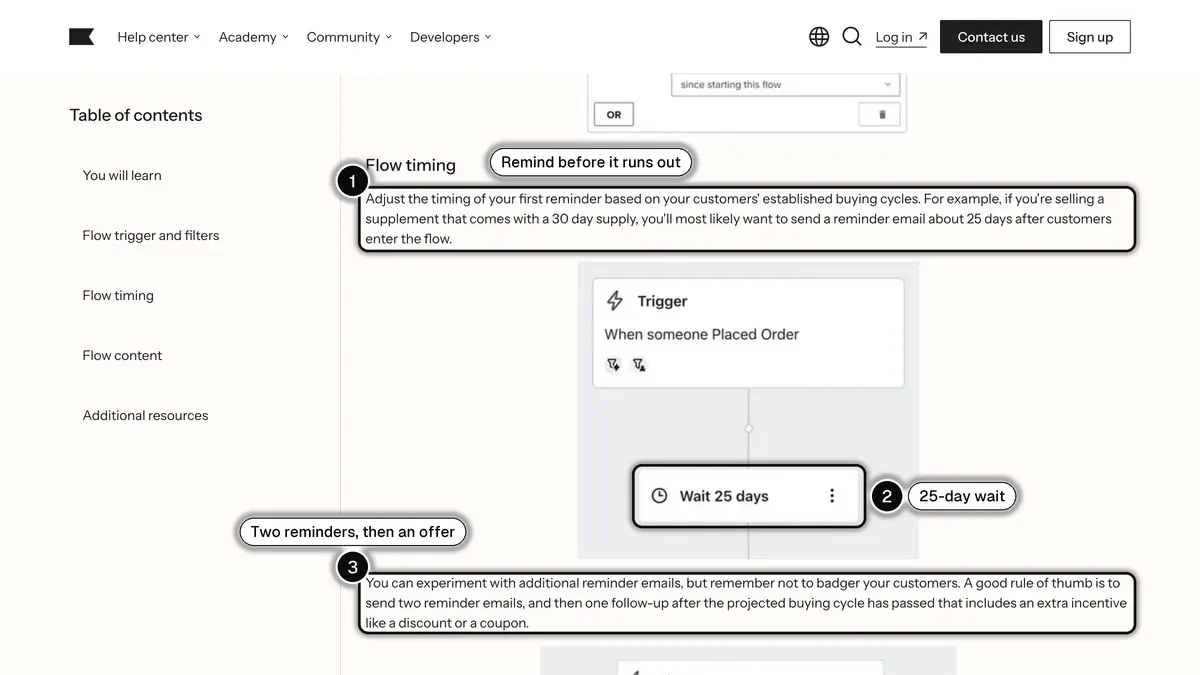
Source: Klaviyo Help Center, How to create a replenishment flow, read on October 23, 2026. In 1, the first reminder before the product runs out; in 2, the 25-day wait after the order; in 3, two reminders, then a follow-up with an incentive.
The timing depends on the product, not on a store-wide average. A 1.7 oz bottle and a 6.8 oz bottle do not run out at the same pace: set the delay per product or per size where you can.
3. Segment by number of orders
A one-order customer and a ten-order customer do not need the same message. Number of orders is the simplest place to start, and it exists in Shopify and in most messaging tools. Here is a starting point, with thresholds to adjust to your buying cycle:
| Segment | Shopify filter (example) | Goal | What to send |
|---|---|---|---|
| One-time buyers | number_of_orders = 1 | Get the second order | How-tos, a complementary product, a replenishment reminder |
| Active repeat buyers | number_of_orders >= 2 AND last_order_date >= -90d | Raise frequency | New arrivals, restocks, bundles |
| Best customers | rfm_group = 'CHAMPIONS' | Keep the relationship | Early access, review requests, referrals |
| Drifting customers | last_order_date < -180d | Win them back | A win-back series (strategy 7) |
Exclude customers who just ordered from every campaign: a promo landing the day after a full-price purchase creates frustration. And measure these four groups before you build more.
4. Turn customer service into a retention channel
A problem solved well can strengthen a customer's trust. Service matters at three moments: the question before buying (size, compatibility, delivery time), order tracking, and returns or exchanges.
- Answer where the customer writes, and bring chat, email and messaging into one inbox so nobody waits.
- Answer before the question: a tracking link sent at shipping prevents many tickets.
- Offer an exchange before a refund, with a clear return policy.
- Fix the cause: a question that keeps coming back often points to a product page or size guide that needs work.
5. Ask for reviews after delivery
A customer who leaves a review commits a little more to your brand, and the review helps the next shopper. Ask after delivery, once the product has been used, and later still for products that take days to judge (skincare, mattresses, shoes).
Shopify lists review requests as an example action for its Loyal RFM group. In practice: one message, a direct link to the review form, one reminder at most. Kanal's review collection on WhatsApp follows the same logic, with a message triggered by delivery.
6. Give your best customers something others don't get
Your best customers do not need a discount to come back. They respond to recognition: early access to a collection, a members-only product, an invitation, a sample tucked into the box. Those are the actions Shopify associates with its Champions group: exclusive deals, early access to new products, a referral program.
To find them, combine the RFM group, the number of orders and a customer tag (customer_tags) you put on your VIPs. A full loyalty program with points and tiers is a separate project, covered in our ecommerce loyalty program guide; here the idea is simpler, and our guide to a WhatsApp VIP tier shows one way to run it in chat.
7. Win back lapsed customers
A lapsed customer is not someone who has not ordered in a month. It is someone who has gone longer than your usual buying cycle without ordering. Klaviyo's Help Center page How to create a winback flow puts it this way: the flow should only target people who have not engaged with you for longer than your business's average buying cycle. Klaviyo suggests measuring that cycle with the average time between orders of your repeat customers.
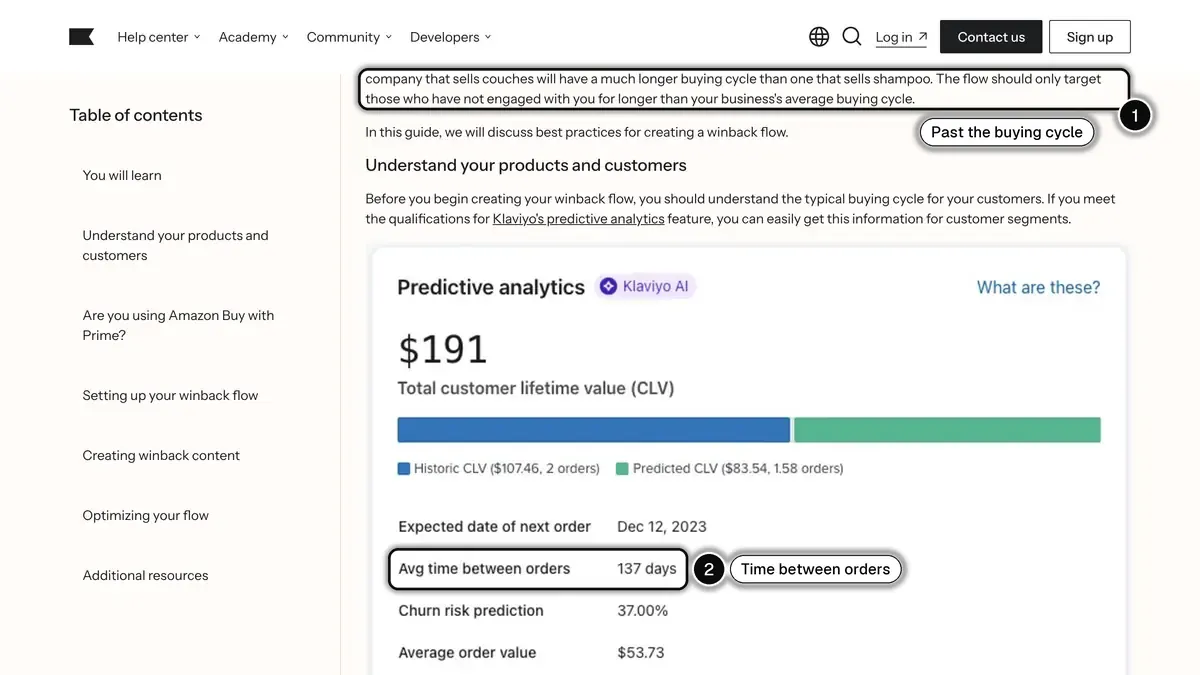
Source: Klaviyo Help Center, How to create a winback flow, read on October 23, 2026. In 1, only target customers past the average buying cycle; in 2, the average time between orders, on Klaviyo's sample profile.
A good win-back series stays short. Klaviyo recommends three messages: a light first touch with a few best sellers or new releases, a reminder of the offer with an expiration date, then a final call to come back, update preferences or unsubscribe. Customers who order during the series leave it.
On Shopify, the Win back customers template in Shopify Messaging sends a marketing message once a set time has passed since the customer's last order. For finer targeting, start from the Last order date filter or from the At risk and Previously loyal RFM groups, which deserve a more personal message than Dormant customers.
8. Measure and adjust
Track a few metrics, always calculated the same way:
| Metric | Where to find it | What it tells you |
|---|---|---|
| Share of returning customers | New vs returning customers report | Whether your base comes back more or less than before |
| Time between orders | Returning customers report (first and last order dates, number of orders) | When to send reminders and win-back messages |
| Customer lifetime value by cohort | Customer cohort analysis | Whether recent customers are worth more than older ones at the same age |
| Unsubscribes per message | Your email or messaging tool | Whether you send too often or to the wrong segment |
The customer retention rate and its formula are covered in a dedicated guide, and our list of ecommerce KPIs shows where to read each metric in Shopify. To know whether a campaign works, hold out a control group that does not get the message over the same period: without it, a lift may come from the season or a sale.
Email, SMS or WhatsApp: which channel for retention?
The channels complement each other. Email carries rich content: order details, product selections, win-back series. SMS carries short alerts for customers who opted in to texts. WhatsApp carries short, personal messages read on the phone, with images and buttons, and the customer can reply in the same thread.
WhatsApp has its own rules. Meta requires consent before you message people, with your business name stated clearly, according to its page on getting opt-in for WhatsApp. Meta charges for each delivered marketing message, based on the message category and the recipient's country code, according to its WhatsApp Business Platform pricing.
Two more limits, both described on Meta's page about per-user marketing template message limits, shape a retention plan:
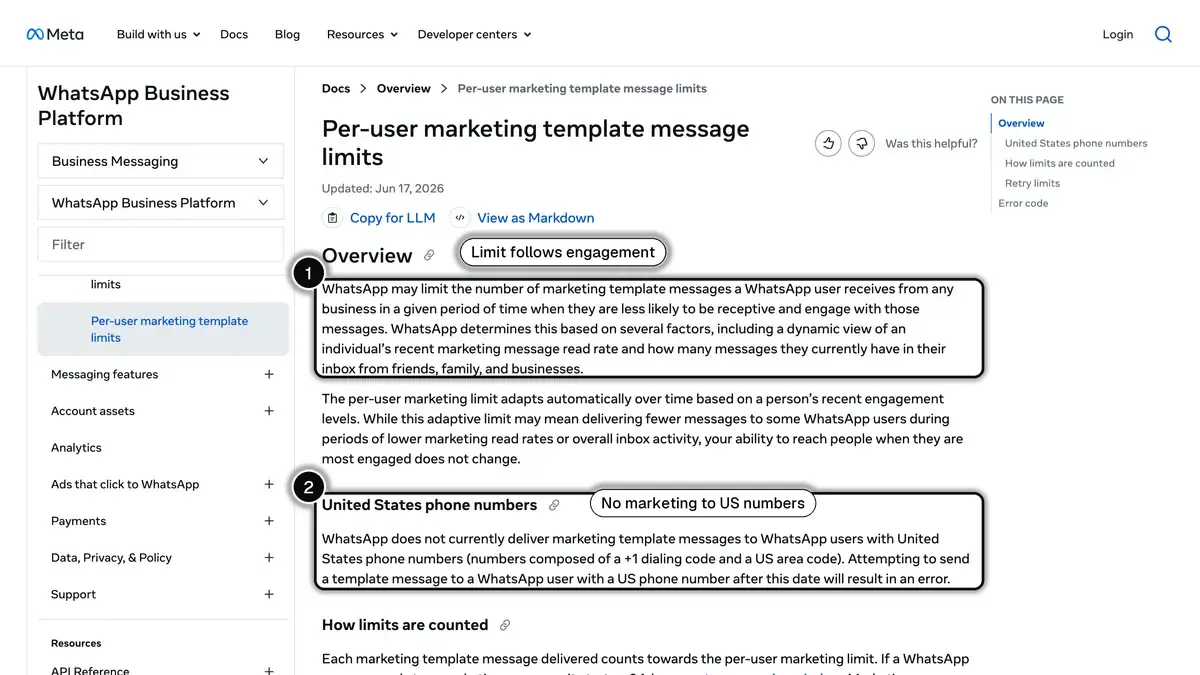
Source: Meta for Developers, Per-user marketing template message limits, read on October 23, 2026. In 1, the limit depends on factors such as the person's recent marketing read rate; in 2, marketing templates are not currently delivered to US phone numbers.
- Per-user limits. WhatsApp may limit how many marketing messages a person receives when they are less likely to engage, based in part on their recent marketing read rate. Send fewer, better-targeted messages: a replenishment reminder to the right customer gets read, a weekly blast to the whole list may stop reaching the least engaged.
- US phone numbers. WhatsApp does not currently deliver marketing template messages to users with US phone numbers (a +1 dialing code and a US area code). For US customers, use WhatsApp for order and shipping updates and conversations, and keep promotions on email and SMS. Our guide to WhatsApp marketing in the USA covers what still works.
Retention marketing on WhatsApp with Kanal
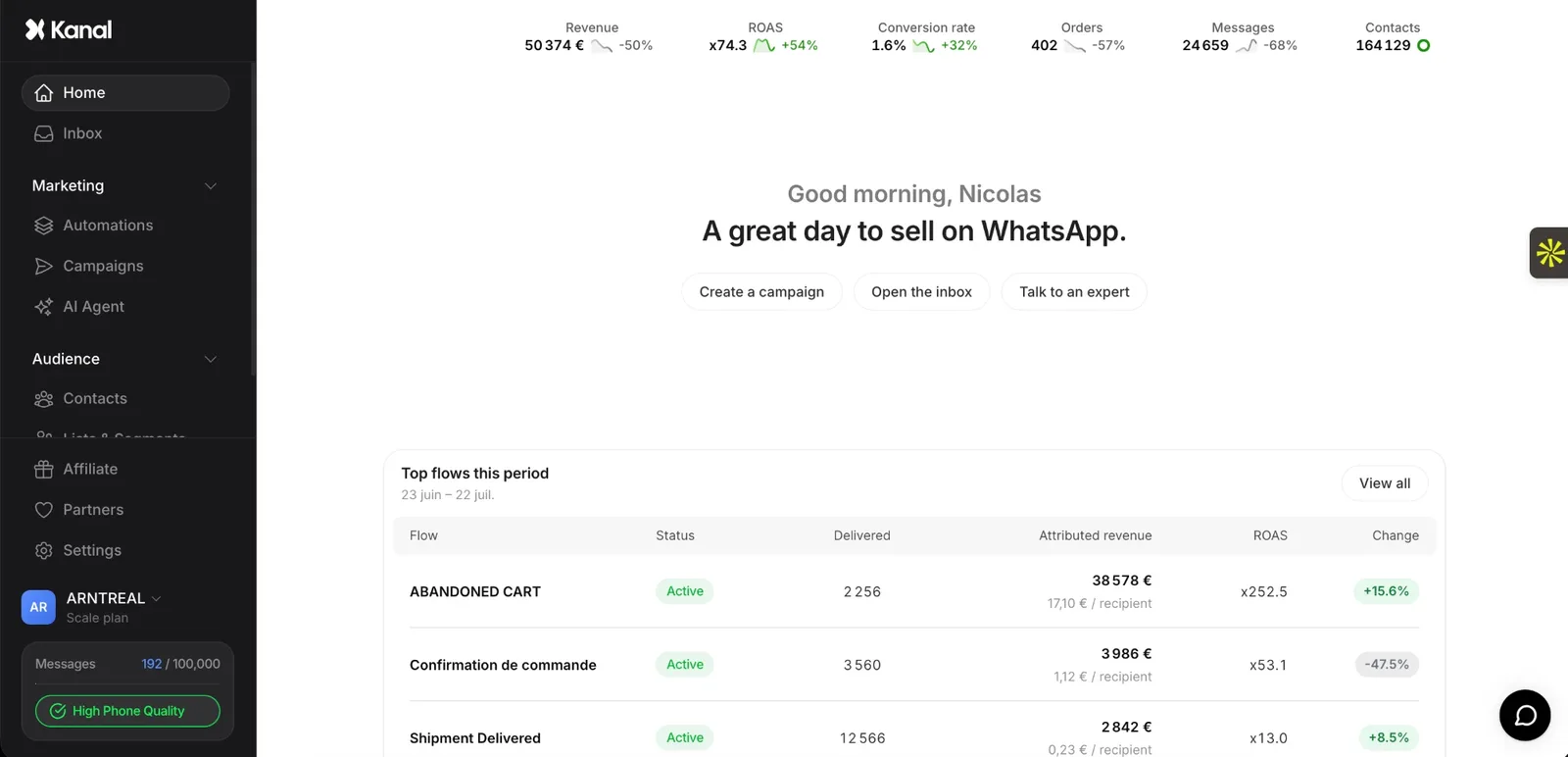
Kanal is the WhatsApp app built for Shopify stores. It runs the strategies in this guide on WhatsApp, from your store's events:
- Automated post-purchase. Automations start when an order is created and at each shipping status (shipped, out for delivery, delivered), with delays between messages: a review request a few days after delivery, for example.
- Reminders and alerts. A delay after the order works as a replenishment reminder, and back-in-stock alerts notify customers waiting for a product.
- Segments by orders and by country. Kanal segments use the number of orders, orders placed within a period and the country of the customer's phone number. A win-back segment can be customers with at least one order but none in the last 90 days, excluding US numbers.
- Personal offers. On the Scale plan, a flow can generate a unique Shopify discount code for each customer and add a Shopify customer tag, for example to mark your VIPs.
- Automated win-back. An automation can wait after an order, check that the customer has not ordered since (conditions are on the Scale plan), then reach out. It can stop as soon as the customer replies, and quiet hours keep messages out of the night.
- Klaviyo and WhatsApp together. With the Klaviyo integration, Klaviyo segments become WhatsApp audiences, a webhook in a Klaviyo flow can trigger a Kanal automation, and WhatsApp events (delivered, read, clicked) flow back into Klaviyo. Email and SMS stay in Klaviyo.
On consent, Kanal does not import Shopify's checkout marketing checkbox: Shopify contacts arrive with an unknown status. WhatsApp opt-in comes from the website WhatsApp widget, a popup, a QR code, a WhatsApp link with a prefilled message, an opt-in step in an automation, or an import with consent. A STOP reply opts the customer out.
More than 500 brands use Kanal, rated 5/5 on the Shopify App Store and set up in 5 minutes. Brands on Kanal see open rates above 90% on WhatsApp, and plans start at €89 a month, with Meta's message fees billed separately.
Retention marketing in short
- Retention marketing gets existing customers to order again, and the second order is where it matters most.
- Start with Shopify's data: one-time customers, returning customers, cohorts and RFM groups.
- Time every message to the product's buying cycle, from replenishment reminders to win-back.
- On WhatsApp, target: consent first, marketing messages paid per message, per-user limits for the least engaged, and no marketing templates to US numbers.
To run these strategies on WhatsApp with Kanal, book a demo: we will show you post-purchase automations and win-back segments on your own store.
See Kanal on your own store
- Your campaigns and cart reminders on WhatsApp, starting from your own store
- Post-purchase offers, back-in-stock alerts, then the AI agent that advises your customers
- You leave with the plan that fits and its price
From €89/month
- brands
- 500+
- to set up
- 5 min
- open rate on WhatsApp
- +90%
Nicolas helps e-commerce brands grow revenue with WhatsApp marketing. With deep expertise in Shopify ecosystems and conversational commerce, he shares proven strategies for abandoned cart recovery, broadcast campaigns, and AI-powered customer engagement.