WhatsApp Statistics 2026: Users, Messages and Adoption Data

Summarize this article with an AI
 ChatGPT
 Claude
WhatsApp statistics for 2026 from WhatsApp and Meta: users, daily actives, a messaging record and business adoption, each linked to its primary source.
Table of contents (10)
Key takeaways
- More than 3 billion people in over 180 countries use WhatsApp, and Meta counts more than 2 billion daily actives.
- WhatsApp peaked at 30 million messages sent per second in July 2026, but Meta's earnings calls give no daily message total.
- The WhatsApp Business app had more than 200 million monthly users in July 2023, a count of app users rather than distinct businesses.
- No independent benchmark exists for WhatsApp marketing open rates, so track read, reply and opt-out rates in your own account.
Quick answer
The figures you can check at the source: more than 3 billion people in over 180 countries use WhatsApp (WhatsApp), WhatsApp has more than 2 billion daily actives (Meta, Q4 2025 earnings call), it peaked at 30 million messages sent per second in July 2026 (Meta, Q2 2026 earnings call), the WhatsApp Business app had more than 200 million monthly users in July 2023 (Meta, Q2 2023 earnings call), and click-to-message ads across Meta's apps reached a $10 billion revenue run-rate (Meta, Q1 2023 earnings call). Every statistic below links to the document it comes from.
A note on method: Meta shares WhatsApp figures irregularly, mostly in earnings calls and on WhatsApp's own site. This page lists figures published by WhatsApp or Meta, dated when the source gives a date, plus one email benchmark published by Mailchimp and labelled as such. Numbers we could not trace to a primary source (users by country, daily messages, business accounts, open rates) are left out.
Users and Reach
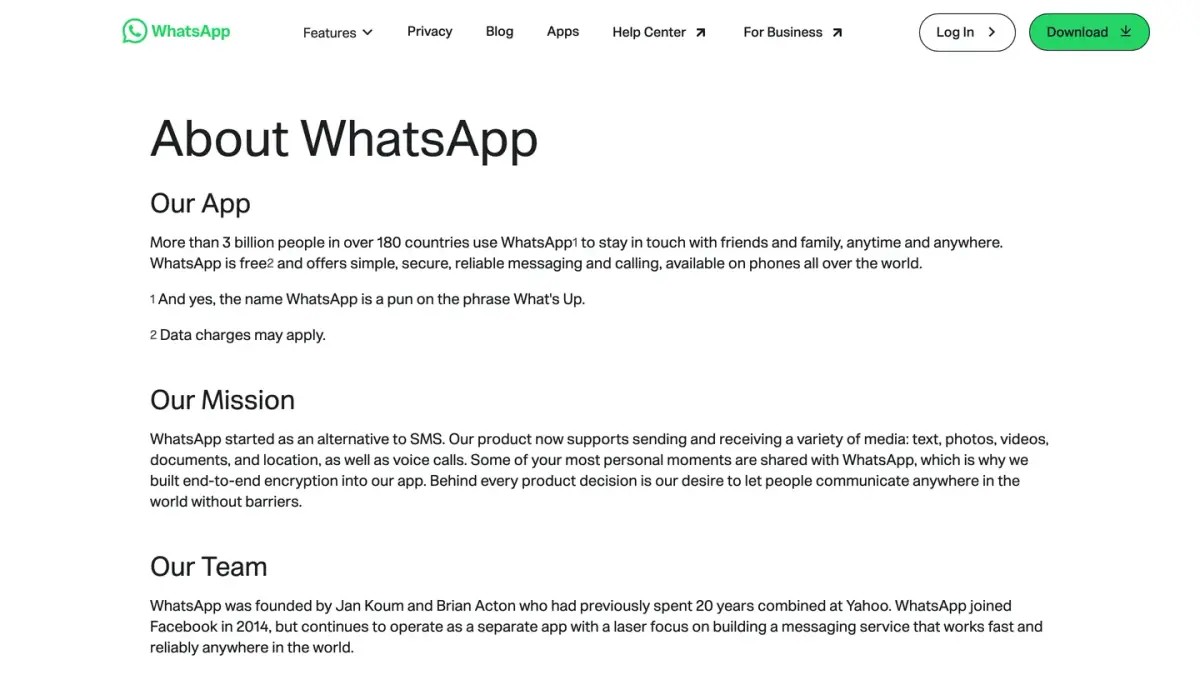
- More than 3 billion people in over 180 countries use WhatsApp, according to WhatsApp's About page.
- More than 2 billion daily actives on WhatsApp, according to Meta's Q4 2025 earnings call (January 28, 2026).
Engagement
- 30 million messages per second: in July 2026, Meta said WhatsApp had just hit an all-time messaging record, peaking at 30 million messages sent per second during the World Cup Final (Q2 2026 earnings call).
- Meta's 2026 earnings calls do not give a daily message total, and the daily figures that circulate for 2026 are third-party estimates, so we do not list them.
- For a brand, what matters is whether your own messages get read and answered. Track read rate (messages read divided by messages delivered) and reply rate per campaign: they tell you more about your WhatsApp marketing than any global total.
Business and API
- More than 200 million monthly users of the WhatsApp Business app in July 2023, according to Meta's Q2 2023 earnings call. This counts users of the app, not distinct businesses.
- There is no independent public benchmark for WhatsApp marketing open rates; vendor figures are not audited. Measure read rate, click rate and opt-outs in your own account.
- Meta now frequency-caps marketing templates per user across all businesses, which rewards quality lists over volume. Our Black Friday playbook covers how to plan sends around the caps.
- Businesses using the official WhatsApp Business API get pre-approved templates, quality ratings per number and progressive sending limits, which is what platforms like Kanal run on.
Commerce and Marketing
- Click-to-message ads reached a $10 billion revenue run-rate, as Meta said on its Q1 2023 earnings call (April 2023). The figure covers ads that open a chat in Messenger, Instagram or WhatsApp, not WhatsApp alone.
- If you run abandoned cart reminders on WhatsApp, measure the recovery rate against your email flow on the same carts, with a holdout group. The mechanics are detailed in our abandoned cart guide.
- @usernames are rolling out through 2026, adding a discovery surface for brands. See our WhatsApp usernames guide.
WhatsApp marketing statistics: ads, paid messaging and AI agents
These figures come from Meta's earnings call transcripts, reread on October 8, 2026.
- Over 80% year-over-year growth in daily click-to-WhatsApp ads revenue, as Meta said on its Q2 2023 earnings call (July 26, 2023).
- A $2 billion annual run-rate crossed by paid messaging within WhatsApp in Q4 2025, according to Meta's Q4 2025 earnings call (January 28, 2026).
- More than 10 million conversations each week facilitated through Meta's Business AIs, up from 1 million at the start of the year, according to Meta's Q1 2026 earnings call (April 29, 2026). Meta gives this figure for its messaging platforms as a whole, not for WhatsApp alone.
- More than 1 million businesses using Meta Business Agents every week to talk to their customers or complete sales, after Meta made them available globally on WhatsApp and Messenger, according to Meta's Q2 2026 earnings call (July 29, 2026).
For email, a public reference point exists: Mailchimp's email marketing benchmarks (read on October 8, 2026, based on data available in December 2023) put the average open rate at 35.63% and the click rate at 2.62% across all users, and at 29.81% and 1.74% for e-commerce. We have not found an equivalent primary source for WhatsApp marketing, and an email open is not measured the same way as a WhatsApp read, so compare each channel with its own history.
France and Europe
Country-level WhatsApp user counts for France and other European markets are estimates we could not trace to a primary source, so this page no longer lists them. For a store selling in Europe, the useful numbers are your own: the share of customers who opt in to WhatsApp at checkout, by country, and how WhatsApp reminders perform against email on the same carts.
The Numbers to Track on Your Own Account
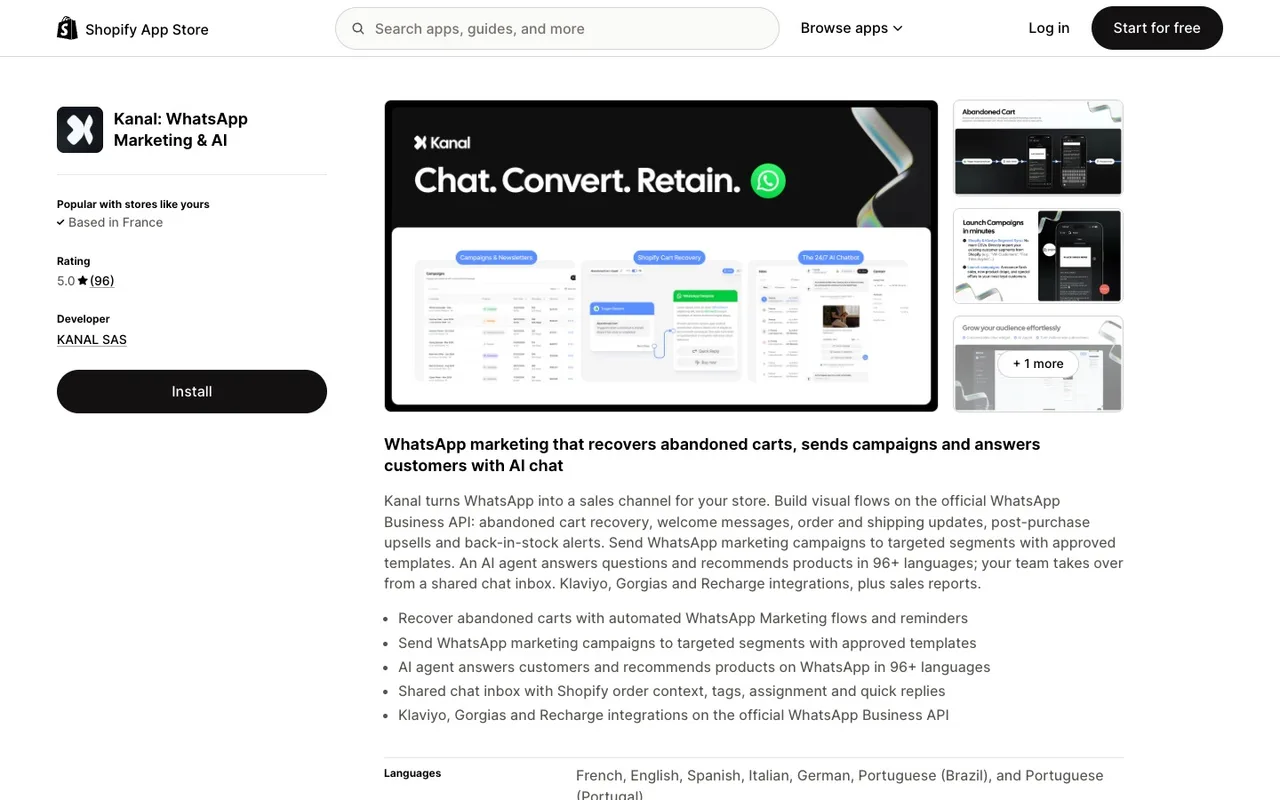
Global figures show the size of the channel; your own figures tell you whether it works for your store. Track these per campaign and per flow:
- Opt-in rate: customers who opt in to WhatsApp divided by customers asked (checkout, pop-up, post-purchase).
- Delivery rate: messages delivered divided by messages sent.
- Read rate: messages read divided by messages delivered.
- Reply rate: replies divided by messages delivered.
- Revenue per message: attributed revenue divided by messages delivered.
- Opt-out rate: opt-outs divided by messages delivered, read together with your number's quality rating.
Keep the definitions fixed, record a baseline over your first weeks, and use a holdout group to measure what WhatsApp adds. Our WhatsApp marketing ROI and KPIs guide goes further into conversion, ROI and ad metrics.
How to cite these statistics
Feel free to cite this page. If you use a statistic, please link to this page or to the primary source given next to each number. This page is updated as WhatsApp and Meta publish new official figures; the "last updated" date in the header reflects the latest revision.
Sources
Frequently asked questions
How many people use WhatsApp in 2026?
According to WhatsApp, more than 3 billion people in over 180 countries use the app. Meta's Q4 2025 earnings call, held in January 2026, put WhatsApp at more than 2 billion daily actives. Other 2026 totals found online are third-party estimates.
How many messages are sent on WhatsApp per day?
Meta's 2026 earnings calls do not give a daily total, and the daily figures for 2026 found online are third-party estimates. The latest figure in Meta's earnings calls is a peak: in July 2026, Meta said WhatsApp had just hit an all-time record of 30 million messages sent per second during the World Cup Final.
What open rate does WhatsApp marketing get?
There is no independent public benchmark for WhatsApp marketing open rates; vendor figures are not audited. The reliable number is the read rate in your own account: messages read divided by messages delivered, tracked per campaign.
How many businesses use WhatsApp?
In July 2023, Meta said the WhatsApp Business app had more than 200 million monthly users, a count of app users rather than distinct businesses. Meta also said in April 2023 that click-to-message ads, which open a chat in its messaging apps, had reached a 10 billion dollar revenue run-rate.
See Kanal on your own store
- Your campaigns and cart reminders on WhatsApp, starting from your own store
- Post-purchase offers, back-in-stock alerts, then the AI agent that advises your customers
- You leave with the plan that fits and its price

- brands
- 500+
- to set up
- 5 min
- open rate on WhatsApp
- +90%
5/5 on the Shopify App Store (125 reviews)

Nicolas helps e-commerce brands grow revenue with WhatsApp marketing. With deep expertise in Shopify ecosystems and conversational commerce, he shares proven strategies for abandoned cart recovery, broadcast campaigns, and AI-powered customer engagement.
Glossary terms in this article
Quick definitions for the WhatsApp Business terms used above.
WhatsApp Business App
The WhatsApp Business App is a free mobile application designed for small businesses to chat with customers, with a catalog, quick replies, and automated greeting messages.
Read full definitionMarketing Template
A marketing template is a WhatsApp message template used for promotion: offers, product launches, back-in-stock alerts or cart reminders. It can be sent at any time to customers who opted in, and Meta charges each delivered message at the marketing rate of the recipient's country.
Read full definitionQuality Rating
The quality rating is the score WhatsApp gives a business phone number, and each of its message templates, based on how recipients react: blocks, reports and read rates. It is shown as high, medium or low (green, yellow, red).
Read full definitionClick-to-WhatsApp Ads
Click-to-WhatsApp ads are Facebook and Instagram ads whose button opens a WhatsApp chat with the business instead of a website. The shopper sends the first message, which lets the business reply freely and, under Meta's pricing, for free during a limited window.
Read full definitionOpt-in
A WhatsApp opt-in is the permission a person gives a business to send them messages on WhatsApp. WhatsApp's Business Messaging Policy requires it before any message: the business must have the person's phone number and their agreement to hear from that business.
Read full definitionOpt-out
A WhatsApp opt-out is a person's request to stop receiving messages from a business on WhatsApp. WhatsApp's Business Messaging Policy requires businesses to respect every such request, whether it is made on WhatsApp or elsewhere.
Read full definitionSuggested articles
WhatsApp Marketing in the USA: What Works During Meta's Pause
Why WhatsApp marketing messages to US numbers are dropped: Meta does not deliver marketing templates to them. What still works, and error 131049 explained.
How Does WhatsApp Make Money? Meta's Business Model (2026)
How does WhatsApp make money with no subscription and no ads in chats? Paid business messaging and click-to-WhatsApp ads. The full breakdown.
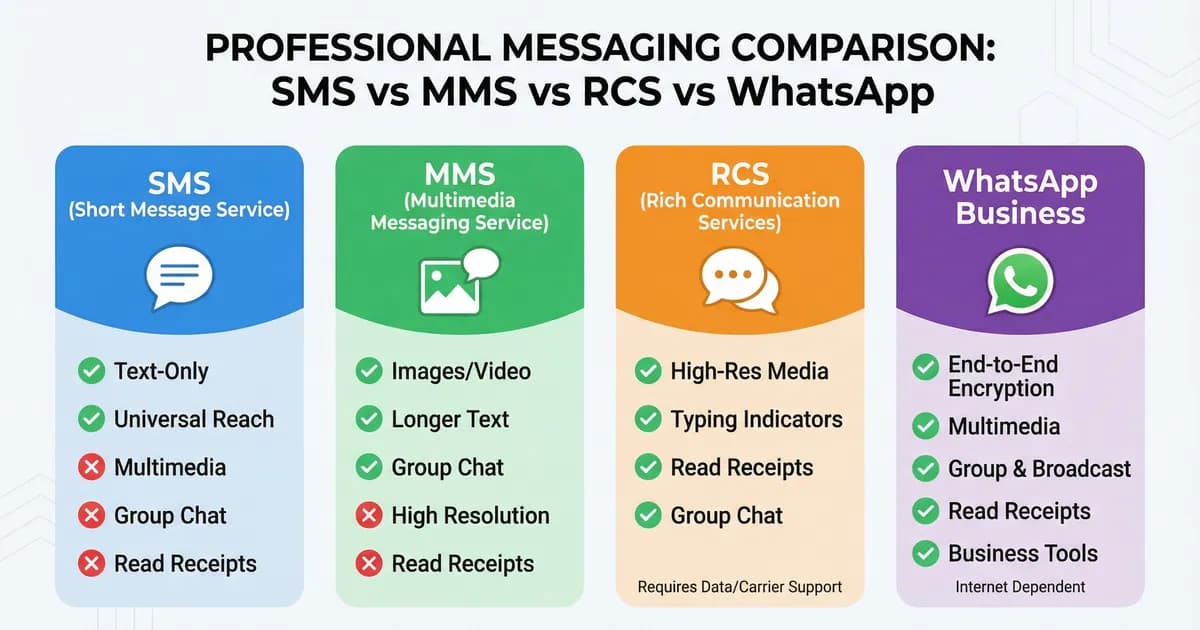
Is WhatsApp SMS or MMS? SMS vs MMS vs RCS vs WhatsApp
WhatsApp is neither SMS nor MMS: it is an app that sends messages over the internet. How SMS, MMS, RCS and WhatsApp differ, in one table, for 2026.

WhatsApp Marketing for E-Commerce: The 2026 Playbook
WhatsApp marketing for Shopify stores: cart recovery, broadcasts, AI chatbots, the metrics to track, and 12 plays that work in 2026.