WhatsApp Marketing in the USA: What Works During Meta's Pause

Summarize this article with an AI
 ChatGPT
 Claude
Why WhatsApp marketing messages to US numbers are dropped: Meta does not deliver marketing templates to them. What still works, and error 131049 explained.
Table of contents (13)
Key takeaways
- Since April 1, 2025, Meta has not delivered marketing templates to US phone numbers, and on October 7, 2026 no end date had been announced.
- Utility and authentication templates, replies inside the 24-hour service window and conversations from click-to-WhatsApp ads still reach US customers.
- Error 131049 signals the per-user marketing limit that applies worldwide, and Meta asks you to wait at least 24 hours before resending.
Quick answer
Why are my WhatsApp marketing messages being dropped in the USA? Because Meta does not deliver them. Its documentation states that WhatsApp does not currently deliver marketing template messages to WhatsApp users with United States phone numbers, meaning a +1 dialing code and a US area code (Meta for Developers, read on October 7, 2026). The block comes from Meta's policy, not from US carriers, and it does not depend on your template, your provider or your quality rating.
Can you still do WhatsApp marketing in the USA in 2026? Yes, but not with marketing templates. Since April 1, 2025, Meta has paused delivery of marketing template messages to United States phone numbers (+1), and the pause was still in place on October 7, 2026, with no announced end date. What still delivers: utility templates (order confirmations, shipping updates), authentication templates, free-form replies inside the 24-hour customer service window, and conversations started from click-to-WhatsApp ads, which open a free entry point window. Add the per-user limits on marketing messages that Meta applies worldwide, and the 2026 rule fits in one line: fewer messages, better targeted.
Introduction: the US market did not close, the rules changed
If you sell to American customers on WhatsApp, you have probably watched campaign reports fill up with failures since spring 2025. Templates that deliver perfectly to France or Germany show up as not delivered the moment the recipient has a +1 number.
The explanation is a platform decision, not a problem with your account. WhatsApp marketing messages to the USA are paused: since April 1, 2025, Meta has suspended delivery of marketing template messages to United States phone numbers. As of October 7, 2026 the pause is still in effect, and Meta has announced no end date.
This guide covers what the pause does and does not block, the compliant playbook for selling to US customers today, the new deliverability rules that now apply everywhere (frequency capping in particular), and how to read failures like error 131049 so you stop guessing.
What Meta's pause blocks, and what still gets through
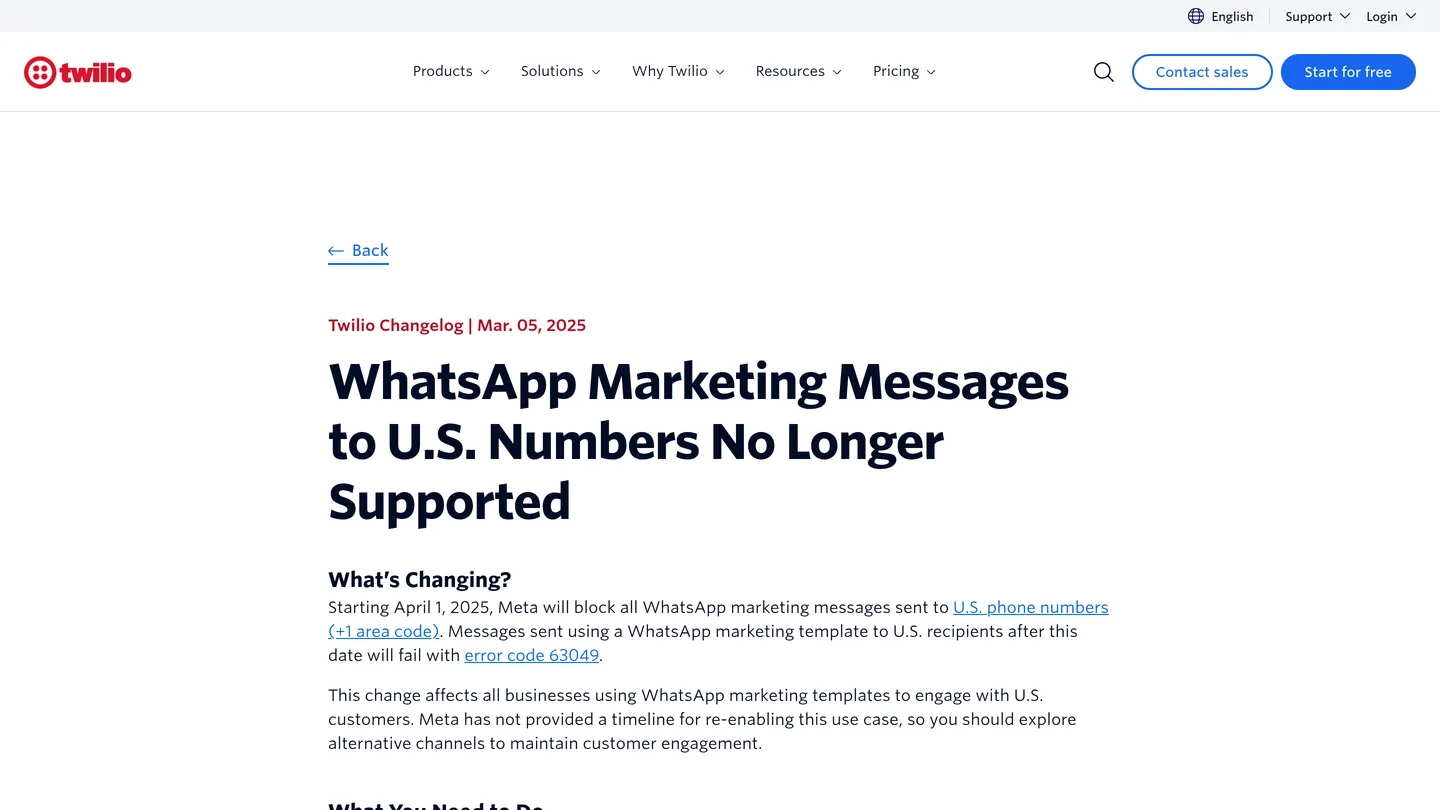
The pause targets one category: marketing template messages sent to United States phone numbers (the +1 country code). Every business is affected in the same way, whatever its size, its provider, or its quality rating. Solution providers documented the change publicly, for example in Twilio's changelog.
Meta's own documentation is brief on the subject: WhatsApp does not currently deliver marketing template messages to users with United States phone numbers, defined as numbers with a +1 dialing code and a US area code, and trying to send one results in an error (per-user marketing template message limits, read on October 7, 2026). By that definition, a +1 number with a Canadian area code is not a US number.
Everything else still works. Here is the delivery picture for US numbers in 2026.
| Message type | Delivery to US (+1) numbers |
|---|---|
| Marketing templates | Paused since April 1, 2025 |
| Utility templates (order confirmations, shipping updates) | Delivered |
| Authentication templates | Delivered |
| Free-form replies in the 24-hour service window | Delivered |
| Conversations from click-to-WhatsApp ads | Delivered, with a free entry point window |
Two practical consequences follow. First, a paused marketing template is not a quality problem, so do not burn hours rewriting a template that was never going to deliver. Second, the channels that remain open are conversation-shaped: they either confirm something the customer did or answer something the customer asked. Your US playbook has to be built on those two motions.
Carriers or Meta policy: who blocks WhatsApp messages to the USA?
The short answer is Meta. Carrier filtering is an SMS topic: text messages travel over the carriers' networks, and carriers decide what they let through. WhatsApp messages do not take that road. WhatsApp's Help Center describes the service as requiring an internet connection, through a mobile data network or Wi-Fi (About WhatsApp charges), so a carrier never handles a WhatsApp message as a text it could filter.
What drops a marketing template to a US number is a rule Meta applies on its own platform. You can tell the two apart by the symptom: a WhatsApp send that Meta declines comes back through the API as a failed message with a Meta error code, such as 131049, not as a carrier rejection.
Utility flows: the backbone of US WhatsApp marketing
Utility templates (order confirmations, shipping updates and other transactional notices) still deliver normally to US numbers. For a store, they are not a consolation prize: they are the messages customers actually open, because they carry information the customer is waiting for.
They also do quiet commercial work. Each utility message keeps your brand present in the customer's chat list, and every customer reply opens the 24-hour customer service window, where you can answer free-form and help them buy again.
Keep utility templates strictly transactional. A template that mixes in promotional content can be classified as marketing, and a marketing template does not deliver to US numbers today. For how each message category is billed, see the WhatsApp Business pricing guide.
Click-to-WhatsApp ads: the free entry point window that still works
Click-to-WhatsApp ads run on Meta's ad network and drop the prospect straight into a WhatsApp conversation with your store. They are the compliant way to run outbound-style marketing to US audiences in 2026, because the customer starts the conversation, not you.
When a user messages you through one of these ads and you reply inside the 24-hour customer service window, a free entry point window opens: Meta does not charge the messages you send in it, templates included (Meta Business Agent messages excepted). Meta's pricing documentation, updated on September 30, 2026, says this window may remain open for up to 7 days, where earlier versions said 72 hours. While the customer keeps writing, you can reply free-form: product recommendations, answers to objections, closing the sale, all without a template.
The discipline is speed and follow-through. Answer within minutes, qualify with two or three questions, and collect an explicit opt-in for your utility and marketing lists before the window closes. Our click-to-WhatsApp ads guide covers campaign setup, budgets and message strategy in depth.
The 24-hour service window: selling by answering
Every inbound customer message opens a 24-hour customer service window in which you can reply free-form, no template required. Since October 1, 2026, Meta charges these service replies at the utility rate of the customer's country ($0.0034 for a US number, read on October 7, 2026) after 1,000 free service messages per business phone number each month (Meta's pricing). The pause changes nothing here: a US customer who writes to you can be served like any other customer.
For US revenue, this window is where the selling happens. Sizing questions, delivery questions, "when is this back in stock" messages: each one is a buying signal, and a fast, useful answer is how you turn it into an order.
The operational bar is responsiveness. A window that opens at 9 pm US time while your team sleeps in Europe is wasted unless something answers for you, which is exactly the work an AI agent or a well-designed automation should absorb.
Running the compliant US playbook on Shopify with Kanal
Orchestrating all of this by hand (utility flows firing on time, ad conversations answered in minutes, US numbers excluded from marketing campaigns) is where most teams drop the ball. That is the job Kanal does for Shopify stores.
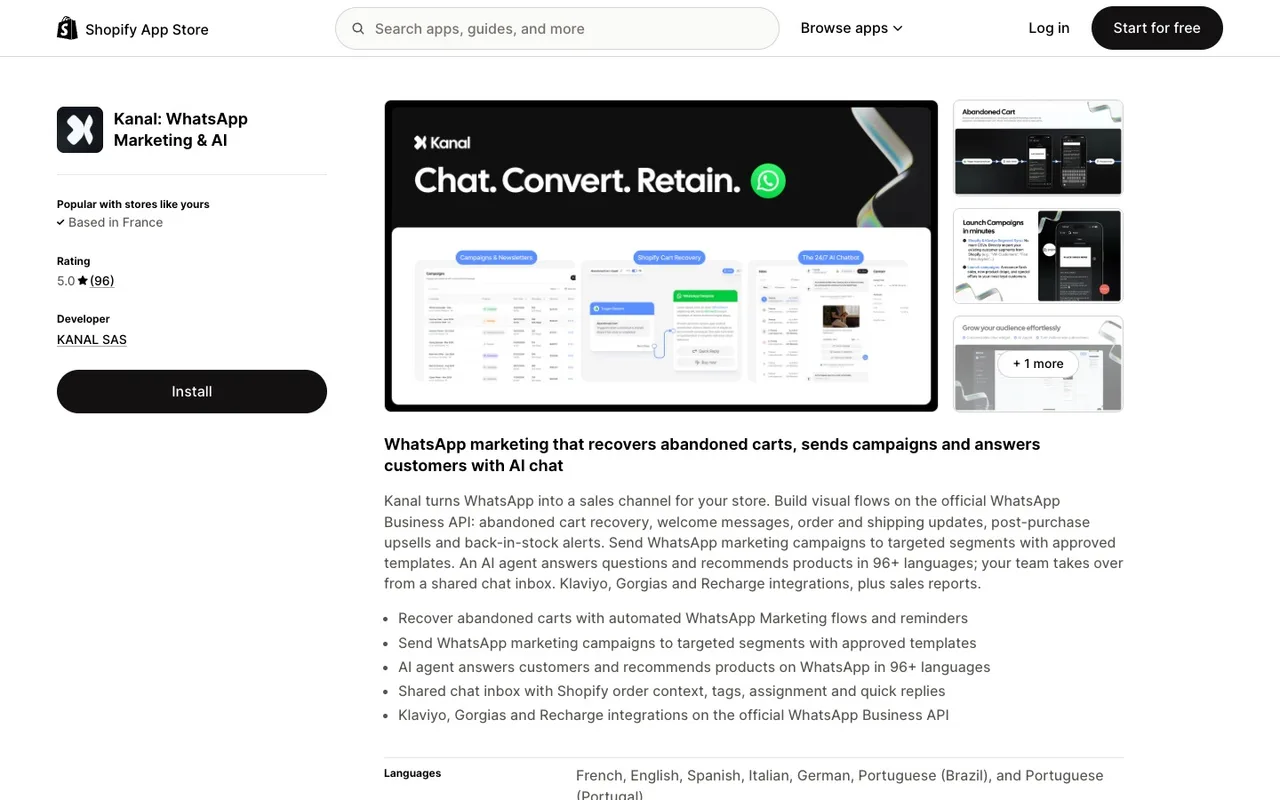
Kanal connects your Shopify store to the WhatsApp Business API and automates the channels that are open in the US: order confirmation and shipping update flows, an AI agent that answers service-window and ad conversations around the clock, and segmented campaigns for the rest of the world. Cart recovery and promotional flows keep running for your non-US audience, while US (+1) numbers are excluded cleanly instead of piling up as failed sends.
To be plain about the limits: Kanal does not bypass Meta's pause or frequency caps, and no tool can. What a good platform changes is execution quality: notifications that fire reliably, conversations answered fast, campaigns targeted well enough to protect your quality rating. That is what moves revenue under the 2026 rules, for US brands and for EU or international brands selling into the US alike.
Frequency capping: the deliverability rule that applies everywhere
Outside the pause, the deliverability rule to plan around is frequency capping. Meta documents it as per-user marketing template message limits (read on October 7, 2026): WhatsApp may limit the number of marketing template messages a person receives from any business in a given period, when that person is less likely to engage with them. The signals Meta names are the person's recent read rate for marketing messages and how many messages they already have in their inbox. Meta publishes no number, and says the limit adapts over time.
One exception helps: if a person replies to a marketing message, a 24-hour customer service window opens, and marketing messages sent inside it do not count toward the limit.
Read that from the customer's side: your campaign competes with every other brand messaging that person today. If other brands got there first, your send can fail with error code 131049 no matter how good your template is. Plan for it in Q4 in particular: our Black Friday WhatsApp playbook covers how to plan sends around the caps.
Since around October 2025, providers have also reported that messaging limits can apply at portfolio level, shared across a Business Manager rather than per number. If several numbers live in one portfolio, one team's aggressive campaign can constrain everyone else's sending.
The playbook: segment hard and message the people most likely to act, prioritize your single best message over three average ones, spread sends instead of blasting your whole base at once, and watch the failure rate of every campaign. If you are rebalancing channel budgets for US promotions, the WhatsApp vs SMS pricing comparison helps you run the numbers.
Error 131049 and templates not delivered: how to diagnose
When a send fails, the error code tells you which rule you hit. Meta's error code list describes WhatsApp error 131049 as a message that was not delivered to maintain healthy ecosystem engagement. It is the code returned when a marketing template runs into the per-user marketing limit, or when a business keeps retrying to a person who has reached it.
A practical checklist when a WhatsApp template is not delivered:
- Check the destination. A marketing template to a +1 number is paused, full stop. That is expected behavior, not a bug.
- Check the error code. 131049 points to the per-user marketing limit. Do not retry in a loop: Meta asks you to wait at least 24 hours before resending, and says repeated retries can make delivery to those users unavailable for up to 24 hours.
- Check the template category. If a template you meant as transactional was classified as marketing, it inherits every marketing restriction, US pause included.
- Check your messaging limits and quality rating. Limits can now apply at portfolio level (reported since around October 2025), so look across your Business Manager, not just one number.
- Read the trend, not one message. A single 131049 is noise. A rising failure rate on a segment is a signal: cut frequency or tighten targeting.
Quality rating care: send less, land more
Your quality rating remains the master switch for reach. It reflects how recipients react: blocks and reports pull it down, useful and expected messages sustain it. The full mechanics are in our quality rating guide.
One reported change matters in 2026: a red rating now typically triggers a correction window rather than an instant downgrade. Treat that window like a fire alarm. Pause campaigns, find the flow or segment generating blocks, and fix it before limits tighten.
Day-to-day hygiene has not changed: clean opt-in only, an easy opt-out in marketing messages, real answers to replies, and templates that say something specific instead of recycling the same blast. Under frequency capping, the message your customers welcome is also the one that keeps your future sends deliverable.
Conclusion: play the channels that are open
WhatsApp marketing in the USA is not dead, it is filtered. Marketing templates to +1 numbers are paused with no announced end date, so the brands earning US revenue on WhatsApp in 2026 are the ones treating utility flows, click-to-WhatsApp ads and the service window as the plan, not the fallback.
The same discipline pays everywhere else. Under Meta's per-user limits, volume is no longer a strategy: targeting, timing and message quality decide what lands. Build for that now and, if Meta reopens marketing templates to US numbers, you will simply have one more open channel and better habits than your competitors.
If you run a Shopify store and want the compliant version of this playbook live this week (utility flows, AI-answered conversations, campaigns that skip +1 numbers automatically), book a Kanal demo and see it on your own catalog.
Resources
- Meta for Developers: per-user marketing template message limits
- Meta for Developers: WhatsApp error codes
- Twilio changelog: WhatsApp marketing messages to US numbers
- WhatsApp Business pricing guide
- WhatsApp Business quality rating explained
- Click-to-WhatsApp ads guide 2026
- WhatsApp vs SMS pricing by country
- Kanal on the Shopify App Store
- Meta WhatsApp Business platform
Frequently asked questions
Why are my WhatsApp marketing messages to the USA being dropped?
Since April 1, 2025, Meta has paused delivery of marketing template messages to United States phone numbers. As of October 7, 2026, Meta's documentation still says WhatsApp does not currently deliver marketing templates to numbers with a +1 dialing code and a US area code, and gives no end date. Utility and authentication templates, replies inside the 24-hour service window, and conversations started from click-to-WhatsApp ads still deliver normally.
Are WhatsApp messages to the USA blocked by carriers or by Meta?
By Meta. WhatsApp messages travel over the internet, on mobile data or Wi-Fi, so they do not go through the carrier filtering that applies to SMS. What stops a marketing template to a US number is Meta's own policy: its documentation says WhatsApp does not currently deliver marketing template messages to numbers with a +1 dialing code and a US area code.
What is WhatsApp error 131049?
Meta's error code list describes 131049 as a message that was not delivered to maintain healthy ecosystem engagement. It is returned when a marketing template runs into the per-user marketing limit, which caps the marketing templates a person receives from any business in a given period, or after repeated retries to a person who has reached it. Meta does not publish a number for the limit and asks you to wait at least 24 hours before resending.
Can I still sell on WhatsApp to US customers in 2026?
Yes. Order confirmations, shipping updates and other utility templates deliver normally, authentication templates work, and you can reply free-form inside the 24-hour customer service window. Since October 1, 2026, those replies cost the utility rate after 1,000 free service messages per business phone number each month. Click-to-WhatsApp ads open a free entry point window when you reply inside the customer service window: Meta does not charge your messages while it is open (Meta Business Agent messages excepted).
When will Meta lift the US marketing pause?
Meta has announced no end date. As of October 7, 2026 the pause is still active, so the reasonable plan is to build US flows on utility messages, click-to-WhatsApp ads and the service window, and keep your marketing templates ready for the day delivery resumes.
Do WhatsApp frequency caps apply outside the USA?
Yes. Meta's documentation says WhatsApp may limit the number of marketing template messages a person receives from any business in a given period, based on signals such as their recent read rate for marketing messages. Meta does not publish a number. When a person has reached the limit, additional marketing sends fail with error code 131049.
See Kanal on your own store
- Your campaigns and cart reminders on WhatsApp, starting from your own store
- Post-purchase offers, back-in-stock alerts, then the AI agent that advises your customers
- You leave with the plan that fits and its price

- brands
- 500+
- to set up
- 5 min
- open rate on WhatsApp
- +90%
5/5 on the Shopify App Store (125 reviews)

Nicolas helps e-commerce brands grow revenue with WhatsApp marketing. With deep expertise in Shopify ecosystems and conversational commerce, he shares proven strategies for abandoned cart recovery, broadcast campaigns, and AI-powered customer engagement.
Glossary terms in this article
Quick definitions for the WhatsApp Business terms used above.
Marketing Template
A marketing template is a WhatsApp message template used for promotion: offers, product launches, back-in-stock alerts or cart reminders. It can be sent at any time to customers who opted in, and Meta charges each delivered message at the marketing rate of the recipient's country.
Read full definitionQuality Rating
The quality rating is the score WhatsApp gives a business phone number, and each of its message templates, based on how recipients react: blocks, reports and read rates. It is shown as high, medium or low (green, yellow, red).
Read full definitionUtility Template
A utility template is a WhatsApp message template that follows up on something the customer did or asked for: an order confirmation, a shipping update, a payment receipt. It must not contain promotional content, otherwise Meta re-categorizes it as marketing.
Read full definitionAuthentication Template
An authentication template is the WhatsApp message template used to send one-time passcodes and verification codes. It is the only template category allowed for identity verification, and it follows a fixed format set by Meta.
Read full definitionCustomer Service Window (24-hour window)
The customer service window is a 24-hour timer that starts when a WhatsApp user messages or calls a business. While it is open, the business can reply with free-form messages; once it closes, it can only send approved message templates.
Read full definitionClick-to-WhatsApp Ads
Click-to-WhatsApp ads are Facebook and Instagram ads whose button opens a WhatsApp chat with the business instead of a website. The shopper sends the first message, which lets the business reply freely and, under Meta's pricing, for free during a limited window.
Read full definitionFrequency Capping
Frequency capping, which Meta calls per-user marketing template limits, is a WhatsApp rule that limits how many marketing template messages one person receives in a given period, counted across all businesses. A capped message is not delivered and is not charged.
Read full definitionOpt-in
A WhatsApp opt-in is the permission a person gives a business to send them messages on WhatsApp. WhatsApp's Business Messaging Policy requires it before any message: the business must have the person's phone number and their agreement to hear from that business.
Read full definitionMessaging Limits
Messaging limits are the maximum number of unique WhatsApp users a business can message outside a customer service window within a moving 24-hour period. A new business portfolio starts at 250, then moves to 2,000, 10,000, 100,000 and unlimited.
Read full definitionOpt-out
A WhatsApp opt-out is a person's request to stop receiving messages from a business on WhatsApp. WhatsApp's Business Messaging Policy requires businesses to respect every such request, whether it is made on WhatsApp or elsewhere.
Read full definitionSuggested articles

Tidio Alternatives: 10 Live Chat and AI Agent Tools (2026)
Tidio alternatives compared: AI agents, live chat, WhatsApp and Shopify fit, with starting prices for Kanal, Gorgias, Zendesk, Intercom, Crisp and more.
WhatsApp Statistics 2026: Users, Messages and Adoption Data
WhatsApp statistics for 2026 from WhatsApp and Meta: users, daily actives, a messaging record and business adoption, each linked to its primary source.
WhatsApp Business Search: How to Get Your Store Found (2026)
Users can now find businesses directly in WhatsApp search. The readiness checklist for your Shopify store: profile, catalog, verification and fast replies.
Meta Business Agent: What Shopify Merchants Need to Know (2026)
What Meta Business Agent is, what it does on WhatsApp and Messenger, how Meta bills it per token since August 2026, and how it fits a Shopify store.