WhatsApp Business Quality Rating: How Meta Scores Your Number

Summarize this article with an AI
 ChatGPT
 Claude
Meta scores every WhatsApp Business number with a quality rating (Green, Yellow, Red). Definition, calculation, recovery playbook.
Table of contents (19)
Key takeaways
- Meta rates each WhatsApp Business API number Green, Yellow or Red from how recipients react, mainly through block rate, report rate and template engagement.
- A Yellow or Red rating freezes messaging tier upgrades, and a Red rating that persists can end in suspension of the number.
- To recover, pause marketing broadcasts for 48 hours, re-verify opt-in and keep marketing templates under 20 percent of volume for 7 to 14 days.
If your WhatsApp Business number shows a Yellow or Red badge in Meta's WhatsApp Manager, you have a problem that is easy to miss. The quality rating is a score Meta calculates from how recipients react to your messages, and it decides how many you can send, how reliably they get delivered, and whether your number gets suspended. If you are dealing with a full ban instead, see WhatsApp account banned: how to fix it.
The 3 Quality Levels and What Each One Means
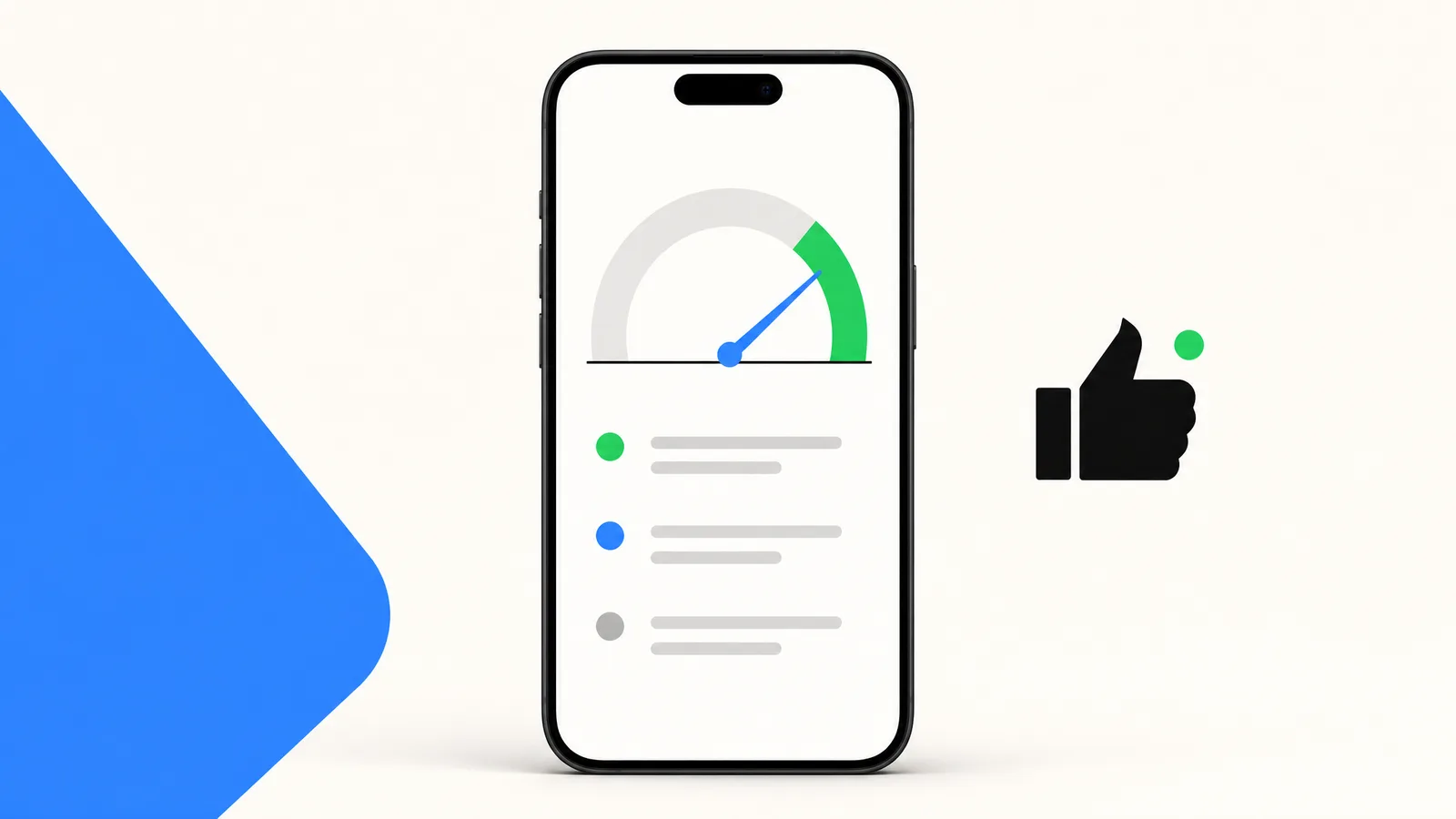
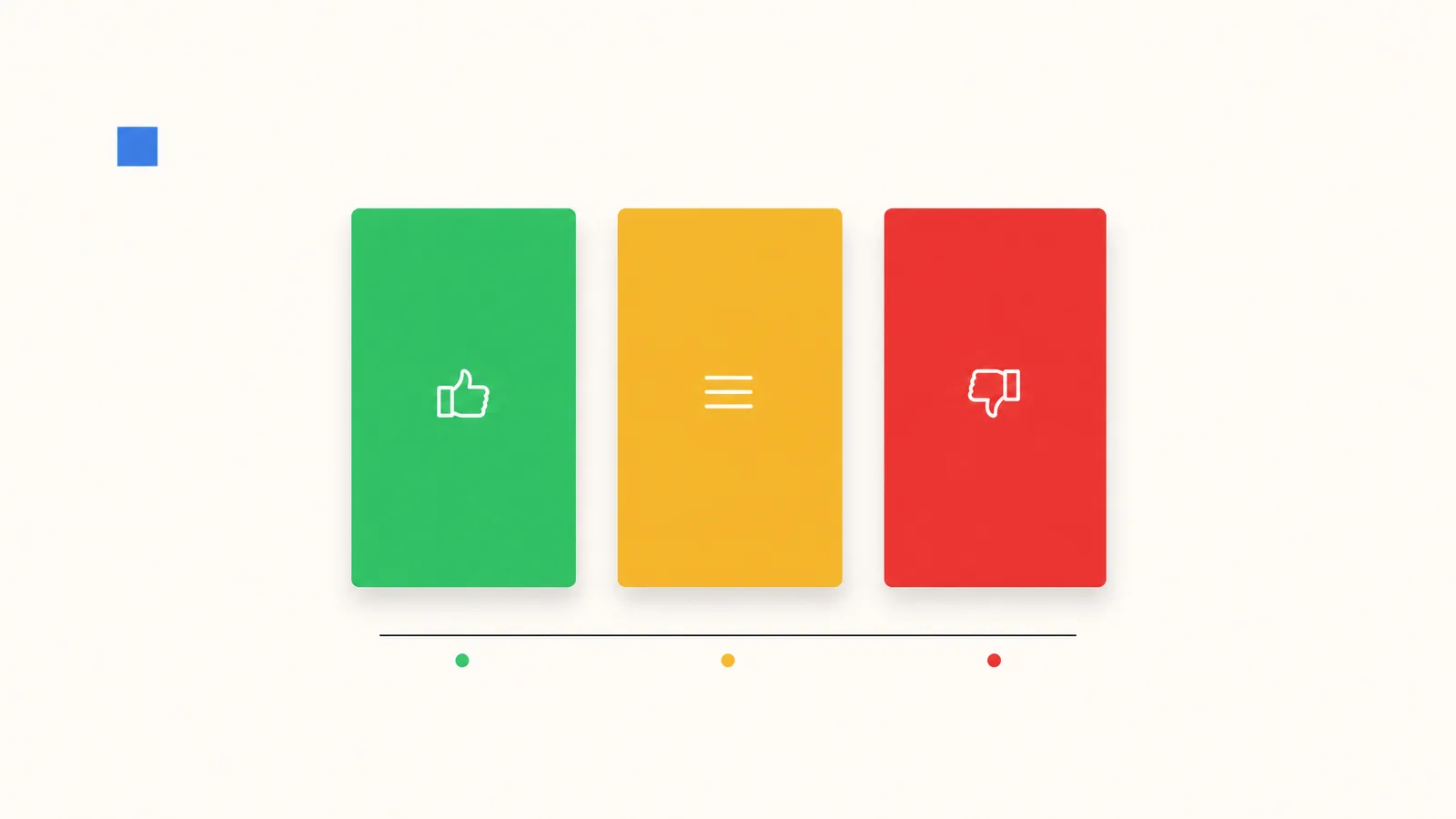
Meta surfaces the quality rating as a color in the WhatsApp Manager dashboard. Each color is a public summary of a continuous internal score.
Green (High). Your number is in good standing. Block rate and report rate are low, recipients engage with templates, and Meta is happy to let your messaging limit grow. New tier upgrades happen automatically when volume justifies it.
Yellow (Medium). Meta has detected elevated negative signals on your number. A single bad broadcast (wrong audience, low opt-in quality, or an irrelevant offer) can be enough to flip Green to Yellow. Yellow is a warning state: messaging continues, tier upgrades pause, and you have a short window to fix the source of the signal before it slides to Red.
Red (Low). The negative signal has persisted or worsened. Messaging limit is frozen, new template approvals get scrutinized harder, and on some accounts marketing templates are restricted while the rating is Red. If Red persists across multiple rolling windows, Meta can suspend the number. Red is a stop-the-presses state. Run the recovery playbook below within 24 hours.
For an overview of where quality rating fits in the broader WhatsApp Business API stack, see the WhatsApp Business API guide and the quality rating glossary entry.
How Meta Calculates the Quality Rating
Meta does not publish the exact formula. The rating works as a weighted score on a rolling 24-hour window with the following inputs.
Block rate. The share of recipients who block your number after receiving a message. Each block is a direct negative signal.
Report rate. The share of recipients who tap Report Spam on your message. Lower volume than block rate in normal operations, but each report is an explicit spam complaint.
Unhealthy template usage. Templates sent to non-opted-in recipients, templates with low click-through and reply rates, and marketing templates blasted at high frequency. Meta cross-references the template ID with reaction signals to spot patterns.
Reply rate (positive signal). The share of recipients who reply to a template. Replies show that recipients want the conversation. It is the reason 1:1 transactional flows, which customers expect, pose little risk to a number's rating.
Template engagement (positive signal). Tap-through on template buttons, opens on attached media. Counts toward the positive side of the score.
Volume relative to tier. Sending to your full tier capacity is normal. Sending to the maximum every day with low reply rate is a soft negative signal.
The score is recalculated continuously: the longer negative signals keep coming, the further the rating slides.
Messaging Limits Tied to Quality Rating
The quality rating gates your messaging tier. Tiers are the cap on how many unique users you can send template messages to in a 24 hour window, documented in Meta's messaging limits reference. Public tiers are 250, 2,000, 10,000, 100,000, and Unlimited, set at the business portfolio level and shared by all of its phone numbers.
Tier progression rules, as read on Meta's page on October 8, 2026:
| Current tier | Upgrade rule |
|---|---|
| 250 | Move to 2,000 by completing one of Meta's scaling paths: verify your business, have your partner verify it, or send 2,000 delivered messages outside customer service windows within 30 days using high-quality templates |
| 2,000 | Automatic increase to 10,000 if you send high-quality messages and have used at least half of your current limit in the last 7 days |
| 10,000 | Same rule to reach 100,000 |
| 100,000 | Same rule to reach Unlimited |
The key catch: a Yellow or Red rating freezes tier progression. You can hit the volume thresholds for a tier upgrade, but Meta will not promote you until the rating is back to Green. It is easy to miss when scaling stalls on an otherwise healthy account.
For the deeper rules around messaging tiers, see the messaging limits glossary entry.
Common Signals That DROP Your Rating
These are the sending patterns that drag a rating down.
Untargeted broadcast. A single send to a list that has not been segmented by purchase recency, location, or product interest. A general 20 percent off promo blasted to 50,000 contacts converts a fraction and drives the rest to block.
Marketing template to non-opted-in numbers. Numbers added to the list from a CSV with no explicit opt-in, a direct violation of Meta's opt-in requirements. The recipient does not recognize the sender and blocks within seconds.
Template spam. Sending the same marketing template more than once per week to the same recipient. Reply rate craters, block rate climbs.
Missing opt-out. No clear way for the recipient to stop messages. Frustration escalates straight to block instead of replying STOP.
Aggressive new-account ramp. A fresh number that hits the 250-user tier and immediately sends 250 marketing templates per day for the first week. Meta interprets the lack of warm-up as bot-like behaviour.
Country mismatch. Sending a template to a country code that the original opt-in did not cover. Recipients who never signed up are more likely to block.
Long inactive gaps. A list that has not been messaged in 90 plus days. Recipients forgot they signed up. The first re-engagement blast drives unusually high block rate.
For more on staying compliant before things go wrong, see the WhatsApp opt-in and GDPR guide.
Common Signals That LIFT Your Rating
The flip side, equally important to understand.
Strong opt-in quality. Recipients who opted in on a checkout page or post-purchase consent screen know who you are and expect your messages, so they have less reason to block.
Tight segmentation. Sending the right message to the right segment. A purchase recency cut, a country cut, or a product interest cut.
High reply rate. Conversational templates that ask a question get replies, and replies pull the score upward.
Mix of utility templates, service replies, and marketing templates. Utility templates (order updates, shipping, OTP) are messages customers expect, which pulls your average block rate down.
Reasonable frequency. Marketing template send frequency under twice per week per recipient.
Visible business identity. Verified business name, profile photo, business description present. Recipients trust the sender, block rate drops.
For best practices on building this kind of trust, see the WhatsApp Business profile optimization guide and the WhatsApp newsletter guide.
How to Check Your Current Quality Rating
The rating is visible in two places.
WhatsApp Manager. Inside Meta Business Suite, navigate to WhatsApp Manager, Phone Numbers. Each row shows the phone number, the current messaging tier, and a colored badge (Green, Yellow, Red) for the quality rating. Hover for the time window the rating applies to.
Cloud API webhook (if you run on the Cloud API). Meta sends a message_template_quality_update and a phone_number_quality_update webhook event whenever the rating changes state. Your BSP can route this to a dashboard or Slack alert.
Inside Kanal. The dashboard shows the rating on the WhatsApp campaigns and settings pages, with the time the last change occurred and an automatic pause toggle that suspends marketing broadcasts when the rating drops below Green.
If you do not see the rating, your number is either on the regular WhatsApp Business app (no rating exposed) or your BSP does not surface the data. See our comparison of WhatsApp Business API providers for what to check when picking a Business Solution Provider.
Step-by-Step Rating Recovery Playbook
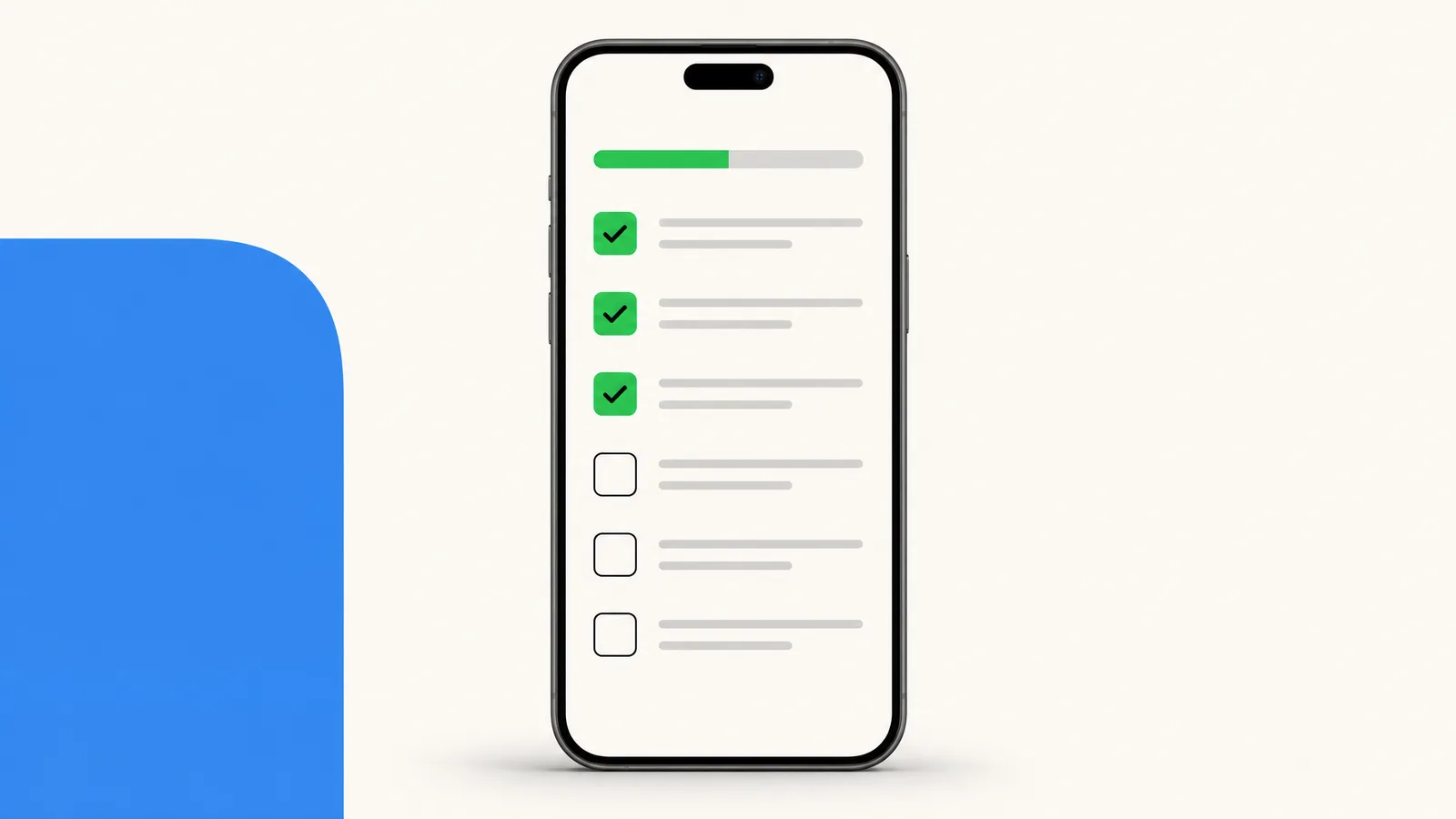
Run this within 24 hours of a Yellow or Red flip. The sooner the negative signals stop, the sooner the rating can recover.
Step 1: Audit the last 7 days of sends. Pull every template sent in the last 7 days. Sort by block rate and report rate per template. Identify the 1 or 2 templates that account for the bulk of negative signals. Those are your offenders.
Step 2: Pause non-essential broadcasts for 48 hours. Cut all marketing broadcasts immediately. Keep only utility templates (order confirmations, shipping updates, OTP) and service-window replies running. The 48-hour pause stops the negative-signal accumulation while the rating window rolls forward.
Step 3: Re-verify opt-in for all active recipients. Pull your full WhatsApp recipient list. Confirm that every segment has explicit opt-in with a timestamp and a source. Remove any segment where consent is uncertain. If you cannot prove consent, the contact should not be on the list.
Step 4: Increase your share of utility templates and service replies. For the next 7 to 14 days, shift the mix toward utility templates and service messages. Marketing template sends should drop to under 20 percent of total volume. Customers expect utility messages, so they draw fewer blocks than promotions, which lifts the moving average.
Step 5: Wait for Meta's automatic re-evaluation. Do not contact support. Meta re-evaluates the rating every 24 hours based on rolling signals. Monitor in WhatsApp Manager or your BSP dashboard until the rating is back to Green.
If the rating still has not lifted after 14 days of clean sending, treat the issue as structural (bad opt-in source, wrong audience targeting, persistent template misuse). Audit again with the offending-template lens, not a recovery lens.
What Happens at Red (Suspension Risk)
Red is not a fine. It is the last warning before suspension. The practical risks at Red:
- Messaging limit frozen. No tier upgrade until the rating recovers.
- Template approval scrutinized. New marketing templates take longer to approve, and Meta rejects more aggressively.
- Marketing template restriction. On some accounts, marketing template sends are blocked while Red, and only utility templates and service replies go through.
- Number suspension risk. If Red persists across multiple rolling windows, Meta can suspend the number outright. Suspension is recoverable via appeal but rarely fast.
The fastest way to convert Red into a permanent suspension is to ignore it and keep blasting marketing templates. The fastest way to recover is to switch to utility-only sends for 7 to 14 days. For broader account ban context, see WhatsApp account banned: how to fix it.
Quality Rating vs Account-Level Rating
These two are often confused. They are distinct.
Quality rating is per phone number. It reflects how recipients react to messages from that number. Three levels (Green, Yellow, Red), recalculated continuously on a 24-hour rolling window.
Account-level rating (sometimes called WABA rating or business verification status) is per WhatsApp Business Account. It reflects whether the business itself complies with Meta's commerce and business policies. It controls things like whether the business can register new numbers, whether it can use specific commerce features, and whether the account is at risk of being deactivated.
A clean WABA can host a number with Red quality rating. A Green-rated number can sit inside a WABA flagged for policy violations. Fixing one does not fix the other. Most quality rating recoveries are number-level fixes (templates, broadcasts, opt-in) while account-level recoveries usually involve a policy review and sometimes business verification re-submission.
How Kanal Protects Merchants From Rating Drops
Kanal layers four protections on top of the raw quality rating signal Meta provides.
First, automatic broadcast pause when the rating drops to Yellow or Red. Marketing broadcasts in the queue are suspended, utility templates and service replies continue. The pause is automatic, no human in the loop. By the time you check the dashboard, the bleeding has already stopped.
Second, opt-in audits at list level. Every WhatsApp contact in Kanal has a stored opt-in timestamp, source, and method. Segments missing valid opt-in data are flagged before a broadcast is sent.
Third, template health scoring at the template level. Each template carries a running block rate, reply rate, and report rate. Templates trending toward unhealthy get a warning badge inside the campaign builder, so you replace them before a broadcast goes out.
Fourth, audience segmentation guardrails. Marketing broadcasts above a certain volume require a confirmed segment (purchase recency, location, product interest), not a flat list dump.
For the full feature set, see the WhatsApp campaigns page, pricing, or book a demo.
Where to Go Next
If your number is currently Green, the highest-leverage move is to set up a Yellow alert and an automatic broadcast pause now, before you ever need it. If your number is Yellow or Red, run the 5-step recovery playbook in this article within 24 hours. Your rating matters more than ever now that Meta applies per-user frequency caps (see WhatsApp marketing in the USA in 2026) and that businesses become findable in WhatsApp search. If you are not sure how to read your current rating, see the WhatsApp Business API guide or book a demo and we will walk through your specific setup.
FAQ
What is the WhatsApp Business quality rating?
The WhatsApp Business quality rating is a score Meta assigns to every WhatsApp Business API phone number based on how recipients have reacted to recent messages. It has three public levels (Green, Yellow, Red) and drives your messaging tier, deliverability and ban risk.
How is the WhatsApp quality rating calculated?
Meta calculates the quality rating from signals collected over the last 24 hours: block rate, report rate, unhealthy template usage, message volume versus tier. Reply rate and template engagement contribute positively.
What does Red quality rating mean for my business?
Red means Meta has flagged your number as low quality. Your messaging limit is frozen, template approvals get scrutinized harder, and the number is at elevated risk of suspension if Red persists.
How long does it take to recover from a Yellow or Red rating?
Recovery time depends on your sending: the rating improves as fresh, cleaner signals replace the ones that caused the drop, so stop the offending behaviour first.
Is quality rating the same as account-level rating?
No. Quality rating is per phone number and reflects recipient reactions. Account-level rating reflects the policy compliance of the WhatsApp Business Account itself. Both matter, but they are distinct.
Does Meta notify me when my quality rating drops?
Yes, through WhatsApp Manager and via the Cloud API webhook. Business Solution Providers such as Kanal can surface that signal and trigger automatic actions like pausing broadcasts.
Can I check my quality rating in the WhatsApp Business app?
No. The quality rating is only exposed for numbers on the WhatsApp Business API (Cloud API). The regular WhatsApp Business app does not surface a rating.
See Kanal on your own store
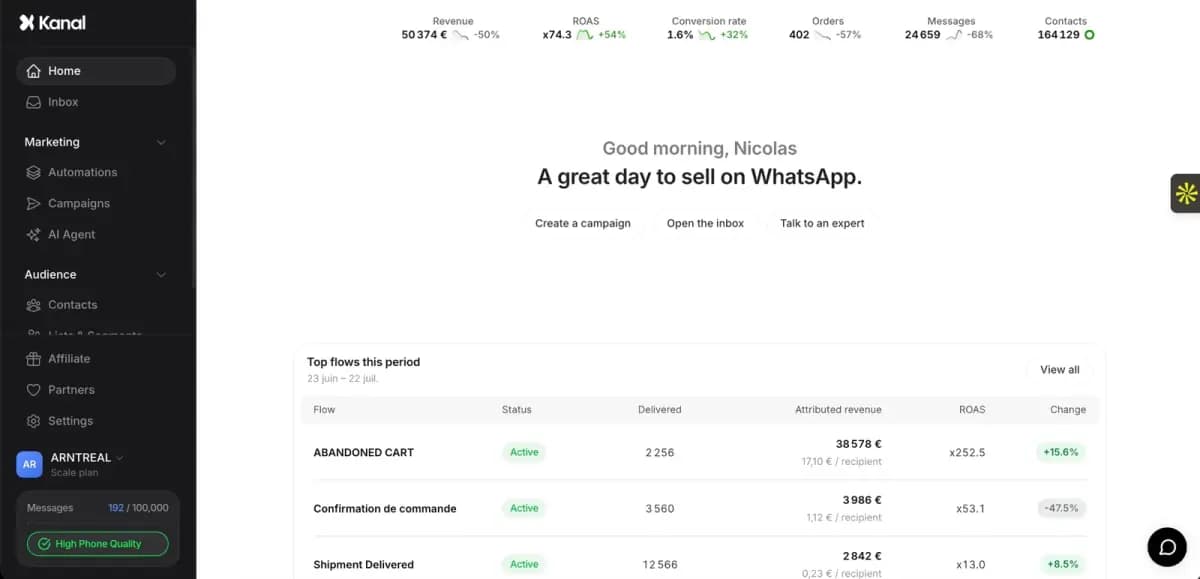
- Your campaigns and cart reminders on WhatsApp, starting from your own store
- Post-purchase offers, back-in-stock alerts, then the AI agent that advises your customers
- You leave with the plan that fits and its price

- brands
- 500+
- to set up
- 5 min
- open rate on WhatsApp
- +90%
5/5 on the Shopify App Store (125 reviews)

Nicolas helps e-commerce brands grow revenue with WhatsApp marketing. With deep expertise in Shopify ecosystems and conversational commerce, he shares proven strategies for abandoned cart recovery, broadcast campaigns, and AI-powered customer engagement.
Glossary terms in this article
Quick definitions for the WhatsApp Business terms used above.
Quality Rating
The quality rating is the score WhatsApp gives a business phone number, and each of its message templates, based on how recipients react: blocks, reports and read rates. It is shown as high, medium or low (green, yellow, red).
Read full definitionMessaging Limits
Messaging limits are the maximum number of unique WhatsApp users a business can message outside a customer service window within a moving 24-hour period. A new business portfolio starts at 250, then moves to 2,000, 10,000, 100,000 and unlimited.
Read full definitionOpt-in
A WhatsApp opt-in is the permission a person gives a business to send them messages on WhatsApp. WhatsApp's Business Messaging Policy requires it before any message: the business must have the person's phone number and their agreement to hear from that business.
Read full definitionMarketing Template
A marketing template is a WhatsApp message template used for promotion: offers, product launches, back-in-stock alerts or cart reminders. It can be sent at any time to customers who opted in, and Meta charges each delivered message at the marketing rate of the recipient's country.
Read full definitionCustomer Service Window (24-hour window)
The customer service window is a 24-hour timer that starts when a WhatsApp user messages or calls a business. While it is open, the business can reply with free-form messages; once it closes, it can only send approved message templates.
Read full definitionOpt-out
A WhatsApp opt-out is a person's request to stop receiving messages from a business on WhatsApp. WhatsApp's Business Messaging Policy requires businesses to respect every such request, whether it is made on WhatsApp or elsewhere.
Read full definitionSegmentation
Segmentation is the practice of splitting a WhatsApp contact list into groups based on traits like purchase history, behavior, or engagement, so each group receives messages that are actually relevant.
Read full definitionUtility Template
A utility template is a WhatsApp message template that follows up on something the customer did or asked for: an order confirmation, a shipping update, a payment receipt. It must not contain promotional content, otherwise Meta re-categorizes it as marketing.
Read full definitionWhatsApp Cloud API
The WhatsApp Cloud API is the version of the WhatsApp Business API that Meta hosts on its own servers. It lets a business send and receive WhatsApp messages, calls and group conversations by code, and since October 23, 2025 it is the only way to use the API.
Read full definitionWebhook
A WhatsApp webhook is an HTTP request with a JSON payload that Meta's servers send to a business's server whenever something happens on its WhatsApp account, such as an incoming message or a delivery status change.
Read full definitionBusiness Solution Provider (BSP)
A Business Solution Provider (BSP) is a company authorized by Meta to give other businesses access to the WhatsApp Business Platform, usually through its own software. Meta now calls these companies partners and splits them into Solution Partners, Tech Providers and Tech Partners.
Read full definitionWhatsApp Business App
The WhatsApp Business App is a free mobile application designed for small businesses to chat with customers, with a catalog, quick replies, and automated greeting messages.
Read full definitionWABA (WhatsApp Business Account)
A WABA (WhatsApp Business Account) is the account that represents a business on the WhatsApp Business Platform. A business needs one to send and receive messages through the API and to create message templates; it holds the phone numbers, the templates and the billing setup.
Read full definitionSuggested articles

Best WhatsApp CRM: 12 Tools Compared (2026)
The best WhatsApp CRM tools compared: CRM features, e-commerce integrations and starting prices for Kanal, Wati, Respond.io, Kommo, HubSpot and more.

11 best WhatsApp chatbots and AI agents compared (2026)
The 11 best WhatsApp chatbot and AI agent platforms in 2026, compared on type of AI, store integrations and the starting price each vendor displays.
WhatsApp Account Review: How Long It Takes & What to Do
WhatsApp account in review? WhatsApp says most reviews are completed within 24 hours. What the status means, how to request a review, what to do while you wait.
WhatsApp Marketing in the USA: What Works During Meta's Pause
Why WhatsApp marketing messages to US numbers are dropped: Meta does not deliver marketing templates to them. What still works, and error 131049 explained.