Ecommerce CRM: 10 Best Tools Compared (2026)


Summarize this article with an AI
 ChatGPT
 Claude
The 10 best ecommerce CRM tools compared (Kanal, Klaviyo, Brevo, HubSpot and more) on customer data, channels and starting price, and what a store CRM must do.
Table of contents (18)
Key takeaways
- An ecommerce CRM keeps one profile per customer with orders, spend, tags, consent and conversations, and uses it to segment customers and automate messages.
- Klaviyo ranks first in the comparison, with email, SMS, WhatsApp and push on one profile and a free email plan up to 250 contacts.
- Sales CRMs such as HubSpot, Salesforce, Zoho CRM and Pipedrive are built around deals and charge per user or seat, so check how each stores orders.
- Kanal shows Shopify orders, total spend and tags on every WhatsApp contact and starts follow-ups from store events, from $89/month.
An ecommerce CRM keeps one profile per customer, with their orders, spend, tags, consent and conversations, and uses it to segment customers and automate the messages they receive. Klaviyo tops our ranking: a B2C CRM built on marketing data, with email, SMS, WhatsApp and push on one profile. If your customer conversations happen on WhatsApp, Kanal is our pick. It brings that profile into WhatsApp: every conversation shows what the customer bought, segments and tags group your customers, and follow-ups start from store events. Kanal goes furthest on Shopify and also connects PrestaShop stores.
This guide starts with what an ecommerce CRM must do, how it differs from a B2B sales CRM and whether Shopify already counts as one. Then we compare 10 tools on the customer data they use, the channels they run and the starting price shown on their own pages.
What is an ecommerce CRM?
An ecommerce CRM (customer relationship management) is the system that knows each shopper: who they are, what they bought, what you sent them and what they agreed to receive. It fills itself from your store instead of a spreadsheet, and it acts on that data. It builds segments, triggers messages and gives your team context when a customer writes in.
What it must do for an online store
Five jobs matter for a store:
- Customer profiles with order history. Orders, total spend, products, tags and past conversations, synced from Shopify or your platform, never typed by hand.
- Segmentation. Lists that update on their own: first-time buyers, VIP customers, customers who haven't ordered in months, one city or one product category.
- Automation. Messages that start from store events, such as an abandoned checkout, a first order, a delivery or a long silence.
- The channels your customers use. Email and SMS for campaigns, WhatsApp and chat for conversations, a support inbox for questions. One profile should sit behind all of them.
- Consent. Opt-ins and opt-outs for each channel, stored on the profile.
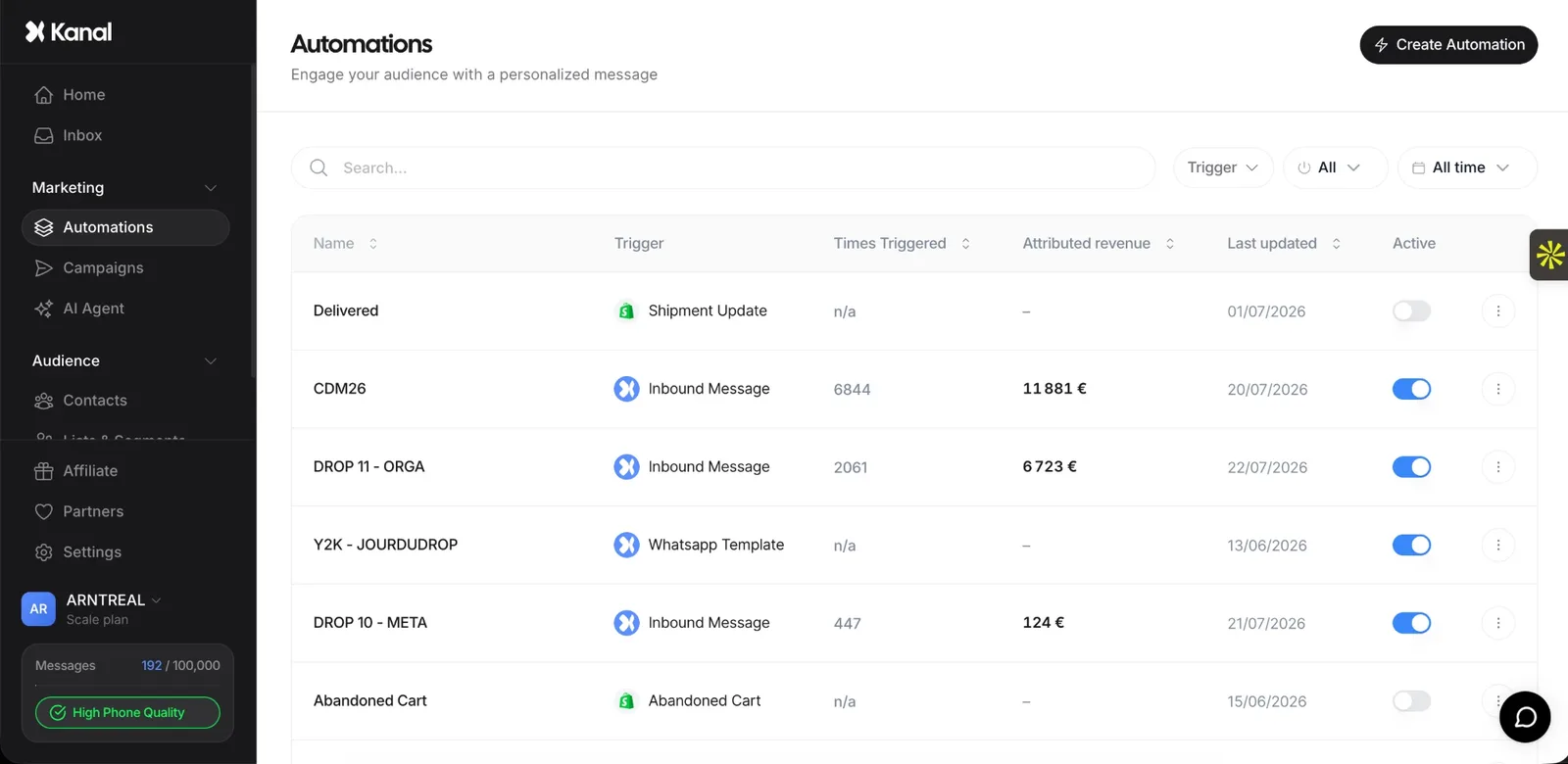 The Kanal app: automations.
In Kanal, for example, a flow can start when a Shopify order is placed, a checkout is abandoned or a tag is added, then wait, branch on conditions and send the right WhatsApp message. The automations page shows the builder.
Ecommerce CRM vs B2B sales CRM
Classic CRMs were built for sales teams. Their core records are leads, accounts and deals, and a sales rep moves each deal through pipeline stages. An online store works the other way round: many individual shoppers, and most messages go out automatically.
| Ecommerce CRM | B2B sales CRM | |
|---|---|---|
| Core record | The shopper and their orders | The account, the lead and the deal |
| Who works in it | Marketing, support and the store team | Sales reps |
| Typical action | Build a segment, then trigger a message | Move a deal to the next stage |
| Main data source | The store (Shopify, PrestaShop) | Sales activity: emails, calls, meetings |
You can connect a sales CRM to a store, but the store data has to fit its objects. Zoho's Shopify extension, for instance, files Shopify customers under Leads or Contacts, orders under Sales Orders and abandoned checkouts under Deals. That suits a B2B team. For a brand that sells to consumers, a CRM that starts from the shopper and the order is simpler to run.
Is Shopify a CRM?
Not exactly. Shopify describes itself as an all-in-one commerce platform, for selling online and in person. It does cover CRM basics:
- A customer profile is created when someone signs up for your mailing list or a customer account, places an order, or starts an order and abandons the checkout.
- Staff can add private notes and tags to a profile, and record whether the customer accepts email, SMS or WhatsApp marketing.
- Customer segments are dynamic, rule-based lists that update automatically, and Shopify Messaging can send marketing messages to them.
Brands add a CRM tool on top when they need more than lists: a shared inbox where the team replies with the order in view, journeys across several channels, loyalty programs or predictive scores. Every tool below connects to Shopify, natively or through an app. If you only want Shopify apps, see our list of the best Shopify CRM apps.
How we compared the tools
We read each tool's website and pricing page on September 11, 2026, along with Shopify App Store listings and help center articles about the store connection. We don't score the tools. For each one, we noted what a customer profile holds, how store data gets in, which channels it runs and the starting price as displayed, in the page's currency. Brevo, Zoho and Pipedrive displayed euros when we checked, and we did not convert anything. Splio and Voyado don't publish prices. Prices change often, so check the vendor's page before you buy.
Ecommerce CRM comparison table
| Tool | Built around | Store connection | Channels | Starting price (as displayed) |
|---|---|---|---|---|
| Klaviyo | B2C CRM: marketing, service and analytics | Shopify app (tags, catalog, coupons) | Email, SMS, WhatsApp, push | Free plan; Email $20/month (251 to 500 contacts) |
| Kanal | WhatsApp conversations with order data, segments and flows | Shopify (native app), PrestaShop (store API) | From $89/month | |
| Brevo | Marketing automation, sales pipelines and loyalty | Brevo PushOwl app | Email, SMS, WhatsApp, chat, push | Free plan; Starter €7/month |
| HubSpot | Contacts, deals and pipelines | Shopify Data Sync | Email, live chat, WhatsApp (Professional and Enterprise hubs) | Free CRM; Starter $15/month per seat |
| Gorgias | Support tickets with Shopify order context | Native Shopify integration | Email, chat, SMS, WhatsApp, Instagram, Facebook | $40/month (Starter, 50 tickets) |
| Splio | Retail CRM with loyalty and predictive AI | Shopify app and connectors, Shopify POS | Email, SMS, RCS, WhatsApp | Not published |
| Voyado | Retail CRM with native loyalty | Voyado Engage app (contacts, orders, vouchers) | Email, SMS/RCS, onsite, in-store | Not published |
| Salesforce | Sales, service, marketing and commerce suite | Data 360 connector (beta), third-party apps | Email marketing, chat (Pro Suite) | $25 per user/month (Starter Suite) |
| Zoho CRM | Leads, deals and sales pipelines | Shopify for Zoho CRM extension | Email, multichannel follow-up cadences | Free for 3 users; Standard €14 per user/month (annual) |
| Pipedrive | Deals and pipeline stages | Independent Shopify connector | Email (campaigns as an add-on) | €14 per seat/month (Lite, annual) |
The 10 best ecommerce CRM tools
1. Klaviyo, a B2C CRM built on marketing data
 Screenshot of the Klaviyo website.
Klaviyo presents itself as a B2C CRM that brings marketing, service and analytics together on its own data platform.
- Customer data: profiles fed by more than 350 pre-built integrations, AI-powered segments, and predictive analytics that estimate when a customer is likely to buy again.
- Store connection: its Shopify app syncs store data such as tags, catalog and coupons.
- Channels: email, SMS, WhatsApp, mobile push and pop-ups. On the service side, Customer Hub lets shoppers track orders and start returns, and a helpdesk manages tickets.
- Starting price: a free plan for email up to 250 contacts, then Email at $20/month for 251 to 500 contacts, according to its Shopify App Store listing. The monthly cost scales with your number of active profiles.
Why it ranks first: one profile behind every email, SMS, WhatsApp and push campaign, on a data platform fed by more than 350 integrations, with a free plan to start. Kanal connects to Klaviyo, so your Klaviyo segments can receive WhatsApp messages. Compare: Kanal vs Klaviyo.
2. Kanal, our pick for customer conversations on WhatsApp
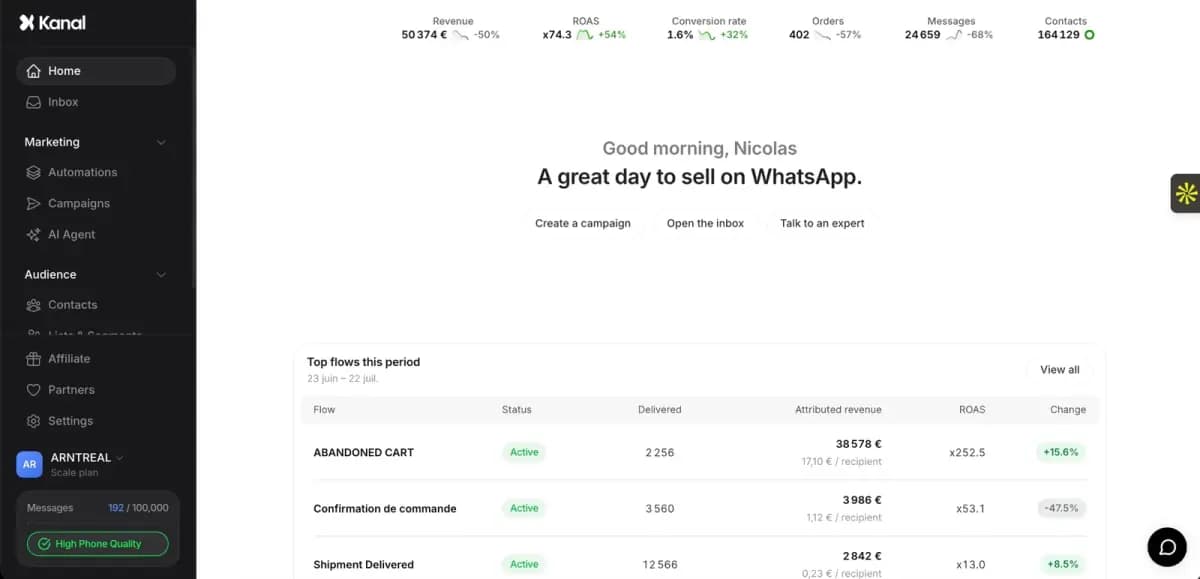
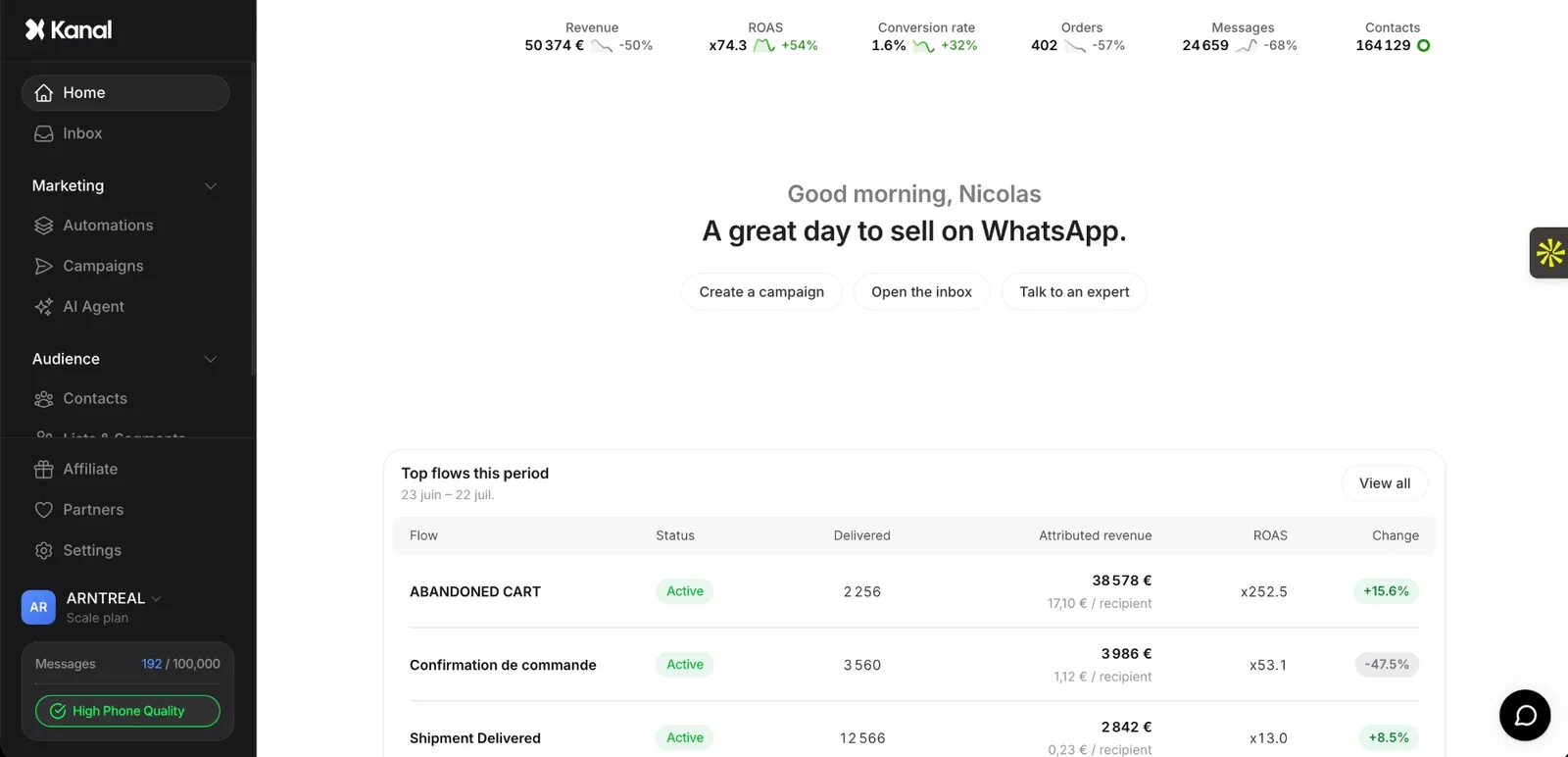 The Kanal app: home dashboard.
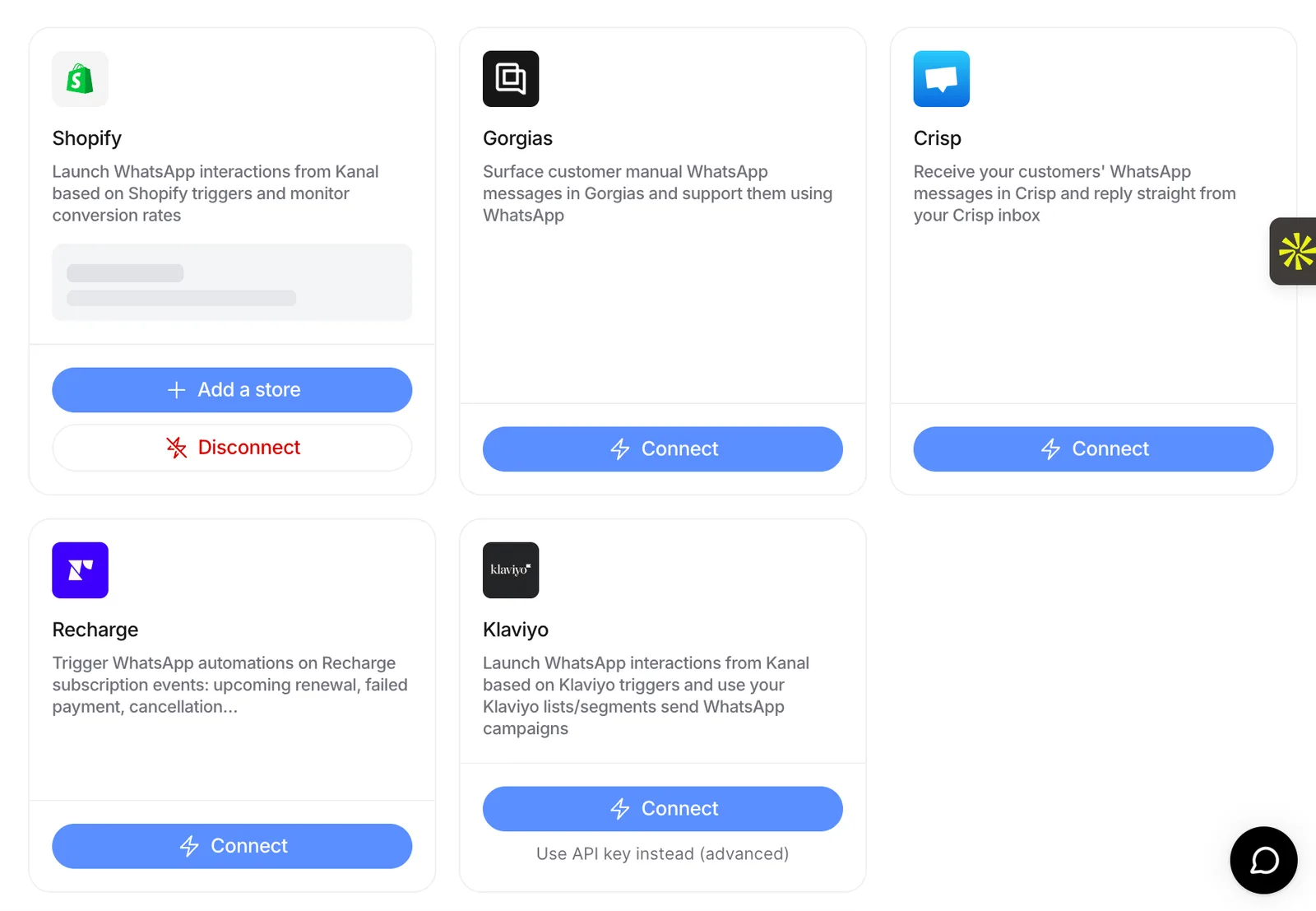 The Kanal app: integrations page.
Kanal is the CRM layer for your customer conversations on WhatsApp. It goes furthest on Shopify: you install it from the Shopify App Store, connect your store in about five minutes without code, and customers, orders and tags sync automatically. PrestaShop stores connect through Kanal's store API, set up with a Kanal expert.
- Customer profiles: every contact shows order history, total spend, tags and past conversations pulled from Shopify, so your team knows who they are talking to before replying.
- Shared inbox: several agents work one WhatsApp Business number, assign conversations, leave internal notes and use quick replies.
- Segments and tags: group customers by behavior and value, purchase history, location or custom properties. Segments are not in the entry Pro plan; they come with Scale.
- Automation: flows triggered by CRM events such as a new order, a high-value purchase or an inactive customer, plus abandoned cart recovery, post-purchase upsells, review requests and back-in-stock alerts.
- AI agent: answers product and order questions around the clock and hands over to your team with the conversation context. It is not part of the entry plan.
- Your stack: Klaviyo segments sync to Kanal (not in Pro), and Kanal also connects to Gorgias, Zendesk, Recharge, Crisp, Loyoly and Splio.
- Consent: opt-ins collected at checkout and on your site, opt-outs handled automatically.
- Starting price: from $89/month, no commitment, with Meta's WhatsApp fees passed through at cost.
Choose it if your customers talk to you on WhatsApp and you want each conversation, segment and follow-up to use your store data. The WhatsApp CRM page lists every feature.
3. Brevo, marketing automation with a sales CRM
 Screenshot of the Brevo website.
Brevo puts campaigns and automation, transactional messages, sales pipelines, a customer data platform and a loyalty program in one account.
- Customer data: the Brevo Data Platform unifies customer data. Segmentation filters contacts by demographics, website activity, campaign engagement and custom events, and the Professional plan adds contact scoring with RFM and CLV.
- Store connection: Shopify connects through the Brevo PushOwl app. According to Brevo, the app syncs customer data, purchase history and order status, and lets you segment by purchase history, product collections, customer tags and lifetime value.
- Channels: email, SMS, WhatsApp, web and mobile push, live chat and a chatbot. WhatsApp is listed among the extra marketing channels of the Professional plan.
- Sales CRM: pipelines and sales automation, with a Sales Free package for 1 seat.
- Starting price: a free plan, then Starter at €7/month (€6.33/month billed yearly) with 5,000 emails per month.
Worth a look if you want email, SMS and a simple sales pipeline from one vendor.
4. HubSpot, a free CRM with Shopify data sync
 Screenshot of the HubSpot website.
HubSpot is a general-purpose CRM for marketing, sales and service teams, with a free tier that has no expiration date.
- Customer data: contact management, deal pipelines and a reporting dashboard on the free CRM. More than 2,000 apps connect through the HubSpot Marketplace.
- Store connection: the Shopify Data Sync integration, available on all HubSpot plans, syncs customers, products, orders and abandoned checkouts. After the first sync, records update within 10 minutes of a change.
- Channels: email campaigns and live chat through its Shopify app. WhatsApp connects to the conversations inbox with Marketing Hub or Service Hub, Professional or Enterprise.
- Starting price: free CRM, then Starter from $15/month per seat (a new-customer price), Professional from $50 and Enterprise from $75 per seat per month.
Worth a look if your team already works in HubSpot, or you sell to businesses as well as consumers and want deals next to store data.
5. Gorgias, a support helpdesk with Shopify order context
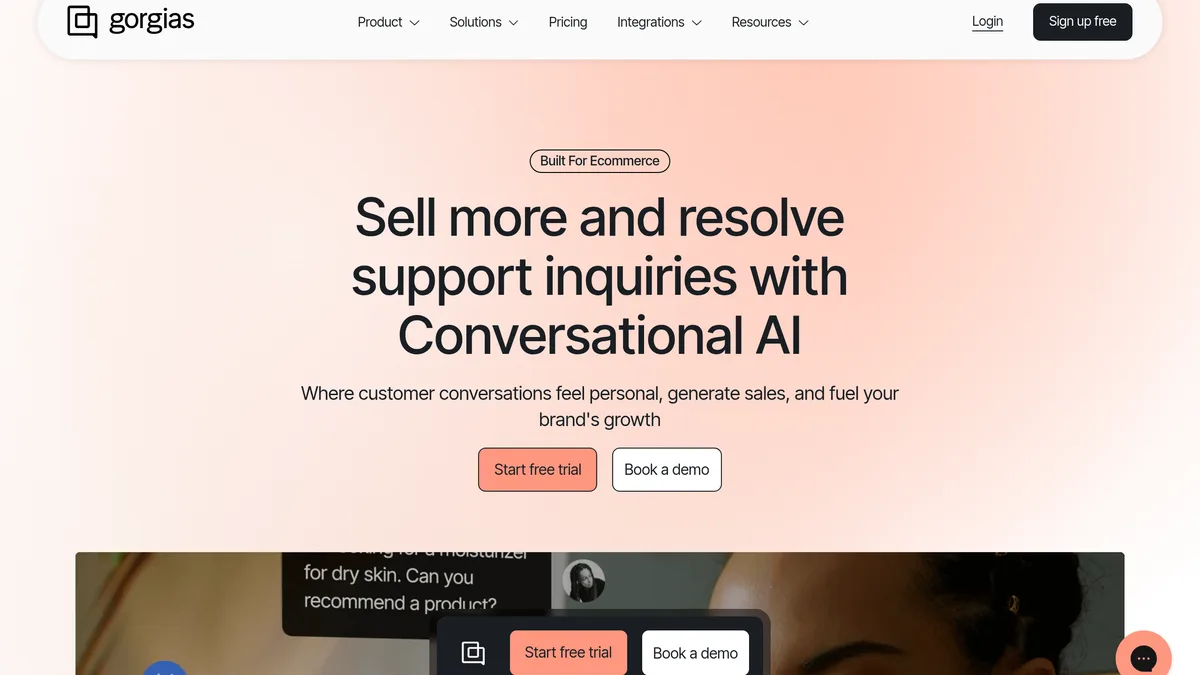 Screenshot of the Gorgias website.
Gorgias is a helpdesk designed for ecommerce and Shopify, with an AI Agent. It covers the service side of the customer relationship. Plans are billed on ticket volume: see what Gorgias costs.
- Customer data: one inbox with live Shopify data and customer context in every conversation. Agents pull up any order, customer or product without leaving the ticket.
- Channels: email, chat, SMS, WhatsApp, Instagram and Facebook in one view, with voice and SMS available as add-ons.
- Automation: the AI Agent answers support questions and automates actions such as returns and order tracking. Each automated interaction beyond the plan's allowance costs $1.50.
- Starting price: Starter at $40/month, billed monthly, with 50 tickets a month and 3 user seats (helpdesk $10 plus AI Agent $30). Plans are priced by ticket volume, never per agent.
Worth a look if most of your customer conversations are support tickets. Kanal connects to Gorgias: WhatsApp conversations can arrive in Gorgias as tickets, with the customer's Shopify order history (Gorgias integration).
6. Splio, a retail CRM with loyalty and predictive AI
 Screenshot of the Splio website.
Splio is an AI-first CRM for retail and e-commerce brands, powered by Tinyclues AI. It combines marketing automation, a customer data platform, loyalty programs and mobile wallets.
- Customer data: RFM segmentation recalculated automatically, predictive audiences (purchase propensity, churn, reactivation) and Ask My CRM, an AI agent that answers questions about your customer data.
- Store connection: a Shopify app, and a standard or an advanced Shopify connector. The advanced one handles several stores, metafield mapping and Shopify POS, and a checkout extension lets customers use Splio Rewards at checkout.
- Channels: email, SMS, RCS and WhatsApp, plus wallet push notifications.
- Pricing: not published. Splio's site offers a demo request.
Worth a look if you run a loyalty program across stores and online. Kanal connects to Splio: Splio segments sync to Kanal and Splio automation events can trigger WhatsApp messages (Splio integration).
7. Voyado, a CRM for omnichannel retailers
 Screenshot of the Voyado website.
Voyado presents its CRM as purpose-built for e-commerce. It unifies first-party shopper data and runs AI-driven email, SMS and loyalty journeys, online and in store.
- Customer data: unified profiles with every interaction, channel and purchase, segments by behavior, CLV and purchase history, and reports on CLV, churn risk and RFM.
- Loyalty: points, incentives and gamified challenges built into the CRM.
- Store connection: the Voyado Engage app syncs contacts and orders, promotions and vouchers, with abandoned cart automation and back-in-stock notifications. The app is free to install but requires a Voyado license, invoiced separately.
- Pricing: no public list prices. Voyado charges a fixed platform fee plus volume-based pricing, and says it is built for mid-market and enterprise omnichannel retailers.
Worth a look if you run physical stores and e-commerce across several markets and want loyalty inside the CRM.
8. Salesforce, a CRM suite from small business to enterprise commerce
 Screenshot of the Salesforce website.
Salesforce covers sales, service, marketing and commerce, from a small-business suite up to Agentforce Commerce (formerly Commerce Cloud) for large brands.
- Customer data: Starter Suite manages leads, accounts, contacts and opportunities, with email marketing, secure payment links and an ecommerce storefront.
- Commerce: Agentforce Commerce connects e-commerce, point of sale and order management on one platform.
- Store connection: Salesforce's Data 360 has a Shopify connector, in beta when we checked. Third-party apps such as CRM Perks: Salesforce Sync (from $19/month on the Shopify App Store) send Shopify customers and orders to Salesforce.
- Starting price: Starter Suite at $25 per user/month (a starting price, transaction fees apply), with a 30-day trial for up to 10 users. Pro Suite starts at $100 per user/month, billed annually.
Worth a look if your company already runs Salesforce, or you want the storefront and the CRM from one vendor.
9. Zoho CRM, a sales CRM with a Shopify extension
 Screenshot of the Zoho CRM website.
Zoho CRM is a sales CRM organized around leads, deals and pipelines, with a free edition for up to 3 users.
- Customer data: workflows and assignment rules, cadences (automated follow-up sequences across channels), sales forecasting, reports and dashboards, and AI agents from the Standard edition.
- Store connection: the Shopify for Zoho CRM extension, published by Zoho at no cost, syncs customers, sales and products. Shopify customers land in Leads or Contacts, orders in Sales Orders and abandoned checkouts in Deals.
- Starting price: free for 3 users, then Standard at €14 per user/month billed annually (€20 billed monthly), taxes excluded.
Worth a look if you already use Zoho apps, or a sales team handles larger accounts next to your online store.
10. Pipedrive, a deal pipeline for B2B and wholesale sales
 Screenshot of the Pipedrive website.
Pipedrive is a sales CRM built around deals and pipeline stages, for teams that close sales one by one.
- Customer data: contacts, deals and pipelines, with email and follow-up automation from the Growth plan. More than 500 integrations are available.
- Store connection: Pipedrive Connector for Shopify, an independent app on the Pipedrive Marketplace, creates Pipedrive contacts from Shopify customers and shows order count, total spent, tags and marketing consent in a side panel.
- Starting price: Lite at €14 per seat/month billed annually (€24 billed monthly), VAT excluded, with a 14-day trial. Email campaigns are an add-on, from €13.33.
Worth a look if you sell to other businesses, such as wholesale or trade accounts, and your reps move deals through stages.
How to choose an ecommerce CRM
Start from where your customer conversations happen.
- Your customers message you on WhatsApp and you want store data in every reply: Kanal. Profiles, segments and flows run on your Shopify or PrestaShop data.
- Email and SMS drive your repeat sales: Klaviyo or Brevo. Kanal adds WhatsApp on top of your Klaviyo segments.
- Most conversations are support tickets: Gorgias, which Kanal can feed with WhatsApp conversations.
- You run loyalty across stores and online: Splio or Voyado.
- Your team already works in a sales CRM: HubSpot, Salesforce, Zoho CRM or Pipedrive, connected to your store through a Shopify integration.
Before you sign, check three things:
- Order data in the profile: does the tool show orders, spend and tags as they are, or map them to deals and sales orders?
- The channels you need: can it reach customers on WhatsApp, and can your team reply from a shared inbox?
- The real price: pricing models differ. Kanal is priced per plan, Klaviyo by active profiles (see how Klaviyo pricing works), Brevo by email volume, Gorgias by tickets, and the sales CRMs per seat. Price your own volume.
For tools built only around WhatsApp, see our WhatsApp CRM comparison. For Shopify apps only, browse the best Shopify CRM apps.
If you sell on Shopify or PrestaShop, book a Kanal demo to see your store data inside WhatsApp conversations, or compare Kanal's plans.
Frequently asked questions
What is CRM for ecommerce?
An ecommerce CRM keeps one profile per customer, with orders, total spend, tags, consent and past conversations synced from your store. It uses that profile to build segments, trigger automated messages on email, SMS or WhatsApp, and give your team context when a customer writes in. Unlike a B2B sales CRM, it is built around shoppers and orders, not accounts and deals.
What are the best e-commerce CRM platforms?
Klaviyo tops our ranking: a B2C CRM with email, SMS, WhatsApp and push on one profile, free up to 250 contacts. For customer conversations on WhatsApp, our pick is Kanal: every contact shows Shopify orders, total spend and tags, and follow-ups run from store events, from $89/month. Brevo also focuses on email and SMS marketing, Gorgias on support tickets, Splio and Voyado on retail loyalty, and HubSpot, Salesforce, Zoho CRM and Pipedrive on sales teams.
What are the top 3 CRM systems?
There is no official top 3. Salesforce, HubSpot and Zoho CRM are three general-purpose CRMs built around contacts, deals and pipelines, and all three can take in Shopify data: HubSpot through Data Sync, Zoho through its Shopify extension, and Salesforce through a Data 360 connector in beta or third-party apps. For an online store, check how each one stores orders before you choose.
Is Shopify a CRM or a CMS?
Shopify describes itself as an all-in-one commerce platform. It includes CRM basics: a customer profile is created when someone signs up, places an order or abandons a checkout, with notes, tags, marketing consent and dynamic customer segments. Brands add a CRM tool when they need a shared inbox, automation across channels or loyalty on top of that data.
How much does an ecommerce CRM cost?
It depends on the pricing model. Kanal starts from $89/month, with Meta's WhatsApp fees passed through at cost. Klaviyo and Brevo start with a free plan, then scale with contacts or email volume. HubSpot, Salesforce, Zoho CRM and Pipedrive charge per user or seat, Gorgias by ticket volume, and Splio and Voyado quote on request.
Can I use Kanal with Klaviyo?
Yes. Klaviyo segments sync to Kanal, so the audiences you email can also receive WhatsApp campaigns, and your team replies with the Shopify order in view. The Klaviyo integration is not part of the entry Pro plan; it comes with Scale.
See Kanal on your own store
- Your campaigns and cart reminders on WhatsApp, starting from your own store
- Post-purchase offers, back-in-stock alerts, then the AI agent that advises your customers
- You leave with the plan that fits and its price

- brands
- 500+
- to set up
- 5 min
- open rate on WhatsApp
- +90%
5/5 on the Shopify App Store (132 reviews)

Nicolas helps e-commerce brands grow revenue with WhatsApp marketing. With deep expertise in Shopify ecosystems and conversational commerce, he shares proven strategies for abandoned cart recovery, broadcast campaigns, and AI-powered customer engagement.
Glossary terms in this article
Quick definitions for the WhatsApp Business terms used above.
Segmentation
Segmentation is the practice of splitting a WhatsApp contact list into groups based on traits like purchase history, behavior, or engagement, so each group receives messages that are actually relevant.
Read full definitionOpt-in
A WhatsApp opt-in is the permission a person gives a business to send them messages on WhatsApp. WhatsApp's Business Messaging Policy requires it before any message: the business must have the person's phone number and their agreement to hear from that business.
Read full definitionRCS (Rich Communication Services)
RCS (Rich Communication Services) is the messaging standard that upgrades SMS in a phone's default messaging app, with high-resolution media, read receipts and typing indicators. For businesses, RCS Business Messaging adds verified senders, rich cards and suggested replies.
Read full definitionQuick Replies
Quick replies are saved message shortcuts in the WhatsApp Business App that insert a frequently used answer when the user types a slash command.
Read full definitionSuggested articles

Best WhatsApp CRM: 12 Tools Compared (2026)
The best WhatsApp CRM tools compared: CRM features, e-commerce integrations and starting prices for Kanal, Wati, Respond.io, Kommo, HubSpot and more.
Shopify Instagram Integration: Connect Your Store (2026)
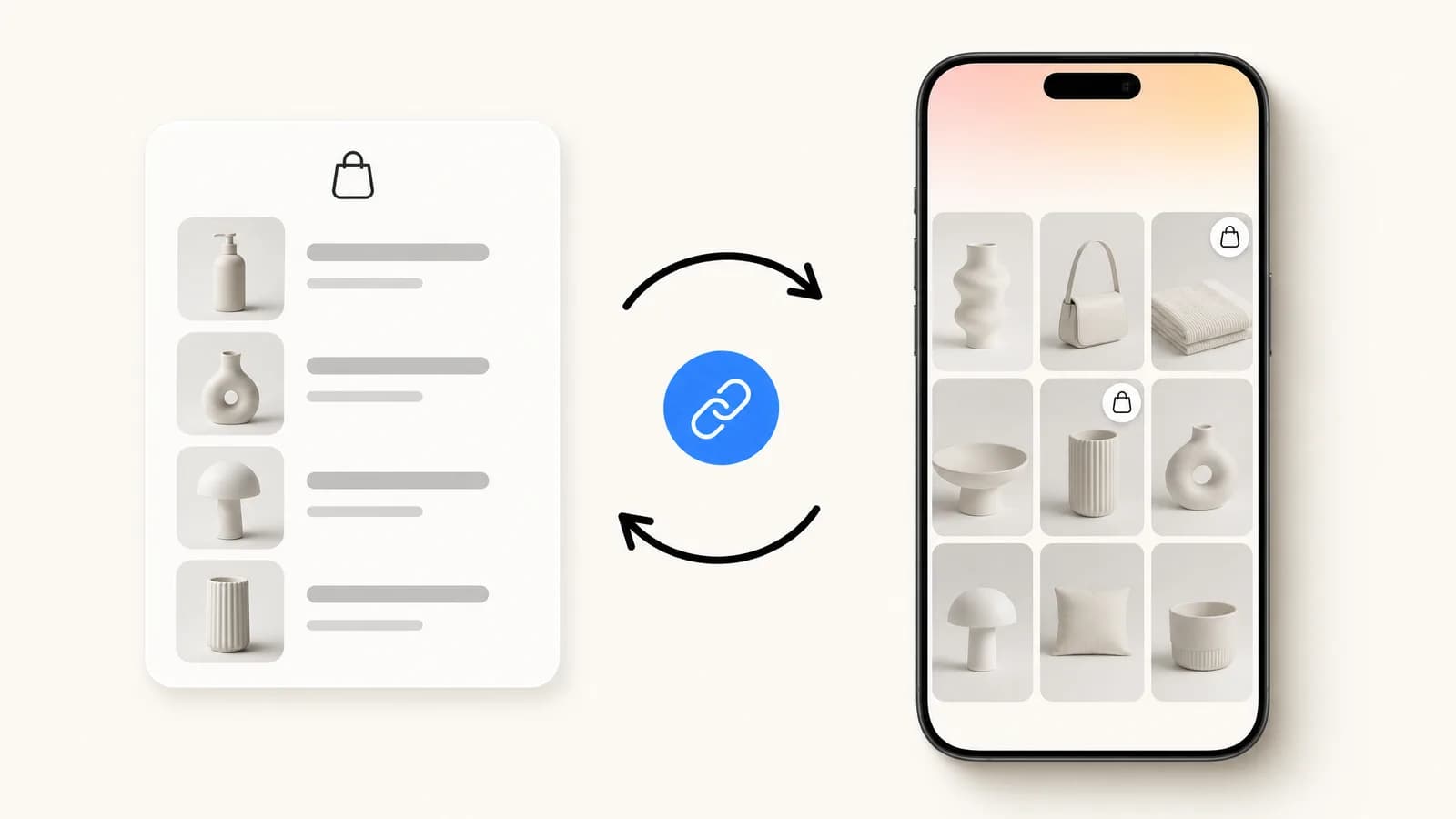
How to connect Shopify to Instagram with the Facebook & Instagram sales channel: requirements, steps, catalog sync, common errors and product tags.
How to Sell on Instagram in 2026: A Guide for Stores
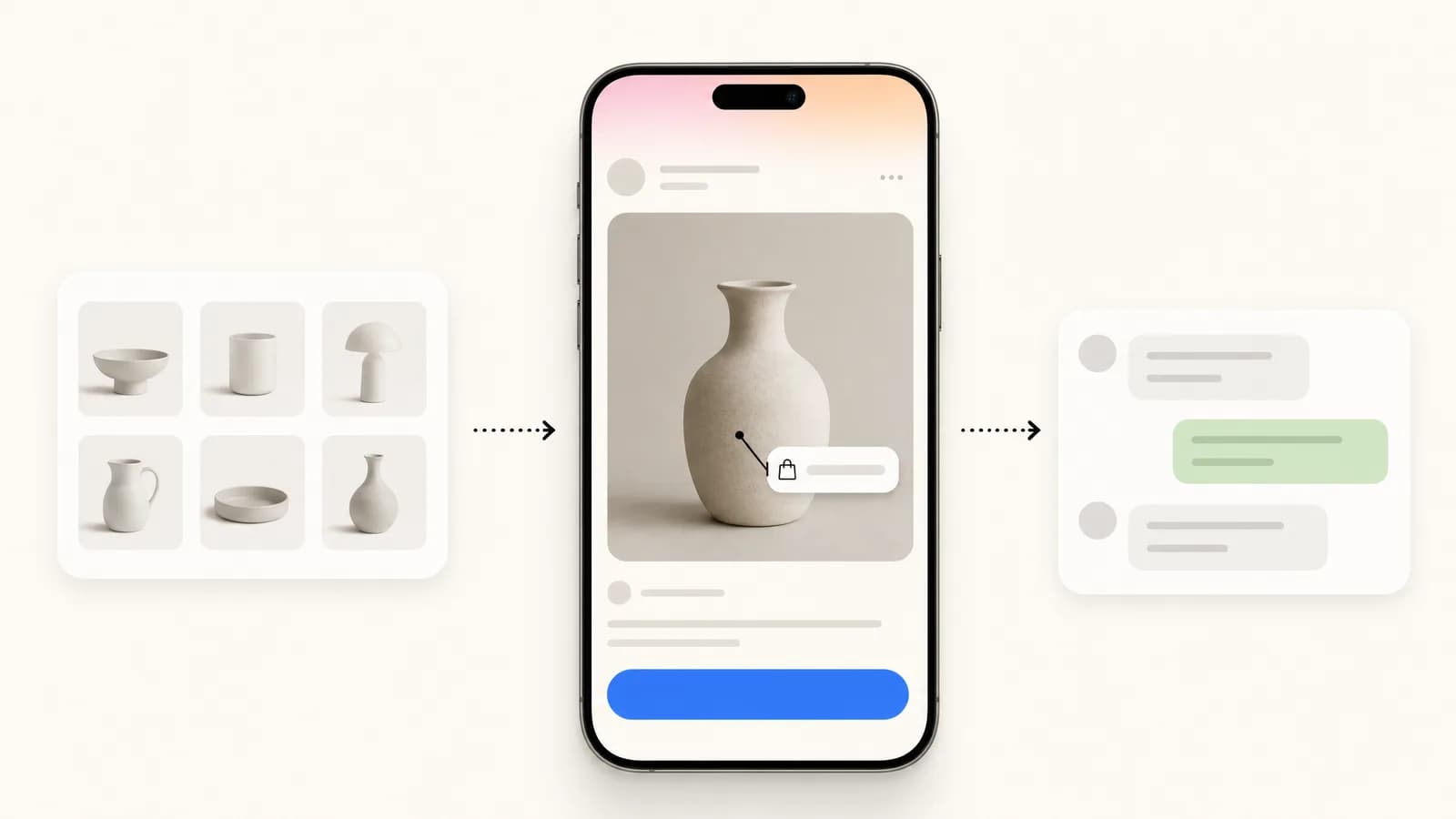
How to sell on Instagram: professional account, shop requirements, product tags, DMs and ads that open a chat, with the steps Meta documents today.

Shopify vs WooCommerce: Costs, Fees and Control (2026)
Shopify vs WooCommerce compared for US stores: subscription or hosting costs, payment fees, maintenance, flexibility, apps and how to migrate between them.