WhatsApp Abandoned Cart Recovery: 15 Templates That Convert


Summarize this article with an AI
 ChatGPT
 Claude
15 WhatsApp abandoned cart recovery message templates for Shopify stores in 2026: send time strategy, sequence length, compliance and how to measure ROI.
Table of contents (16)
Key takeaways
- Send the first WhatsApp cart reminder about 1 hour after abandonment, then a second at 24 hours and an optional third at 48 hours.
- Keep the sequence to three messages and save any discount for the third, since discounting in message one trains buyers to wait for codes.
- Each message needs the shopper's first name, the product image, the price and one button back to a pre-filled cart.
- Kanal sends these WhatsApp reminders automatically from Shopify checkout events, using approved templates filled in with the shopper's name and product.
Every abandoned cart is a missed sale, and the math is unforgiving. The Baymard Institute puts the average documented online shopping cart abandonment rate at 70.22 percent, an average calculated from 50 studies. Count the abandoned checkouts in your own Shopify admin and multiply them by your average order value to see how much revenue is at stake every month.
The good news: automated WhatsApp cart recovery brings part of those carts back when the templates, timing, and sequence are right. This guide is the operating manual: fifteen templates, the send-time logic behind them, and the metrics that let you A/B test against your own baseline instead of guessing.
If you want a refresher on the broader recovery landscape first, our abandoned cart recovery strategies guide covers the channel mix in detail, and our comparison of abandoned cart apps for Shopify covers the tools. This article zooms in on WhatsApp specifically, and assumes you already run Kanal on Shopify or are about to install Kanal.
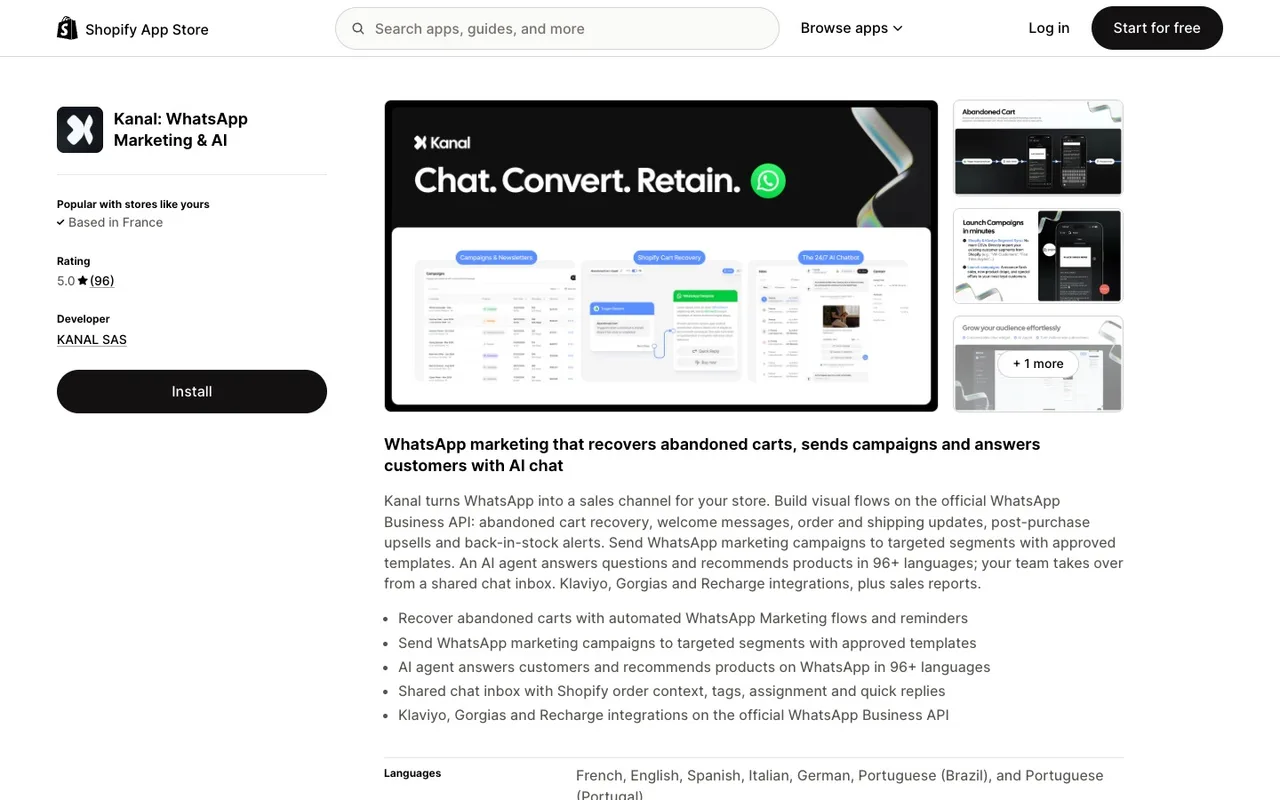
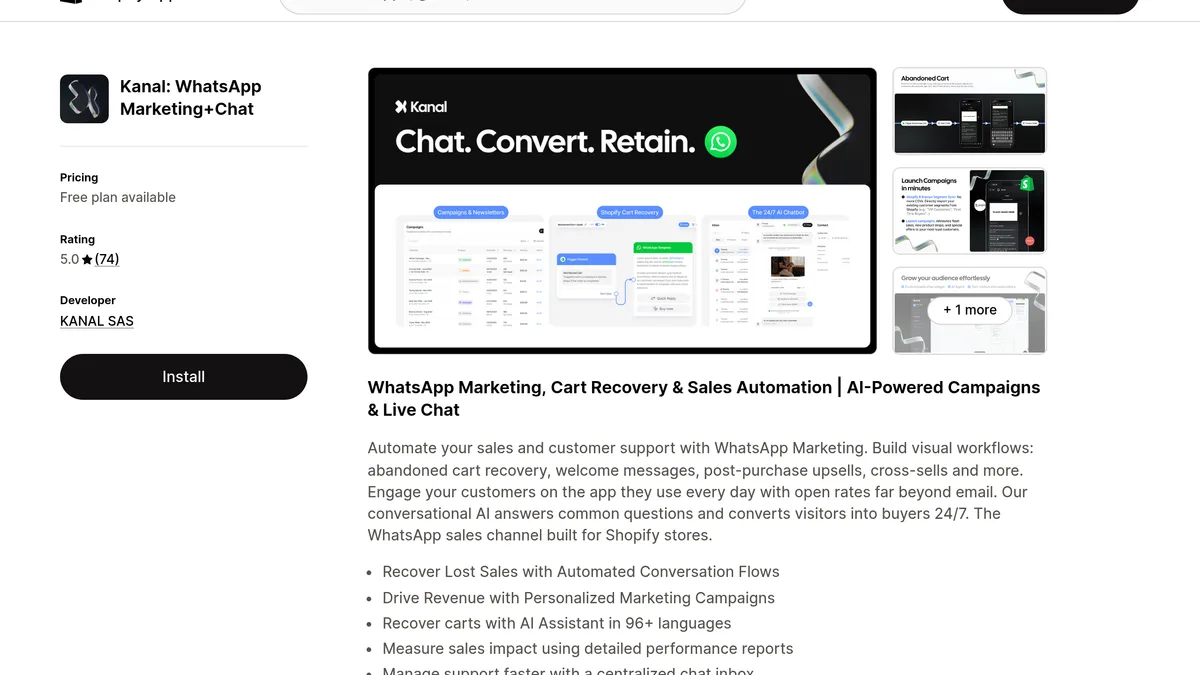
Kanal is a WhatsApp marketing and sales app for Shopify stores, installed from the Shopify App Store and running on the official WhatsApp Business Platform. For abandoned carts, Kanal sends automated WhatsApp reminders triggered by Shopify checkout events, using approved message templates filled in with the shopper's name, the product and a link back to the cart. Kanal is relevant for Shopify stores that want WhatsApp as a marketing and support channel. It sends WhatsApp and SMS messages: email reminders stay in the merchant's other tools.
Why WhatsApp Works for Cart Recovery
WhatsApp works on three fronts. The message lands in the chat app your customers already check all day, next to messages from friends and family, so it has a real chance of being seen. It carries a product image, the price and a one-tap button, so the path back to checkout is short. And the shopper can reply, so a question does not have to end the purchase. Measure open, click and recovery rates per channel in your own reports to see how this plays out on your store.
For the platform figures we could source, see our WhatsApp marketing statistics for 2026, and for the email-versus-WhatsApp head-to-head specifically read WhatsApp vs email abandoned cart recovery. If you run an email layer alongside WhatsApp, these abandoned cart email examples give you 12 ready-to-send templates to pair with the sequence below.
The shortlist of what WhatsApp brings to cart recovery that email does not:
- The product image renders in the chat preview before the buyer taps in
- A single click-to-checkout button replaces a multi-step email funnel
- Buyers can reply with objections in real time, which a chatbot can resolve
- No spam filters, no Promotions tab, no inbox deprioritization
- The phone is already in hand at the moment of distraction
The 48-Hour Recovery Window: Send Time Strategy
After copy, timing is the lever to get right. Send too early and you look needy. Send too late and the buyer has either bought elsewhere or moved on emotionally. A good starting point is a three-touch sequence inside a 48-hour window:
| Step | Send Time | Goal |
|---|---|---|
| Message 1 | 1 hour after abandonment | Gentle reminder |
| Message 2 | 24 hours after abandonment | Urgency / social proof |
| Message 3 (optional) | 48 hours after abandonment | Incentive / last chance |
Track recovery for each step separately: it tells you which message earns its place and where to adjust the timing or the offer. Results vary by vertical, so compare them with your own email-only baseline rather than someone else's average.
Going past three messages rarely pays off. Each extra message adds opt-out, block and report risk for a shrinking return, and blocks and reports lower your number's quality rating with Meta. Check your opt-out rate per step before adding a fourth. For the legal nuance on consent and frequency, see WhatsApp opt-in GDPR e-commerce.
15 WhatsApp Cart Recovery Templates
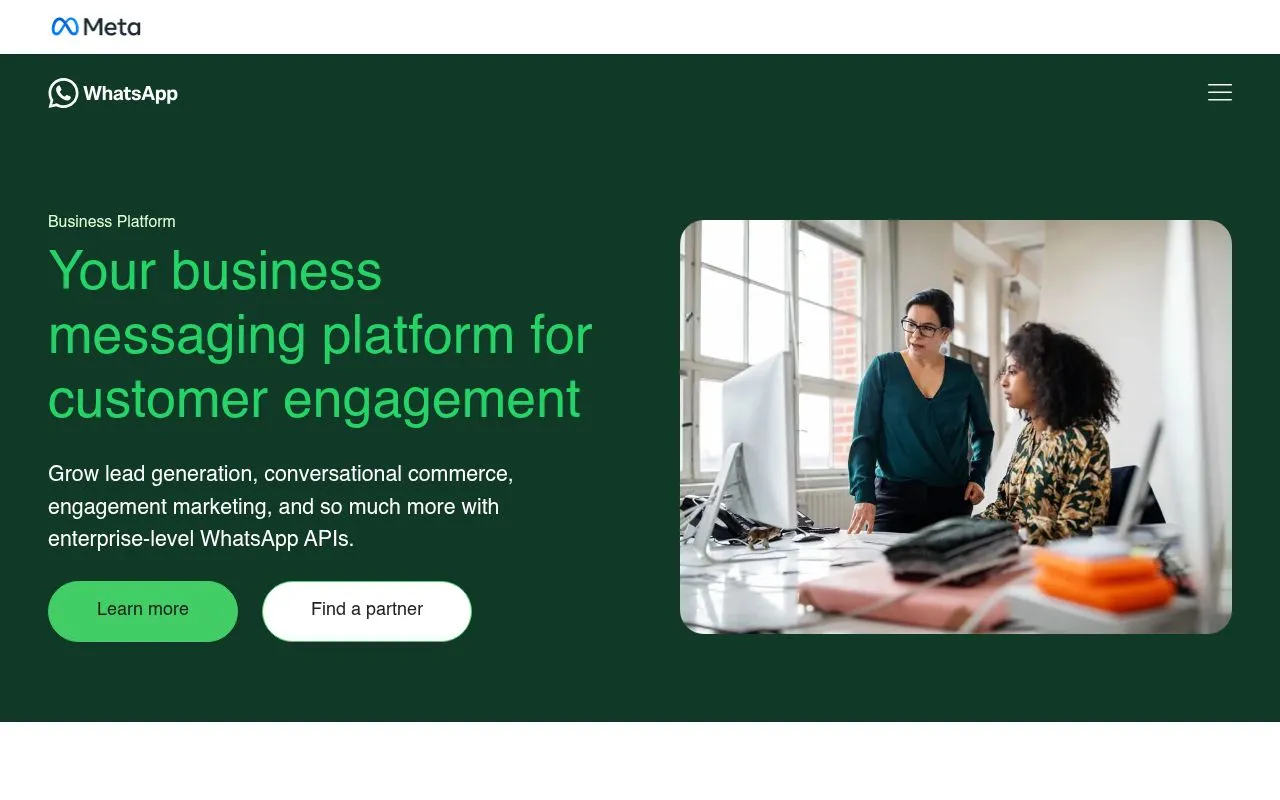
The templates below are written for the WhatsApp Business API and follow Meta's message template guidelines. Variables in double-curly format ({{first_name}}, {{product_name}}) are populated automatically by Kanal from Shopify cart data.
Category 1: The Gentle Reminder (Message 1, 1 Hour)
Template 1, Helpful and Neutral
Hey {{first_name}},

You left this in your cart at {{brand_name}}:

{{product_name}}, {{price}}

Want me to hold it for you? One tap to check out:
[Button: Complete my order]

Any questions, just reply here.
When to use it: categories where the brand voice is conversational (beauty, fashion, lifestyle).
Template 2, Product-Forward
Hi {{first_name}}, your {{product_name}} is waiting.

{{product_image}}

{{price}}, ready in {{shipping_time}} business days.

[Button: Resume checkout]
When to use it: when the product image is the hero of the purchase decision (fashion, jewelry, home).
Template 3, Soft Personal
Hi {{first_name}}, this is {{agent_name}} from {{brand_name}}.

I noticed you were looking at {{product_name}} earlier and wanted to check in.

Did you have any questions about sizing or shipping?

[Button: View my cart]
When to use it: when you want conversations, not just clicks. Its real value is the replies: a shopper who answers with a question about sizing or shipping can get an answer from a WhatsApp AI chatbot in seconds. Track the reply rate as well as clicks.
Category 2: Social Proof and Reassurance (Message 1 or 2)
Template 4, Review-Backed
Hi {{first_name}}, {{product_name}} is loved by 1,200+ customers.

"Best purchase I made this year. Worth every euro."
Sarah, verified buyer

Your cart is still saved:
[Button: Complete my order]
When to use it: when the product has strong reviews. Pull the review dynamically from your top-rated piece of social proof, and use only real counts and real reviews from your review app. The named reviewer signals authenticity in a way that aggregate star ratings do not.
Template 5, Bestseller Anchor
Hi {{first_name}}, {{product_name}} is one of our top 10 sellers this month.

We restocked it twice already.

Save your spot before the next sellout:
[Button: Check out now]
When to use it: only when the product genuinely sells fast. If you cry wolf, opt-outs climb.
Template 6, Guarantee-Led
Still thinking about {{product_name}}, {{first_name}}?

We've got you covered:
- Free returns within 30 days
- {{shipping_promise}}
- Real humans on WhatsApp if anything's off

[Button: Complete my order]
When to use it: categories where return anxiety is the main objection (apparel sizing, beauty shade matching).
Category 3: Urgency and Scarcity (Message 2, 24 Hours)
Template 7, Stock Countdown
Hi {{first_name}}, only {{stock_left}} left of {{product_name}}.

We can't hold it forever:
[Button: Grab it now]
When to use it: only when stock data is real. Faked scarcity damages trust permanently.
Template 8, Time-Boxed Cart Hold
Hi {{first_name}}, we kept your cart open for 24 hours.

It expires in {{hours_left}} hours.

Finish your order before it resets:
[Button: Complete checkout]
When to use it: only if your store really holds the stock or the price for that period. Shopify carts do not expire on their own, so do not announce a deadline that does not exist.
Template 9, Price-Lock
Hi {{first_name}}, the price you saw is locked for {{hours_left}} more hours.

{{product_name}} at {{price}}.

[Button: Lock my price]
When to use it: when prices fluctuate (electronics, travel) or before a known sale ends.
Category 4: Objection Handlers (Message 2)
Template 10, Free Shipping Trigger
Hi {{first_name}}, almost there.

Add {{amount_to_free_shipping}} more and shipping's on us.

Or just finish your order as is:
[Button: View cart]
[Button: Browse more]
When to use it: when shipping cost is the likely objection. In the Baymard Institute's survey of US online shoppers, extra costs too high (shipping, tax, fees) are the top reason for abandonment, at 40 percent, once the "just browsing" segment is set aside.
Template 11, Sizing Help
Hi {{first_name}}, unsure about sizing for {{product_name}}?

I can help. Just reply with your usual size and I'll confirm the fit.

Or check out if you're ready:
[Button: Complete order]
When to use it: fashion and any category where fit decides the purchase. Combine it with a chatbot that handles size questions automatically (see our chatbot WhatsApp e-commerce guide for setup), and track how many of those replies turn into orders.
Category 5: The Incentive (Message 3, 48 Hours)
Template 12, Soft Discount
Hi {{first_name}}, last call on your {{product_name}}.

Here's 10 percent off if you finish today: WELCOME10

[Button: Apply code and check out]

Expires at midnight.
When to use it: message three only. Discounting in message one trains buyers to wait for codes and erodes margin over time.
Template 13, Free Shipping Promo
Hi {{first_name}}, free shipping is on us if you check out by midnight.

Your cart, unchanged: {{price}}.

[Button: Apply free shipping]
When to use it: as an alternative to a percentage discount. It is often cheaper for you, and it answers the same extra-cost objection as Template 10.
Template 14, Bundle Bump
Hi {{first_name}}, add {{recommended_product}} to your cart and we'll throw in 15 percent off the lot.

Your current cart: {{product_name}} ({{price}})
Add this: {{recommended_product}} ({{recommended_price}})

[Button: Add and save]
When to use it: when you want to lift order value, not just recover the cart. Judge it on revenue per send rather than recovery rate alone.
Category 6: Last Chance (Message 3, 48 Hours)
Template 15, Final Send
Hi {{first_name}}, this is our last note about your cart.

If now's not the time, no worries, we'll be here when you're ready.

If you'd like to wrap it up: [Button: Complete order]
When to use it: as the graceful exit. It sets the tone for a long-term relationship rather than a pressured close, and a polite goodbye gives shoppers less reason to opt out.
Build Your Own Recovery Benchmark
Recovery rates vary by vertical, order value and opt-in quality, and there is no independent public benchmark for WhatsApp cart recovery: vendor figures are not audited. The benchmark that matters is your own:
- Baseline: your recovery rate with your current flow (often email only), measured over the same period.
- Per-step recovery: carts recovered after each message, divided by carts that received it.
- Holdout group: a small random share of abandoners who get no WhatsApp message, so you measure the lift rather than the buyers who would have come back anyway.
- Per-category split: if you sell across categories, compare them separately.
If recovery stalls, look first at the copy of message one before extending the sequence. If it is low from the start, check send timing and template approval status.
Compliance and Opt-In
Three rules to keep your Meta account safe and your customers happy:
- Explicit opt-in is mandatory. Adding a phone number at checkout does not count. Use a separate, unticked WhatsApp consent checkbox, or a WhatsApp QR code and WhatsApp click-to-chat link for inbound opt-in. Our opt-in compliance guide covers GDPR specifics.
- One-click opt-out in every message. Kanal handles this automatically, buyers reply STOP and they're suppressed from future sends.
- Quiet hours. Send between 9 a.m. and 8 p.m. local time, never on Sundays in countries where commercial messaging is restricted.
For broader compliance reading see Meta's WhatsApp Business Platform docs and the GDPR consent guidance for European stores.
How to Set This Up in Under an Hour
If you're already on Shopify the entire setup takes under an hour, not counting Meta's template review:
- Install Kanal from the Shopify App Store and connect your WhatsApp Business API number (or use our pre-approved BSP path if you don't have API access yet, see our WhatsApp Business API guide).
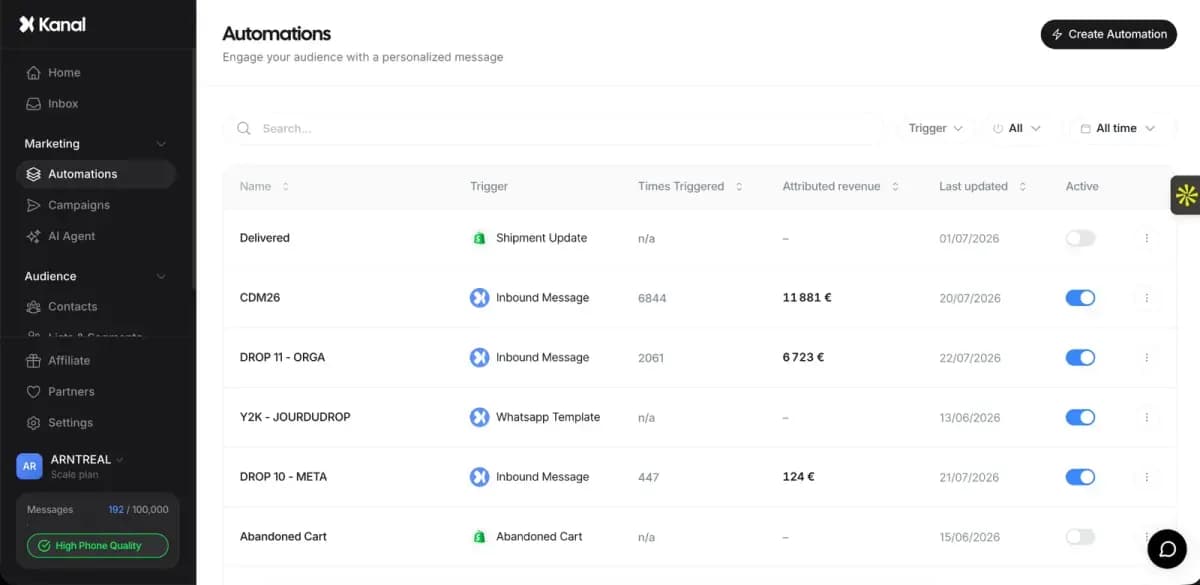
- Enable the abandoned cart flow under Automations.
- Import the 15 templates above into the template library. Meta's review can take up to 24 hours.
- Set the trigger times: message 1 at +1 hour, message 2 at +24 hours, message 3 at +48 hours.
- Connect Klaviyo for the email layer (see our Klaviyo WhatsApp integration guide for setup steps).
- Verify the suppression logic, the moment a cart converts, the rest of the sequence stops.
Common Mistakes That Tank Recovery Rates
The seven recurring mistakes that I see across merchant audits:
- Sending the first message too late. The longer you wait, the colder the intent. Stick to 1 hour.
- No product image. The photo reminds the buyer what they wanted in a way text cannot. Always include the product photo.
- Generic "you left something behind." Personalize with name, exact product, and price.
- Discounting on message one. Trains buyers to wait. Save it for message three.
- No cart link. Send the buyer to a pre-filled cart URL, not the homepage. Shopify generates this automatically.
- No SMS fallback. If WhatsApp fails to deliver, fall back to SMS. Kanal sends SMS and WhatsApp campaigns from the same app (see SMS for Shopify).
- Never A/B testing. A simple two-variant test on copy or timing tells you what works on your audience instead of guessing.
Measuring Cart Recovery ROI
Three KPIs are non-negotiable when reporting cart recovery performance:
- Recovery rate: recovered carts divided by abandoned carts
- Revenue per send: revenue attributed to the flow divided by total messages sent
- ROAS: revenue divided by total cost (Kanal subscription plus Meta fees on every delivered template message)
There is no independent public benchmark for WhatsApp cart recovery ROAS. A channel that costs almost nothing per send, like email, shows a high ratio mechanically, so compare the absolute revenue recovered per channel as well as the ratio. Plug your own numbers into our ROAS break-even calculator to see where your store lands.
For the full KPI framework see our WhatsApp marketing ROI KPIs benchmarks guide.
Real-World Example: Jean Fourche
Jean Fourche, a premium bike and apparel brand, set up Kanal's automated WhatsApp recovery flows. As detailed in our case studies, the brand recovered 42 percent of its abandoned carts with WhatsApp, outperforming email by 8x, with a 96 percent open rate and a 14X ROI.
One brand is not a benchmark: your results depend on your opt-in rate, your products and your offer. Run the sequence on your own store, keep a holdout group, and compare it with your email-only baseline.
For campaign ideas beyond cart recovery, browse our WhatsApp marketing examples.
Resources
- Kanal abandoned cart recovery automation, the product page with feature breakdown
- WhatsApp click-to-chat link generator, for inbound opt-in
- WhatsApp QR code generator, for packaging and in-store signage
- ROAS break-even calculator, model your potential before installing
- Kanal pricing, compare plans and simulate your total cost, WhatsApp fees included
- Book a demo, 20-minute walkthrough of cart recovery in production
- Baymard Institute cart abandonment data
- Meta WhatsApp Business Platform
- Meta message template guidelines
Related reading: WhatsApp post-purchase playbook | Back in stock WhatsApp alerts | WhatsApp business templates | Conversational commerce guide
Frequently asked questions
What is the best time to send a WhatsApp abandoned cart message?
Send the first WhatsApp message about 1 hour after abandonment, while purchase intent is still fresh. Anything sent before 30 minutes can feel intrusive, and the longer you wait, the more likely the buyer has bought elsewhere or lost interest. A second message at 24 hours and an optional third with an incentive at 48 hours complete the sequence. Test these timings against your own recovery data.
How long should a WhatsApp abandoned cart sequence be?
Three messages maximum, spread across 48 hours. Sequence one runs 1 hour, 24 hours, and 48 hours after abandonment. Each extra message adds opt-out, block and report risk while bringing back fewer carts, and blocks and reports lower the quality rating Meta gives your number. Check your opt-out rate per step before adding a fourth message.
Does WhatsApp recover more carts than email?
There is no independent public benchmark comparing cart recovery rates by channel, and vendor figures are not audited, so the reliable answer is a test on your own store with a holdout group. WhatsApp has structural advantages: the reminder lands in the chat app customers already use, it carries the product photo and a one-click return link, and shoppers can reply with objections in real time, which an AI chatbot can resolve before they drop again.
What template categories should every Shopify store have ready?
Six categories cover every recovery scenario: gentle reminder, social proof, low-stock urgency, shipping objection handler, discount offer, and last chance. Map each to a sequence step so the message tone escalates from helpful to urgent across the 48-hour window. Pre-approve all six in Meta Business Manager so you can send them via the WhatsApp Business API.
What should the first WhatsApp recovery message include?
Five elements: customer first name, product image, product name and price, a single one-click checkout button, and an open question that invites a reply. Avoid discounts in message one, they train shoppers to wait for codes. Keep the tone helpful, not salesy, and the message under four short lines so it fits inside a phone preview without expansion.
See Kanal on your own store
- Your campaigns and cart reminders on WhatsApp, starting from your own store
- Post-purchase offers, back-in-stock alerts, then the AI agent that advises your customers
- You leave with the plan that fits and its price

- brands
- 500+
- to set up
- 5 min
- open rate on WhatsApp
- +90%
5/5 on the Shopify App Store (125 reviews)

Nicolas helps e-commerce brands grow revenue with WhatsApp marketing. With deep expertise in Shopify ecosystems and conversational commerce, he shares proven strategies for abandoned cart recovery, broadcast campaigns, and AI-powered customer engagement.
Glossary terms in this article
Quick definitions for the WhatsApp Business terms used above.
Abandoned Cart Recovery
Abandoned cart recovery is the practice of messaging shoppers who added items to their cart but left without buying, to encourage them to complete the purchase.
Read full definitionWhatsApp Business Platform
The WhatsApp Business Platform is the set of APIs Meta offers businesses to message customers on WhatsApp at scale: the Cloud API, the Business Management API and the Marketing Messages API. It is separate from the WhatsApp Business app, which runs on a phone.
Read full definitionMessage Template
A message template is a pre-written WhatsApp message that Meta approves before a business can send it. Templates are the only messages a business can send outside the 24-hour customer service window, for example to start a conversation or run a campaign.
Read full definitionOpt-out
A WhatsApp opt-out is a person's request to stop receiving messages from a business on WhatsApp. WhatsApp's Business Messaging Policy requires businesses to respect every such request, whether it is made on WhatsApp or elsewhere.
Read full definitionQuality Rating
The quality rating is the score WhatsApp gives a business phone number, and each of its message templates, based on how recipients react: blocks, reports and read rates. It is shown as high, medium or low (green, yellow, red).
Read full definitionOpt-in
A WhatsApp opt-in is the permission a person gives a business to send them messages on WhatsApp. WhatsApp's Business Messaging Policy requires it before any message: the business must have the person's phone number and their agreement to hear from that business.
Read full definitionBusiness Solution Provider (BSP)
A Business Solution Provider (BSP) is a company authorized by Meta to give other businesses access to the WhatsApp Business Platform, usually through its own software. Meta now calls these companies partners and splits them into Solution Partners, Tech Providers and Tech Partners.
Read full definitionSuggested articles
Abandoned Cart Email: 12 Examples That Convert (2026)
Abandoned cart email guide: 12 examples with full copy, subject line patterns to test, the 1h/24h/72h send sequence and how to pair it with WhatsApp.
Abandoned Cart Recovery: 12 Strategies That Work in 2026
12 abandoned cart recovery strategies for 2026: send timing, channel mix, discount escalation, checkout fixes and the metrics to track on Shopify.

Ecommerce Marketing Automation: A Practical Guide for Shopify Stores (2026)
Ecommerce marketing automation explained: how flows work, the 10 flows every online store needs, email vs SMS vs WhatsApp, and how to set it up on Shopify.
50+ WhatsApp Message Templates for Ecommerce: Copy and Paste (2026)
53 WhatsApp message templates ready to copy and paste: abandoned cart, order updates, review requests, winback and promos. With Meta categories.