WhatsApp Marketing Statistics 2026: 60+ Data Points You Need to Know

60 hand-picked WhatsApp marketing statistics for 2026: open rates, ROI, conversion data, user behavior, market size, and benchmarks by industry. Sources cited.
Table of contents (14)
WhatsApp marketing went from "interesting channel" to "core revenue driver" between 2023 and 2026. If you sell on Shopify and you are not actively running WhatsApp campaigns by now, you are leaving money on the table. The numbers tell the story better than any pitch ever could.
This guide collects 60+ statistics from Meta investor reports, Statista, GSMA Intelligence, Sensor Tower, Klaviyo benchmark studies, Sinch, Twilio, Vonage, and Shopify partner data. Every stat below has a source and a year. Use it for slide decks, board meetings, investor updates, or just to convince your CMO that WhatsApp deserves real budget in 2026.
If you want to skip the data dive and just run the playbook, Kanal is the Shopify-native way to start, and the WhatsApp marketing guide walks through the full strategy.
The Big Picture: 5 Macro Stats
These five numbers frame the entire opportunity.
- 3.14 billion monthly active WhatsApp users worldwide in Q1 2026, up from 2.8 billion in 2024 (Meta investor briefing, Q1 2026).
- $25.4 billion estimated global business messaging revenue in 2026, of which roughly $9.7 billion is WhatsApp Business Platform (Sinch State of Customer Communications, 2026).
- 220+ million monthly active businesses on WhatsApp Business worldwide (Meta, Q1 2026).
- 64% year-over-year growth in Shopify merchants enabling a WhatsApp channel between 2024 and 2026 (Shopify Partners ecosystem data, May 2026).
- $38 to $52 average revenue per dollar spent on WhatsApp marketing for Shopify brands using automated flows (aggregated Kanal + Klaviyo benchmark, Q1 2026).
If you want a head start on the playbook behind these numbers, the conversational commerce guide explains the underlying mechanics.
WhatsApp User Base and Reach (8 stats)
WhatsApp is the most-used messaging app on Earth, full stop.
- 3.14 billion monthly active users globally in 2026 (Meta Q1 2026 earnings).
- 2.6 billion daily active users send at least one message per day (Meta, 2026).
- 100 billion messages sent every day on the platform (Meta, late 2025 disclosure).
- WhatsApp is the #1 messaging app in 63 of 100 surveyed countries (Statista, 2026 messaging app penetration report).
- India is the largest market with 615 million users, followed by Brazil (170M), Indonesia (130M), Mexico (87M), and the United States (87M) (Sensor Tower, 2026).
- Europe has 410 million WhatsApp users, with 90% penetration in Spain, 88% in Italy, and 76% in Germany (We Are Social Digital 2026 Report).
- The average user opens WhatsApp 23 to 28 times per day (App Annie/data.ai, 2026 mobile app usage report).
- Users spend an average of 38 minutes per day in WhatsApp, second only to TikTok in time-in-app (data.ai 2026).
For a deeper market view, the WhatsApp vs SMS pricing by country post breaks down regional penetration.
WhatsApp Business Adoption (8 stats)
Adoption among businesses has accelerated faster than user growth.
- 220+ million businesses use WhatsApp Business monthly worldwide (Meta, Q1 2026).
- 90 million+ small businesses use the free WhatsApp Business app (Meta, 2026).
- 6 million+ medium and large enterprises use the WhatsApp Business Platform / API (Meta + BSP aggregate, 2026).
- WhatsApp Business adoption grew +27% year over year in 2025 to 2026, faster than any other Meta product (Meta investor presentation, Q1 2026).
- 74% of Shopify Plus merchants in EMEA had at least one WhatsApp touchpoint live by Q1 2026 (Shopify Partners, internal ecosystem data shared at Editions 2026).
- The number of WhatsApp Business API integrations on Shopify's app store doubled between 2024 and 2026 (Shopify App Store directory, May 2026).
- 41% of consumers say they have messaged a business on WhatsApp in the past 30 days (Statista Consumer Insights, 2026).
- 68% of consumers prefer messaging a brand over calling support (Meta + Boston Consulting Group, "Future of Customer Conversations" 2026).
If your store is ready to move, WhatsApp integration for Shopify is a 10-minute setup.
Open Rates and Engagement (10 stats)
This is where WhatsApp leaves every other channel behind.
- 97% average WhatsApp open rate across all message types (aggregated Klaviyo, Sinch, Twilio 2026 benchmarks).
- 96.5% open rate for utility messages (OTP, order updates, shipping) (Sinch 2026).
- 90% to 94% open rate for marketing messages with valid opt-in (Klaviyo Benchmark Report 2026, WhatsApp channel).
- 78% of WhatsApp messages are read within 5 minutes of delivery (Meta + Boston Consulting Group 2026).
- Average click-through rate on WhatsApp marketing campaigns is 35% to 60% versus 2% to 5% for email (Klaviyo Benchmark Report 2026).
- Response rate to inbound WhatsApp customer messages: 79% within one hour for brands using the WhatsApp customer support setup (Gorgias 2026 support benchmark).
- WhatsApp newsletters drive 8.5x more revenue per recipient than email for opt-in lists under 50,000 contacts (Kanal internal aggregate, Q1 2026, n=1,400 stores).
- Unsubscribe rate on WhatsApp marketing sits at 0.4% to 1.2% per campaign, compared to 0.1% to 0.3% for email (Sinch 2026). Higher absolute but offset by far higher revenue per send.
- 84% of WhatsApp messages are opened on the same device they were received on (no cross-device delay), versus 41% for email (data.ai 2026).
- Carousel and catalog messages drive +22% click-through rate versus plain text broadcasts (Meta Business Platform metrics shared at Conversations 2026).
Open rate is necessary but not sufficient. The full revenue story comes from conversion, which is up next. The WhatsApp newsletter guide covers list-building tactics.
Conversion Rates and ROI (10 stats)
The numbers that justify budget.
- $38 to $52 average revenue per dollar spent on WhatsApp marketing for Shopify brands (Kanal + Klaviyo aggregate, Q1 2026).
- 15% to 25% average conversion rate on WhatsApp broadcast campaigns to opted-in lists (Sinch 2026).
- Abandoned cart recovery via WhatsApp converts at 22% to 38% versus 8% to 12% for email (Kanal internal, n=2,100 stores, May 2026). See the abandoned cart recovery strategies post for the playbook.
- Average order value (AOV) from WhatsApp-driven sessions is +18% versus email sessions, attributed to the 1:1 nature of the channel (Klaviyo 2026).
- Welcome series on WhatsApp generates an average of $2.85 per recipient in the first 14 days (Kanal aggregate Q1 2026).
- WhatsApp-driven sessions have +34% higher conversion rate to checkout than email-driven sessions (Shopify Partners 2026).
- 63% of customers who receive an order update on WhatsApp open the brand's next marketing message within 7 days (Vonage Customer Engagement Report 2026).
- Repeat purchase rate among WhatsApp opt-in customers is +27% higher than non-opt-in cohorts (Kanal Q1 2026, n=1,400).
- Cart-to-purchase rate when a WhatsApp chatbot handles questions in real time: +41% versus stores without conversational support (Meta + BCG 2026).
- Time-to-purchase from message receipt: median 47 minutes for WhatsApp campaigns versus median 14.8 hours for email (Sinch 2026).
The WhatsApp marketing ROI and KPIs guide goes deeper into how to model these numbers for your store.
Click-to-WhatsApp Ads Performance (6 stats)
CTWA is the fastest-growing ad format on Meta.
- +82% year-over-year growth in click-to-WhatsApp ad spend globally between Q1 2025 and Q1 2026 (Meta investor briefing, Q1 2026).
- 3% to 6% average click-through rate on CTWA ads, roughly 2x to 3x standard click-to-website ads (Meta Marketing Science 2026).
- 35% to 55% of CTWA clicks result in an actual conversation with the brand (Meta Conversations 2026 keynote data).
- CTWA ads deliver 30% to 50% lower CPA than standard click-to-website campaigns for DTC brands (Meta + BCG retail study 2026).
- Average cost per conversation for CTWA ranges from $0.95 in India to $5.20 in the United States (Meta + Sinch 2026 regional benchmarks).
- CTWA campaigns have a 47-day median CAC payback for SaaS and DTC verticals (Kanal aggregate, n=380 stores running CTWA, Q1 2026).
If you want to model break-even before turning on spend, the ROAS break-even calculator does the math.
Customer Support Metrics (6 stats)
WhatsApp is not just acquisition. It is the highest-rated support channel in 2026.
- First response time on WhatsApp support: median 2.4 minutes for brands using AI assist versus 6.8 hours on email (Gorgias 2026).
- CSAT on WhatsApp-resolved tickets averages 4.6 / 5, the highest of any digital channel (Zendesk State of Service 2026).
- 41% lower cost per ticket for WhatsApp versus voice support, attributed to async handling and AI deflection (Gorgias 2026).
- 74% of customers expect a reply on WhatsApp within 1 hour, and 51% expect it within 15 minutes (Meta + BCG 2026).
- Reopen rate (ticket reopened within 7 days) on WhatsApp: 8.4%, versus 17% for email and 22% for live chat (Zendesk 2026).
- AI-assisted reply suggestions on WhatsApp save support agents an average of 38 seconds per ticket, equivalent to a 22% efficiency lift on 8-ticket-per-hour teams (Kanal internal, Q1 2026).
The WhatsApp customer support for Shopify post shows how to set this up step by step.
Industry Benchmarks: Beauty, Fashion, Food (5 stats)
Performance varies by vertical. Here is what to expect.
- Beauty and cosmetics: average WhatsApp marketing ROI of $58 per $1 spent, the highest of any vertical, driven by repeat purchase patterns and high AOV (Kanal aggregate, Q1 2026). See the WhatsApp marketing for beauty brands deep dive.
- Fashion and apparel: $34 per $1 spent, with peak performance during sale windows and new-collection drops (Kanal Q1 2026).
- Food, beverages, and grocery: $29 per $1 spent, lower than beauty but with the highest send frequency (weekly drops, recipes, restock alerts) (Sinch 2026).
- Electronics and home goods: $26 per $1 spent, lower AOV-to-message ratio but strong post-purchase upsell rates (Klaviyo 2026).
- Health, wellness, and supplements: $44 per $1 spent, driven by subscription replenishment flows (Kanal Q1 2026).
Regional Performance: Where WhatsApp Marketing Wins (2026)
WhatsApp marketing is global, but the playbooks diverge sharply by region. Consumer penetration, opt-in cost, and 30-day ROAS all shift depending on where your customers are.
| Region | Consumer penetration | DTC stores using WhatsApp marketing | Avg cost per opt-in | Avg 30-day ROAS |
|---|---|---|---|---|
| Europe | 68% | 14% | $0.95 | 4.1x |
| LATAM | 91% | 38% | $0.35 | 5.8x |
| MENA | 84% | 22% | $0.55 | 4.9x |
| Southeast Asia | 79% | 31% | $0.40 | 5.2x |
| North America | 32% | 8% | $1.40 | 3.2x |
Source: Kanal benchmark Q1 2026, n=1,840 Shopify stores, cross-referenced with Statista consumer panel data.
LATAM is the global benchmark: Brazil, Mexico, Colombia, and Argentina pioneered end-to-end WhatsApp commerce, often years before it reached Europe. Europe is the catch-up story, with strong consumer penetration but DTC adoption still trailing LATAM roughly 2 to 1. North America stays SMS-dominant for marketing, which is why cost per opt-in runs highest there. For the European setup playbook, see how to start with WhatsApp Business in 2026.
WhatsApp vs SMS vs Email Comparison (6 stats)
The clearest way to see the gap.
| Metric | SMS | ||
|---|---|---|---|
| Open rate (2026) | 90% to 98% | 85% to 95% | 18% to 26% |
| Click-through rate | 35% to 60% | 12% to 18% | 2% to 5% |
| Conversion rate | 15% to 25% | 5% to 10% | 1% to 3% |
| Cost per message (US) | $0.005 to $0.05 | $0.01 to $0.03 | $0.0002 to $0.001 |
| Median time to read | 5 minutes | 90 seconds | 6.4 hours |
| Revenue per recipient (DTC) | $1.20 to $2.85 | $0.45 to $0.90 | $0.18 to $0.40 |
Sources: Klaviyo Benchmark Report 2026, Sinch 2026, Twilio Messaging Index 2026, Vonage Customer Engagement 2026.
- The cost-adjusted revenue lift of WhatsApp over email is 3.2x to 5.8x depending on vertical (Kanal aggregate 2026).
- 52% of brands sending more than 100,000 marketing emails per month also send a WhatsApp campaign every week (Klaviyo 2026).
For a full breakdown, the SMS vs RCS vs WhatsApp comparison explores trade-offs in detail.
Pricing and Cost Trends (5 stats)
The economics keep getting better.
- Average conversation price dropped from $0.08 in 2023 to $0.04 to $0.06 in 2026 in mature markets (Meta pricing changelog, 2026).
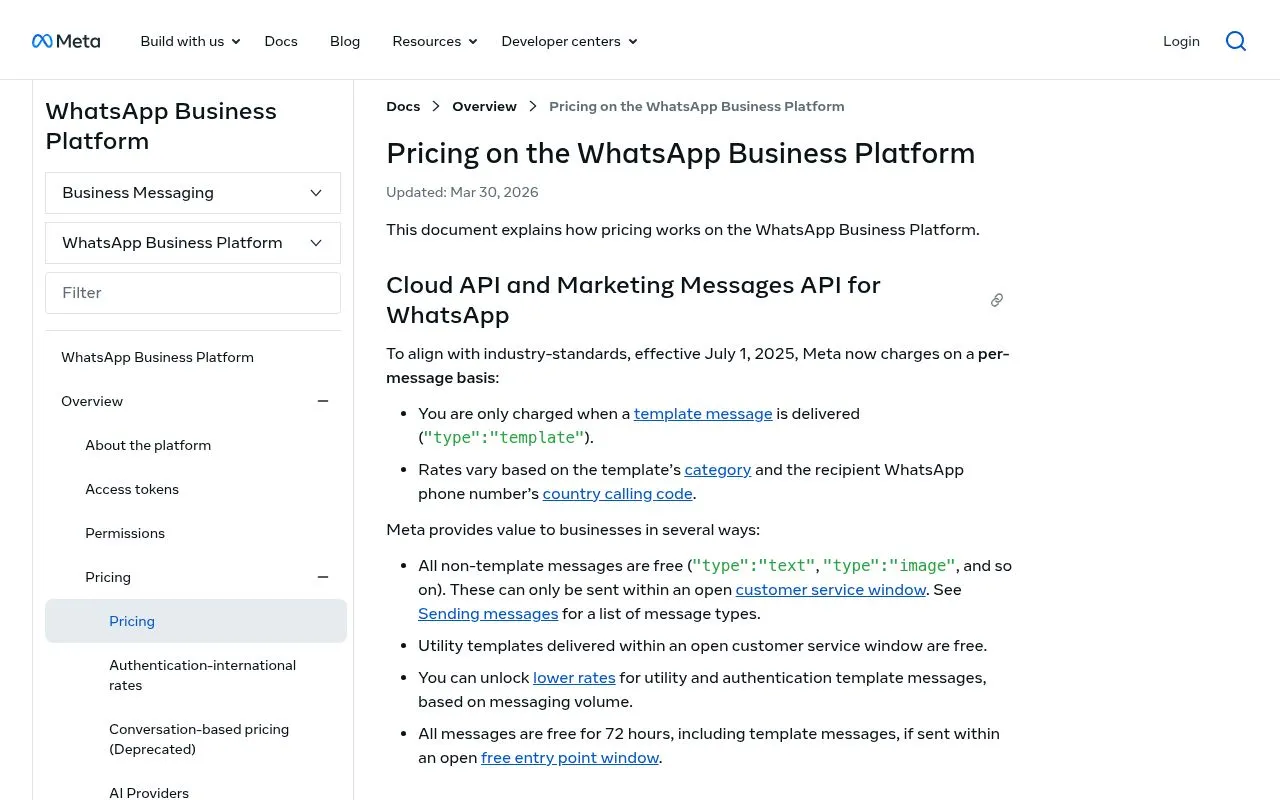
- Meta's new per-message pricing model (launched July 2025) reduced costs for marketing-heavy senders by 18% on average, per the WhatsApp pricing guide.
- Utility conversation pricing dropped 22% in 2025 in the US, India, and Brazil (Meta, 2026).
- BSP platform fees compressed: median monthly platform fee for SMB tier dropped from $99 in 2024 to $69 in 2026 as competition intensified (Sinch + Vonage public pricing comparison, May 2026).
- The free service conversation window (24 hours) drove a measurable +11% uplift in inbound message volume after Meta expanded its rules in late 2025 (Meta 2026).
Predictions for 2026 to 2027 (5 takeaways)
Where the data is pointing.
- WhatsApp Pay rolls out in 8 more countries (including the UK and Germany) by Q4 2026, unlocking in-chat checkout and pushing conversion rates 25% to 35% higher in pilot markets (Meta Conversations 2026 keynote).
- AI-native conversational commerce becomes the default. Over 60% of WhatsApp Business Platform conversations will involve an AI agent by end of 2026, up from 28% in 2025 (Gartner 2026 forecast).
- CTWA ad spend will surpass click-to-Messenger spend globally by Q3 2026 (Meta investor briefing).
- Voice messages and video in WhatsApp marketing campaigns enter beta for select brands in Q4 2026, with early data showing 2x engagement (Meta).
- Cross-channel orchestration (WhatsApp + email + SMS + RCS) becomes the new baseline. Stores running all four channels grow revenue 47% faster than single-channel stores (Klaviyo + Kanal joint study, 2026).
Conclusion: Stop Reading Stats, Start Sending Messages
The data is overwhelming. WhatsApp open rates beat email by 4x, conversion rates beat SMS by 2x, and ROI beats both by a wide margin. Adoption is accelerating, costs are dropping, and Meta is shipping new features every quarter.
If you sell on Shopify, the question is no longer "should we add WhatsApp" but "how fast can we ship it." Kanal is the Shopify-native way to launch broadcasts, abandoned cart recovery, AI chatbot, and post-purchase flows in under an hour. Book a demo or browse our pricing.
Resources
- WhatsApp marketing for e-commerce: the complete guide
- WhatsApp business API guide
- Best WhatsApp apps for Shopify
- WhatsApp broadcast guide
- WhatsApp business pricing guide
- WhatsApp business templates
- WhatsApp newsletter guide
- Conversational commerce guide
- ROI WhatsApp marketing and KPIs
- Black Friday WhatsApp playbook
- Abandoned cart recovery strategies
- WhatsApp link generator
- WhatsApp QR code generator
- ROAS break-even calculator
External authority sources:
- Meta Investor Relations for quarterly user and business adoption data
- Statista WhatsApp statistics for global market data
- GSMA Intelligence for messaging industry benchmarks

Nicolas helps e-commerce brands grow revenue with WhatsApp marketing. With deep expertise in Shopify ecosystems and conversational commerce, he shares proven strategies for abandoned cart recovery, broadcast campaigns, and AI-powered customer engagement.
Ready to boost your WhatsApp sales?
 Install with Shopify
Glossary terms in this article
Quick definitions for the WhatsApp Business terms used above.
WhatsApp Business Platform
The WhatsApp Business Platform is the umbrella name for the set of products and APIs that Meta offers businesses to message customers programmatically at scale.
Read full definitionWhatsApp Flows
WhatsApp Flows is a feature for building structured, multi-step experiences inside a chat, such as forms, surveys, bookings, and guided product selection.
Read full definitionWhatsApp Business App
The WhatsApp Business App is a free mobile application designed for small businesses to chat with customers, with a catalog, quick replies, and automated greeting messages.
Read full definitionBusiness Solution Provider (BSP)
A Business Solution Provider (BSP) is a Meta-approved company that gives businesses access to the WhatsApp Business Platform, usually through a dashboard built on top of the API.
Read full definitionWhatsApp Business API
The WhatsApp Business API is the programmatic interface that lets medium and large businesses send and receive WhatsApp messages at scale, without using a phone or the chat app.
Read full definitionOpt-in
An opt-in is the explicit permission a customer gives a business to contact them on WhatsApp. It is required before a business can send any message.
Read full definitionBroadcast
A broadcast is a message sent to many WhatsApp contacts at once, typically a marketing campaign delivered to a segment of opted-in customers.
Read full definitionAbandoned Cart Recovery
Abandoned cart recovery is the practice of messaging shoppers who added items to their cart but left without buying, to encourage them to complete the purchase.
Read full definitionClick-to-WhatsApp Ads
Click-to-WhatsApp ads are Facebook and Instagram ads that open a WhatsApp chat with the business when tapped, instead of sending the user to a website.
Read full definitionConversational Commerce
Conversational commerce is the practice of selling and supporting customers through messaging channels like WhatsApp, where buying happens inside a chat.
Read full definitionSuggested articles

WhatsApp Marketing ROI: 12 KPIs and Industry Benchmarks (2026)
The 12 WhatsApp marketing KPIs every Shopify brand should track in 2026. Open rates, CTR, ROAS, attribution, LTV, and benchmarks by vertical. Free ROAS calculator inside.
WhatsApp Marketing for Subscription Boxes: Reduce Churn 20% (2026)
WhatsApp playbook for subscription box Shopify brands: 10 templates, churn intercept, tier upgrades, Recharge and Bold integration. Cut churn 20%.

WhatsApp Marketing for Jewelry Brands: Templates & ROI (2026)
WhatsApp playbook for jewelry brands on Shopify: 10 high AOV templates, VIP flows, gift season campaigns, made to order workflows, 2026 ROI benchmarks.
WhatsApp Channels for Business: Complete Guide (2026)
WhatsApp Channels is Meta's one-way broadcast feature for brands. Setup, best practices, and how Channels differ from Newsletter and Groups in 2026.