WhatsApp Channels for Business: Complete Guide (2026)

Summarize this article with an AI
 ChatGPT
 Claude
WhatsApp Channels for businesses: what a channel is, where to find the channels list, how to create one and share its link, and Channels vs newsletters.
Table of contents (13)
Key takeaways
- A WhatsApp Channel is a free, public, one-way feed in the Updates tab where only admins post and followers can only react or answer polls.
- Channels have no API, no automation and no segmentation in 2026, so every post is published by hand and seen by all followers.
- Use a Channel for free reach and brand affinity, and a newsletter on the Business API for segmented, automated sends that land in the chat list.
WhatsApp Channels are Meta's one-way broadcast feature, launched in 2023 and now rolled out globally. A Channel is a public, follow-able profile from which only the admin posts. Followers see updates in a dedicated Updates tab, separate from their chats. There is no two-way conversation, no replies in chat, and no API. Channels are how brands build a free, owned audience on WhatsApp without paying per-message under the Business API. This guide covers what Channels can and cannot do, how they differ from a WhatsApp Newsletter or a Broadcast list, and when a Shopify brand should ship one.
Channels vs Groups vs Broadcast Lists vs Newsletter
Four formats, often conflated, very different mechanics. Pick the wrong one and you spend a quarter rebuilding. WhatsApp Status is a fifth, lighter option: see our WhatsApp Status ideas for business for what it does well.
| Format | Direction | Reply mechanic | Max audience | Cost | API |
|---|---|---|---|---|---|
| WhatsApp Channel | One-way (admin only) | Reactions, polls (no chat) | Uncapped, public | Free | None in 2026 |
| WhatsApp Group | Many-to-many | Open chat, all members visible | 1024 members | Free | None |
| Broadcast list (free app) | One-way push | Private reply per recipient | 256 contacts per list | Free | None |
| Newsletter via Business API | One-way push, two-way reply | Private chat reply | Uncapped, opted-in | Per delivered message | Yes |
Each format was built for a different stage of the relationship with the customer.
- Channels are for free brand reach. No automation, no segmentation, no Shopify trigger. Followers opted in by tapping Follow.
- Groups are for small clusters with active two-way chat. Almost never the right surface for e-commerce marketing because phone numbers are visible to all members.
- Broadcast lists are the entry-level free-app push, limited to 256 contacts and requiring recipients to have your number saved.
- Newsletter via Business API is the paid, automation-friendly surface for scale and measurement. Our Newsletter guide covers that path in detail.
The most important pair to disambiguate: Channels vs Newsletter. Channels are free, public, one-way with reactions only. A WhatsApp newsletter is paid, private, two-way capable, automation-driven. The two work well together: Channels for top-of-funnel reach, Newsletter for measurable conversion. See also our broadcast guide for the broadcast-specific deep dive.
How Channels Work for Followers
The follower experience is closer to Instagram Stories than to a chat. Four mechanics:
Separate Updates tab. Channel posts land in a tab distinct from chats. No chat-list entry, no unread badge.
Reactions and polls only. One emoji per post. Admins can publish polls. No free-text reply. To message the brand, the follower uses the separate Business chat.
Notification opt-in per Channel. Each follower decides whether to turn on notifications for your Channel, so only part of your audience is alerted when you post. Follower count is not a notification reach.
Public profile. Public URL (whatsapp.com/channel/<id>), bio, avatar, header. Posts can be forwarded.
WhatsApp channels list: where to find the directory and how discovery works
The list of WhatsApp channels lives inside the app: open the Updates tab and tap Explore. From there, according to WhatsApp's Help Center (read on October 7, 2026), you can:
- browse by category and filter channels by topic;
- sort channels by what is new, popular or most active;
- change your region to see the channels available in other countries;
- search for a channel by name.
The list you see is filtered by your country and language. If a channel does not show up in Explore, search for its exact name or ask its admin for the direct link. Channels labeled "Ad" are promoted channels, and a verified badge next to a name means WhatsApp has verified the channel as authentic.
For a brand, two rules matter. First, there is no application form: WhatsApp states that requests to add a channel to Explore, Recommendations or Suggestions are not accepted. Second, recommendations are computed. WhatsApp lists the signals its system may consider:
- the channel's updates, its number of followers, the reactions to its updates and how often it posts;
- how similar its content is to that of popular channels;
- the viewer's general location and language, which WhatsApp says have the biggest influence;
- the viewer's own activity on channels.
WhatsApp gives no thresholds for any of these, so treat a "minimum posting frequency" you read elsewhere as a guess.
Outside the directory, the bigger discovery driver is the share link. Channels are shared inside chats and groups frequently because the format is lightweight. Put the Channel link on packaging, in the WhatsApp link of your bio, and in checkout confirmation emails rather than relying on the directory alone, then compare weekly follower growth before and after each new placement.
How to get and share your channel link
In the Updates tab, open your channel, then open its menu. Tap Copy link to paste the link anywhere, Share link to send it through another app, Send link via WhatsApp to forward it to up to five chats or groups, Share to my status, or QR code to save or print a code that opens the channel (How to share your channel).
How to Create a WhatsApp Channel
The setup is short. Five steps, following WhatsApp's Help Center (read on October 7, 2026):
- Open WhatsApp on the phone that will host the admin account. This must be a real phone number you control. You cannot host a Channel from MM Lite or the Business API, but Channels are also accessible from the WhatsApp Business app.
- Tap the Updates tab, then the plus icon, then Create channel, and tap Continue.
- Add a channel name, an optional description and an optional icon. You can change all three at any time.
- Tap Create channel. WhatsApp then offers to send invites to your contacts: select contacts, or tap Skip and invite people later.
- Publish your first posts. Do not let the Channel sit empty after creation. Have 3 to 5 posts ready before you share the link.
You can invite up to 16 additional admins to help you manage the channel: they can change its info and settings, publish, edit and delete updates, and see its metrics.
Can a business get a verified channel?
Not by asking for it. WhatsApp says channel verification is not publicly available and that requests to verify channels are not accepted. The route that exists is Meta Verified for Business on WhatsApp, a paid subscription offered to some businesses on the WhatsApp Business app: its plans list verified channels among their benefits, from one on Business Standard to ten on Business Max.
The admin account hosting the Channel is a normal WhatsApp account. The phone number is not displayed publicly to followers, but it is visible to Meta. Host the Channel on a dedicated phone number rather than the personal number of a team member.
Best Practices for E-commerce Brands
A Channel is a different content surface from a Newsletter. Starting points to test, then adjust to your own follower data:
Frequency. 3 to 5 posts per week. Daily is too much. WhatsApp lists posting frequency among the signals its recommendations may consider, without giving a threshold.
Content mix. 60% product (drops, restocks, looks), 30% brand (behind-the-scenes, founder, customer features), 10% direct sales. Pure-sales Channels get muted fast.
Lead with the image. Hero image carries the message. Captions 1 to 3 short sentences with a link.
Polls every 2 to 3 weeks. A poll gives followers an easy reason to interact and surfaces variant preferences.
Track weekly, not daily. Weekly net adds is the signal that says whether your content strategy is working.
Anchor to product launches. Run an announcement, teaser, poll, drop sequence, and add UTM parameters to the links in your posts to see how much launch-day revenue the Channel brings. See our Black Friday WhatsApp playbook.
Channels vs Newsletter via Business API
The most important strategic question for a Shopify brand is when to use a Channel and when to use a paid Newsletter. Both exist on WhatsApp. They serve different goals.
| Dimension | Channel | Newsletter (Business API) |
|---|---|---|
| Cost | Free | Per delivered message, rate by country and category |
| Direction | One-way, reactions and polls only | One-way send, two-way reply possible |
| Audience | Public followers, can be discovered | Opt-in subscribers, requires opt-in flow |
| Where it lands | Updates tab (separate from chats) | Customer's main chat list |
| Automation | None in 2026 | Full automation, Shopify-event triggered |
| Segmentation | None | Tag, RFM, last-purchased SKU |
| Reply mechanic | Reactions, polls only | Free-text two-way chat |
| Use it for | Top-of-funnel reach, brand affinity | Conversion, transactional ROI |
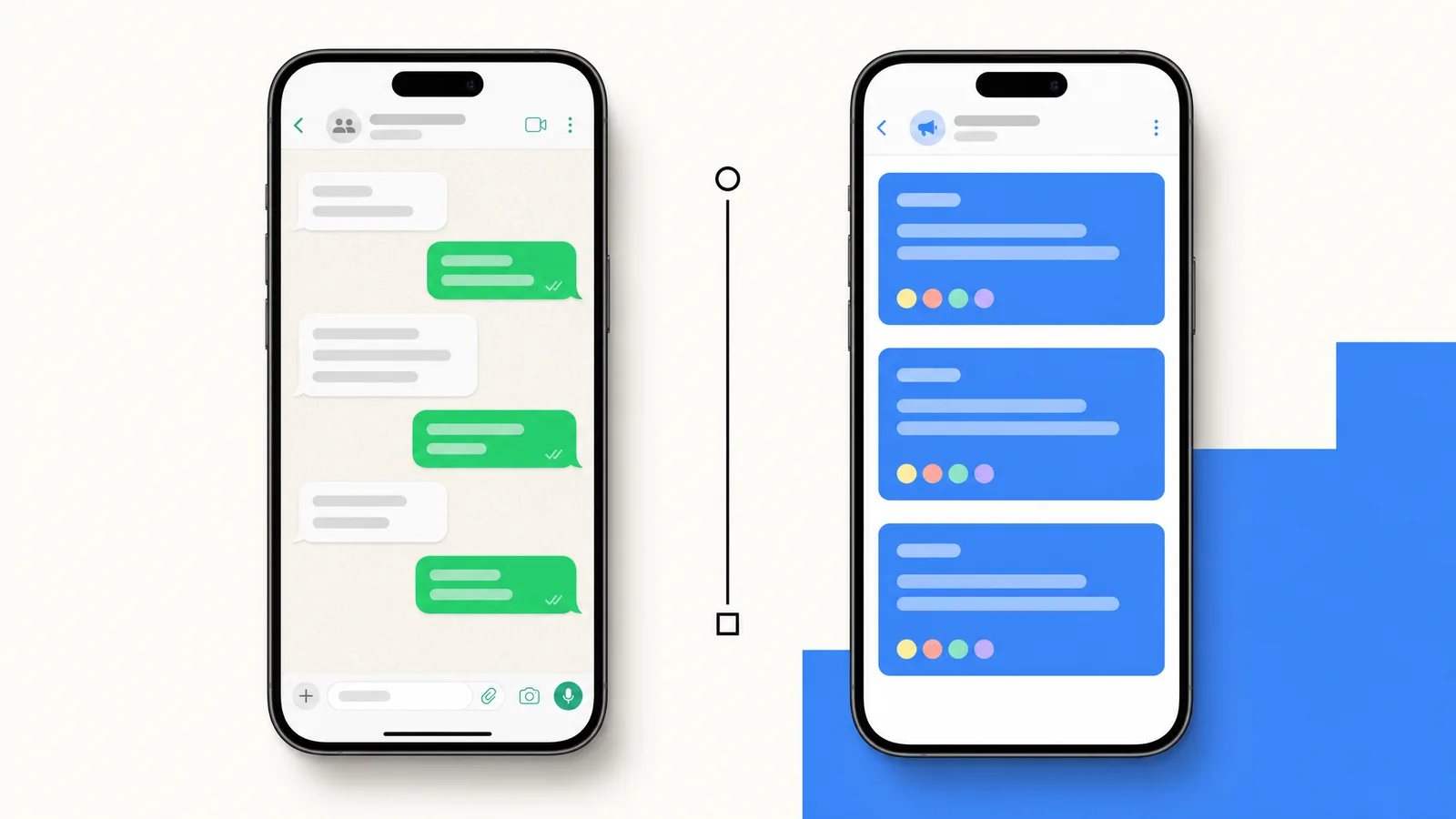
The clearest mental model: Channels are a megaphone, Newsletter is a one-to-one CRM. Each does one job well, so the real question is not which one to pick but how to stack them.
A sensible 2026 stack for a Shopify store with 50 to 200k followers/subscribers:
- Channel (free): brand awareness, drop teasers, content marketing, polls, story moments
- Newsletter via Business API and Kanal: segmented sends, abandoned cart, back-in-stock, post-purchase automations, click-to-WhatsApp ads follow-up
- Customer support chat via same API: replies to incoming queries
Channel Ideas by Vertical
Content patterns to adapt to your own catalog:
Fashion drops. Lookbook teasers, drop reminders, and short-form video, with short captions that let the image carry the message.
Beauty. A mix of product education, restocks, and founder content, with polls to surface shade and SKU preferences before launches.
Food and beverage. Recipe content, behind-the-scenes, and flash drops.
Sports and creators. A bridge between an Instagram audience and a paid newsletter or subscription, with promo codes in posts to monetize and to measure what the Channel drives.
What ties these patterns together: consistent voice, image-first feed, narrow product category, and a clear path off the Channel into a paid surface.
Limitations and What to Plan Around
What Channels do not do in 2026:
- No API, no automation. Posts must be published manually. No Klaviyo integration, no Shopify event trigger, no webhook.
- No segmentation. Every follower sees every post. You cannot send to "VIP" or "France only" segments.
- No two-way chat from a follower. If a follower wants to ask a question, they must message the brand on a separate surface.
- Limited analytics. Free-tier analytics show follower count, reactions per post, poll responses. They do not show open rate, click rate, or conversion attribution. There is no per-post revenue dashboard.
- No native CTA buttons. Posts can include links, but there is no template-style structured button. Conversion happens via plain links.
- Light moderation tools. As an admin, you cannot ban a follower from reacting or seeing posts. Mute and report are the only abuse controls.
These constraints are intentional. Channels are a brand-affinity surface, not a CRM. If you need real automation, attribution, or segmentation, you need the WhatsApp Business API and a Newsletter setup.
When to Choose Channels vs Newsletter for Your Store
A short decision framework:
Start with a Channel if you are pre-revenue or sub $50k MRR and you do not have a Business API setup yet. The Channel is free and validates whether your audience opts in to a WhatsApp surface.
Start with a Newsletter if you are doing $50k+ MRR and email open rates are dropping. The Business API runs through a BSP like Kanal or one of the alternatives. Weigh what each send costs against the revenue it brings in.
Run both if you are above $100k MRR. The Channel builds top-of-funnel reach. The Newsletter drives measurable revenue. They reinforce each other.
How Kanal Complements WhatsApp Channels
Kanal does not host Channels (Channels live inside the WhatsApp app and Meta does not expose a Channel API). What Kanal does is run everything around the Channel.
- Newsletter on the Business API for segmented, automation-driven sends (WhatsApp campaigns)
- Click-to-WhatsApp ad funnels that feed both Channel and Newsletter
- Shopify integration that connects order, cart, and customer events to messaging automations (Shopify integration)
- AI chatbot for replies to incoming customer messages (AI chatbot)
- A WhatsApp link generator for the click-to-chat links you put in your bio, on packaging, and in email footers
When both run together, the Channel feeds the Newsletter: a post with an opt-in link invites followers to subscribe to messages you can segment and automate. See pricing and book a demo to see the integrated setup.
Getting Started
If your store does not already have a WhatsApp presence, start with a Channel. Free, 15 minutes to set up, validates whether your audience engages on the surface. Once you cross 1k followers, layer on a Newsletter via the Business API.
If you are on Shopify, install Kanal for the Newsletter side. Channels you set up directly from the WhatsApp app, then promote the join link through your existing channels (bio, packaging, email footer).
Frequently asked questions
What are WhatsApp Channels?
WhatsApp Channels are Meta's one-way broadcast feature, launched in 2023 and rolled out globally through 2024. A Channel is a public, follow-able profile from which only the admin can post. Followers see new posts in their Updates tab (separate from chats). There is no member chat, no reply, and no two-way conversation. Channels are how brands and creators build a follower base on WhatsApp without using the Business API.
How are WhatsApp Channels different from a WhatsApp Newsletter?
A WhatsApp Channel is free, lives in the Updates tab, allows reactions and polls but no two-way chat, and has no API or automation in 2026. A WhatsApp newsletter through the Business API is paid (Meta charges per delivered message), lands directly in the customer's chat list, supports two-way replies, and integrates with Shopify automations. Channels are for free reach and brand affinity. Newsletter is for measurable, automation-driven commerce messaging.
Are WhatsApp Channels free for businesses?
Yes. Creating a Channel, posting, and growing a follower base are all free. Meta does not charge per-post fees for Channels in 2026. The trade-off is no automation, no API, no real-time analytics on the free tier, and no Shopify integration. Channels work as a complement to a paid Business API setup, not as a replacement.
Can I send a WhatsApp Channel post to followers automatically?
No. As of 2026, Channels do not support API-driven automation. You cannot schedule a post via a webhook, cannot trigger one from a Shopify event, and cannot connect a Channel to Klaviyo or any marketing automation tool. Posts must be written and published manually in the WhatsApp app or web interface. If you need automation, you need the WhatsApp Business API and a Newsletter setup, not a Channel.
How many followers can a WhatsApp Channel have?
There is no follower cap announced by Meta as of 2026. How many followers a brand gathers depends on the audience it already has and on its discovery efforts: Channels can be found in the in-app directory and shared via link.
Can WhatsApp Channel followers reply to my posts?
Not in chat. Followers can react with emojis (one per post) and respond to polls. They cannot send a free-text message to the Channel. If a user wants to message the brand, they must do so through the brand's regular Business chat (a separate surface). This is the main structural difference between Channels and Newsletter. Channels are true one-way broadcast.
WhatsApp Channels vs Groups, what is the difference?
A WhatsApp group is many-to-many: every member can post and see every other member's number. Max 1024 members. A Channel is one-to-many: only the admin posts, followers see only the admin, follower count is uncapped. Groups suit small communities and customer support clusters. Channels suit brand broadcast at scale. For e-commerce, Channels are almost always the right surface and groups almost always the wrong one.
Where can I find the list of WhatsApp channels?
Open the Updates tab in WhatsApp and tap Explore: this is the channels directory. You can browse by category, sort channels by new, popular or most active, change the region to see channels from other countries, and search by name. The list is filtered by your country and language, and WhatsApp says it does not accept requests to add a channel to Explore or to its recommendations.
How do I get the link to my WhatsApp channel?
Every channel has its own link and QR code. In the Updates tab, open your channel, open its menu and tap Copy link to paste it anywhere, Share link to send it through another app, or QR code to save or print the code. You can also forward the link to up to five chats or groups at a time, or post it to your status.
Can a business get a verified WhatsApp channel?
WhatsApp says it does not currently accept requests to verify channels. The exception is Meta Verified for Business on WhatsApp, a paid subscription offered to some businesses on the WhatsApp Business app: its plans list verified channels among their benefits, from one on Business Standard to ten on Business Max, according to WhatsApp's Help Center on October 7, 2026.
See Kanal on your own store
- Your campaigns and cart reminders on WhatsApp, starting from your own store
- Post-purchase offers, back-in-stock alerts, then the AI agent that advises your customers
- You leave with the plan that fits and its price

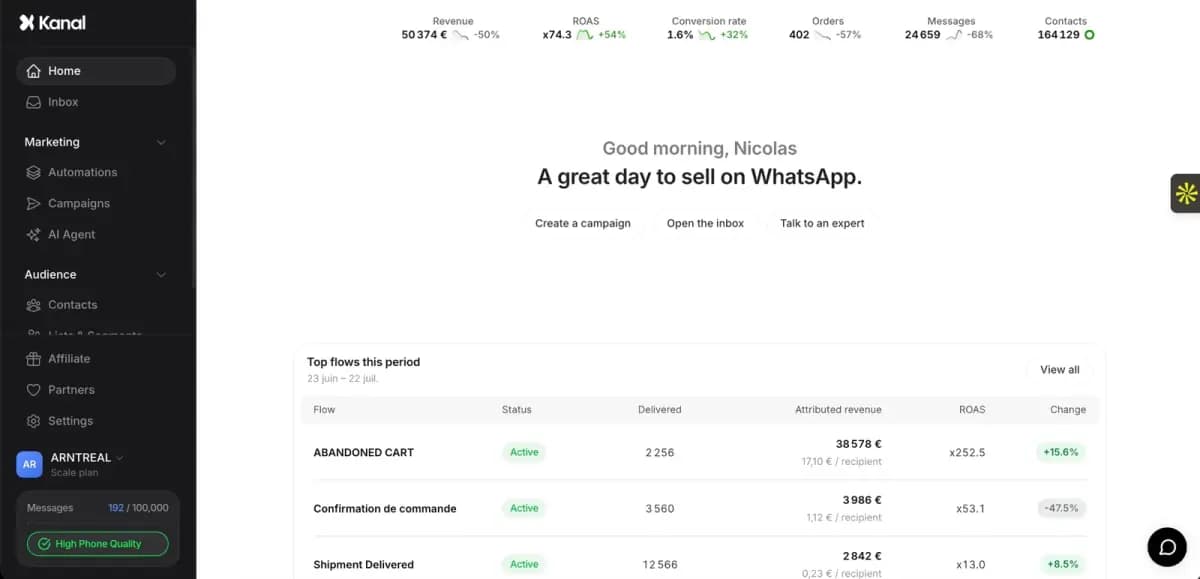
- brands
- 500+
- to set up
- 5 min
- open rate on WhatsApp
- +90%
5/5 on the Shopify App Store (125 reviews)

Nicolas helps e-commerce brands grow revenue with WhatsApp marketing. With deep expertise in Shopify ecosystems and conversational commerce, he shares proven strategies for abandoned cart recovery, broadcast campaigns, and AI-powered customer engagement.
Glossary terms in this article
Quick definitions for the WhatsApp Business terms used above.
WhatsApp Channels
WhatsApp Channels are a one-to-many broadcast feature in the Updates tab, where admins post to an unlimited audience of followers who can react and vote but not reply.
Read full definitionSegmentation
Segmentation is the practice of splitting a WhatsApp contact list into groups based on traits like purchase history, behavior, or engagement, so each group receives messages that are actually relevant.
Read full definitionOpt-in
A WhatsApp opt-in is the permission a person gives a business to send them messages on WhatsApp. WhatsApp's Business Messaging Policy requires it before any message: the business must have the person's phone number and their agreement to hear from that business.
Read full definitionOfficial Business Account (blue tick)
An Official Business Account (OBA) is a WhatsApp Business Platform phone number that Meta has verified as belonging to an authentic business. It shows a blue checkmark next to the business name; the green tick it replaced no longer exists.
Read full definitionWhatsApp Business App
The WhatsApp Business App is a free mobile application designed for small businesses to chat with customers, with a catalog, quick replies, and automated greeting messages.
Read full definitionWebhook
A WhatsApp webhook is an HTTP request with a JSON payload that Meta's servers send to a business's server whenever something happens on its WhatsApp account, such as an incoming message or a delivery status change.
Read full definitionBusiness Solution Provider (BSP)
A Business Solution Provider (BSP) is a company authorized by Meta to give other businesses access to the WhatsApp Business Platform, usually through its own software. Meta now calls these companies partners and splits them into Solution Partners, Tech Providers and Tech Partners.
Read full definitionClick-to-WhatsApp Ads
Click-to-WhatsApp ads are Facebook and Instagram ads whose button opens a WhatsApp chat with the business instead of a website. The shopper sends the first message, which lets the business reply freely and, under Meta's pricing, for free during a limited window.
Read full definitionwa.me Link (Click-to-Chat)
A wa.me link is WhatsApp's official click-to-chat URL. Opening it starts a conversation with a specific number, without the visitor saving the contact first.
Read full definitionSuggested articles
50+ WhatsApp Message Templates for Ecommerce: Copy and Paste (2026)
53 WhatsApp message templates ready to copy and paste: abandoned cart, order updates, review requests, winback and promos. With Meta categories.
WhatsApp in Shopify Messaging: Pricing, Features and Limits
WhatsApp is live in Shopify Messaging: what the channel does, per-message prices by country ($0.106 UK, $0.172 France), limits and the US rule, October 2026.
Best WhatsApp Marketing Software: 10 Tools Compared (2026)
The 10 best WhatsApp marketing software tools compared: features, e-commerce integrations and starting prices for Kanal, Wati, Zoko, Charles and more.
WhatsApp Marketing for Beauty Brands: Strategies & Templates
The WhatsApp marketing playbook for beauty and skincare brands: consultation flows, replenishment automation, VIP loyalty and 7 templates (2026).