SMS vs MMS vs RCS vs WhatsApp: Best for Marketing 2026

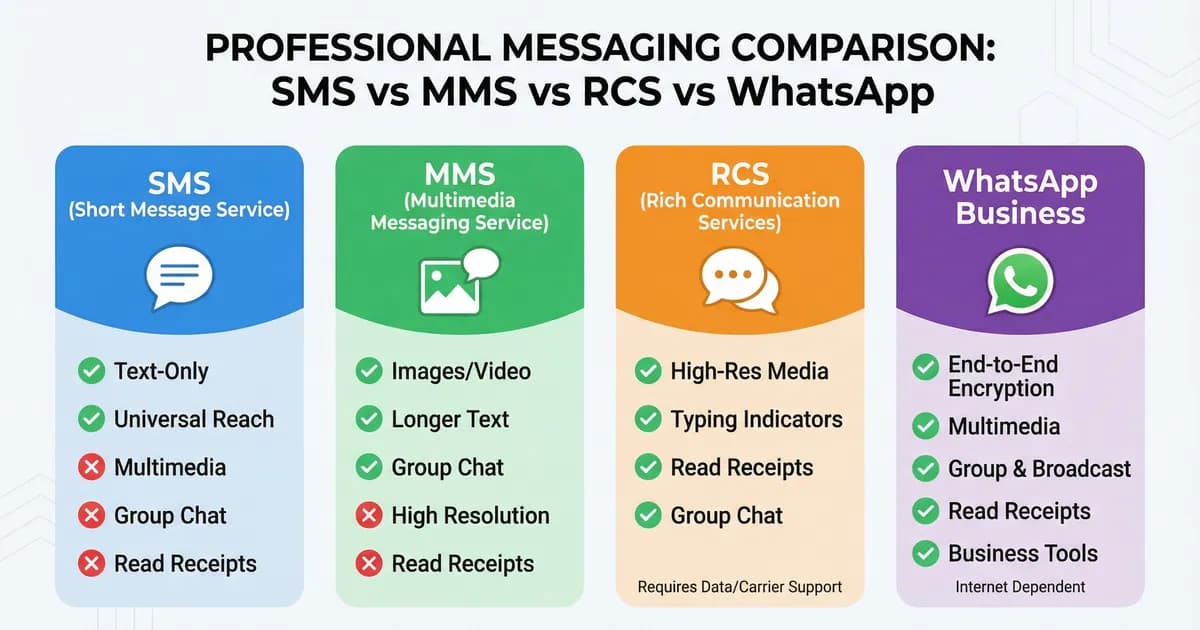
Pick the right messaging channel: costs, features, reach and use cases for SMS, MMS, RCS, and WhatsApp. Direct comparison for Shopify and DTC marketers.
Table of contents (42)
Choosing the right messaging channel can make or break your e-commerce marketing strategy. SMS, MMS, RCS, and WhatsApp each have distinct strengths, but which one delivers the best ROI for your Shopify store?
This guide breaks down every difference: features, pricing, reach, and the use cases each channel fits best.
Quick Comparison: SMS vs MMS vs RCS vs WhatsApp
| Feature | SMS | MMS | RCS | |
|---|---|---|---|---|
| Character Limit | 160 | 1,600 | Unlimited | Unlimited |
| Rich Media | No | Low-quality images | HD images, video, buttons | HD images, video, docs |
| Interactive Buttons | No | No | Yes | Yes |
| Product Carousels | No | No | Yes | Yes (via API) |
| End-to-End Encryption | No | No | Rolling out (iOS 26.5+, carrier-dependent) | Yes (default) |
| App Required | No | No | No | Yes (WhatsApp) |
| Global Reach | Any mobile phone | Phones and carriers with MMS support | Supported devices and carriers only | More than 3 billion people |
| Avg Cost per Message | $0.01-0.05 | $0.03-0.08 | $0.02-0.06 | $0.0034 per delivered US utility message (Meta's pricing); marketing templates to US numbers paused since April 1, 2025 |
| Bot/Automation Support | Basic | No | Limited | Advanced (AI chatbots) |
| Shopify Integration | Via apps | Via apps | Limited | Native (Kanal) |
SMS: The Universal Baseline
What it is
Short Message Service: 160 characters of plain text sent over the cellular network. Works on every phone ever made.
Best for
- Transactional messages: Order confirmations, OTP codes, delivery updates
- Urgency: Flash sales with a simple link
- Universal reach: Customers without smartphones or data plans
Limitations
- No images, no buttons, no product previews
- Carrier filtering can block marketing messages
- Per-message cost adds up for large lists
- Limited personalization options
E-commerce use case
SMS works well for order notifications and time-sensitive alerts. For cart recovery, SMS gets a link in front of the customer, but it cannot show the product or offer buttons the way WhatsApp can.
Compare the best SMS marketing apps for Shopify to find the right solution, or check out the best abandoned cart apps for multi-channel recovery.
MMS: Rich Media, Higher Cost
What it is
Multimedia Messaging Service: an extension of SMS that supports images, GIFs, audio, and video clips (up to 500KB).
Best for
- Product showcase: Send product images directly
- Brand campaigns: GIFs and short videos grab attention
- Loyalty rewards: Visual coupon codes and barcodes
Limitations
- Image quality is compressed (max ~500KB)
- 2-3x more expensive than SMS
- No interactive elements (buttons, carousels)
- Inconsistent rendering across devices and carriers
E-commerce use case
MMS adds the product image that plain SMS cannot show. But the higher cost and lack of interactivity make it less efficient than WhatsApp for abandoned cart recovery.
RCS: The SMS Successor
What it is
Rich Communication Services: Google's upgrade to SMS that brings app-like experiences to the native Messages app. Supports HD media, buttons, carousels, and read receipts.
Best for
- Android-heavy audiences: RCS adoption is strongest on Android via Google Messages
- No-app experience: Rich messaging without requiring customers to install anything
- Verified sender: Business logo and name display automatically
- Carrier-integrated campaigns: Works with telecom billing relationships
Limitations
- Coverage gap: Not available on all devices/carriers
- iPhone inconsistency: Apple added RCS in iOS 18 but with limited feature support
- Automation is limited: No mature chatbot ecosystem compared to WhatsApp
- Encryption still rolling out: E2EE arrived with Universal Profile 3.0 and iOS 26.5 (May 2026), but it depends on carrier support and up-to-date apps on both ends
What changed in 2026
RCS security took a real step forward. The GSMA's Universal Profile 3.0 (March 2025) defined interoperable end-to-end encryption based on the MLS protocol, and Apple shipped it with iOS 26.5 in May 2026: iPhone-Android RCS chats can now be encrypted when both carriers and both apps support it, a rollout Apple describes as beta and carrier-dependent. That narrows a historic gap with WhatsApp, where every chat has been end-to-end encrypted by default for years. For the full technical breakdown and business implications, see our complete RCS messaging guide.
E-commerce use case
RCS is promising for broadcast campaigns with its carousel format. However, the coverage gap means you always need an SMS fallback, adding complexity. With WhatsApp, you reach customers on a single, consistent platform used by more than 3 billion people.
WhatsApp: The E-commerce Powerhouse
What it is
A messaging app used by more than 3 billion people, with a mature Business API for automated customer communication. Supports rich media, interactive buttons, product catalogs, and AI chatbots.
Best for
- Abandoned cart recovery: personalized product reminders with a one-tap checkout link
- Customer support: an AI chatbot answers 24/7 (at Fincut, a fashion brand, Kanal's AI chatbot handles 80% of queries automatically, see our case studies)
- Broadcast campaigns: Segmented marketing campaigns to thousands of customers
- Post-purchase engagement: Upsells, review collection, and back-in-stock alerts
- European and LATAM markets: reach customers in the messaging app they already use
Why WhatsApp wins for e-commerce
- Rich, interactive messages: images, buttons, catalogs and carousels in one thread
- Two-way conversations: customers reply to ask a question before they buy
- Deep Shopify integration via platforms like Kanal
- AI-powered automation with conversational chatbots
- CRM integrations with Klaviyo, Gorgias, Zendesk
Limitations
- Requires opt-in (customers must consent to receive messages)
- Meta charges each delivered template message, by category and country
- Template messages must be pre-approved by Meta
- Customers need WhatsApp installed
Head-to-Head: Which Channel Wins?
For e-commerce marketing and cart recovery, WhatsApp wins on rich media, two-way conversations and automation. SMS wins on reach and instant transactional delivery, MMS on visual fallback, and RCS on branded native experiences where carriers support it. The breakdown below compares them use case by use case.
For Abandoned Cart Recovery
| Channel | Product image | Action buttons | Two-way replies | Automation support |
|---|---|---|---|---|
| SMS | No | No | Plain text | Basic |
| MMS | Yes (compressed) | No | Plain text | No |
| RCS | Yes (HD) | Yes | Yes | Limited |
| Yes (HD) | Yes | Yes | Advanced (AI chatbots) |
WhatsApp comes out ahead for cart recovery because it combines rich interactive messages, two-way conversations and mature automation on one consistent platform. For a published result, Jean Fourche, a premium bike and apparel brand, recovered 42% of its abandoned carts with Kanal's automated WhatsApp recovery flows (see our case studies). Learn more about automated abandoned cart recovery with Kanal.
For Promotional Campaigns
| Channel | Best Format | Personalization | Segmentation | Winner? |
|---|---|---|---|---|
| SMS | Text + link | Basic (name) | Limited | |
| MMS | Image + text | Basic | Limited | |
| RCS | Carousel + buttons | Moderate | Moderate | |
| Rich media + CTA + catalog | Advanced | Advanced | Yes |
With Klaviyo integration, you can send hyper-personalized WhatsApp campaigns based on purchase history, browsing behavior, and customer segments.
For Customer Support
| Channel | Real-time Chat | Bot Support | Media Sharing | CRM Integration | Winner? |
|---|---|---|---|---|---|
| SMS | No | Basic | No | Limited | |
| MMS | No | No | Images only | Limited | |
| RCS | Limited | Limited | Yes | Limited | |
| Yes | AI Chatbot | All formats | Full | Yes |
WhatsApp with an AI chatbot handles common queries instantly. For complex issues, integrate with Gorgias or Zendesk for seamless escalation.
Industry-Specific Channel Recommendations
The right channel mix depends on your industry, AOV, and customer behavior. Here are concrete starting points by vertical.
Fashion and apparel
- Primary: WhatsApp (newsletter drops, back-in-stock, VIP early access)
- Secondary: SMS (flash sale alerts, stock countdown)
- Avoid: MMS (compressed images, inconsistent rendering across devices)
Beauty and skincare
- Primary: WhatsApp (consultations, replenishment reminders, education)
- Secondary: Email (long-form content, ingredient guides)
- Avoid: SMS-only flows (plain text cannot carry the education high-consideration products need)
Food and beverage
- Primary: WhatsApp (delivery confirmations, subscription management)
- Secondary: SMS (last-mile updates if no WhatsApp)
- Avoid: RCS (still too inconsistent across operators)
Home and furniture (high AOV)
- Primary: WhatsApp (concierge service, pre-purchase questions)
- Secondary: Email (visualization tools, full product specs)
- Tertiary: SMS (delivery scheduling)
Subscription / consumables
- Primary: WhatsApp (replenishment reminders, plan changes)
- Secondary: SMS (failed payment alerts, urgent action)
- Avoid: Email-only (too easy to miss critical messages)
Health and supplements (regulated)
- Primary: Email (compliant educational content)
- Secondary: WhatsApp (post-purchase support, subscription)
- Avoid: Marketing claims via SMS without explicit opt-in (regulator scrutiny)
The bottom line: WhatsApp wins as the primary channel in most e-commerce verticals. SMS still has a role for time-critical, no-app fallback. RCS is promising but adoption uneven. MMS has little left to offer once RCS or WhatsApp is available.
Pricing Comparison
Cost per 1,000 messages (US market)
| Channel | Cost | Notes |
|---|---|---|
| SMS | $10-50 | Per message, carrier fees apply |
| MMS | $30-80 | 2-3x SMS cost |
| RCS | $20-60 | Similar to SMS, data-based |
| $3.40 (utility) | Per delivered template at Meta's US rate; marketing templates to US numbers paused since April 1, 2025 |
The WhatsApp figure uses Meta's US list rate per delivered message (Meta's pricing): 1,000 x $0.0034 = $3.40 for utility templates. Meta has paused marketing templates to US numbers since April 1, 2025 (see WhatsApp marketing in the USA). For support, WhatsApp is cost-effective: when a customer writes in, your free-form replies inside the 24-hour customer service window are not charged until September 30, 2026. From October 1, 2026, they cost the utility rate after 1,000 free service messages per business phone number each month.
Check Kanal's pricing for transparent WhatsApp Business API costs.
The Omnichannel Strategy
The smartest e-commerce brands don't choose one channel. They orchestrate all of them:
- WhatsApp as primary channel for cart recovery, campaigns, and support (Kanal)
- SMS as fallback for customers without WhatsApp
- RCS as a future-proof upgrade path from SMS
- Email for long-form content and newsletters (via Klaviyo integration)
With Kanal's Shopify integration, you can set up automated WhatsApp flows with SMS fallback, ensuring every customer gets reached on their preferred channel.
FAQ
Is WhatsApp really better than SMS for marketing?
For e-commerce marketing, yes. WhatsApp adds what SMS lacks: rich media (images, buttons, catalogs) and two-way conversations in an app customers already use. There is no independent public benchmark comparing the two, so send the same campaign on both channels and compare clicks and revenue in your own reports.
Should I use RCS or WhatsApp?
WhatsApp is the safer choice in 2026. More than 3 billion people use it, according to WhatsApp, and it offers mature automation tools and consistent behavior across all devices. RCS is still fragmented between Android and iOS. Use RCS as a future complement, not a replacement for WhatsApp.
What's the cheapest messaging channel for e-commerce?
Per message, SMS is usually cheapest for marketing sends. WhatsApp bills each delivered template by category and country: in the US, $0.0034 for a utility message such as an order update (Meta's pricing), while Meta has paused marketing templates to US numbers since April 1, 2025. Compare channels on revenue per message sent, not on cost alone: run the same offer on both and measure it in your own reports. Calculate your potential ROI with our ROAS calculator.
What is RCS business messaging?
RCS business messaging (RBM) is the brand-to-consumer layer of RCS: verified sender profiles, rich cards, carousels, and suggested replies delivered through aggregators like Sinch, Twilio, and Vonage. It is the natural upgrade path from transactional SMS. For revenue conversations, WhatsApp still offers a more mature business API, deeper automation, and a larger installed audience.
Conclusion
For e-commerce in 2026, WhatsApp is the clear winner for customer engagement, cart recovery, and marketing campaigns. Its combination of broad reach, rich interactive messages, two-way conversations, and AI automation capabilities makes it the most complete messaging channel available.
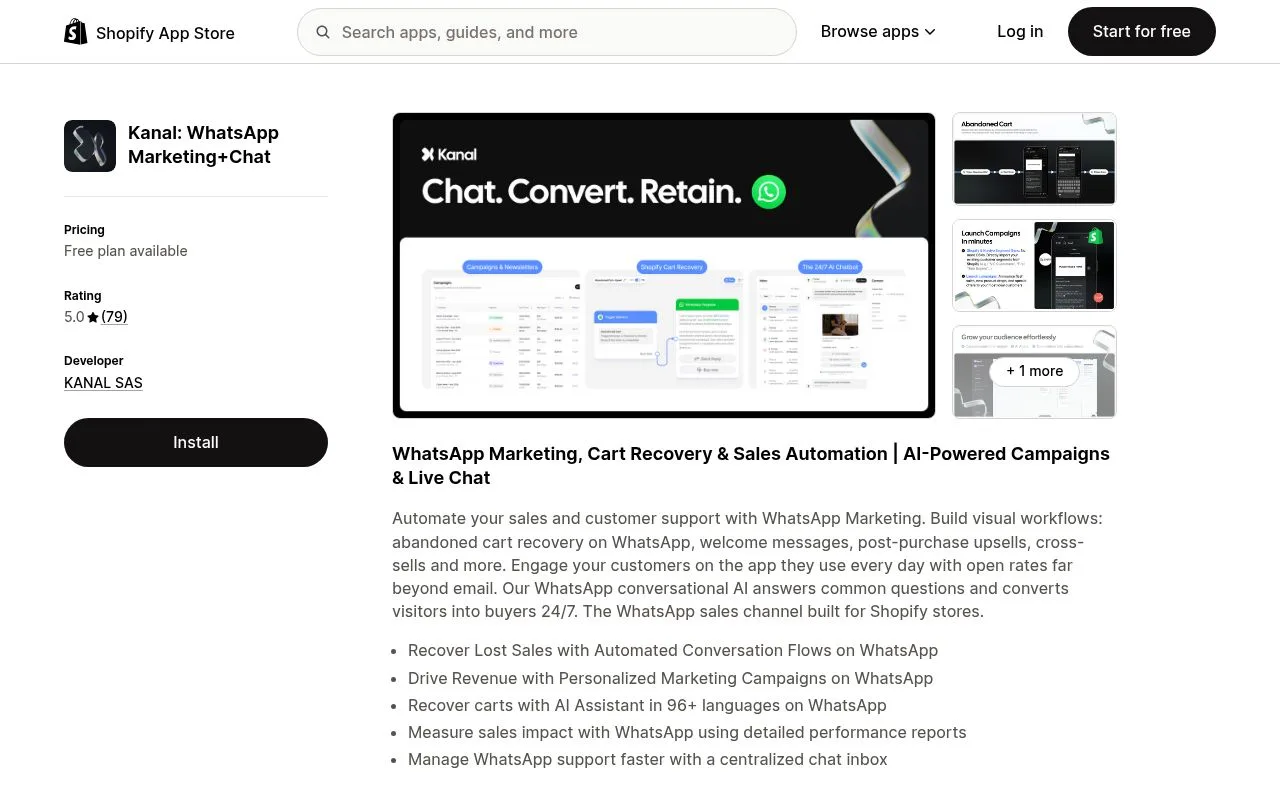
Ready to get started? Install Kanal on your Shopify store and start recovering abandoned carts with WhatsApp in minutes. Or book a free demo to see the platform in action.
Explore our free tools: WhatsApp Link Generator | WhatsApp QR Code Generator | ROAS Calculator

Nicolas helps e-commerce brands grow revenue with WhatsApp marketing. With deep expertise in Shopify ecosystems and conversational commerce, he shares proven strategies for abandoned cart recovery, broadcast campaigns, and AI-powered customer engagement.
Ready to boost your WhatsApp sales?
 Install with Shopify
Glossary terms in this article
Quick definitions for the WhatsApp Business terms used above.
RCS (Rich Communication Services)
RCS (Rich Communication Services) is the messaging standard that upgrades SMS with images, buttons, read receipts, and verified senders, promoted by Google and supported on iPhone since iOS 18.
Read full definitionMarketing Template
A marketing template is a message template categorized as promotional, used for offers, product launches, and campaigns. It requires opt-in and is the most heavily reviewed template category.
Read full definitionAbandoned Cart Recovery
Abandoned cart recovery is the practice of messaging shoppers who added items to their cart but left without buying, to encourage them to complete the purchase.
Read full definitionBroadcast
A broadcast is a message sent to many WhatsApp contacts at once, typically a marketing campaign delivered to a segment of opted-in customers.
Read full definitionOpt-in
An opt-in is the explicit permission a customer gives a business to contact them on WhatsApp. It is required before a business can send any message.
Read full definitionWhatsApp Flows
WhatsApp Flows is a feature for building structured, multi-step experiences inside a chat, such as forms, surveys, bookings, and guided product selection.
Read full definitionSegmentation
Segmentation is the practice of splitting a WhatsApp contact list into groups based on traits like purchase history, behavior, or engagement, so each group receives messages that are actually relevant.
Read full definitionUtility Template
A utility template is a message template that delivers information tied to a specific transaction or account, such as order confirmations, shipping updates, and appointment reminders.
Read full definitionCustomer Service Window (24-hour window)
The customer service window is the 24-hour period, opened by a customer message, during which a business can reply with free-form messages instead of approved templates.
Read full definitionWhatsApp Business API
The WhatsApp Business API is the programmatic interface that lets medium and large businesses send and receive WhatsApp messages at scale, without using a phone or the chat app.
Read full definitionSuggested articles
RCS Messaging: The Complete Guide for E-commerce (2026)
RCS (Rich Communication Services) explained for Shopify in 2026. RCS vs SMS vs WhatsApp, carrier rollout status, pricing, and where it fits in your messaging stack.

WhatsApp Marketing for E-Commerce: The 2026 Playbook
WhatsApp marketing for Shopify stores: cart recovery, broadcasts, AI chatbots, the metrics to track, and 12 plays that work in 2026.
WhatsApp Statistics 2026: Users, Messages and Adoption Data
WhatsApp statistics for 2026 from WhatsApp and Meta: users, daily actives, a messaging record and business adoption, each linked to its primary source.
WhatsApp Marketing in the USA: What Works During Meta's Pause
Meta has paused marketing templates to US numbers since April 2025. What still works in 2026: utility flows, click-to-WhatsApp ads, and error 131049 explained.