WhatsApp vs SMS Pricing by Country: 20-Market Comparison (2026)

Compare WhatsApp vs SMS cost across 20 markets in 2026: indicative rates, break-even analysis for Shopify stores and how to cut your messaging bill.
Table of contents (24)
The most common mistake e-commerce teams make when comparing WhatsApp and SMS is reading the headline numbers. A WhatsApp marketing message can look expensive next to a single SMS, until you factor in the much cheaper utility category and the replies you send in the 24-hour customer service window, which Meta does not charge until September 30, 2026.
In this guide we'll break down how WhatsApp and SMS pricing actually work, give you a 20-market price table, show you exactly where each channel wins on cost, and walk through a 5,000-orders-per-month example so you can see the break-even on your own Shopify store.
How WhatsApp pricing works
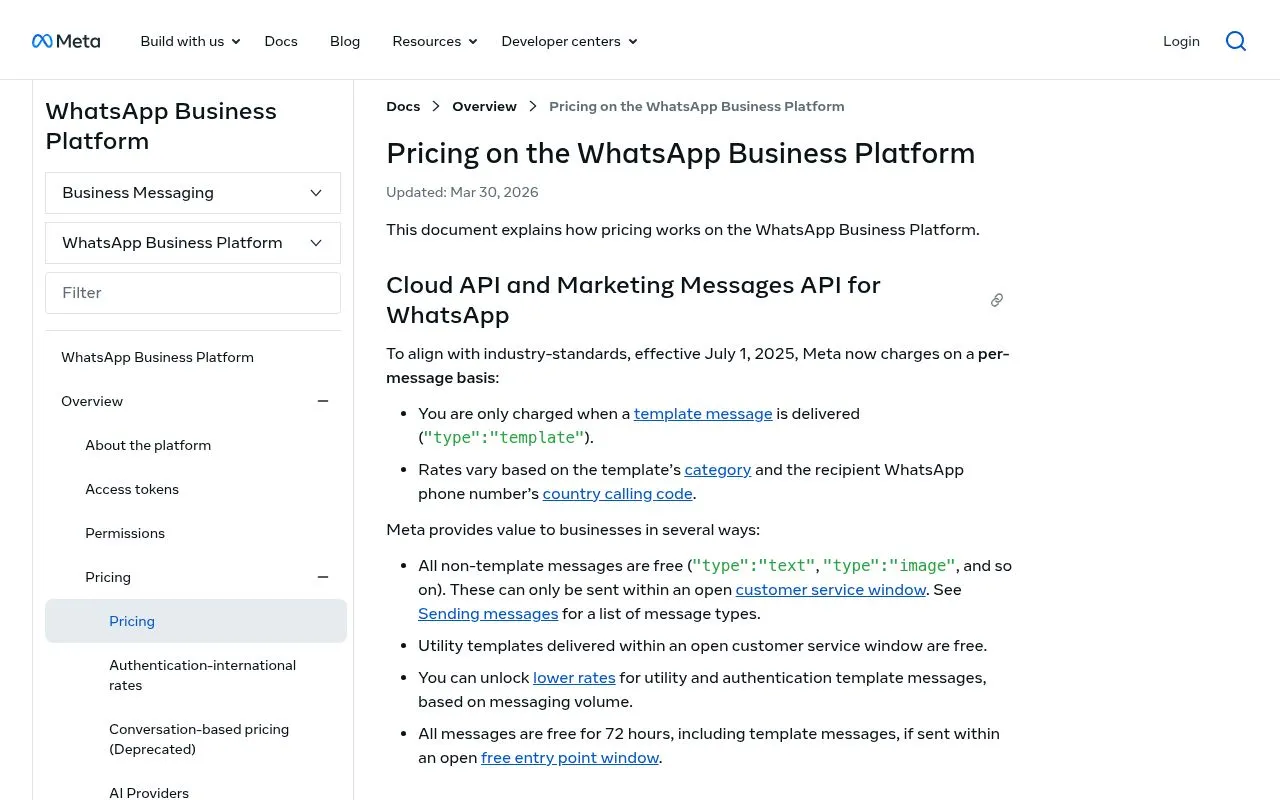 WhatsApp Business Platform pricing documentation page" style="max-width:100%;border-radius:12px" loading="lazy" />
WhatsApp's pricing model differs from SMS in what gets billed. Since July 1, 2025, Meta charges per delivered template message. Until June 30, 2025, it charged per 24-hour conversation, a model that is now deprecated. You pay when a template is delivered, not when it is sent, and the messages customers send you are never charged.
Each template falls into one of three categories, and the category determines the rate (Meta's pricing, per delivered message):
- Marketing: promotional content, new product launches, abandoned cart recovery. Highest rate: $0.0250 per delivered message on Meta's North America rate card, though Meta has paused marketing templates to US numbers since April 1, 2025 (see WhatsApp marketing in the USA).
- Utility: order updates, shipping notifications, account alerts, anything tied to a specific transaction. $0.0034 per delivered US message, lower with monthly volume tiers.
- Authentication: OTP codes, login verifications. Same rate as utility in the markets of the table below ($0.0034 in the US), also with volume tiers.
Service messages are not a template category. They are your free-form replies inside the 24-hour customer service window that each customer message opens (or resets). They are not charged until September 30, 2026. From October 1, 2026, Meta charges them at the market's utility rate after 1,000 free service messages per business phone number each month.
The country calling code of the recipient's number sets the rate. Turkey and India are the cheapest markets in the table below. The Netherlands, Germany, and France are the most expensive for marketing messages. For the full official methodology and the message categories, see the Meta WhatsApp pricing documentation.
A typical e-commerce conversation includes:
- Your outbound template message (e.g. "Your order #1234 has shipped")
- The customer's reply ("Where is the tracking?")
- Your follow-up ("Here's the link: ...")
- Several more back-and-forth messages
Only the first message is a billable template. The customer's messages are never charged, and your free-form follow-ups are service messages: not charged until September 30, 2026, then billed at the utility rate beyond 1,000 free per business phone number each month. That's the structural difference with SMS, where every leg is billed.
How SMS pricing works
SMS is priced per message, full stop. Every outbound message generates a billable event, and inbound messages are usually charged separately (or routed through a different short code). The rate depends on:
- The destination country: operator termination fees vary 5-10x between countries
- The route: direct operator routes are more reliable but more expensive than grey routes
- Volume: high-volume senders negotiate lower rates, but Shopify stores rarely qualify
- Sender ID: alphanumeric sender IDs cost more than numeric short codes in some markets
- Message length: anything over 160 characters splits into multiple billable segments
SMS providers add their own margin on top of operator termination fees. In Western Europe, that margin is typically 15-30% of the raw cost. In emerging markets like Brazil or Mexico, providers sometimes absorb the margin and pass through near-cost rates to compete with WhatsApp.
The fundamental issue with SMS for e-commerce isn't the cost of the first message. It's the lack of a reply window. Every "we have a question about your order" exchange, every back-and-forth that closes a deal, each leg costs another full SMS.
The 20-market price table
Here are the 2026 rates for WhatsApp (per delivered marketing and utility message) and indicative SMS rates (typical e-commerce range, including provider margins) across the markets that matter most for Shopify stores. WhatsApp rates are Meta's list rates per delivered message, in USD, from the rate card effective July 1, 2026 (Meta's pricing). SMS rates are blended provider averages.
| Country | WhatsApp Marketing / msg | WhatsApp Utility / msg | SMS (avg per msg) |
|---|---|---|---|
| United States | $0.0250 | $0.0034 | $0.01-0.03 |
| United Kingdom | $0.0635 | $0.0220 | $0.03-0.05 |
| France | $0.0859 | $0.0300 | $0.04-0.07 |
| Germany | $0.1365 | $0.0550 | $0.04-0.08 |
| Spain | $0.0707 | $0.0200 | $0.03-0.06 |
| Italy | $0.0795 | $0.0300 | $0.04-0.07 |
| Brazil | $0.0625 | $0.0068 | $0.02-0.04 |
| Mexico | $0.0305 | $0.0085 | $0.02-0.03 |
| India | $0.0118 | $0.0014 | $0.005-0.015 |
| Indonesia | $0.0411 | $0.0250 | $0.015-0.025 |
| Australia | $0.0732 | $0.0113 | $0.04-0.06 |
| Canada | $0.0250 | $0.0034 | $0.01-0.03 |
| Argentina | $0.0618 | $0.0260 | $0.02-0.04 |
| Netherlands | $0.1597 | $0.0500 | $0.04-0.07 |
| Belgium | $0.0592 | $0.0171 | $0.04-0.07 |
| Switzerland | $0.0592 | $0.0171 | $0.05-0.10 |
| UAE | $0.0499 | $0.0157 | $0.05-0.12 |
| Saudi Arabia | $0.0501 | $0.0107 | $0.04-0.10 |
| Turkey | $0.0109 | $0.0009 | $0.02-0.04 |
| Poland | $0.0366 | $0.0122 | $0.03-0.05 |
Note: Canada shares Meta's North America rates with the US, Belgium and Switzerland are billed at Meta's "Rest of Western Europe" rates, and Australia at its "Rest of Asia Pacific" rates. Meta has paused marketing templates to US numbers since April 1, 2025, so the US marketing rate is shown for reference only. Utility rates drop as monthly volume grows. On October 1, 2026, Meta raises the marketing rate in Mexico (to $0.0397), Saudi Arabia and the UAE (to $0.0576), and Rest of Asia Pacific, including Australia (to $0.0842). For other countries, check Meta's rate calculator.
A few patterns jump out:
- Western Europe is the most expensive region for WhatsApp marketing. The Netherlands, Germany, and France sit at the top of the WhatsApp columns.
- Turkey and India have the lowest WhatsApp rates. A marketing message costs $0.0109 in Turkey and $0.0118 in India, and a utility message $0.0009 and $0.0014. India's SMS range is also the lowest in the table.
- Gulf markets have some of the highest SMS rates. UAE and Saudi Arabia have high operator-driven SMS rates ($0.05-0.12 and $0.04-0.10), while a WhatsApp marketing message costs $0.0499 and $0.0501 there (rising to $0.0576 on October 1, 2026) and a utility message $0.0157 and $0.0107.
- Canada, Mexico, Poland and the Gulf show the tightest gap on marketing. There, a WhatsApp marketing message falls inside or near the SMS range, while a utility message costs less than an SMS, making break-even depend more on flow design than raw cost. In the US, where marketing templates are paused, WhatsApp competes with SMS on utility, authentication, and service messages.
Break-even analysis: when WhatsApp wins
Since July 1, 2025, WhatsApp no longer bundles a multi-message flow into one fee: each delivered template is charged, like each SMS. WhatsApp's cost edge now comes from three places: utility messages priced below SMS in most markets of the table above, customer messages that are never charged, and replies inside the 24-hour customer service window that are not charged until September 30, 2026. Here are the e-commerce use cases where it matters most:
Abandoned cart recovery
A standard abandoned cart sequence sends 3-5 messages over 24-72 hours. With SMS, that's 3-5 billable messages per cart. With WhatsApp, it's also 3-5 billable marketing messages: Meta charges each delivered template, follow-ups within 24 hours included. If the customer replies, you get a 24-hour customer service window where you can answer with free-form messages, no template needed. Those replies are not charged until September 30, 2026. From October 1, 2026, they cost the utility rate after 1,000 free service messages per business phone number each month.
In France, a 4-step abandoned cart flow costs roughly $0.20 per cart on SMS. On WhatsApp, the same 4 marketing messages cost 4 x $0.0859 = $0.3436 per cart at Meta's list rate (Meta's pricing, per delivered message). On unit cost alone, SMS is cheaper for this flow in France, so the WhatsApp case rests on the replies and conversions you measure on your own store, and on sending fewer, better-timed reminders.
For a deep dive on this flow, see our guide on abandoned cart recovery strategies.
Post-purchase flow
Order confirmation, shipping update, delivery confirmation, review request. That's 4 SMS messages per order. On WhatsApp, it's 4 templates, each charged when delivered, but transactional updates run as utility templates, Meta's lower-priced category. Utility templates sent while a customer service window is open (the customer wrote to you in the last 24 hours) are not charged until September 30, 2026, and the customer's own questions are never charged.
A US Shopify store doing 5,000 orders/month would pay $0.04 x 5,000 = $200/month on SMS for shipping updates alone. On WhatsApp utility, it's $0.0034 x 5,000 = $17/month at Meta's US list rate (Meta's pricing, per delivered message), before any volume-tier discount.
Customer support deflection
Service messages, your free-form replies inside the 24-hour customer service window, have not been charged since November 1, 2024, and stay free until September 30, 2026. The customer's own messages are never charged. If you migrate your support inbox to WhatsApp and let customers DM you their question, a support thread costs nothing in Meta fees until September 30, 2026. From October 1, 2026, Meta charges your replies at the market's utility rate ($0.0034 per delivered US message, per Meta's pricing) after 1,000 free service messages per business phone number each month. Compare that to SMS, where you'd pay for every reply.
Check what your support replies cost on SMS today to size the saving on your own ticket volume. See the WhatsApp Business pricing guide for the message categories and the October 1, 2026 change.
Cross-border traffic
WhatsApp has a global single-API model. SMS providers charge wildly different rates per country, and the markup on premium routes is often hidden. For Shopify stores selling into Latin America, Southeast Asia, or the Gulf, WhatsApp delivers more predictable unit economics.
Break-even analysis: when SMS still wins
SMS isn't dead. There are three specific scenarios where it can still win on cost:
One-shot transactional blasts
If you're sending a single message that you know won't generate a reply (a flash sale notification, a one-time coupon, an emergency stock-out alert), and the recipient is in a low-SMS-cost market (India, Indonesia, parts of Eastern Europe), SMS at $0.005-0.015 can beat WhatsApp marketing (in India, $0.0118 per delivered marketing message, per Meta's pricing).
The catch: replies change the math. SMS replies are billed. On WhatsApp, the customer's messages are never charged, and your answers inside the 24-hour customer service window are not charged until September 30, 2026 (from October 1, 2026, they cost the utility rate after 1,000 free service messages per business phone number each month).
Markets with low WhatsApp adoption
In the US, WhatsApp is not the default messaging app, while any mobile phone can receive an SMS. If a large part of your audience does not use WhatsApp, SMS gets to more eyes per dollar spent: check how many of your customers opt in to WhatsApp before you move a flow. For promotional sends to US numbers, SMS is also the only option of the two for now: Meta has paused marketing templates to US numbers since April 1, 2025.
This is a deliverability question, not a pricing one, but it shows up on the bottom line. Meta only charges delivered messages, so a WhatsApp message that can't reach the customer costs nothing in Meta fees, but it sells nothing either, while a $0.03 SMS that does reach them can.
Authentication in cheap-SMS countries
For pure OTP flows where the user doesn't continue the conversation, SMS wins wherever your SMS price is below Meta's authentication rate for the recipient's country. Check before you decide: at Meta's list rates, authentication costs the same as utility in the markets of the table above, for example $0.0014 per delivered message in India and $0.0068 in Brazil (Meta's pricing).
How message categories change the math
The category mix is where most teams leave money on the table. Meta's pricing gives you three template categories with very different rates per delivered message, plus free-form service replies:
| Category | UK rate per delivered message | Typical use case |
|---|---|---|
| Marketing | $0.0635 | New product launches, promos, win-back |
| Utility | $0.0220 | Order confirmations, shipping, account alerts |
| Authentication | $0.0220 | OTP, login codes |
| Service (free-form, not a template) | Not charged until Sep. 30, 2026; from Oct. 1, 2026, utility rate after 1,000 free per business phone number each month | Your replies inside the 24-hour customer service window |
The implication: every message you can legitimately send as utility instead of marketing costs $0.0220 instead of $0.0635 in the UK. Service messages, your free-form replies after a customer writes in, are not charged until September 30, 2026.
In practice, the larger the share of your volume that runs as utility and service messages rather than marketing, the lower your per-customer cost compared with an SMS equivalent doing the same work.
For more on message categories and policy nuances, read our WhatsApp Business API guide.
Worked cost example: 5,000-order Shopify store
Let's run a concrete monthly cost comparison for a US-based Shopify store doing 5,000 orders/month. The volumes below are assumptions: replace them with your own.
Assumptions:
- 5,000 orders per month
- 12,000 abandoned carts
- 5,000 orders generate 5,000 shipping update sequences
- 1,800 customer support inquiries per month
- 2 marketing broadcasts per month to a 20,000-contact list
SMS scenario (US rates ~$0.02/msg):
| Flow | Messages/customer | Volume | Cost |
|---|---|---|---|
| Abandoned cart (3 msgs) | 3 | 12,000 carts | $720 |
| Shipping updates (3 msgs) | 3 | 5,000 orders | $300 |
| Support replies (avg 4) | 4 | 1,800 tickets | $144 |
| Marketing broadcast | 1 | 40,000 sends | $800 |
| Total | $1,964/month |
WhatsApp scenario (Meta's US list rates per delivered message, Meta's pricing):
Meta has paused marketing templates to US numbers since April 1, 2025, so the abandoned cart and broadcast flows cannot run on WhatsApp for US customers today. Here are the flows WhatsApp can carry for this store:
| Flow | Messages | Rate | Cost |
|---|---|---|---|
| Shipping updates (utility, 3 msgs) | 15,000 | $0.0034 | $51 |
| Support replies (service, avg 4) | 7,200 | Not charged until Sep. 30, 2026 | $0 |
| Abandoned cart and marketing broadcasts | Marketing templates paused for US numbers | Stay on SMS | |
| Total (WhatsApp flows) | $51/month |
On SMS, the same two flows cost $300 + $144 = $444/month. From October 1, 2026, the first 1,000 service messages each month stay free for each business phone number, and the other 6,200 support replies cost the utility rate: 6,200 x $0.0034 = $21.08, for a WhatsApp total of $72.08/month with one number.
Per-message billing means each WhatsApp template is charged, like each SMS, so the gap here comes from the category: a US utility message ($0.0034) costs less than the ~$0.02 SMS. Utility templates sent while a customer service window is open are not charged until September 30, 2026, so the utility line can come in lower, and every customer who replies opens a 24-hour customer service window where you can answer with free-form messages, no template needed. For European stores, where marketing templates deliver, rerun the calculation with local rates and add the marketing flows: Meta's marketing rates are higher there ($0.0859 per delivered marketing message in France and $0.1365 in Germany, per Meta's pricing), so the share of utility and service messages matters even more.
Run your own version of this calculation with the Kanal ROAS break-even calculator, or with the cost simulator on Kanal's pricing page, WhatsApp fees included.
Tips to reduce WhatsApp messaging cost
A few playbook moves can cut your WhatsApp bill without reducing volume.
1. Route flows as utility, not marketing
Order confirmations, shipping updates, delivery notifications, and review requests all qualify as utility messages. In the UK, a utility message costs $0.0220 against $0.0635 for marketing (Meta's pricing, per delivered message), and for US numbers a template classified as marketing is not delivered at all while Meta's pause lasts. Make sure your provider classifies templates correctly when they're submitted to Meta for approval.
2. Encourage customer replies
Each customer message opens (or resets) a 24-hour customer service window. Inside it, you can answer with free-form messages instead of templates: these service messages are not charged until September 30, 2026, and from October 1, 2026 they cost the utility rate after 1,000 free per business phone number each month. End every utility message with a question that invites a reply ("Got any questions about your order?"). Each reply lets you follow up with a free-form message instead of a marketing template.
3. Combine marketing content instead of multiplying sends
Since July 1, 2025, two templates sent to the same customer within 24 hours no longer share one billable conversation: each delivered template is charged. If a weekend flash sale and a related product recommendation go to the same customer, put both in one template: one delivered marketing message, not two.
4. Use authentication templates correctly
For OTPs and login codes, use the authentication category, not marketing: in the UK, Meta charges $0.0220 per delivered authentication message against $0.0635 for marketing (Meta's pricing). Check that your BSP (Business Solution Provider) submits OTP templates as authentication: an OTP template filed as marketing is charged the marketing rate.
5. Build opt-in quality, not opt-in volume
Low-quality opt-ins (scraped lists, incentivized signups without intent) generate complaints and downgrade your messaging tier. A downgraded tier means lower daily message limits and fewer customers reached per campaign. See our WhatsApp marketing guide for opt-in best practices.
6. Pick a provider with no per-message markup
Some BSPs charge a markup on top of Meta's rates. Kanal passes WhatsApp fees through at cost, with no per-message markup, and plans start from $89/month. On a large monthly volume, even a small per-message markup adds up. Compare Kanal pricing, where a cost simulator shows your total with WhatsApp fees included, against your current provider.
For a deeper breakdown of providers and their fee structures, see our WhatsApp Business API providers comparison.
How WhatsApp vs SMS stacks up against RCS
A quick sidebar on RCS (Rich Communication Services), since it's increasingly relevant for e-commerce in 2026. RCS sits between SMS and WhatsApp on cost (typically $0.005-0.020 per message in supported markets), and supports rich media, but lacks the 24-hour customer service window and the global API consistency that WhatsApp offers. For the full three-way comparison, see SMS vs MMS vs RCS vs WhatsApp.
For most Shopify stores in 2026, the recommendation remains: WhatsApp as primary channel, SMS as fallback for non-WhatsApp users, RCS as an optional layer in supported markets.
Conclusion
Comparing channels on the price of a single message is an easy way to overspend on messaging. Meta charges each delivered WhatsApp template, so count every template in a flow, then factor in the category (utility costs far less than marketing) and WhatsApp's 24-hour customer service window, where you can answer with free-form messages, no template needed: not charged until September 30, 2026, then the utility rate after 1,000 free service messages per business phone number each month. The right comparison is flow by flow, not message by message.
The three actions to take this week:
- Audit your current SMS spend by flow type, then map each flow to its WhatsApp equivalent using the table above.
- Check that your utility templates are classified as utility, not marketing, when they are submitted to Meta.
- Migrate your highest-volume flow (usually shipping updates, or abandoned cart outside the US) to WhatsApp first, measure the cost delta for 30 days, then expand.
Want us to run the cost analysis for your store before you commit? Book a demo and we'll walk through your last 90 days of messaging spend and project the WhatsApp equivalent.
Resources
Frequently asked questions
Is WhatsApp cheaper than SMS for marketing campaigns?
It depends on the market and on the flow. Since July 1, 2025, Meta charges each delivered marketing template, follow-ups included: in France, $0.0859 per delivered marketing message (Meta's list rate), to compare with your SMS price there. In the US, Meta has paused marketing templates to US numbers since April 1, 2025. WhatsApp's edge comes from replies: customer messages are never charged, and your answers inside the 24-hour customer service window are not charged until September 30, 2026 (from October 1, 2026, they cost the utility rate after 1,000 free service messages per business phone number each month).
How does WhatsApp's per-message pricing actually work?
Since July 1, 2025, Meta charges each delivered template message. The old per-conversation model, where one fee covered a 24-hour window, is deprecated. The template category (marketing, utility, or authentication) and the country calling code of the recipient's number set the rate. Customer messages are never charged. Service messages, your free-form replies inside the 24-hour customer service window, are not charged until September 30, 2026. From October 1, 2026, they cost the utility rate after 1,000 free per business phone number each month.
Which countries have the cheapest WhatsApp pricing?
Among the markets in this guide, Turkey ($0.0109) and India ($0.0118) are the cheapest per delivered marketing message, followed by Canada ($0.0250) and Mexico ($0.0305, rising to $0.0397 on October 1, 2026), per Meta's list rates effective July 1, 2026. The US has the same North America rate, but Meta has paused marketing templates to US numbers since April 1, 2025. Western Europe is generally the most expensive for marketing messages: the Netherlands ($0.1597), Germany ($0.1365), and France ($0.0859) top the table. For other countries, check Meta's rate calculator.
When does SMS still beat WhatsApp on cost?
SMS can win in three scenarios: one-shot single-message blasts where you know the customer won't reply, markets with very low SMS rates and no WhatsApp adoption (some US carrier campaigns), and authentication codes in countries where Meta's authentication rate is higher than your SMS price. Since each WhatsApp template is charged, marketing flows can also cost less on SMS in markets where a WhatsApp marketing message costs more than an SMS. Utility flows like order and shipping updates usually favor WhatsApp: $0.0034 per delivered US utility message (Meta's list rate).
How can I reduce my WhatsApp messaging bill?
Use utility templates for transactional flows ($0.0220 per delivered UK utility message against $0.0635 for marketing, Meta's list rates), encourage customers to reply (your free-form answers inside the 24-hour customer service window are not charged until September 30, 2026, then cost the utility rate after 1,000 free service messages per business phone number each month), combine related marketing content into one template instead of several sends, and choose a provider with no per-message markup on top of Meta's rates.

Nicolas helps e-commerce brands grow revenue with WhatsApp marketing. With deep expertise in Shopify ecosystems and conversational commerce, he shares proven strategies for abandoned cart recovery, broadcast campaigns, and AI-powered customer engagement.
Ready to boost your WhatsApp sales?
 Install with Shopify
Glossary terms in this article
Quick definitions for the WhatsApp Business terms used above.
Customer Service Window (24-hour window)
The customer service window is the 24-hour period, opened by a customer message, during which a business can reply with free-form messages instead of approved templates.
Read full definitionWhatsApp Business Platform
The WhatsApp Business Platform is the umbrella name for the set of products and APIs that Meta offers businesses to message customers programmatically at scale.
Read full definitionAbandoned Cart Recovery
Abandoned cart recovery is the practice of messaging shoppers who added items to their cart but left without buying, to encourage them to complete the purchase.
Read full definitionMarketing Template
A marketing template is a message template categorized as promotional, used for offers, product launches, and campaigns. It requires opt-in and is the most heavily reviewed template category.
Read full definitionUtility Template
A utility template is a message template that delivers information tied to a specific transaction or account, such as order confirmations, shipping updates, and appointment reminders.
Read full definitionWhatsApp Flows
WhatsApp Flows is a feature for building structured, multi-step experiences inside a chat, such as forms, surveys, bookings, and guided product selection.
Read full definitionBroadcast
A broadcast is a message sent to many WhatsApp contacts at once, typically a marketing campaign delivered to a segment of opted-in customers.
Read full definitionBusiness Solution Provider (BSP)
A Business Solution Provider (BSP) is a Meta-approved company that gives businesses access to the WhatsApp Business Platform, usually through a dashboard built on top of the API.
Read full definitionOpt-in
An opt-in is the explicit permission a customer gives a business to contact them on WhatsApp. It is required before a business can send any message.
Read full definitionMessaging Limits
Messaging limits define how many unique customers a business can start conversations with in a rolling 24-hour period. New numbers start low and scale up with good quality.
Read full definitionRCS (Rich Communication Services)
RCS (Rich Communication Services) is the messaging standard that upgrades SMS with images, buttons, read receipts, and verified senders, promoted by Google and supported on iPhone since iOS 18.
Read full definitionSuggested articles
10 Best WhatsApp Marketing Tools and Software (2026)
The 10 best WhatsApp marketing tools and software compared: features, e-commerce integrations and starting prices for Kanal, Wati, Zoko, Charles and more.

RCS Messaging: The Complete Guide for E-commerce (2026)
RCS (Rich Communication Services) explained for Shopify in 2026. RCS vs SMS vs WhatsApp, carrier rollout status, pricing, and where it fits in your messaging stack.

Klaviyo Alternatives: 11 Tools for E-commerce Brands (2026)
Klaviyo alternatives compared: channels, pricing models and Shopify fit for Kanal, Omnisend, Brevo, Mailchimp, Shopify Messaging, Postscript and more.

Judge.me Email Marketing: What the New Shopify App Does and Costs
Judge.me, known for Shopify product reviews, now sells email marketing: automations, campaigns and popups, with 15,000 free emails a month. Features, pricing and where it fits in your stack.