Business SMS for E-Commerce: The Complete Guide (2026)


Summarize this article with an AI
 ChatGPT
 Claude
Business SMS guide for Shopify stores in 2026. Compliance, opt-in rules, cost, 10DLC and short codes explained, plus when WhatsApp beats SMS for ecommerce.
Table of contents (37)
Key takeaways
- Business SMS reaches any mobile phone without an app, but marketing texts need prior express written consent in the US and explicit opt-in in the EU.
- On Twilio, an outbound SMS segment costs 0.0083 USD plus carrier fees in the US, 0.0798 USD in France and 0.112 USD in Germany.
- Most Shopify stores fit a 10DLC number at 1.15 USD a month, while a random short code costs 1,000 USD a month.
Business SMS is still a dependable channel in e-commerce. It reaches any mobile phone, with no app to install, and delivery is near-instant, so it remains a backbone for order alerts, OTPs, and time-sensitive promotions. But the rules around it have tightened sharply since 2023, and the cost calculus versus WhatsApp has shifted meaningfully.
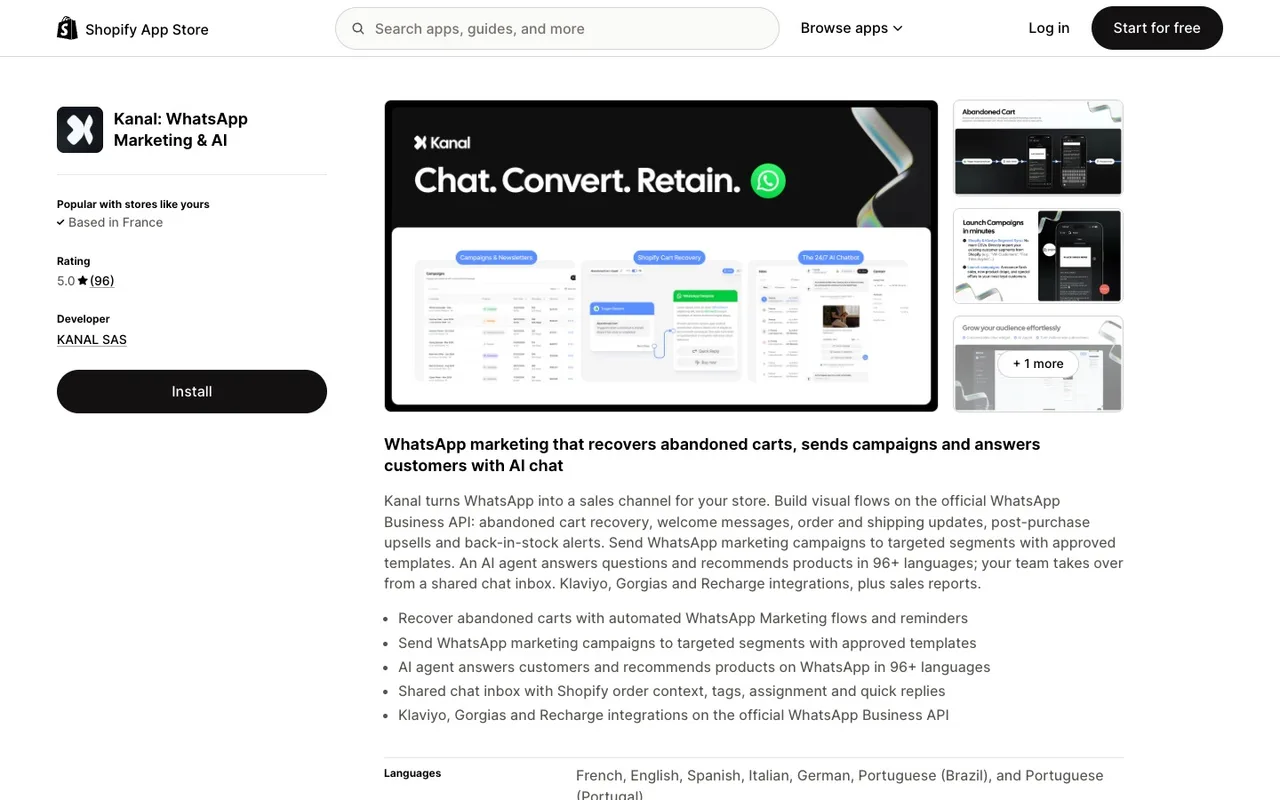
This guide walks Shopify merchants through everything you need to ship business SMS in 2026: how it actually works, what 10DLC and short codes mean, cost per country, the compliance landscape, and where Kanal, an SMS and WhatsApp marketing app for Shopify (App Store listing), fits.
What is business SMS?
Business SMS is text messaging sent from a registered sender to consumers through a licensed messaging platform (often called an Application-to-Person or A2P provider). It is fundamentally different from personal texting:
- Bulk delivery: send to thousands of recipients in seconds
- Branded sender ID: customers see your brand name (where allowed) or a registered short code
- Scheduling and automation: trigger from Shopify events (order placed, shipped, abandoned)
- Opt-out handling: STOP/UNSUBSCRIBE keywords are processed automatically
- Deliverability analytics: per-carrier delivery reports, click tracking on shortened URLs
- Regulatory compliance: opt-in records, sending-hours limits, do-not-call list sync
If you are choosing between channels, our SMS vs MMS vs RCS vs WhatsApp comparison helps you weigh trade-offs by use case. For RCS in particular, see what an RCS message is and how RCS business messaging works. Apple runs its own business channel on iPhone, covered in our Apple Messages for Business guide, which is separate from iMessage between individuals.
Types of business SMS for e-commerce
Transactional SMS
Triggered automatically by a Shopify event:
- Order confirmation: "Order #1234 confirmed. Total $89."
- Shipment: "Your order shipped. Track: [link]"
- Delivery: "Your package is out for delivery"
- OTP / 2FA: login or payment verification codes
These flow through the "utility" category in most carrier frameworks, with lower fees and looser opt-in requirements. To send order and delivery updates on WhatsApp as well, plug your Shopify store into Kanal's Shopify integration.
Marketing / promotional SMS
Time-sensitive offers and broadcasts:
- Flash sales: "24h only: 30% off, code FLASH30"
- New launches: "New drop just live: [link]"
- Cart recovery: "Your cart is still waiting"
- Loyalty: "Thanks for shopping. Here's 10% off your next order."
For cart recovery specifically, our abandoned cart recovery strategies guide shows what actually works in 2026.
Conversational SMS
Two-way exchanges with customers:
- Post-purchase reviews: "How was your order? Reply 1-5"
- Appointment reminders: "Your fitting is tomorrow at 2 PM"
- Customer service follow-ups
10DLC, toll-free, short codes: choosing your sender type (US focus)
The US carrier ecosystem requires you to register a sender. There are three options.
10DLC (10-Digit Long Code)
A standard phone number registered under the A2P 10DLC framework administered by The Campaign Registry. This is what most Shopify merchants use.
- Cost: on Twilio, as of October 8, 2026, brand registration is a one-time 4.50 USD (sole proprietor or low-volume standard brand) or 46 USD (standard brand), a campaign costs a 15 USD vetting fee, then 1.50 to 10 USD a month depending on the use case (Twilio's A2P 10DLC fees). Each outbound segment costs 0.0083 USD plus a carrier fee of 0.0035 to 0.005 USD, and the number 1.15 USD a month (Twilio US SMS pricing)
- Throughput: 10-100 messages per second depending on trust score
- Use case: most stores under 100k subscribers
Toll-free SMS
A 1-8xx number that supports SMS. Lower setup friction than 10DLC.
- Cost: on Twilio, 2.15 USD a month for the number plus 0.0083 USD per outbound segment and carrier fees (Twilio US SMS pricing, as of October 8, 2026)
- Throughput: up to 3 messages/second standard, 30+ post-verification
- Use case: customer support lines, low-volume marketing
Short codes
5-6 digit numbers provisioned through carriers and approved by the CTIA.
- Cost: on Twilio, 1,000 USD a month for a random short code or 1,500 USD a month for a vanity short code, billed quarterly with a one-time setup fee, plus 0.0083 USD per outbound segment and carrier fees (Twilio US SMS pricing, as of October 8, 2026)
- Throughput: up to 500 messages/second
- Use case: high-volume retailers and large national brands
The CTIA Messaging Principles and Best Practices document (PDF) is the canonical reference for what is allowed on each sender type.
Business SMS cost by country (2026)
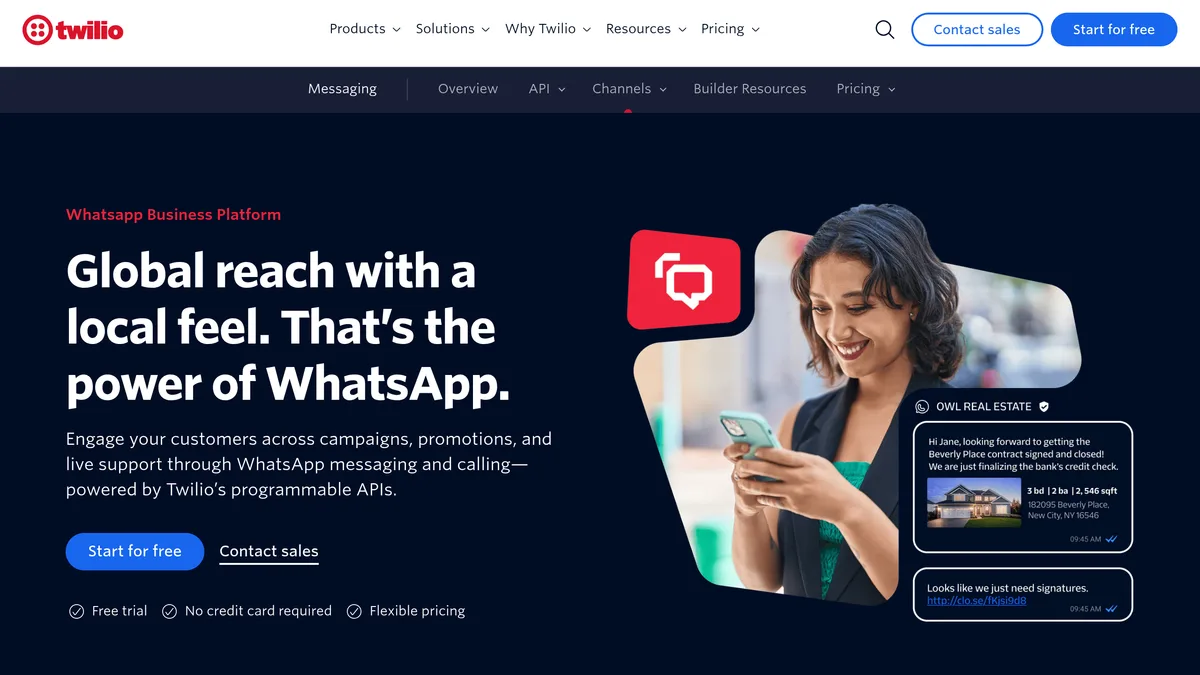
SMS prices depend on the provider, the destination country and the sender type. The table below gives one provider's public list prices as a reference point: Twilio's pay-as-you-go rate per outbound SMS segment, in US dollars, as displayed on each country page on October 8, 2026. Twilio states that prices may change without notice and that additional carrier fees may apply.
| Destination | Twilio price per outbound SMS segment | Sender type on the page |
|---|---|---|
| United States | 0.0083 USD, plus a carrier fee of 0.0035 to 0.005 USD on long codes | Long code, toll-free or short code |
| United Kingdom | 0.056 USD (0.0524 USD on a short code) | Mobile number or alphanumeric sender ID |
| France | 0.0798 USD | International number or alphanumeric sender ID |
| Germany | 0.112 USD | Mobile number or alphanumeric sender ID |
| Spain | 0.0875 USD | International number or alphanumeric sender ID |
| Italy | 0.0927 USD | Mobile number or alphanumeric sender ID |
| Netherlands | 0.1143 USD | International number or alphanumeric sender ID |
| Brazil | 0.0599 USD | International number |
| Mexico | 0.1819 USD | Long code |
| United Arab Emirates | 0.1176 USD | International number or alphanumeric sender ID |
Source: Twilio SMS pricing pages for each country, read on October 8, 2026. Messages are charged per segment. Shopify SMS apps and other providers set their own rates: read the pricing page of the tool you use.
For a full breakdown across markets, see our WhatsApp vs SMS pricing by country guide.
SMS vs WhatsApp: cost and features
| Business SMS | WhatsApp via Kanal | |
|---|---|---|
| Cost per send | Per segment, by destination: on Twilio, 0.0083 USD plus carrier fees in the US and 0.056 USD in the UK (Twilio pricing, October 8, 2026) | Per delivered template, e.g. 0.0635 USD (UK marketing) or 0.0220 USD (UK utility) (Meta's pricing) |
| Messages included | 1 segment (160 chars) | 1 template per charge; replies in the 24-hour customer service window: 1,000 free per business phone number each month |
| Media | Text only (MMS for images, US-only) | Images, video, buttons, carousels, location |
| AI chatbot | No | Yes (via Kanal AI chatbot) |
Since October 1, 2026, those WhatsApp replies cost the utility rate after 1,000 free service messages per business phone number each month. Meta has also paused marketing templates to US numbers since April 1, 2025 (see WhatsApp marketing in the USA). Open, click and conversion rates depend on your list and your offer, and vendor benchmarks are not audited: compare them in your own reports once both channels run side by side.
Compliance: the rules you cannot skip
United States: TCPA, 10DLC, and CTIA
The Telephone Consumer Protection Act (TCPA) requires prior express written consent for marketing SMS. Violations cost 500-1,500 USD per message in class action settlements. The carrier-side rules layered on top:
- A2P 10DLC registration through The Campaign Registry for any non-personal sending
- Opt-in proof kept on file, so you can show when and how each subscriber consented
- STOP keyword must work without confirmation (a single STOP unsubscribes immediately)
- HELP keyword must return brand identity and customer service info
- Quiet hours: 8 AM - 9 PM in the recipient's timezone (TCPA)
- Prohibited content (SHAFT): Sex, Hate, Alcohol, Firearms, Tobacco face stricter vetting
European Union: GDPR + ePrivacy
The EU requires explicit opt-in under GDPR Article 7 and the ePrivacy Directive:
- Pre-ticked boxes are invalid
- Granular consent (you cannot bundle SMS opt-in with terms of service)
- Records retained for the entire duration of processing
- Withdrawal must be as easy as giving consent
Country-level enforcement varies. In France, the CNIL requires prior consent for marketing texts to consumers, forbids pre-ticked consent boxes, and requires every message to identify the sender and offer a simple way to refuse further messages. In Germany, the Federal Network Agency runs aggressive enforcement on SMS spam.
For an e-commerce-specific deep dive on opt-in mechanics, see our WhatsApp opt-in and GDPR guide. The same principles apply to SMS.
UK: PECR and UK GDPR
In the UK, marketing texts fall under the Privacy and Electronic Communications Regulations (PECR), alongside the UK GDPR and the Data Protection Act. The ICO's guidance on electronic mail marketing says you can only send them to people who have specifically consented. The exception, known as the soft opt-in, covers existing customers who bought or negotiated to buy from you: you can text them about similar products or services if you gave them a simple way to opt out when you collected their details and in every message since. You must not disguise or conceal your identity, and each message needs a valid contact address to opt out. The ICO notes that this guidance is under review following the Data (Use and Access) Act.
Build a compliant opt-in: the operating playbook
The cheapest way to stay compliant is to make opt-in clear from day one.
- Active opt-in checkbox (never pre-ticked) at checkout and signup
- Granular consent: separate boxes for transactional alerts, marketing SMS, and WhatsApp
- Plain-English wording: "I agree to receive marketing text messages from Brand X at the number provided. Reply STOP to unsubscribe. Msg & data rates may apply."
- Double opt-in for marketing (a confirmation SMS reduces invalid numbers and disputes)
- Consent ledger: store timestamp, IP, form ID, and exact wording shown to the customer
- STOP handling wired to your platform so unsubscribes are honored across all sender numbers
- Sync with national opt-out registries (DNC in the US, etc.)
Kanal records consent per contact, for SMS and for WhatsApp, from your Shopify store; collecting that consent stays on your side.
High-converting SMS templates for Shopify
Here are eight templates you can adapt to your store. Replace the placeholders and test on a small segment first.
1. Order confirmation
{first_name}, your order #{order_id} is confirmed.
Total: ${total}. Estimated delivery: {date}.
Track: {short_url}
{brand} - Reply STOP to opt out
2. Shipment update
Good news! Order #{order_id} is on its way.
Track: {short_url}
ETA: {delivery_date}.
{brand}
3. Abandoned cart (1h after)
{first_name}, your cart is still waiting at {brand}.
{top_product} is back in stock.
10% off with code COMEBACK10 until midnight: {short_url}
Reply STOP
4. Flash sale
{first_name}, 4h flash sale: 30% off {category}.
Code FLASH30, ends at 10 PM.
First-come basis: {short_url}
{brand} - Reply STOP
5. Review request
{first_name}, how is your {product}?
Rate in 30 sec: {short_url}
Thanks!
{brand}
6. Back-in-stock alert
{first_name}, {product} is back in stock.
Limited quantities: {short_url}
{brand}
7. Birthday
{first_name}, happy birthday!
Here's 15% off site-wide with BDAY15
Valid 48h: {short_url}
{brand}
8. Win-back (90 days inactive)
{first_name}, it's been a while!
Come back with 20% off: code RETURN20.
Valid 7 days: {short_url}
{brand} - Reply STOP
SMS best practices:
- 160 characters max (longer texts split into multiple segments and double your cost). Our SMS vs MMS explainer shows what changes when you add a picture.
- No emojis or accented characters if you want maximum carrier compatibility
- Always include sender brand and STOP keyword
- Shorten URLs through a branded domain to maintain trust
When WhatsApp beats SMS for e-commerce
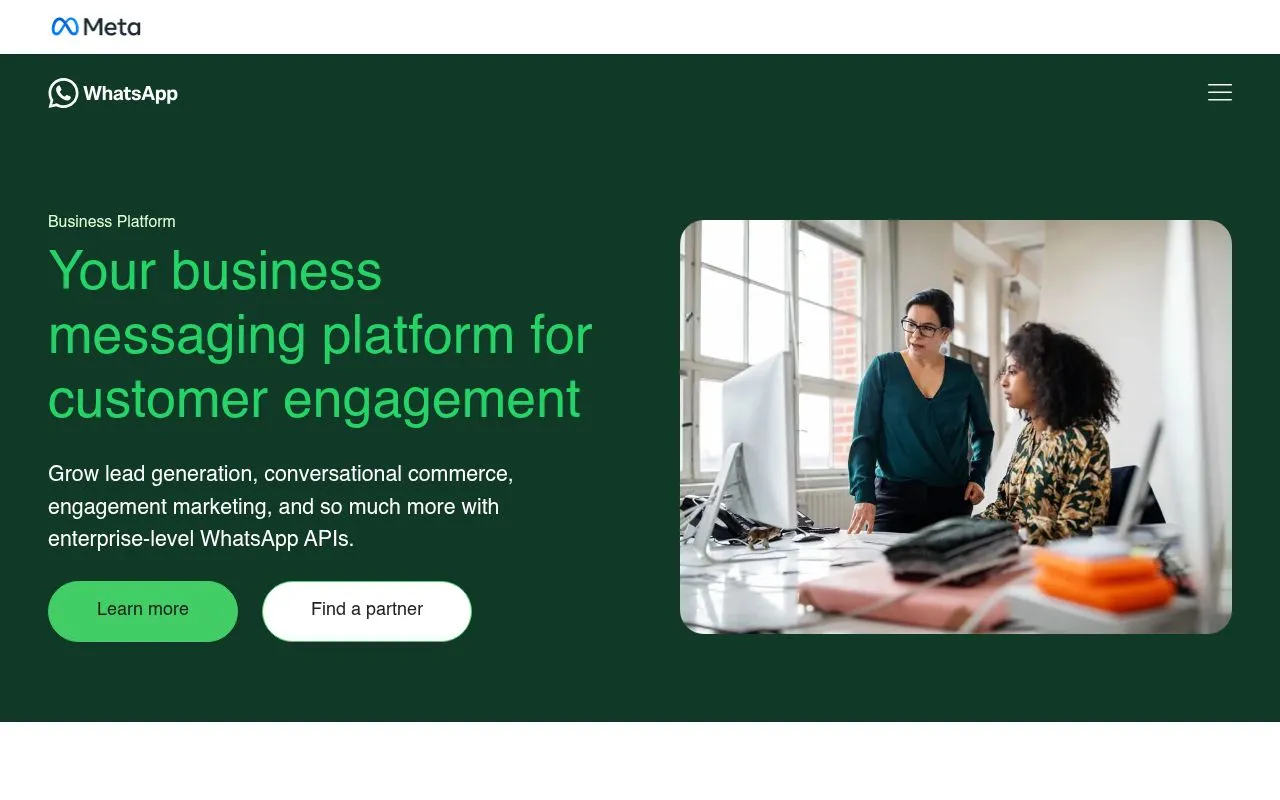
SMS still wins for transactional immediacy in low-WhatsApp markets (US, Canada, parts of Northern Europe). But for media-rich messaging, or in markets where your customers already chat on WhatsApp, WhatsApp does what SMS cannot: images, buttons, carousels and a real two-way thread.
Concrete use cases to test on WhatsApp first:
- Cart recovery with product image: WhatsApp shows a photo of the abandoned item with a checkout button, which plain SMS cannot. Compare click-through with your SMS reminder. See our abandoned cart playbook.
- Product launches: a WhatsApp carousel shows up to 10 products in a single message. Our WhatsApp broadcast guide covers structure and timing.
- Customer service: a WhatsApp chatbot can answer routine questions (order status, sizing, returns) on its own, something plain SMS cannot do.
- Two-way pre-purchase: customers reply to ask sizing or compatibility. SMS technically supports this but the UX is worse than a chat interface.
For a deeper look at when to switch, see our WhatsApp Business API guide and the comparative WhatsApp Business API providers comparison.
Combining SMS + WhatsApp: the omnichannel playbook
The winning approach in 2026 is WhatsApp first, SMS fallback. Recommended waterfall:
- Day 0, 1h after cart abandonment: WhatsApp message with product image + "Complete checkout" button
- Day 1: email follow-up with extended cart and reviews
- Day 2: WhatsApp reminder with 10% off
- Day 3: SMS short text as last touch for customers who never replied on WhatsApp
This pattern works because WhatsApp carries the rich, conversational touches, and SMS reaches the customers who never replied on WhatsApp, at low marginal cost. For Klaviyo users, our Klaviyo + WhatsApp integration guide shows how to wire the waterfall inside Klaviyo flows.
ROI: a concrete example
Let's run the math for a Shopify store with 10,000 SMS subscribers in the US. The click-through and conversion rates below are assumptions for illustration: replace them with the figures from your own campaigns.
SMS-only campaign:
- 10,000 segments x 0.0083 USD = 83 USD at Twilio's US rate (October 8, 2026)
- Carrier fees on a long code: 10,000 x 0.0035 to 0.005 USD = 35 to 50 USD, depending on the recipient's carrier
- Messaging cost: 118 to 133 USD, before the number, the 10DLC registration and your SMS tool's subscription
- 7% CTR x 4% conversion x 75 USD AOV = 28 orders = 2,100 USD revenue
- ROAS: between 15.8x and 17.8x on messaging cost alone
Same audience via WhatsApp:
- Not possible for this campaign today: Meta has paused marketing templates to US numbers since April 1, 2025 (see WhatsApp marketing in the USA).
- For US customers, WhatsApp still carries utility messages (order and shipping updates), replies inside the 24-hour customer service window, and conversations started from click-to-WhatsApp ads.
In markets where marketing templates deliver, Meta charges each delivered marketing message at the rate of the recipient's country: check yours in our WhatsApp Business pricing guide or in the cost simulator on Kanal's pricing page, then ask whether WhatsApp converts better on your audience. Split one segment between the two channels with the same offer, compare orders per send, and use our ROAS break-even calculator to model your own numbers.
SMS platforms compared for Shopify
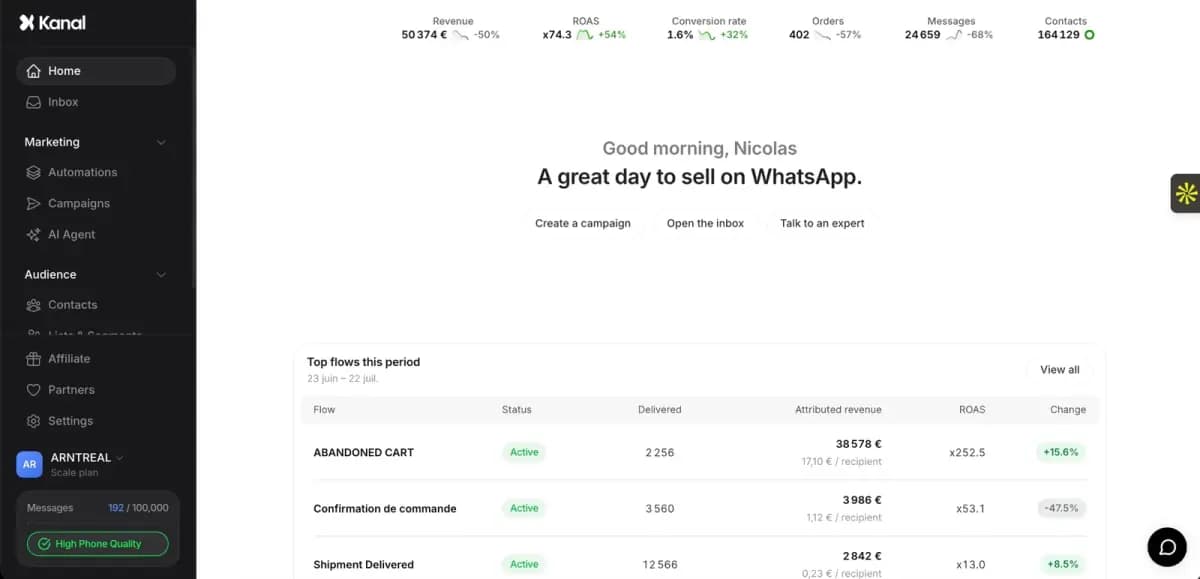
Kanal sends SMS and WhatsApp campaigns and automations from the same app, connected to the Shopify store.
| Criterion | Kanal | Brevo | Twilio | Klaviyo |
|---|---|---|---|---|
| Main channel | SMS and WhatsApp | Email and SMS | SMS by API | Email and SMS |
| Shopify integration | Native 1-click | Plugin | Manual | Native |
| Abandoned cart | Automatic, by SMS or on WhatsApp | Email + SMS | Manual | Email + SMS |
| Segmentation | Shopify + Klaviyo | Brevo CRM | Manual | Native |
For the broader Shopify app landscape, see our best WhatsApp apps for Shopify guide and our comparison of SMS apps for Shopify. The product page for the channel is SMS marketing for Shopify. If you are moving off SMSBump, our Kanal vs SMSBump comparison covers the migration.
Frequently asked questions
What is business SMS and how does it differ from personal texting?
Business SMS is a one-to-many messaging channel sent from a registered sender (10DLC long code, toll-free, or short code) through a licensed messaging platform. Unlike personal texting, it supports bulk sending, branded sender IDs, scheduled delivery, opt-out handling (STOP), delivery analytics, and is bound by carrier compliance (10DLC in the US, GDPR/PECR in Europe).
What is the difference between 10DLC and short codes?
10DLC is a registered long number under the US A2P framework, with a brand and a campaign to register. Short codes are 5-6 digit numbers approved by carriers, built for high throughput. On Twilio's US pricing page, read on October 8, 2026, both cost 0.0083 USD per outbound SMS segment plus carrier fees; a long code number is 1.15 USD a month, a random short code 1,000 USD a month and a vanity short code 1,500 USD a month. Short codes suit high-volume retailers; 10DLC fits most Shopify stores.
How much does SMS cost per country in 2026?
It depends on the provider and the destination. On Twilio's pricing pages, read on October 8, 2026, an outbound SMS segment costs 0.0083 USD in the US plus carrier fees, 0.056 USD in the UK, 0.0798 USD in France, 0.112 USD in Germany, 0.0599 USD in Brazil and 0.1819 USD in Mexico. Other providers publish other rates: check the pricing page of yours. On WhatsApp, Meta bills each delivered template instead, by category and country: for example 0.0635 USD per UK marketing message and 0.0220 USD per UK utility message (Meta's pricing).
When should I use WhatsApp instead of SMS for my Shopify store?
Use WhatsApp when your audience is in markets with high penetration (Brazil, India, Mexico, Spain, France, Germany, UAE), when you want to send images, product carousels, or interactive buttons, or when you need two-way conversations. Keep SMS for transactional alerts in low-WhatsApp markets like the US or Canada. You can also run both, with WhatsApp first and SMS as fallback.
Can SMS handle product catalogs and rich media?
Plain SMS is limited to 160 characters of text with no rich media. MMS supports images and longer text but is US-centric and costs more per send: 0.022 USD against 0.0083 USD per SMS segment on Twilio's US price list, read on October 8, 2026. RCS adds catalogs and buttons but has uneven device support. WhatsApp Business API natively supports catalogs, carousels, buttons, video, and location, which makes it the better fit for media-rich messaging.
Conclusion
Business SMS remains a solid backbone for transactional and time-sensitive messaging, especially in markets where WhatsApp adoption is lower. But the channel has hard ceilings: no rich media, no chatbot, no carousel, and tightening carrier rules. The 2026 playbook is to lead with WhatsApp where adoption supports it, fall back to SMS for delivery completeness, and keep opt-in, segmentation, and analytics coherent across the two.
Ready to run SMS and WhatsApp from one app? Book a Kanal demo or install Kanal from the Shopify App Store to see it on your store.
Resources
- WhatsApp Business API guide
- Best WhatsApp apps for Shopify
- WhatsApp marketing for e-commerce
- WhatsApp broadcast guide
- WhatsApp Business pricing guide
- Abandoned cart recovery strategies
- WhatsApp opt-in and GDPR
- WhatsApp vs SMS pricing by country
- Conversational commerce guide
- Klaviyo + WhatsApp integration guide
- Free tools: WhatsApp link generator | WhatsApp QR code generator | ROAS break-even calculator
See Kanal on your own store
- Your campaigns and cart reminders on WhatsApp, starting from your own store
- Post-purchase offers, back-in-stock alerts, then the AI agent that advises your customers
- You leave with the plan that fits and its price

- brands
- 500+
- to set up
- 5 min
- open rate on WhatsApp
- +90%
5/5 on the Shopify App Store (125 reviews)

Nicolas helps e-commerce brands grow revenue with WhatsApp marketing. With deep expertise in Shopify ecosystems and conversational commerce, he shares proven strategies for abandoned cart recovery, broadcast campaigns, and AI-powered customer engagement.
Glossary terms in this article
Quick definitions for the WhatsApp Business terms used above.
Opt-out
A WhatsApp opt-out is a person's request to stop receiving messages from a business on WhatsApp. WhatsApp's Business Messaging Policy requires businesses to respect every such request, whether it is made on WhatsApp or elsewhere.
Read full definitionOpt-in
A WhatsApp opt-in is the permission a person gives a business to send them messages on WhatsApp. WhatsApp's Business Messaging Policy requires it before any message: the business must have the person's phone number and their agreement to hear from that business.
Read full definitionRCS (Rich Communication Services)
RCS (Rich Communication Services) is the messaging standard that upgrades SMS in a phone's default messaging app, with high-resolution media, read receipts and typing indicators. For businesses, RCS Business Messaging adds verified senders, rich cards and suggested replies.
Read full definitionCustomer Service Window (24-hour window)
The customer service window is a 24-hour timer that starts when a WhatsApp user messages or calls a business. While it is open, the business can reply with free-form messages; once it closes, it can only send approved message templates.
Read full definitionMarketing Template
A marketing template is a WhatsApp message template used for promotion: offers, product launches, back-in-stock alerts or cart reminders. It can be sent at any time to customers who opted in, and Meta charges each delivered message at the marketing rate of the recipient's country.
Read full definitionAbandoned Cart Recovery
Abandoned cart recovery is the practice of messaging shoppers who added items to their cart but left without buying, to encourage them to complete the purchase.
Read full definitionClick-to-WhatsApp Ads
Click-to-WhatsApp ads are Facebook and Instagram ads whose button opens a WhatsApp chat with the business instead of a website. The shopper sends the first message, which lets the business reply freely and, under Meta's pricing, for free during a limited window.
Read full definitionSegmentation
Segmentation is the practice of splitting a WhatsApp contact list into groups based on traits like purchase history, behavior, or engagement, so each group receives messages that are actually relevant.
Read full definitionSuggested articles
Shopify vs WooCommerce: Costs, Fees and Control (2026)
Shopify vs WooCommerce compared for US stores: subscription or hosting costs, payment fees, maintenance, flexibility, apps and how to migrate between them.
Shopify vs Wix: Plans, Payment Fees and Selling (2026)
Shopify vs Wix compared for US merchants: plan prices, card rates, product limits, sales channels, apps, support and how to migrate between the two platforms.
Shopify vs Squarespace: Pricing, Fees and Selling (2026)
Shopify vs Squarespace compared for US merchants: plan prices, card rates, transaction fees, checkout, apps, support and how to move from one to the other.
Shopify vs Etsy: Fees, Traffic and Which to Choose (2026)
Shopify vs Etsy compared for US sellers: subscription and listing fees, transaction and payment fees, traffic, what you can sell, sales tax and using both.